Category: ADVERTISING

  • Gurbaksh Singh to lead DAN Innovation Lab

    By A Correspondent


    Dentsu Aegis Network (DAN) India has announced the launch of DAN Innovation Lab in an attempt to foster, access and accelerate innovative learning. Led by Gurbaksh Singh, earlier chief creative technologist at Dentsu Webchutney, DAN Innovations Lab India will drive solutions for clients keeping creative and tech at its functional core.


    Singh will work with teams at Dentsu Webchutney, Isobar India and Posterscope India on emerging technologies to drive tech-led innovations for all the three agencies. However, eventually Dan Innovation Lab will also support all DAN brands and service all DAN clients across India.


    Anand Bhadkamkar

    Commenting on the launch, Anand Bhadkamkar, CEO, Dentsu Aegis Network India said: “I am extremely proud to announce the launch of DAN Innovation Lab. The facility will function as a central faculty between Dentsu Webchutney, Isobar and Posterscope to bring together the network’s expertise in strategy, technology, design and creativity from across the Group. Keeping creativity at its core, DAN Innovation Lab will focus on generating ideas and fresh business tactics to help drive greater efficiencies and deliver the best possible outcomes for our clients.”


    Gurbaksh Singh

    Commenting on his new role, Singh added: “I am deeply honoured to take up this new role. This has opened a whole bunch of opportunities on a much larger playground. Working with multiple creative teams across agencies will only strengthen the creative output. I believe in embracing new makers and sparking curiosity that can lead to incubating a new culture of innovation in the group. Developing new solutions on this new front will be exciting and equally challenging.”


  • Puneet Kapoor joins Lowe Lintas as Regional Creative Officer, South

    By A Correspondent


    Lowe Lintas has appointed Puneet Kapoor as its new Regional Creative Officer. He has previously worked with McCann Worldgroup where he was Head of Creative, South.


    Puneet Kapoor

    Talking about his new role, Kapoor said: “Lowe Lintas Bangalore has been such a stellar office for many years spewing out one great campaign after the other. It’s a great challenge to add thunder to the impressive repertoire of work and I am really looking forward to collaboration with the teams and clients to do some iconic work.”


    Amer Jaleel

    Added Amer Jaleel, Group CCO and Chairman, Mullen Lowe Lintas Group: “We have had a legacy of great creative people from Bengaluru. We have also had the best of brand work originating out of Bengaluru. The connection is more than obvious. We had been on the lookout for someone who was both entrenched in solid brand work and had the more recent portfolio of engaging and contemporary digital conversations. In Puneet we found that and more. A really great team guy and intuitive leader. We are blessed and bonussed!”


    Sagar Kapoor

    Commenting on Kapoor’s appointment, Sagar Kapoor, CCO, Lowe Lintas said: “Besides his experience Puneet gets with him truly infectious energy. He is excited about making brands bigger and more popular. He has shown considerable expertise in the Southern region, again working on brands that have a national footprint. We are looking forward to taking the office and our brand partners to the next level.”


  • A Roller Coaster Ride of Adspends


    By Indrani Sen


    It appears from GroupM’s This Year Next Year (TYNY) 2020 report that the Indian ad Industry is on a roller coaster ride in spite of the slowdown in certain sectors of the manufacturing industry and hits and misses in agriculture during 2019. Prasanth Kumar, CEO – Group M South Asia expects sustained and stable investment across the media in India in 2020.


    GroupM predicted in TYNY 2019 that the World AdEx will grow by 3.67% from 2018 to 2019 and the Indian AdEx will grow by 14%, higher than the CAGR growth of the previous four years. In TYNY released last week, GroupM has estimated that world AdEx grew by 3.7% from 2018 to 2019, but Indian AdEx grew by only 9% against the earlier estimated growth of 14%. However, there was no comment on the drop of growth rate in the press release issued by Group M.


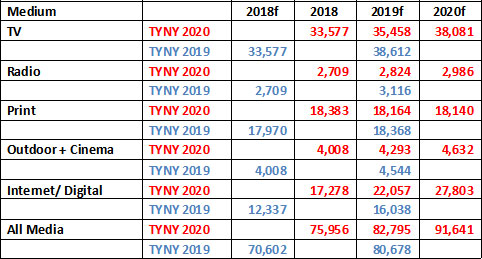
    I initially thought that probably the drop in the growth rate of adspend was due to the slowdown in the industry, but a closer look at TYNY2019 and TYNY2020 statistics showed that upward revision of the estimate of the total adspend in India in 2018 led to lowering of the growth rate from 14% to 9%. A comparison of the two reports is shown in the following table.


    Indian Adspend (INR crore)


    It is interesting to note that the forecast for 2018 for Digital as shown in TYNY2019 was increased by 40% in actual adspends of 2018 shown in TYNY 2020. Estimate for Print was also increased marginally while all other estimates remained the same. These changes in Digital and Print adspends resulted in an overall increase of total ad spend from 70,602 crore to 75,956 crore in 2018. GroupM should have added an explanatory note in their press release to warn the users of TYNY about these changes in their estimates as reflected in TYNY 2019 and TYNY 2020.


    As per TYNY 2019, India was 10th largest market in adspends in the world, the 3rd highest contributor to incremental global ad spends and the fastest growing major ad market in the world. In TYNY 2020, India continues to be the 3rd highest contributor to incremental global adspends and the fastest growing major ad market in the world and has come up to 8th position in the list of largest markets by ad spends by beating Canada and Australia. In 2020, adspends in India is predicted to grow by 10.9% against a global growth of 5.1% in adspends.


    According to Kumar, Digital would garner 65% of incremental ad spend in India in 2020. Tushar Vyas, President Growth and Transformation – GroupM South Asia further commented: “There are multiple advancements happening in technology which is transforming digital advertising and other mediums. India being a diverse country, digital will keep growing, especially with the rise of content platforms and its availability in multiple languages powered by the growth of 3Vs (video, voice and vernacular)”.


    In conclusion, I agree that Digital media has gained its own momentum of growth in India and most advertisers do not want to miss out on the opportunities offered by the new media. Slowdown in certain sectors of manufacturing industry is unlikely to affect the investment in digital advertising in particular which would be the engine of growth in ad spends in India in 2020 as predicted by TYNY 2020.


  • Publicis Health appoints Dorelle Kulkarni as Senior VP

    By A Correspondent


    Dorelle Kulkarni

    Publicis Health, the healthcare unit from Publicis Worldwide, India has appointed senior health and communications expert, Dorelle Kulkarni as the Senior Vice President. As the head of the unit, Kulkarni will lead a team of dedicated healthcare specialists while also managing growth, strategy and communications output for the agency. She will report to Srija Chatterjee, MD, Publicis Worldwide, India.


    Kulkarni joins the agency from Strategic Partners Group (SPG) where she was the Vice President and managed three key verticals for the company including PR, digital and creative brand solutions.


    Srija Chatterjee

    Said Chatterjee: “Publicis Health continues to remain a key pillar of growth for our network. The unit had an amazing run last year servicing some great pharma & healthcare brands while also winning multiple new clients. Having a capable leader to further drive this momentum and put out effective work is what our focus is for 2020. We are glad to have Dorelle take on this mantle and are confident of seeing a great turnaround in our work and culture in the near future.”


  • Deepak Pant joins Publicis Groupe as Head, Data Science Practice

    By A Correspondent


    Deepak Pant

    Publicis Groupe India announced the appointment of Deepak Pant as Head, Data Science Practice. In this role, Pant will be incharge of enhancing capabilities on measurement, research, advanced analytics, digital analytics, data strategy including data integrity and automation, and also developmental work on Publicis People Cloud.


    Anupriya Acharya

    Said Anupriya Acharya, CEO Publicis Groupe South Asia: “Data is what fuels our marketing transformation solutions across creative, media and tech. In the last six years we have made significant progress in our Data Science Practice and today it competes with the best specialist shops. While it started as a centre of excellence providing advanced analytics solutions to our global clients, in the last 3-4 years we have seen increased appetite and hence huge uptake even in the local market. As margins of companies come under pressure the focus on ROI of marketing is only increasing. With 2000+ experts across digital and tech in the Groupe, our Data Science Practice has unmatched ability on multiple domain solutions.”


    Added Pant: “It’s both an honour and a huge responsibility to lead the Publics Groupe India’s Data Science Practise. The exciting possibilities that the scale and diversity of the Groupe and its clients present are unmatched. I look forward to making a difference here and bringing disruptive solutions that enable strong business results for clients and the Groupe alike.”


  • Wavemaker elevates Mansi Datta to Managing Partner

    By A Correspondent


    Mansi Datta

    Wavemaker has announced the appointment of Mansi Datta as Managing Partner. In her new role, Datta will head North operations for Wavemaker India and will report into Ajay Gupte, CEO, Wavemaker – South Asia. Datta has been part of Wavemaker (and earlier Maxus) since 2015.


    Commenting on the appointment, Gupte said: “Mansi is an exceptional client leader with focus on strategic planning and implementation across varied media from analogue to digital. Mansi has displayed great leadership skills in her previous role as GM. Under her guidance, Wavemaker is looking forward at delivering many more business innovations and operational efficiencies along with growing the region.”


  • Mufflerman & the Mango People


    By Avik Chattopadhyay


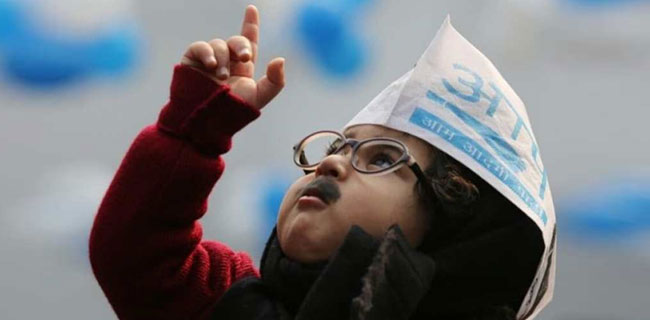
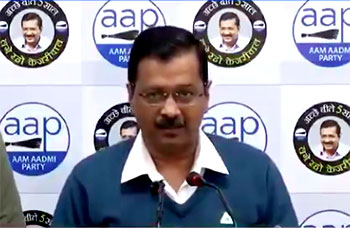
    In February 2015, I had done a piece for MxMIndia titled on Brand AAP on the occasion of Delhi waking up to the 67-03 mandate. Last night, my friend Pradyuman helped me refresh my memories of the same as I sat down to pen my thoughts on Delhi waking up to the 62-08 reality!


    After five years, I look at the AAP brand again.
    To see whether it remains the same. Or has it changed. Or evolved.
    There is nothing political in my analysis and assessment here…purely from a brand manager’s perspective.

    So, what have been the FIVE key learnings of the AAP brand?


    That the core purpose remains the same.
    The core brand idea cannot be tinkered with based on different occasions and opportunities.
    The AAP purpose remains the very same as it was in 2014 and 2015.
    It is all about fundamental deep-rooted development… about education, health, water, electricity, mobility and safety.
    It is an organisation of middle-class people who earn their bread the hard way.
    Therefore its purpose has to do with improving the lives of the middle class.
    You do not play around with your purpose just because you are in the driver’s seat… the destination remains the same as long as the vehicle remains the same.


    That the personality has to mature with time.
    This is crucial in the life-cycle of any brand, for it determines the ‘route’ you may take to help your vehicle reach its destination.
    It was “clean development” in 2015, it is “clear development” in 2019.
    The demonstrations on the street have given way to demonstration of actual work done.
    So, is the leader no longer the ‘rebel’? He sure is, but the cause is more clearly defined.
    And the energies of the rebel are channelised now.
    There was definitely some bluster in 2015. Its only candour now.
    The candour earlier was sometimes uncomfortable. Now, it is comforting.


    That the promise has to be clearly demonstrated.
    The comfort in the candour comes through the demonstration of the promise.
    At the end of the day, human life cannot improve by consuming tweets, memes and social media posts.
    It is by schools, clinics, uninterrupted electricity, free water, improved mobility and greater safety.
    It is about the here and now.
    Digital and social media are only supports and not the core food.
    Spinning stories are good for a satiated and secure person, not for someone who is still getting his / her life into order.
    As Lenin had said, “How can a man think with his mind when his throat is parched?”


    That the key stakeholders are to be respected.
    Most brands forget this in their ‘power trip’.
    As a ‘ruler’ one has the greed to look down upon the electorate and grant it a “mind” far lesser than it actually has.
    The context has to be set up right at the start, the key stakeholders identified and their engagement plans chalked out.
    Each stakeholder has to be given his / her due place, and space.
    The context is about every-day life and livelihood of the two crore people of Delhi, and quite frankly nothing more.
    The key stakeholders are [a] the voter, [b] the non-voter, [c] the candidate and [d] the reporter.


    The voter – central to your brand’s existence and is looking at you making his/ her life better, bit by bit, but surely, with every passing day. The Delhiite is immensely proud of a unique culture that the city-state has conjured up for itself. That has to be catered to and not rudely challenged. This is the “Mango People” and they come in various textures and flavours. Appreciate them and preserve them instead of putting them into a large mixer and churning them into one gooey mass.


    The non-voter – a very important influence on the voter – the children and the people in the NCR who will not vote but will surely have a clear opinion on who deserves to won.


    The candidate – is an individual in his / her own right, with a mind and a heart of one’s own; can chart out own strategies within the larger framework, express own opinion and share own plans rather than be a mute by-stander at the mercy of the bosses. Very similar to what happens in large organisations, is it not, with the regional managers / department managers / project heads?


    The reporter – do grant him / her the power to observe, analyse, digest and then opine; the sheer urge to browbeat and force feed ‘stories’ does not work especially in a battle-zone that is highly aware and expressive.


    That uncluttered messaging is crucial to any campaign.
    Keep it simple, uncluttered, frank and forthright.
    I just loved the little interactive film shared on social media about Mufflerman looking into your door saying “Can I come in?”
    In 2015 it was the Mufflerman game, this time it was this truly disarming video interaction.
    That is what the target stakeholder likes…clarity and candour, without mixing up issues that are not relevant to the occasion at all.
    I would surely want the entire nation to be united and stronger but right now I have to decide on who can improve my daily life better.
    The relevance of messaging is always critical to any campaign’s success, and this was a great demonstration of the same.


    The AAP 2019-2020 election campaign is a lesson for every brand manager.
    On how to carefully nurture and deliver a brand that rides on huge expectations and external challenges.
    And how to stay true and committed to the core purpose and not get waylaid into distracting and diversionary narratives.
    As my brand guru Wally Olins used to keep reminding me, “Live your own life, Avik. You only have one bloody chance!”


    Avik Chattopadhyay is a brand strategist living in New Delhi NCR. He writes on MxMIndia on most alternate Thursdays, but this time we requested him to write on a Wednesday. His views here are personal.


  • Traditional media grew 6% in 2019. Forecast for 2020: 5.1%: Pitch Madison report


    By A Correspondent


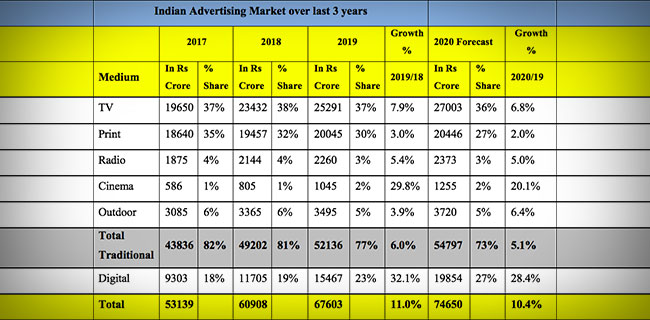
    The annual Pitch Madison Advertising Report 2020 was released on Thursday in Mumbai with the message that didn’t need much spelling out: traditional media grew only 6% in 2019 and actually degrew in the third and further quarter. The forecast for growth in 2020 is down to 5.1%. But digital media is galloping ahead. It grew 32 in 2019, and the forecast for 2020 is 28.4%.


    Said Sam Balsara, Chairman, Madison World: “Whilst 2019 has been a tumultuous year for AdEx, I believe Adex will grow dramatically over the next five years given that we are one of the larger growing economies of the world and already growing at twice the rate of global AdEx (11% vs 5.4%). Despite this India’s contribution to global AdEx is under 2%, which is bound to go up. Advertisers need to experiment more with media and do things differently to harness the power of media for Brands.”


    Key findings of the report:

    A. Overall:

    1) In absolute terms, AdEx has grown from Rs. 60,908 crore to Rs. 67,603 crores, an addition of 6,695 crores or 11%. This makes it the 2ndhighest addition to AdEx in a single year in the entire last decade.

    2) The growth rate of 11% in 2019 is lower than the PMAR mid-year projection of 13.4% and last year’s growth of 15%.

    3) 56% of this growth has been contributed by Digital, which has expectedly grown by as much as 32%.  Traditional media has grown by mere 6%

    4) TV still continues to be the largest contributor to AdEx with 37.4% share, followed by Print at 29.7%, Digital at 22.9%. Outdoor at 5.2%, Radio at 3.3% and Cinema at 1.5%. All mediums except Digital and Cinema have lost share.

    5) A quarter-wise analysis shows that unlike in most years, when Quarter 4 shows a blip because of the festive season, this year Quarter 2 showed a blip on the back of IPL, World Cup and General Elections and in fact Quarter 3 and Quarter 4 show a de-growth of 3% and 7% respectively.


    B. TV:

    1) After a rocking 2018 when TV AdEx grew by 19%, TV grew by only 8% in 2019.

    2) TV lost 1% share point and its share in the total AdEx stands at 37%, demonstrating that it is vulnerable.

    3) FMCG continues to rule the roost in TV AdEx, contributing 49% although its contribution came down by 1% share point in 2019. Telecom and Auto follow with 12% and 7% contribution respectively. Ecommerce category also gained dramatically during the year by as much as 20% and has reached Rs. 1,320 crore.

    4) The main categories that have fueled the overall growth of Rs. 1,860 crore in 2019 is FMCG (Rs. 740 crore), Telecom (275 crore) and Ecommerce (Rs. 220 crore). Predictably contribution of the Auto sector to the overall growth is negative in 2019 at -4%.

    5) There is a marginal decline in total FCT that has been telecast in 2019, perhaps because of disappearance of the FTA channels, unlike in most previous years when FCT has gone up year on year.

    6) In terms of revenue, Sports genre has grown the highest by as much as 47% and Hindi GEC by about 7%, which leads us to conclude that despite a soft market, these two genres have been able to command a rate increase.


    C. Print

    1) Print grew by 3% in 2019, lower than PMAR’s mid-year projected rate of 5%. Whilst this is the 3rdconsecutive year Print has grown less than 5%, it continues to be the 2nd highest contributor after TV with a share of 30%.

    2) Print share in AdEx has gone down from 42% in 2011 to 30% today.

    3) FMCG, Auto, Education, Real Estate and Retail continue to be the main cash cows and contributed almost 50% to Adex in 2019. Ecommerce is fast emerging as an important category for Print and grew 14%, over 2018. Political Parties are estimated to have contributed Rs. 200 crore on account of  Lok Sabha Elections.

    4) Nearly 65% of Print’s growth of Rs. 588 crore is accounted for by 4 categories – Education, Ecommerce, Real Estate and Retail.

    5) In terms of volume there is a 3% decline in 2019. Hindi publications continue to maintain the lead over English Publications, contributing 35% followed by English at a distant 25%.


    D. Digital

    1) Digital Adex made impressive gains during the year and achieved a growth rate of 32.1% in 2019, the highest growth achieved by any medium in the year taking Digital AdEx to Rs. 15,467 crore.

    2) Digital has grown at a compound annual growth rate of more than 30% over last 5 years and now contributes 23% of AdEx, an increase of 4% share points over last year.

    3) Search, Social, Video & Display have all equally contributed to the growth of Digital AdEx, with each contributing between 20% to 30% to the total.

    4) Consumption of video is going up year on year and in 2019 video spends grew by as much as 59% beating the Digital AdEx growth of 32%. Almost all of Digital AdEx (94%) is on mobile.

    5) 52% of Digital AdEx came from “classical advertising” ie display banners (22%) and online video (30%).

    6) If we were to combine TV+ Online Video, TV growth of 8% would increase to 16%.


    E. Forecast

    1. The PMAR Forecast for 2020 for AdEx is muted. In arriving at the projected growth figure for the whole year at 10.4%, the report is guided by the expectation that the economy should bounce back in the 2ndhalf of 2020 as indicated in the government’s Economic Survey published on January 31, 2020. PMAR therefore sees a subdued H1 for AdEx and a buoyant H2, specially Q4.

    2. We also expect a wide variation of growth rates across mediums with Digital medium leading the growth at 28.4% and ending the year with 27% share of AdEx at Rs. 19,854 to be precise.

    3. TV will continue to be the largest medium with a 36% share of AdEx, but will have a subdued growth rate of 6.8%.

    4. Print will lose 3 percentage points in terms of share of AdEx and end up with a 27% share registering a 2% growth.

    5. Radio and Outdoor are expected to grow at 5% and 6% respectively and maintain their share at 3% and 5%.

    6. Cinema, amongst traditional media should grow at a high growth rate of 20.1% taking its spend to Rs. 1255 crore.




  • Glance partners with DDB Mudra to launch TVC

    By A Correspondent


    Glance, a subsidiary of InMobi Group, has unveiled a campaign titled ‘Lock It To Rock It’ that’s crafted by the DDB Mudra and launched to communicate the possibilities of a locked screen. The campaign typifies the ‘locked door’ metaphor to build the campaign narrative – ‘A lock screen isn’t dull anymore’.


    Said Vishnu Srivatsav, Regional Creative Head – Advertising & Digital, DDB Mudra South, who led the campaign: “Glance as a product is so unique and so unlike anything that’s out there. It’s a combination of content, technology, innovation and beautiful design. To communicate such a differentiated specific proposition is quite challenging, because this amounts to a fundamental behaviour change. But we hit on this great metaphor of locked doors that helped us communicate the lock screen coming alive in a disruptive visual manner.”


    Added Bikash Chowdhury, Chief Marketing Officer of Glance: “Being locked out is typically associated with being deprived of something valuable. Glance by design, works on the lock screen and transforms it into a source of entertainment and information. By showcasing Glance in the most unexpected of moments and places, and delivering delight to users, the campaign brings to life the idea that with Glance, locked isn’t dull anymore.”


  • Zero Gravity bags digital mandate for Red Hunt

    By A Correspondent


    Zero Gravity Communications has bagged the national digital media duties for Red Hunt post a multi-agency pitch.


    Said Khushboo Solanki Sharma, Founder of Zero Gravity Communications: “We are indeed delighted to find an opportunity to work with such an experienced team at Adjavis Venture Limited. Red Hunt is an up-and-coming brand in the fast-growing FMCG men grooming category. The challenge is to explore new opportunities that digital media platforms can provide to brands in India and the International market. We have outlined a creative strategy, best media mix, and are looking for ROI driven digital action plan that helps the brand portfolio within the targeted audience – youth. We will be closely looking at behaviour economics in the target audience that helps connect with sales and larger brand building. Let’s #gethunted.”


    Added Shail Patel, Director at AVL is the brain behind this new brand Red Hunt: “Having launched the men’s range nationally with a communication targeting the youth of today, it was observed that in the men grooming category it’s important to tap the digital space. Digital space is where the youth of today spends a considerable amount of his time. This is the place to tap the potential target audience at one to one. We were looking at various agencies who can help the brand to tap this space. An agency that understands this space, the consumer mindset and subsequently takes this understanding to this consumer most effectively. In this connection, we felt Zero Gravity Communications run by a team of young and energetic people could deliver better and together we can build brand Red Hunt. We are really looking forward to a fruitful association in creating brands which are our DNA.”


  • ‘Not working? Try networking’ says BBDO’s new campaign for Idea

    By A Correspondent


    Vodafone Idea may be in the news for various other reasons and as a company needs some fresh new ideas for survival, but its brand Idea is moving ahead with a high blitz campaign under the ‘What an idea’ theme to address the issues of unemployment and underemployment. Titled ‘Not working? Try Networking!’, the campaign – developed by BBDO India – showcases the myriad opportunities that internet throws open to people from different age groups and socio-economic backgrounds, across India.


    Said Suraja Kishore, CEO – BBDO India: “Brand Idea has been consistent in creating a distinct tone of voice in the category by inspiring imaginatively simple solutions to large complex problems, this campaign is topically relevant in amplifying how connectedness can unlock new possibilities for everyone.”


  • Industry leaders join hands for a national water movement

    By A Correspondent


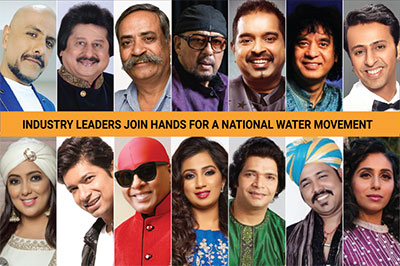
    Paani Ka Teeka, a project created by IdeaHive Media, a social enterprise currently focusing on water, education and job creation has partnered with Piyush Pandey and Louiz Banks for a music-based project to make the voice of water reach every corner of the nation. The duo, who will be reuniting after the iconic ‘Mile Sur’ anthem,  have garnered the support of music industry leaders like Zakir Hussain, Shankar Mahadevan, Shreya Ghoshal, Shaan, Vishal Dadlani, Harshdeep Kaur, Neha Bhasin, Pankaj Udhas, Salim Merchant, Sivamani, Mame Khan, Rakesh Chaurasia, among others to join hands with the campaign for water consciousness.


    Said Dilip Moorkoth, Founder Paani Ka Teeka and the Director of IdeaHive Media: “It’s a blessing to be able to get the support of industry leaders and domain experts who have believed in our vision with Paani ka Teeka. The objective of the campaign is to make this project a citizens’ movement and work towards a water-secure India.”