Category: ADVERTISING

  • Sanju Menon is COO – Publicis Ambience & Beehive

    By A Correspondent


    Sanju Menon

    Publicis Worldwide India has announced the appointment of Sanju Menon as Chief Operating Officer of Publicis Ambience and Publicis Beehive. Menon takes over the reins from Paritosh Srivastava, who recently was elevated to the role of Managing Director of L&K Saatchi & Saatchi. Menon will be responsible for driving the growth agenda while also providing fresh thinking and impetus to a host of brands under Publicis Ambience and Publicis Beehive. He has already assumed charge from January 2, 2020 and will report to Srija Chatterjee, MD, Publicis Worldwide, India.


    Menon joins Publicis Worldwide from sibling Leo Burnett India where his last role was as Executive Vice President managing the entire Bajaj portfolio for the agency. Apart from Bajaj, he was also associated with brands across the Publicis Groupe including Jeep, Viacom, Bridgestone, Sketchers, Abbott Nutrition and Cholayil among others.


    Srija Chatterjee

    Commenting on the appointment, Chatterjee said: “It’s been an emotional ride these past few days as one of our most dependable faces departs to take on a larger role at the Groupe level. But that’s an exciting journey to undertake and Paritosh deserves every bit of the success that has come his way. I’d like to thank Paritosh for setting up steady and solid-looking agencies under Publicis Ambience & Publicis Beehive. At the same time, I’d like to welcome Sanju to the Publicis Worldwide family and can vouch for his credibility as one of the most exciting talents to watch out for. His credentials in driving growth and strategy and his team-bonding skills make him a prized asset to possess. I look forward to partnering him and carving out an upward trajectory for several brands under the Publicis stable.”


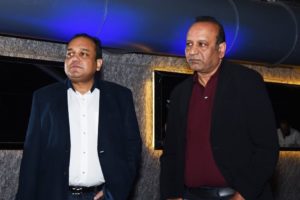
    Paritosh-Srivastava

    Added Srivastava: “Leaving is always tough, especially when it’s been a deep emotional relationship of over eight years. Publicis Worldwide will always be close to my heart and will root for its success and glory. However, the silver lining is that no one better than Sanju Menon could have taken the mantle. He’s a fantastic human being and an incredible professional who will add amazing value to our wonderful clients. I’m certain that he will take the agency to greater heights. My heartfelt wishes to Sanju, Srija, Ajay, Neeraj, Suraj, Sridhar and the entire PWW team for a great ride into the future.”


    On joining Publicis Worldwide India, Menon said: “The last five years at Leo Burnett have been very rewarding. I will cherish the association I have had with the various teams I have worked with. With LB’s rich history of innovation, these years have been of great learning too, and I hope to take every bit of it with me to Publicis Worldwide. From the outside, I have seen that Publicis Worldwide has fantastic talents and long-standing relationships with brands that are trusted, loved, and have enormous potential. Equipped with the Publicis Groupe’s ‘Power of One’ philosophy and with the trust of our partners, I look forward to working with Srija and her talented team on building effective and innovative solutions that will make Publicis Worldwide more agile, and a powerhouse within the group. I’m looking forward to being a part of this exciting new journey.”


  • 10 Takeaways from DAN Digital Report 2020


    The headline was digital media is expected to cross the Rs 50k crore mark by end-2025. But, then, there was a lot more in the report. Here are key highlights and takeaways:


    Anand Bhadkamkar, CEO, Dentsu Aegis Network India: “2019 was a challenging year for the Indian advertising industry as well. With the economic slowdown, advertisers decided to cut back on spends, consumers decided to wait-and-watch, market sentiments reached a new low and India’s Ad Expenditure (AdEx) witnessed a consequential fall. But even in the midst of it all, digital continued to grow. Digital is a masterstroke in advertising and Dentsu Aegis Network recognizes this strength. We also recognize the need for an industry level report that can give directions toward which this industry is moving. While with every new edition, the DAN Digital report has been upping its rank in quality, range and comprehensiveness, we welcome sincere feedback and inputs from the entire industry to help establish a robust eco-system for this fast growing and increasingly important industry channel, so that all of us can progress together!”


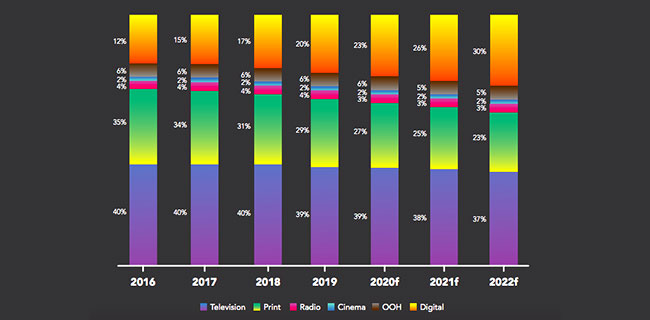
    Ashish Bhasin, CEO, APAC and Chairman, India – Dentsu Aegis Network: “The Media and Advertising industry is shifting at a rapid speed and Digital is certainly taking charge. Consumers are leaving behind huge digital footprints and there is a lot more emphasis on managing data and developing martech capabilities, now. 2020 is expected to witness a major change in advertising in India, with digital becoming a bigger medium. In fact, by 2021, it’s growth should surpass that of print. Yet, despite this progressive swing, the industry has failed to come together to agree upon a common measurement metric for digital. As leaders in digital, Dentsu Aegis Network today stands at the forefront of this evolution and understands the need to have more information on Digital. The DAN Digital report, now in its fourth edition, is exhaustive, systematic, thorough and meets this need gap brilliantly. The report has now become the most credible source of information when it comes to digital in India.”


    1. The Indian advertising industry has grown at a rate of 9.4% over 2018 to reach Rs. 68,475 Crore by the end of 2019. The industry will grow by 10.9% to reach Rs. 75,952 Crore by the end of 2020. It is expected to grow at 11.83% CAGR to reach a market size of Rs. 1,33,921 Crore by 2025.

    2. By the end of 2019 the digital advertising industry stands at Rs. 13,683 Crore, up at a rate of 26% from Rs. 10,859 Crore in 2018. It is expected to grow at 27% to reach Rs. 17,377 Crore by the end of 2020.

    3. Advertising spends on Digital media is expected to grow at a CAGR of 27.42% to cross the Rs. 50,000 Crore mark and reach an industry size of Rs. 58,550 Crore by the end of 2025. This sustained growth can be attributed to the technological advancements, improvements in data science & analytics, introduction of policies & regulations among others.

    4. Television takes the largest share of media spends at 39% (Rs. 26,869 Crore) followed by print media (29%, Rs. 20,110 Crore) and Digital Media (20%, Rs. 13,683 Crore). In the year 2020, spends on Television media is expected to grow at 10% and its share will remain steady while that on Print media is expected to grow at 3% with this share declining to 27%.

    5. Across various industry verticals, FMCG sector spends the highest by contributing 30% (Rs. 20,182 Crore) to the advertising industry. Next to FMCG stands with 10% contribution by E-commerce (Rs. 6,915 Crore) followed by Automotive sector (8%, Rs. 5,797 Crore).

    6. Among the various industry segments, FMCG has the highest expenditure on advertising i.e. 30% (Rs. 20,182 Crore) followed by E-commerce (10%) and Automotive segment. FMCG spends a large majority of their advertising budget on television (61%) while Retail, Automotive and Retail spend a large share of their advertising budget on Print. The biggest spenders on digital media are BFSI (42%), Consumer Durables (38%) and E-commerce (37%).

    7. Advertising spends on Digital Media is led by Social media with the highest share of 28%, contributing Rs. 3,835 Crore to the Indian digital advertising pie. This is followed by spends on Paid search (23%), Online Video (22%) and Display media (21%). Display media, online video and social media are expected to have the fastest growth in 2020. The share of paid search is expected to reduce from 25% to 23% by the end of 2020.

    8. FMCG segment spends a large share of their digital media budget on online video (36%), while E-commerce, consumer durables spend a mostly on paid search and social media.

    9. By 2020, advertising spends on Mobile devices is expected to grow by 41% to have a share of 52% to the digital advertising market, overtaking spends share on Desktop. Furthermore, the expected spends on mobile devices will reach a share of 64% by 2022.

    10. Advancements in marketing technologies and subsequent fusion with marketing creativity, along with the advent of 5G technology and increased adoption of E-commerce advertising will lead to the evolution of content for the next 500 million Internet users, thereby catapulting the digital media industry towards the Rs. 50,000 Crore milestone by the year 2025.


  • Zee partners Kyoorius to sponsor ~75% of Kyoorius Creative Awards entry fee

    By A Correspondent


    Entertainment major Zee Entertainment Enterprises Ltd (ZEE) and Kyoorius have announced a unique offer for the advertising fraternity which will see Zee funding around 75% of the awards entry cost incurred by the creative agencies, making their participation in the Kyoorius Creative Awards significantly less expensive. Punit Goenka, MD and CEO, Zee & President, International Advertising Association (IAA), Rajesh Kejriwal, Founder & Director, Kyoorius and journalist Anant Rangaswami made the announcement. To be called the Zee Kyoorius Creative Awards, the last date for receiving entries is April 10, 2020 and the awards are scheduled to be held on June 5, 2020 in Mumbai.


    Last year, Kyoorius Creative Awards had received 2600 entries. Given the entry fee of Rs 15,000 and Zee taking care of Rs 11,000, it could well be a spend between Rs 2.75 and 3 crore.


    Punit Goenka and Rajesh Kejriwal

    The move, notes a communique, is provoked by the acknowledgement of the challenges faced by the creative fraternity, and encourages increased participation while significantly reducing their award entry budgets. It further added: “Recognising budget constraints and immense pressure on margins experienced by the agencies, Zee has announced this support to ensure that every creative work finds its due share of recognition and appreciation. A significant reason for Zee’s support to the advertising fraternity is the fact that, as an Entertainment Company with strong and established businesses in the realm of broadcast, films, music, digital and live entertainment, the company has been a direct beneficiary of the immense creative talent of the Industry. With this initiative, Zee recognises and applauds the creative quotient of the industry, which complements the entertainment environment through the creation of television commercials, and the significant contribution of the community through their involvement in TV programming, films and content for digital platforms.”


    Speaking on the announcement, Goenka said: “We are extremely proud of our symbiotic relationship built with the advertising fraternity, both media and creative, in this journey of entertaining the world. We firmly believe that no creative work should be deprived of being showcased, appreciated or recognised due to commercial constraints. Our association with the Kyoorius Creative Awards enables us to make this disruptive and much-needed change in the current ecosystem. I am glad that this initiative is also in line with IAA’s overall approach of democratizing the advertising world.”


    Added Kejriwal: “As we step into the seventh year of the Kyoorius Creative Awards, it gives us a great sense of satisfaction to witness the immense support expressed by the creative community and marketers. This initiative would not have achieved the success levels which it has without the investment of time and energy of all the players in the value chain. We are delighted that Zee has taken a yet another thought leadership stance by supporting the creative community through its association with the Kyoorius Creative Awards. The support from Zee will not just democratise the awards ecosystem, but will also disrupt the existing power structures.”

  • The Four Giant Leaps


    By Indrani Sen


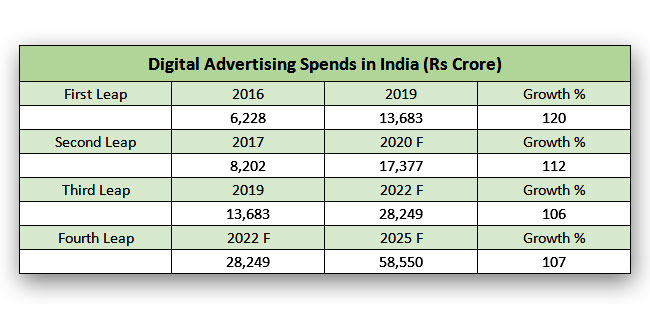
    According to the DAN Digital Advertising Reports, spends on digital advertising in India is increasing by 100%+ every three years and is poised to cross the 50,000 crore milestone before 2025. It was only in the second half of the last decade, the Indian advertising industry crossed the milestone of 50,000 crores, so it seems strange that the newest and youngest competitor for the share of the advertising pie will be crossing that same milestone by middle of this decade! We have already witnessed the first giant leap from 2016 to 2019 and it seems quite possible that in three more giant leaps digital advertising will achieve this fantastic growth.


    Digital Advertising Spends in India (Rs Crore)
     First Leap 2016 2019 Growth %
    6,228 13,683 120
    Second Leap 2017 2020 F Growth %
    8,202 17,377 112
    Third Leap 2019 2022 F Growth %
    13,683 28,249 106
    Fourth Leap 2022 F 2025 F Growth %
    28,249 58,550 107

    Source: DAN Digital Advertising Reports


    The question which comes up next is which industry verticals are contributing to this spectacular growth of digital advertising? An analysis of the DAN Digital Advertising Reports show that almost across all industry verticals, advertisers have been increasing their spends across various platforms of digital advertising. The following table shows the comparative weightage on digital advertising by industry verticals in their total advertising budget in 2017 and 2019. Except Media & Entertainment where the weightage has remained 23% and miscellaneous small categories grouped under “others” where the weightage has gone down, across all other industry verticals, advertisers stepped up their expenditure on digital media. Digital media is no longer a myth; it is a reality now competing for share of the advertising pie and propelling the growth of advertising in India.


    Weightage on Digital Advertising
    2017 2019
    FMCG 7% 19%
    Auto 12% 16%
    E Commerce 30% 37%
    Retail 16% 20%
    Telecom 28% 35%
    BFSI 24% 42%
    M&E 23% 23%
    Consumer Dur 19% 38%
    Others 9% 4%

    Source: DAN Digital Advertising Reports


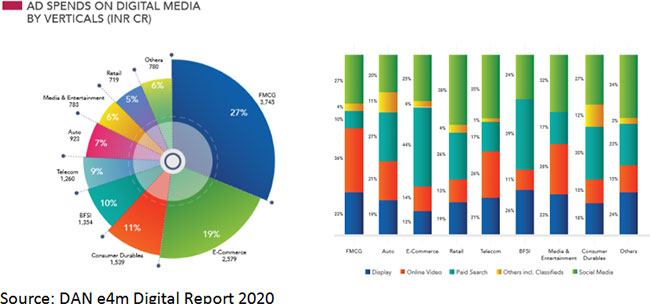
    Though FMCG as a category spends 19% of their advertising budget on digital media, it contributes 27% of the total digital advertising pie, followed by E Commerce 19%, Consumer Durable 11%, BFSI 10% and Telecom 9%, followed by others as shown in the chart below on the left. So, across all industry verticals, advertisers have got into the Indian digital bandwagon.


    The next chart on the right shows that based on the target audience and their use of different digital media, the various industry verticals use the different digital formats for advertising; while E Commerce and BFSI rely more on paid search, Retail and Telecom rely on Social Media. However, a comparison of 2017 and 2019 shows that the share of formats in digital advertising have hardly changed except video increasing at the cost of classified and paid search.


    2017 2019
    % %
    Social 28 28
    Paid Search 26 25
    Display 21 21
    Video 19 22
    Classified 6 4

    Source: DAN Digital Advertising Reports


    In 2017, 43% of the digital advertising was through mobile, which increased to 47% in 2019 and is expected to grow to 53% in 2020. Clearly, the mobile revolution in India has contributed in a large way to the growth of digital advertising. By the time digital advertising crosses the 50,000 crore mark mobile will have 60% + share in that revenue. Programmatic buying has also been growing year on year and by 2020 direct buying will be 44% with programmatic buying going up to 56%.


    The digital media industry still faces many challenges, but apart from a detail discussion on ROI for digital advertising, the current report does not touch on the other issues like ad fraud, ad blocking software, lack of metric for measurement etc. On the whole, the DAN e4m Digital Report 2020 is an informative and excellent resource and the advertising and marketing industry should be thankful to the leadership of Dentsu Agies Network for sharing it free with all concerned.


  • Benetton India awards digital mandate to Dentsu X-cubic

    By A Correspondent


    DX–cubic, the Dentsu X agency, has won the digital business of the Benetton Group, effective January 2020. The erstwhile agency was Wavemaker.


    Speaking on this occasion, Sundeep Chugh, MD & CEO, Benetton India said: “Benetton’s strength lies in its millennial consumer base who show a deep connection and love for the brand. Adapting with the changing times, Benetton wants to be innovative and upbeat with digital communications and campaigns. We are excited to get Dentsu X on-board. The team shows excellent knowledge and dedication and we are hopeful of doing some very successful work together.”


    Divya Karani

    Added Divya Karani, Chief Executive Officer, Dentsu X: “Yes, we are super-excited to win and work on Benetton. Partnering a strong brand, built upon innovation, with such a strong connect with the mercurial millennials is exhilarating. Given our ethos of delivering experiences beyond just mere exposures, this is right up our street! We look forward to a productive and enduring partnership.”


  • Kartik Sharma quits. Ajay Gupte is new Wavemaker CEO

    By A Correspondent


    Ajay Gupte

    Wavemaker has announced the appointment of Ajay Gupte as Chief Executive Officer for Wavemaker, South Asia. Gupte, who is currently COO of Wavemaker India, takes over from Kartik Sharma who steps down to pursue other opportunities in the industry.


    Gupte will continue to be based out of Wavemaker Gurugram and will report into Prasanth Kumar, CEO – GroupM South Asia and Gordon Domlija, President Wavemaker Asia-Pacific and China CEO.


    Said Prasanth Kumar, CEO – GroupM South Asia: “I would like to take this opportunity to thank Kartik for his contribution over the years and wish him all the very best.”


    Commenting on Gupte’s appointment he added, “At GroupM we always believe in building on the hard work and passion of our people and it gives me great pleasure to see Ajay take over as the new CEO of Wavemaker South Asia. He comes with vast experience working in multiple markets and categories. He is a well-rounded professional, and I see him bring in distinctive and increasing value for our clients and the overall ecosystem. I am confident that he will continue to grow Wavemaker as an agency of the future.”


    Added Domlija: “India is a hugely important market for Wavemaker, and we’ve got a very successful team here. I’ve gotten to know Ajay as a strong client and team leader, and I’m convinced he is the right choice to help Wavemaker to future sucesss and, ultimately, to keep looking for better ways to unlock growth for our clients, our agency and our people.”


    Said Gupte: “I am humbled and very excited to take over the role of the CEO of Wavemaker South Asia. It is an exciting time for the Indian market as the Indian advertising industry is also having a global impact, and I see lots of opportunities for growth.”


  • Goafest to highlight women’s issues with Red Abby

    By A Correspondent


    The Advertising Club and the Advertising Agencies Association of India (AAAI) have come together to launch a communication programme that will address the issue of violence against women in society. The special campaign will be a part of the upcoming edition of Goafest 2020. The winning campaign will be crowned with the newly instituted special award ‘The Red Abby’ that celebrates the woman and her spirit.


    Speaking about the initiative, Ashish Bhasin, President – AAAI, said: “Violence against women is an issue that has been a significant area of concern. It is critical that we as an industry that is responsible and renowned for driving awareness and building perceptions, use our collective capabilities for the betterment of society. We hope that this initiative will help us put together a high impact campaign that will empower women and help change mindsets.”


    Added Partho Dasgupta, President  – The Advertising Club ” I strongly believe that it is imperative that everyone from the industry comes together and leverages our circle of influence to bring about positive social change. “


  • Casagrand awards digital media mandate to Kinnect

    By A Correspondent


    Kinnect has been awarded the digital media marketing mandate for Casagrand, South India’s real estate company. The agency’s Bengaluru office will handle the account.


    Commenting on the account win, Rohan Mehta, CEO – Kinnect said: “Casagrand is an exciting mandate to secure, and we are elated to add this prominent brand to our esteemed clientele. Using tech, creative, and data to complement our strong media strategy, we aim to deliver substantial business outcomes for the brand on digital.”


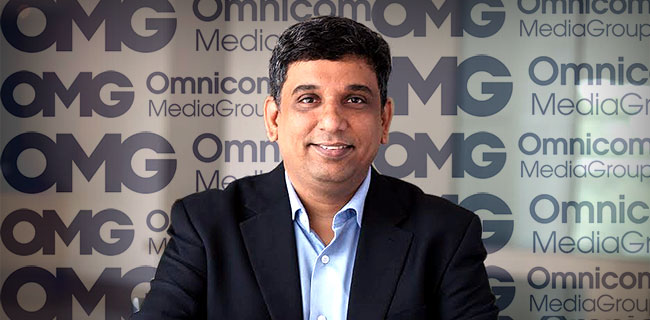
  • Omnicom Media Group Kartik Sharma to helm Omnicom Media Group in India

    Caption: Photo Montage: Rafiq Barak. It may be noted that Kartik Sharma will join OMG only in mid-2020.


    By A Correspondent


    It’s now confirmed. Omnicom Media Group has appointed Kartik Sharma as CEO for its operations in India. Sharma joins the Omnicom entity from GroupM’s Wavemaker, where he was most recently CEO for South Asia. He is slated to join the network mid-year. His exit from Wavemaker was announced on Wednesday (January 29). The position was created after former OMG CEO Harish Shriyan’s exit was announced in July 2019.


    With over 25 years of media experience under his belt, Sharma has served in a leadership capacity at some of the largest agency networks, including Mindshare, Lintas Media, Madison Media and Maxus and managed clients such as L’Oreal, Mondelez, Netflix and Vodafone. In his new role, Sharma will work closely with Priti Murthy, CEO of OMD India, and Jyoti Bansal, CEO of PHD India, on chartering the continued growth of the agency brands in India.


    Speaking on the appointment, Tony Harradine, CEO of Omnicom Media Group Asia-Pacific, said in a statement: “A revered leader with an impressive track record, I am thrilled that Kartik has joined us. I have the utmost confidence in his ability to steer our business to even greater heights in one of the most important markets in Asia.”


    For those not in the know, Omnicom Media Group is the media agency network owned by Omnicom, the global. advertising services conglomerate. According to a report in Campaign, OMD occupies the top spot by projected billings in the COM vergence 2019 global billings rankings report. GroupM’s Mindshare is second in the ranking and Carat is #3. In India, GroupM occupies the top slot amongst media agency networks, and OMG is as of now perhaps at #5.


    Clearly, Sharma has his role cut out for him. He took charge of Maxus from Ajit Varghese in January 2014 and there has been no looking back since. Sharma has led both Maxus and Wavemaker to winning the coveted Agency of the Year title at the Emvies.


  • FCB Interface executes ‘Punishing Signal’ campaign for the Mumbai police

    By A Correspondent


    You’ve already seen this on the Whatsapp circuit or read about it on the front page of The Times of India a few days back. FCB Interface has enable the Mumbai Traffic Police to offer an innovative solution called The Punishing Signal. FCB Ulka has of course been partnering the Mumbai Police with billboard creatives at the Chowpatty-Gamdevi-Babulnath Road junction.


    Said Madhukar Pandey, Joint Commissioner of Police (Traffic), Mumbai Police:  “Honking is bad habit and an act of traffic indiscipline. Unfortunately, many Mumbaikars indulge in reckless honking. Honking causes noise pollution, hurts the eardrums, increases heart rate, creates traffic confusion and causes stress. Unnecessary honking is a menace which everyone recognizes but does little to curb. This small experiment is one of many attempts by Mumbai Police to create better road discipline in Mumbai. Hopefully, it will encourage Mumbaikars to honk less, and create a noise-free and stress-free commute.”


    As a part of the campaign, the first leg of activation was tested in Mumbai at important junctions that are most prone to heavy traffic such as CSMT, Marine Drive, Peddar Road, Hindmata and Bandra. And the film gives one glimpses of the confused honking Mumbaikars who honked, waited, honked and learnt it the hard way, that honking is not the way out.


    Shedding light on the creative idea, Robby Mathew, Chief Creative Officer, FCB Interface, said: “Sometimes, the stick works better than the carrot. And a signal that gave us a gentle rap on the knuckles for honking unnecessarily, seemed like a good idea to me”.


    Added Rohit Ohri, Group Chairman and CEO 0 FCB Group: “We have been partnering Mumbai Police for many years now. Noise pollution is a big problem in our cities. This new initiative is a fantastic creative solution for bringing about awareness and a behaviour change amongst the drivers in Mumbai.”


  • Industry Reax to Budget 2020-21


    A cross-section of the industry reacts to Nirmala Sitharaman’s maiden Budget 


    Girish Menon, Partner and Head, Media and Entertainment, KPMG in India

    Although there was no direct reference to the media and entertainment sector in Budget 2020, the focus on improving India’s digital connectivity bodes well for the sector. The Honourable Finance Minister’s announcement that an amount of INR 6,000 crores will be spent on BharatNet initiatives will see more citizens connected to the proposed pan-India FTTH network. Media and entertainment is increasingly becoming a digital medium and an enhancement of the underlying digital communications infrastructure will support more immersive experiences. Finally, the focus on building a vibrant start-up ecosystem with measures to improve access to funding and IP protection will help India emerge as a global hub for technological innovation.


    Rakesh Jariwala, Partner – International Tax Services, EY India

    Removal of exemption on sale, distribution and exhibition of cinematograph film will subject theatrical revenues to domestic withholding tax considerations and could pose working capital considerations for already funding constrained film industry. Amendment of source taxation rule to include advertising income relating to customer based in India while global consensus is being formed on digital taxation rules may result in short term pain for the foreign businesses which do not have access to a tax treaty. Reduction of withholding tax rate on technical services to 2% will provide relief on potential rate related disputes on production services. Reduction in import duty of news print should help the ailing print businesses. 


    Ashish Bhasin, CEO, APAC and Chairman, India – Dentsu Aegis Network:

    I think this is a good budget in some ways because it has attempted to put money in the hands of the middle class through rationalisation of tax rates as well as has concentrated on looking after the agricultural sector, including introduction of best practises like storage for producers and other measures. However, I do feel that the expectations from the budget were much more and it does feel like a bit of a missed opportunity.


    While it is good to see that the dividend distribution tax has been abolished, I expected more on the rationalisation of direct taxes, particularly the cess introduced over and above the tax rates.


    It is good to see efforts being made to encourage new-age skill development as well as helping the start-ups and what’s particularly interesting is the proposal to set up data centre farms all over the country. This will prepare India for the economy of tomorrow. It is also good to see attempts at simplification of taxation through digitisation but the proof of the pudding will lie in seeing its implementation on ground.


    It would be fair to say that at best it is a mixed budget and while there are some encouraging decisions, enough does not seem to have been done for the situation the economy is in.


    Karan Darda, Executive Director, Lokmat Media Group:

    We welcome the proposed reduction in custom duty on import of newsprint and light-weight coated paper. In recent years, newspaper industry has been facing many headwinds and the environment has overall been very challenging. 10% customs duty was introduced last year and that added to the burden. The reduction in customs duty would ease the burden and help the industry in this critical juncture. 


    Anand Bhadkamkar, CEO, Dentsu Aegis Network (DAN) India:

    The budget has provided relief to middle class with lower tax rates which is a welcome move, as it will provide more liquidity. On direct taxes, the abolition of DDT and introduction of a tax dispute resolution scheme is a welcome step alongside tax reliefs for startups.


    The budget is focusing on easing and simplification of compliance, with changes in corporate laws as well as in GST and direct taxes. However, I was expecting further simplification of cess and surcharges beyond tax rates across slabs.


    The proposals for development of road infrastructure, setting up data centre parks and skill development initiatives are welcome steps in addition to allocations for social welfare schemes.


    However, the expectations from the budget were high on the background of current economic slowdown, and as such seems to be short on matching those expectations, with no specific industry sector focused sops to provide stimulus. While the budget shows focus on long term growth and social development, overall in the current scenario it looks like a mixed budget, falling a bit short of market expectations of more corrective measures.


    Gautam Sinha, CEO – Times Internet:

    Budget 2020 is a promising step towards establishing India’s future as an enduring digital economy. The increased focus on improving data connectivity under Bharat Net, steps to boost the smartphone manufacturing industry and the Rs 8,000Cr allocation for the National Mission on Quantum Computing & Technology will help build better digital infrastructure to support this sector’s rapid growth. Finally, deferring tax on ESOPs for startups is also a major move that will help promising startups attract and retain talent that would fuel our burgeoning digital ecosystem.


    Redickaa Subrammanian, Co-founder and CEO, Resulticks:

    Digital disruption has transformed India’s business landscape and the announcement for building more data centre parks will further aid in laying a strong foundation for a digitally connected country. INR 8000 crore allotment for developing quantum technology is impressive, and this in tandem with the grassroots level skilling initiatives, make for a strong technology ecosystem. Engineering students will also gain real-world experience through the new internship programs, creating a digitally skilled talent pool equipped to work in a digital economy.


    As a fast-growing AI and ML based technology start-up, we welcome setting up of the investment clearance cell. The proposed revisions in the income tax structure should lead to increased consumer demand and provide an overall impetus for economic growth in India. The announcement made in Budget 2020 showcases the government’s support for India’s technological advancement and we are excited about the entrepreneurial spirit it promotes.”


    Prashan Agarwal, CEO – Gaana:

    We appreciate the efforts of the government to boost the digital ecosystem in the country. The increased focus on improving connectivity under the Bharat Net scheme and the emphasis on Artificial Intelligence will allow OTT players to offer bespoke and personalised solutions to consumers. Additionally, the impetus to the smartphone manufacturing industry will make internet consumption accessible to a wider section of Indian society that will expand the scope of revenues for OTT players. The allocation of Rs 8000 crore for setting up the National Mission on Quantum Computing and Technology will also boost the development of the industry by making resources cost-effective.


    Mitesh Shah, Head of Finance, BookMyShow: 

    At the onset, we would like to laud Government for growth driven budget. We welcome the progressive policies aimed at encouraging rural demand, changes in personal taxes spurring consumption and impetus to infrastructure development, measures aimed at bolstering growth and reverse slowdown. Additionally, taxation related on ESOPs as perquisite and removal of DDT are significant moves. However, the benefits of taxation relief on ESOP should be expanded to companies at various stage of growth.


    Compliance on e-commerce has been increased by mandating them to deduct TDS @1% on all goods and services sold on e-commerce platforms. This would be in addition to TCS under GST and this amendment might further increase the cost of compliance for e-Commerce companies. Government’s vision to build data centre parks, allocation towards quantum computing and its focus on using artificial intelligence in statistical and other government departments will take India’s growth story to the next level.


    Increase in compliance on e-commerce by mandating deduction of TDS @1% on all goods and services sold on e-commerce platforms. This would be in addition to TCS under GST and this amendment might further increase the cost of compliance for E-Commerce companies. Government’s vision and focus on investing in new age technologies to build data centre parks, allocation towards quantum computing and its focus on using artificial intelligence in statistical and other government departments will certainly give an impetus to ‘Digital India’.


    Kunal Bahl, CEO & Co-founder, Snapdeal:

    Thankful to the Hon’ble FM for accepting the start-up sector’s request for ESOP taxation reforms. Also, the higher time & turnover limits for carry forward of losses for start-ups will enable them to optimize growth decisions in formative years.


    Overall, Budget 2020 is a thoughtful weaving together of specific proposals to tackle varied issues. Measures to improve access to finance for MSMEs and reduced taxation for the middle-income segment are welcome steps. Boosting physical infrastructure, expanding digital connectivity and growing use of technology in government functioning are important building blocks for the long-term growth of the Indian economy.

     

  • Sonal Dabral quits Ogilvy, to explore options in content creation

    By A Correspondent


    Sonal Dabral

    Sonal Dabral, Chief Creative Officer South & South East Asia and Vice Chairman Ogilvy India, has decided to move on. Dabral wants to explore options in content and content creation, something he has always had a keen interest in, notes a communique, adding: “With so much happening now in this space, Dabral felt the time was right to follow his passion and explore storytelling not confined to advertising. Ogilvy thanks Dobral for his many years of contribution to our offices across India and Asia, and wish him all the best on his next adventure.”

    Said Piyush Pandey, Chief Creative Officer Worldwide & Executive Chairman India, Ogilvy: “Sonal was one of my key partners in the creative renaissance at Ogilvy India in the early 1990s. He later moved on to do successful stints as the creative head of Ogilvy Malaysia and Singapore. Sonal came back to India as Chairman of Bates India and, after exploring DDB Mudra for a few years, joined Ogilvy again.  I wish him well and am certain he will make the content world shine.”