Category: ADVERTISING

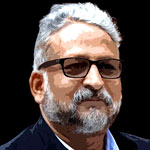
  • Samarjit Choudhry takes charge of Happy mcgarrybowen, Soumitra Karnik takes additional charge as CCO

    By A Correspondent


    Happy mcgarrybowen, which was hit by complaints of sexual harassment of its founders and their eventual ouster, has elevated Samarjit Choudhry to the role of President while Soumitra Karnik has been assigned with the additional charge as Chief Creative Officer (CCO).


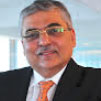
    Samarjit Choudhry

    Speaking on his appointment, Choudhry said: “mcgarrybowen has a strong philosophy of solving real problems. They truly operate as a media-agnostic agency. In India the foundation for this is already there and the agency has been operating as Happy mcgarrybowen for over two years now. My mandate is to take it to the next level. Other than communication, we already have a strong design practice and in conjunction with the other offerings from DAN, today we offer our clients a one stop solution for whatever their needs might be. I look forward to taking the opportunity to take the legacy forward. And all we ask is, ‘Give us your biggest problem’.”


    Soumitra Karnik

    Speaking about the role, Karnik added: “Happy mcgarrybowen is a phenomenal creative brand and has an enviable body of work to prove it. All these years, I have greatly admired them from a distance and I count my blessings for being given this opportunity to be a part of their creative trajectory.  I assume this role with utmost confidence only because the culture of HMB will not have it any other way. I shall take my mandate from Gordon Bowen, our Global CCO, in the coming days and will talk about it soon. Personally, I’d like to build a collaborative creative culture where everyone works with everyone and everyone learns from everyone. There is so much talent out there in the world and sometimes all it takes is a simple call to say, ‘Hi, I have this idea and I need you to make it even more amazing’. Most clients deserve a spectacular package. Anything less is just plain misfortune.”


    Ashish Bhasin

    Said Ashish Bhasin, CEO Greater South, Dentsu Aegis Network and Chairman & CEO India: “With its new leadership in place, I am more than confident that the agency is now in extremely able hands. Happy mcgarrybowen has always been a brand to reckon with and I have no doubt that Samarjit and Soumitra, together, will further fuel this brand legacy and help Happy mcgarrybowen scale new heights.”


  • Buffalo launches ad campaign with ambassador Varun Dhawan

    By A Correspondent


    Fashion brand Fbb has created an ad campaign titled ‘Setting You Free’ featuring brand Buffalo’s ambassador Varun Dhawan to celebrate its 40th milestone.


    Celebrating the four-decade success Rajesh Seth, COO, Fbb said: “It’s not every day that we see brands successfully serve for forty years. We celebrate the 40th year of our iconic brand Buffalo with pride and are filled with gratitude for the undying support by our customers. We believe that this is just the beginning and are working towards achieving many more milestones.”


    Speaking about the campaign, Anand Subbarao, Co-founder, AndAnd Brand Partners Pvt. Ltd. Said: “When you have Varun as an ambassador for a popular brand like Buffalo, executing the campaign is a seamless process. The brand has a strong yet soft personality that matches with the superstar; which is why the film looks distinctly great.”


  • Getting the most out of Goafest


    By Sanjeev Kotnala


    Goafest was fun when it used to be held at the Cavelossim Beach. It was hot and humid. One needed sunglasses, a hat and suntan lotion as standard accessories to navigate through the venue. I have been one of the stupids who questioned the relevance of some of fun activities including raindance, and I regret it.

    Certain limitations, costs, security, liabilities and other management issues moved Goafest to a hotel venue. The air-conditioning is excellent and the sessions are mighty comfortable. There used to be sundowner, after-hours party and enough beer to go around. But, in the process, Goafest missed out on both GOA and the FEST.  The fun element had taken a beating.

    It still holds its charm. It provides ample opportunities for ice-breaking, networking, training, knowledge sharing, deal closure and even informal business commitments. And it keeps evolving with time.

    This year we are moving to Unplugged entertainment of 30 minutes right after lunch. It may be a tough act. However, it achieves few things. It used lunch break as stage set-up time. It wakes up and recharges delegates. It gets them into the hall early and hence help in starting the post-lunch knowledge session on time.  Moreover, it allows the awards to start early without the long entertainment set-up period. And that will help start the after-parties early. My issues with this masterstroke are very few. Why even have these 30 minutes of entertainment. And such entertainment on a full stomach… does it sync? It may not work.  On top of it: just a 30-minute performance? What are we trying to do?

    For all we know, this is a mellowed down version of the real disruptive idea. Have the entertainer or the star performer as first slot of the day to help start conference on time.


    Goafest is fun when you are a part of a group.

    It’s pure fun when you are part of a group nominated by your organisation to attend Goafest. However, there is another subset of delegates. Independent individuals. These are start-up guys, entrepreneurs, small agency owners, media representatives and consultants. For them, it is a challenge to be a part of a group for long. And that includes the group from your ex-organisation.

    Whatever may be the subset you belong to, Goafest becomes chaotic by Day 2. It does not matter how big your group is. And by Day 3, people are bored of being with the same colleagues. The conversations dry up.  At this stage, Zombies takes over. You find delegates missing knowledge sessions and relaxing in their rooms. Sometimes it is just late-night partying and stressed out socialising/ networking that is the culprit. Sometimes, it’s the sequencing of the sessions.


    So, what can you do at Goafest?

    Get up early.  Take a walk along the beach. Many of you may not be near the beach. It’s okay, catching the early morning soft-flowing Goa breeze is a fabulous experience.

    Spend some time watching the shortlisted entries. Move to the display area early in the morning when the rest of the delegates are still deciding what to do. Now that you are there, don’t just glance over them, invest time. Study and understand them. If you find something that stuns you, compliment that agency or people when you meet.  Sometimes this is the best way to network. Everyone wants more appreciation!

    Pick the 2-5 sessions you definitely want to attend. Pick the first half and close it with the Unplugged session or may be start your day with it.

    Use your fingers and check about the author and the subject. Priming dry land before showers always helps. You will find that your interest in the subject and session gets enhanced. May be you already have the question you want to ask. Draft it and save it in your SMS. And when the time comes, plug that in the Goafest App.

    Avoid the sessions you do not want to attend. Don’t get pulled into them for any reason. The time is better utilised at the display area, networking outside, having drinks or just relaxing. I recommend early morning or the lunch time extending into the Unpugged session for this. There is nothing more tiring than listening with resourcefulness to something you are not interested in.

    Remember, networking and introductions happen in less crowded situations. So, create opportunities by being early at the start of the day, post-lunch session and awards night. A wee bit earlier than the hall doors open up and you may find it rewarding in term of connects you make. Do work like a homing pigeon. Make the networking worth for the other person too. So be ready with your deeply researched true networking opening conversation.

    Find the missing GOA in Goafest. Step out. Go to another beach. Eat at shacks. Have streetfood with friends. Find that lovely seafood joint or just land up at a casino for the adventure. Do something beyond Goafest!

    Most importantly, switch-off your e-mail and social media notifications. Do continue to post from the fest. People must know you are there. And respect the speaker, organisers and delegates by putting your phone on silent when you are attending any session.

    Find out the free Wi-Fi spots and passwords at the hotel. Check the connectivity. And at night update all your apps.

    Place three-alarms on your phone. Slot 15-20 minutes for an unhurried clean-up and replies of your inbox. Maybe at 0830, 1330 and 1830 Hrs.  Practice upward delegation. Check up how you can stop playing e-mail ping-pong and kill it with a phone call.

    Trust me, if there is fire, the right people have your number to reach you. Use your mobile camera to capture the moods, selfies and groupies. Select the picture you want to keep, delete all others and post the images (if you’re going to) then and there. Timing is everything.

    This Goafest, may you get what you deserve from it. May it create an all-new benchmark and reference of what to do in future. And may I meet Miss2016.


  • Jack in the Box Worldwide to manage digital duties of ITC’s Dermafique

    By A Correspondent


    Jack in the Box Worldwide will manage the digital communication duties for Dermafique from ITC. The mandate comprises all services including brand strategy, social media, search, listening and creative duties.


    Commenting on this, Kaizad Pardiwalla, President & Chief Operating Officer, The 120 Media Collective, said: “Dermafique is one of the few Indian premium skin care brands and we are thrilled to partner with them on their journey. What’s especially exciting is that Dermafique is a digital first brand and we look forward to creating content that consistently delivers business impact for them.”


  • Day1@Goafest: E-commerce calls the shots at Industry Conclave

    By Rahul Chandawarkar


    E-commerce held centre stage on Day 1 of Goafest 2019 which kicked off at the Grand Hyatt hotel in Bambolim, Goa on Thursday, April 11.

    Sponsored by Discovery Channel, the Industry Conclave had the marketing chiefs of the leading e-commerce brands, Amazon, Flipkart and Myntra explain to the audience the dramatic changes that have taken place in the field of digital marketing.

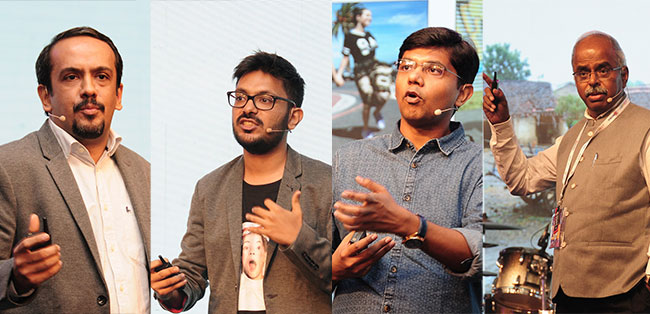
    Ravi Desai, Vijay Sharma, Achint Seti and Velumani

    Ravi Desai, director, mass and brand marketing, Amazon India explained how the old system of ‘pen portraying’ a customer was completely passé now. Desai said that Amazon India had created a mind-boggling 1,00,000 digital advertisments during Diwali 2018 to address hundreds of customer-types across multiple segments.

    Desai explained how primetime TV advertising was also passé. According to the senior executive, the modern-day, urban consumer was consuming content in very different ways. Desai demonstrated with the help of a video clip, how consumers were comfortable directing Amazon’s artificial intelligence device, Alexa to play songs of their choice on Amazon’s Echo, smart speaker system. “If consumers are hooked to this, we need to devise ways and means to catch their attention on this platform,” Desai said.

    Citing the example of his teenaged son and his friends, Desai said that multiple TV channels did not interest these teenagers anymore. “They were more keen to play PUBG ( Player Unknown’s Battleground), the popular, online multiplayer game and live streaming video games. Our advertising needs to cater to these new trends,” Desai said.

    Quoting Amazon founder Jeff Bezos, who said, “Focus obsessively on customers,” Desai explained how building customer loyalty was a prime objective at Amazon. According to Desai, the ‘Amazon Prime’ programme where a customer paid INR 129 every month to avail of a free and fast delivery, advertisement free video streaming, audio streaming and exclusive deals was a step in this direction.

    Likewise, Vijay Sharma, associate director, brand marketing and head digital media, Flipkart said that digital marketing and digital brands had changed the face of modern-day marketing. According to Sharma, fast moving consumer goods (FMCG) like Coke and Pepsi had made way for brands like Apple and Google as the world’s leading brands.

    Explaining the challenge of digital marketing, Sharma said that artificial intelligence was being used extensively by Flipkart to run its latest advertising and marketing campaign, ‘The Big Billion Days’.

    Multiple celebrities and models were roped in to run the popular, ‘Ab Hoga (name of city) budget se mukt!’ digital marketing campaign, which was made to reach a wide audience across the entire country.

    In a similar vein, Achint Setia, vice president – marketing, Myntra, explained how the modern-day customer was consuming information across a wide variety of platforms like the internet, television and the android phone. “In such a scenario, we necessarily have to use artificial intelligence to make a customer experience a joyful moment with the mere touch of  button,” Setia said.

    Explaining that Myntra was a cool and youthful brand, Setia said that the company had put a customer loyalty programme titled, ‘Myntra Inside’ in place. With the help of a video clip, Setia demonstrated how the programme treated the customer to a personality make-overs, gifted new dresses and curated the experiences of the customers using cutting edge technology. Myntra also gifted select customers overseas trips.

    Earlier in the afternoon, popular singer Shaan regaled the audiences with many of his hit Bollywood songs and also sang several English-Hindi medleys.

    The audiences were also regaled and kept spellbound by a very peppy presentation made by Dr A Velumani, creator and managing director of Thyrocare, the company which has made a mark in the field of healthcare. Velumani touched many a chord when he narrated his rags to riches story. Advocating the philosophy of frugality, Velumani explained how he did not own a home despite being very rich. “As an entrepreneur I feel it is more important to grow my business and create more employment,” Velumani said.


    Rahul Chandawarkar, a former newspaper editor, is a communications strategist and superactive triathlete based in Goa. He has been covering Goafests for MxMIndia since 2017.


  • Day3 Goafest 2019: Mary Kom, CSR and social sector rule conversation

    By Rahul Chandawarkar


    Corporate Social Responsibility (CSR) and the social sector was the common thread that bound most presentations together on the final day of the third day of Goafest which concluded at the Grand Hyatt hotel in Bambolim, Goa on Saturday, April 13.


    Matt Eastwood, global chief creative officer, McCann Health who spoke in the National Geographic knowledge seminar in the afternoon said that while the world was going through tough times, it was also a time for advertising professionals across the world to be agents of positive change.


    Day3@Goafest2019: Key Takeaways

    :: Increased involvement by corporates in CSR projects had given rise to the concept of ‘return on doing good’ (RODG).

    :: Hi-end technology platforms like Artificial Intelligence (AI) were helping creativity reach new heights.

    :: The United Nations were keen that 50 per cent of its sustainability development goals (SDG) should emerge out of India.

    :: One of the speakers redefined the four Ps of marketing as purpose, people, passion and physical.


    Rahul Chandawarkar, a former newspaper editor, is a communications strategist and active triathlete based in Goa. He has been covering the Goafest for mxmindia.com since 2017. 

    Eastwood said that in a competitive world, business enterprises had realised that if they made a positive impact on society though the corporate social responsibility route, their brands stood to gain. Eastwood went on explain how increased involvement by corporates in CSR projects had given rise to the concept of ‘return on doing good’ (RODG).


    Citing an India example, Eastwood explained how the Kwality Dairy milk company had chosen to address the problem of Vitamin D deficiency among Indian school children through a very innovative CSR project.


    Kwality Dairy had managed to convince 50 schools in the Delhi region to shift their open-air assembly timings to 1130am, so that children could be exposed to peak sunlight for at least 20 minutes of the day. Several hundred more schools had shown interest in implementing this idea. According to Eastwood, this innovative initiative on the part of Kwality Dairy would directly benefit the brand, as the brand would have top-of-the-mind recall when parents made a decision to buy milk for their children.


    Among the several, international CSR examples that Eastwood shared with the audience, was the one initiated by Microsoft where, they created an information technology supported game which enabled physically disabled children to play video games. According to Eastwood, this ‘let everybody play’ philosophy of Microsoft would positively impact the brand.


    Earlier in the day, Ross Jauncey, Head of Create at Google spoke along similar lines in the Google keynote address and said: “The best time for creativity was now.”


    Jauncey was of the opinion that hi-end technology platforms like Artificial Intelligence (AI) were helping creativity reach new heights. Demonstrating this through a video clip, Jauncey showed how the recently launched Kupu app was helping people shoot photos on their android phone and learn the aboriginal, Maori language in New Zealand.


    Similarly, Jauncey pointed out to a Nike advertisement campaign on multiple digital platforms which supported the anti-racism movement by featuring several sporting champions across the various continents of the world.


    Society and the social sector once again resonated in the joint presentation made by Navi Radjou and Jaideep Prabhu, co-authors of the popular books, Jugaad and Frugal Innovation. Radjou and Prabhu who spoke in the Lokmat Knowledge Seminar maintained that while the spirit of ‘jugaad’ or innovative business practices was ingrained in the Indian business person’s psyche, the concept of doing business with less had spread across the globe.


    Citing some examples, the authors said that a major consumer clothing brand like Levis had recently launched their ‘wasteless jeans’ created from plastic waste. The company had also promoted their ‘go water-less’ campaign where they recommended that their jeans did not have to washed regularly and that you could even shower in your jeans, the next time you want them washed to drive home the recycle-reuse mantra.


    Turning their attention to India, the authors said that the United Nations were keen that 50 per cent of its sustainability development goals (SDG) should emerge out of India. The authors were confident that this was completely possible as they discussed chapters from their latest book, ‘Do better with less!” which showcased many an example of Indian innovative entrepreneurship (jugaad) across India.


    Later in the early evening, Phil Kemish, co-founder of Disrupt Marketing speaking at the MTV knowledge seminar redefined the four Ps of marketing as purpose, people, passion and physical.


    Exemplifying some of these Ps, Kemish stated how UK’s new chocolate brand, Tony’s Chocolonely had launched their product by pointing out that they were against all cocoa farms in Africa which employed children. Kemish pointed out that the brand had mentioned their values and beliefs on their wrappers and had launched their product solely on the basis of word of mouth publicity.


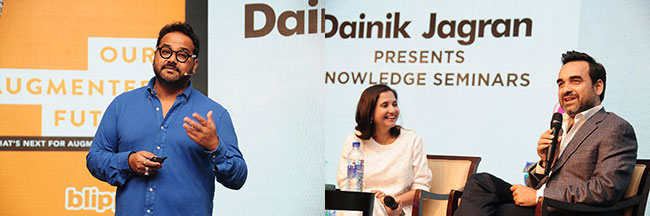
    Finally, Ambarish Mitra, co-founder of Blippar who spoke at the Jagran Knowledge Seminar had the audience in awe as he introduced them to the relatively new, hi-tech concept of augmented reality (AR). Mitra did this by virtually creating a retail store on stage complete with garments etc which he could literally sift through. According to Mitra, AR and visual reality (VR) were the fourth and latest stages in the evolution of computing interface.


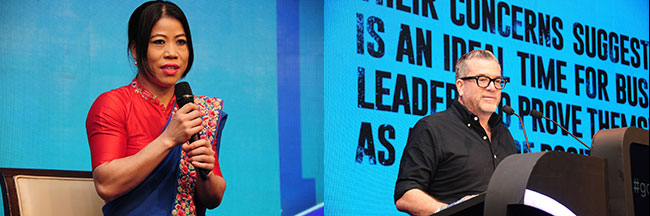
    The final day also stood out with India’s boxing icon, Mary Kom surprising everyone by giving a near-professional rendition of the popular, Alanis Morissete song, “What’s going on!”. Likewise, Bollywood singer Mohammed Irfan and actor Pankaj Tripathi entertained everyone with their songs and anecdotes respectively.


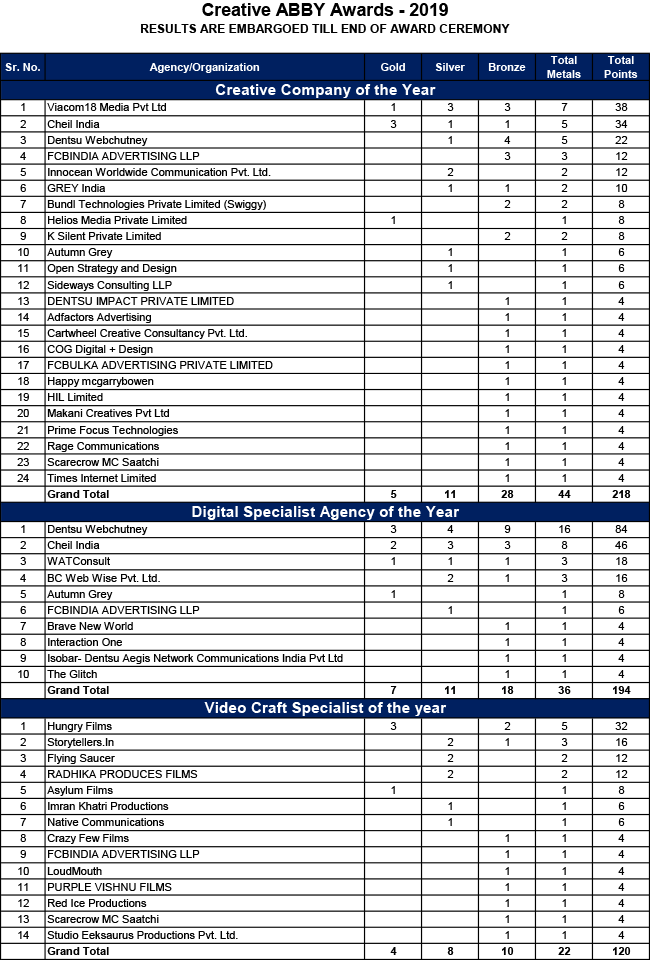
  • Viacom18, and not a creative agency, tops Creative Abby 2019


    By A Correspondent


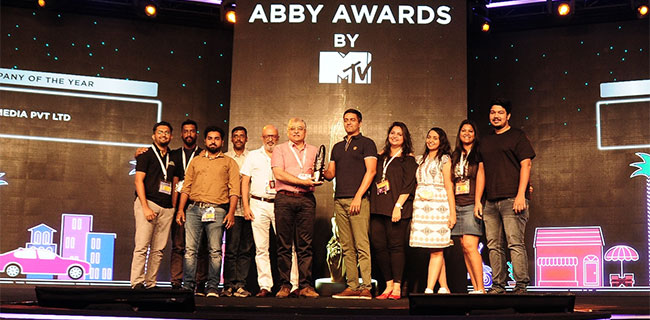
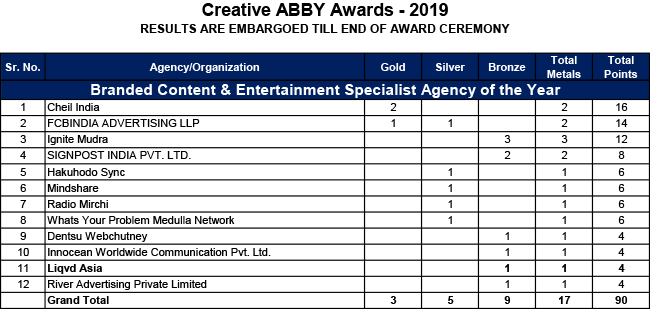
    Goafest 2019 came to an end on Saturday evening with broadcaster Viacom18 bagging the Creative Company of the Year at Abby 2019.


    Commenting on the winners, Shashi Sinha, Chair of the Awards Governing Council, Abby Awards, said: “It has been another great year of the Abby Awards We’re happy that the big winners are in Audio Visual. We have taken certain steps to encourage entries in those specific categories. We’ve opened up, bifurcated and streamlined certain categories to enable that. A lot of the work that has been entered here is very good work.”


    On the rise of digital that was evident in the list of Abby winners, Vikram Sakhuja, President, The Advertising Club, added: “This has been the best year for digital ever. People are realising now what the true power of the platform is. Earlier digital was an add on, now with the advancement of the platforms the syntax has to change. In the shortlists there was almost 50-50 between digital and broadcast.”


    Adding on to the evolution of digital, Ashish Bhasin President of Advertising Agencies Association of India (AAAI) said: “In a few years we won’t differentiate between a digital agency and a non-digital agency, because down the line if an agency cannot do digital, I don’t think it can retain business. This is the democratisation that I was talking about, the market has opened up so that not only the big names, but even smaller and boutique companies are coming in with good work.”


    Said Nakul Chopra, Chairman – Goafest 2019 on the tweaking and rationalisation of award categories: “There is a proactive effort we have made to be fair to all constituencies, through our various categories. At present we see more affinity towards some categories while maybe some years down the line merging of a couple of categories will make sense. While the market and field evolves, we as custodians of the market standards will simultaneously evolve to reflect those changes.”


    There were a total of 2700 entries across the various creative and media categories.


  • Goafest2019: What You Missed & What They Messed


    By Sanjeev Kotnala


    On Day 2 of Goafest2019, I tweeted ‘This is best Goafest Day ever’. Few have asked me as to what made me say so? Honestly, it has nothing to do freely availability of cold beer, lovely breakfast at Grand Hyatt or that the unfinished story had a new beginning. I will answer it at the end of this article.

    What was important was something entirely different.


    BLURRING OF LINES AT GOAFEST2019.

    Goafest2019 awards reflected reality. The lines defining the roles and expectations in the industry are blurring. The only relevant definition is being ‘creative solution contributor to growth’. The pseudo-line of controls like digital, creative, craft, print, traditional are no longer relevant.

    It surprises me when some industry stalwarts fails to recognise the new reality.

    What is there to be shocked of, if a digital agency wins PR Agency of the Year, a digital agency is the Direct Marketing Agency of the Year and a TV station is the Creative Agency of the Year. If you look at the second row of awards, you will find more such surprises.

    You can’t limit the scope of any organisation by the charter and contract. The festival itself has moved away from a sharply focussed singularly stated theme (Like Brand Dharma) to a broader eclectic mix of sessions.

    However, when Viacom18 won the top creative award, there was no point in rechristening it as ‘Company of the Year’. The era of brand purpose and growth, instead of relooking at redefining who can enter or who is an agency or a company, we should move to purpose-agnostic ‘Organisation’ terminology.


    MORE REAL WORK WINNING AT GOAFEST2019.

    The scam quotient is under control. The awards juries have been phenomenal. More Real Work Is Winning, as said by Shashi Sinha, Chair, Awards Governing Council GoaFest2019.

    The displaying of the Abby Shortlist for people to file objection seems to be working. I wish they displayed not just a list but also the complete entry. For example, how would anyone know what is the creative associated with ‘Meri Doosri Country’ campaign by Sony Ten 2’s for the FIFA World Cup 2018, until it is accessible?

    If the full entry is displayed at the Shortlist level, it will solve my second demand automatically. I have voiced it many times. At Goafest2019, I personally spoke with people managing the show. We must make available full winning entries for the public. It can quickly be done digitally.

    It will help demonstrate that genuine creative is winning at the festival. And students and practitioners who could not make to Goafest2019 will have access to this precious information.


    SCAM PREVENTION IS NOT JUST GOAFEST’S RESPONSIBILITY.

    No awards body can control and check a scam winner. They rely on the client and the agency collectively signing an undertaking about creation, inspiration, originality and exposure.

    If a scam does happen after this, we must look inwards and question our inaction. To stop scam winners, we have to act like a professional vigilance team. Just like citizen vigilance helps stop terrorism, only professional vigilance can stop scam entrants.

    So, for a moment think about how you can contribute. Pledge that next time when anyone seeks help to stop such scams, you will find the time to raise objections if any.


    KNOWING EVERYTHING DOES NOT COUNT.

    Day 1- started with Dr A Velumani of Thyrocare shaking up delegates. Presenting his story of struggle and hardship, dedication, passion and nothing to lose approach.  Ravi Desai of Amazon followed it with ‘7 seminal shifts’ in marketing.

    I sat through Ravi’s presentation with a bored expression. I know all this. What are you adding to my knowledge?

    Later at night, I was discussing it with dear friend Sumit Roy of Univbrands, he questioned my reaction. I realised where my bias was creeping in. There is a huge gap between  ‘I know Vs. I think Vs. I act’. Our knowledge has changed, but behaviour has not seen a shift. There is a need for individual behavioural change and attitude re-referencing before we can expect industry level shift.

    By the time we had Phil Kemish, Co-Founder, Disrupt Marketing and Brandtrepreneur, speaking about the four Ps (Purpose, People, Passion and Physical – bringing the brand to life) of marketing attitude. I was a different listener, a different delegate.

    Once, you realise and want to bridge the gap between  ‘I know Vs. I think Vs. I act’, your reaction as a delegate will change.


    THINGS REDEFINED AT GOAFEST2019.

    Overall, there is a tremendous change. We are getting better at time management. I still do not subscribe to Chairman or anyone extending any session. It happened during Unplugged and few knowledge sessions.

    The shifting of live entertainment to just after lunch slot worked. It eased the pressure on the evening schedule. It helped in starting post-lunch sessions and the evening awards on time. It also ensured that in the after-party, there was enough time to serve drinks before the 1 am closure deadline.

    The festival delegate average age is sharply falling. There is a shift towards smaller organisations and digital companies participating. Suddenly, it felt as if I was in some other industry do.

    However, there is a significant change in the number of delegates visiting display areas. I am sure they are interested, but the tight schedule of sessions and awards leave no time. May be we can make them available on a pen drive as part of the festival kit. I am not sure how does this impact sponsorship, or it opens space for further activities.

    One understands and appreciates the magical sponsor slot. However, it needs to be monitored and curated in terms of straight plugging and content. The way Google launched Google Creative was absolutely understandable and appreciated. However, everyone was not like Google. Some brands overtly pushed their agenda masquerading as knowledge.


    GOAFEST2019. DAY-2. THE BEST DAY EVER.

    The Day 2 had an absolutely fantastic set of speakers in the knowledge session. Madonna Badger opened the day with talking about ‘Women are not objects’. She made her case with examples – Women are equal, but their objectification makes them less than equal. Gorden Bowen made a strong case for creativity. He pointed out the need to be Creativity Lead, data-driven and tech-supported way of working.  Barry Wacksman empathised on the need to be proactively being a disruptor.

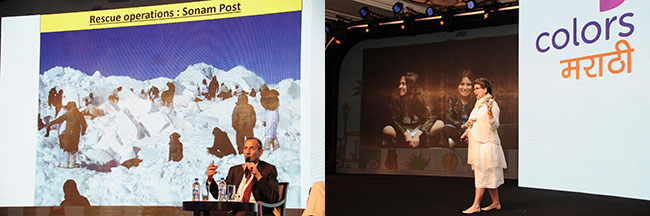
    Harshvardansinh Zala, Founder and CEO Aerobotics, topped this with an exciting session. He is just 16. His inspiring talk made the delegates look inward. It at least made me re-evaluate my journey. Lt Gen Hooda spoke of training and values defining the work ecosystem in armed forces. More than talking of the Uri attack, he sensitised delegates sitting in the comfort of an AC, the hardship frontline soldiers face at the border in extreme positions.

    Cricketer Virender Sehwag batted all questions upping the run rate. Part of the leadership series, he differentiated three leadership styles with relatable examples. Saurav Ganguly; creating the team, Anil Kumble; setting the target and keeping focus, and MSD- getting work done by the team.

    The only blip on Day 2 was Sidhant Chaturvedi and Kalki Koechlin talk. It went nowhere in spite of the interviewer Kubbra Sait trying her best. Jonita Gandhi’s unplugged session was nice. She got the crowd involved and moving with her.


    GOAFEST2019. CHANGE AND STRUGGLE THE NEW CONSTANTS.

    Change is a constant. The struggle is another constant in life. Without it, even the change does not make sense. Struggle in life happens at multiple fronts. In a multi-dimensional festival like GoaFest, it’s a churn towards the better.

    This time round there was so much learning in what is loosely called celebrity slots. Harshwardansinh Zala, Lt Gen Hooda, Virender Sehwag, Pankaj Tripathi and Mary Kom. You could have them as entertainment and/or as an inspiration. The choice is yours. But do put your filter through the test of the filter of ‘I know Vs. I think Vs. I act’

    Unlike the Mumbai roads that are repaired just before the monsoon, I hope Goafest management committee will visit the challenges now, much in advance. And we will have a brilliant Goafest 2020 on 10-11-12 April, the second Thursday-Friday-Saturday of April.


    TOMORROW: GOAFEST2020. Unsolicited advice to help make it better.


    Sanjeev Kotnala is a senior marketing and strategy consultant. His columns appear on MxMIndia every Wednesday and on special occasions. The views here are personal



  • Day2@Goafest2019: Creativity takes centrestage

    By Rahul Chandawarkar


    BAMBOLIM (Goa): Creativity took centrestage on Day 2 of Goafest 2019. Senior advertising professionals from across the globe reiterated the fact that creativity still ruled the roost despite the advent of high technology in the making of advertising commercials.


    Gordon Bowen, founder and global chairman of McGarryBowen was of the opinion that creativity would always outlast data. Bowen who was speaking in the morning session of the Knowledge Seminar sponsored by Colors Marathi said that contemporary advertising was creativity led, data supported and technology driven. Driving home his point, Bowen said: “Even the Bible says that God is the creator. Creativity will always remain relevant.”


    Day2@Goafest2019: Key Takeaways

    :: Creativity would always outlast data

    :: Majority of the Fortune 500 companies were stagnating and losing the battle to smarter, swifter, digitally savvy companies.

    :: Speed was of essence in the transformation process.

    :: The three key stages of transformation were business transformation, experiential transformation and marketing transformation.

    :: The #Women Not Objects campaign initiated by Badger and Winters agency had made a positive impact in the USA.

    :: The youth in metro and non-metro India no longer thought differently.


    Rahul Chandawarkar, a former newspaper editor, is a communications strategist and active triathlete based in Goa. He has been covering the Goafest for mxmindia.com since 2017.


    Bowen shared several video clips of award winning advertising campaigns designed by his company for United Airlines, Chrysler, Hallmark cards and Chevron where the common thread clearly was the high level of creativity.


    Bowen, an unabashed fan of the Indian advertising world, complimented it for its ‘three-pronged’ strengths of being collaborative, humane and passionate.


    The same thread was carried forward by Barry Wacksman, vice chairman and global chief strategy officer at R/GA in the afternoon session of the Knowledge Seminar sponsored by MX Player. Pointing out how majority of the Fortune 500 companies had stagnated as they had lost the marketing battle to smaller, more digitally savvy companies, Wacksman said that transformation was the need of the hour for all of them.


    Wacksman, who stressed the need for speed in the transformation process, said that it constituted three stages, namely, business transformation, experiential transformation and marketing transformation. He further explained each stage with an advertising intervention created by his company which had helped the client manifold.


    For business transformation, Wacksman gave the example of how a banking app (Next Bank) was created in Brazil to encourage the younger generation to use banking services. In the example on experiential transformation, Wacksman explained how his company had used a video of basketball ace Michael Jordan taking a dunk shot wearing a particular model of Nike shoes. This resulted in record sales within two hours of the video being uploaded on the Android platform. Similarly, by introducing a gaming character called ‘Galaxy Skin’ on the Samsung Galaxy Note Pad 9 mobile phone, sales of over 240% was achieved for consumers in the 18-24 age group.


    Earlier in the day, Madonna Badger, Founder and Chief Creative Officer, Badger and Winters grabbed everybody’s attention when she spoke of her company’s highly visible, #Women Not Objects campaign across the USA. Badger who showed the audience multiple, contemporary product advertisements in which women have been portrayed as mere objects said, “This is an unacceptable situation. Women cannot be portrayed as mere objects.”


    Badger also shared a video survey undertaken by her company across the USA which showed how this advertising was having a negative impact on school-going children. Badger has even taken her campaign to the Cannes Lions International festival of creativity to reach out to the advertising fraternity at large.


    In the afternoon session, Navin Shenoy, marketing head, youth, music and English entertainment at Viacom 18 made a presentation on the topic of ‘MTV Youth Insights’ giving the audience a peep into MTV’s research wing.


    Quoting research figures, Shenoy pointed out the youth in metro and non-metro India no longer thought differently. A significant takeaway of Shenoy’s presentation was that youth from non-metro India was increasingly comfortable living and working in his/her hometowns.


    According to Shenoy much of this transformation was because of the reach of television, the internet and social media across the length and breadth of India.


    Day 2 at Goafest 2019 was also highly entertaining owing to some very interesting sessions like the one featuring Bollywood actress, Kalki Koechlin and emerging actor, Siddhant Chaturvedi of ‘Gully Boy’ fame and cricketer Virender Sehwag, who had the audience in splits with his easy-going humour.


    Child prodigy Harshwardhansinh Zala, all of 16 years old and founder of the Aerobotics 7 technology company had the audience awestruck, while Lt Gen DS Hooda ( retd), the Northern Army commander during the 2016 surgical strikes into Pakistan occupied Kashmir (POK) stirred patriotic emotions and Bollywoood singer Jonita Gandhi had everybody tapping their feet and clapping their hands with her peppy music.


  • Mindshare creates ‘senso-bot’ for oral care advice


    On the occasion of World Oral Health Day, Sensodyne brought virtual dentists closer to the public, in order to give them the best oral care advice. To do this, Mindshare created a chatbot, which when invoked through Google Assistant, by simply saying ‘Hello Sensodyne’, discussed oral care problems with users.


    Ruchi Mathur

    Said Ruchi Mathur, Senior Vice President, Client Leadership, Mindshare North & East: “Our constant endeavour is to deliver solutions that are rooted in relevant consumer insights and create a strong impact for our brands in the marketplace. While many brands in the industry have been using conversational UI to deliver campaigns, we wanted to link it to a tangible benefit for the consumer. This troika of partnership between Sensodyne, Lybrate and Google Voice helped us create this industry first.”


    Added Anurita Chopra, Area Marketing Director, Oral Health, GSK Consumer Healthcare: “Tooth Sensitivity is a common condition not only in India but around the world. The lack of awareness of this condition makes many consumers give up the simple pleasures of enjoying their favorite food and drinks. We are excited to launch this breakthrough, first-of-its-kind tech innovation ‘Hello Sensodyne’ that will address queries of individuals on tooth sensitivity and allow them to take actions towards leading a sensitivity free life.”


  • Unsolicited advice to help make Goafest2020 better


    By Sanjeev Kotnala


    In the article yesterday, I discussed ‘what you missed, and they messed?’ with reference to advertising industry’s biggest festival of creativity and ideas. Goafest2019 finished on April 13, 2019. Like always, it had its own moments of the Good, the Bad and the Ugly.  There has been tremendous change as the festival keep evolving.

    Here I am sharing few inputs, that may help the Goafest Managing Committee see things differently:

    1. REALIGN. Do meet the absentee agencies now. Show them the new picture and help to get them positively polarised towards the fest.

    2. Launch a Goafest2019 survey among delegates. Provide a platform for free, honest expression and suggestions. Run it with all delegates and all sponsor and organisations on the corporate level.

    3. ENHANCED TRANSPARENCY. STOP SCAMS. Share all entries in their totality at the time of Shortlist. Give it enough time for people to check and raise an objection. Make the association protocol, SOP for objection resolution public.

    4. ENHANCE EFFICIENCY AND FESTIVAL CONSTRUCT. Capture data to make more sense of priorities and preferences. Track people movement. Record entry and exit details from different zones.

    5. TRANSPARENCY. Include a session where jury members express and share what they were looking at, what kind of discussion happened, and what favoured the significant winners.

    6. SESSIONS OF IMMEDIATE RELEVANCE. The festival needs more sessions like the one by Ambarish Mitra, CEO & Founder, Blippar who spoke about augmented reality, virtual reality and its rapid evolution in the marketing and advertising realm.

    7. SCHEDULE SHARING. Speaker schedules should be shared much in advance along with the title and synopsis for every speaker activity. Stop hiding timeline inefficiencies by creating a block of activities. Restrict evening dinner timing. Force discipline and movement to the after-party.

    8. HELPING GETTING SPONSOR THE DUE. (A) Once after-party starts, stop all ports serving drinks. Helps maximise sponsor return from parties. (B) Rightsize and re-position the sponsor logo on stage panels to ensure they are part of the picture frame.

    9. DELEGATE COMFORT.(A) Introduce premium seats that one can pre-book by session or by day. (B) Include a section in the app where the participants can see the complete list of questions asked to a speaker. (C) Let the speakers choose the question, or the moderator choose the question. Or a third panel to select the question to be raised.

    10. GOA QUOTIENT. Think about somehow increasing the missing Goa quotient, else we may as well call it the ‘Hyatt Advertising Fest’. Even if that means adding a feni stall. Floral-print-T-shirts, food items. May be offer some discounts.


    Like every piece of unsolicited advice, I hold no liability if it does not give the desired results. So act on your own risk.


    Sanjeev Kotnala is a senior marketing and strategy consultant. His columns appear on MxMIndia every Wednesday and on special occasions. The views here are personal