Category: ADVERTISING

  • #LaughAtDeathattempts to make Indians accept death

    By A Correspondent


    Specialist heathcare agency Medulla and the Indian Association of Palliative Care (IAPC) have come up with what’s possibly yet another Cannes Lions award worthy work. It has launched a new public awareness campaign on palliative or end of life care that will help Indians #LaughAtDeath.


    In India, death is a taboo topic, with people uncomfortable discussing it. Leaving terminally ill patients and their families confused, lonely and often depressed. Palliative or end-or-life care focuses on making terminally ill patients comfortable during their last days. It includes counseling for the patient and their family members, which helps them accept death, make the most of their last days and actually enjoy them.


    These patients were selected from hundreds of terminally ill patients that IAPC members support daily, and trained by India’s best stand-up comedians – Kunal Kamra, Kashyap, Vinay Sharma, PunitPania, Shriram R and Anand Reghu.


    The campaign has broken on Twitter through the first ever comedy show on Twitter and will be amplified on social and digital media through a partnership with The Logical Indian, a platform that leads news and issues that often miss the limelight in the traditional Indian media. Radio Mirchi is also joining hands to bring the #LaughAtDeath campaign to radio.


    Said Amit Akali, Chief Creative Officer at Medulla: “This was the most difficult (almost impossible) project of our lives. Made easy and possible by the patients, eager to share their stories and make the most of their last days. They moved us with their courage and floored us with their live performances, some of them taking a stage for the first time in 85 years! They opened their lives to the stand-up comics and rehearsed hard for days.”


    Said Mihir Chitre, Creative Group Head: “The most rewarding part of this campaign has been interacting with the terminally ill patients. I think they’ve changed the way I look at life.”


    Added Praful Akali, Medulla founder and MD:“This is not just a campaign but an ongoing project and platform for terminally ill patients to share their stories and spread awareness on Palliative care. Love it because it brings alive the power of palliative care in a real way. It is about the strongest demo campaign you’ll ever see.”


    Said Dr Mary Ann Muckaden, President of IAPC: “We are looking forward to increase access to palliative care in India with Medulla – right now only 3 per cent of cancer patients get even simple pain relief. Hopefully, this campaign will change that. A big thank you to the patients for sharing their stories, the comedians who trained them, Film-maker Rahul Sengupta for capturing their performances, the venue and media partners who supported us in creating awareness.”

  • Cannes Lions honours David Droga with the Lion of St. Mark

    By A Correspondent


    The Cannes Lions International Festival of Creativity has announced that David Droga, Founder & Creative Chairman of Droga5, will be honoured with the Lion of St Mark award at this year’s fest.


    Droga is one of the most awarded creatives at the Lions. He won his first metal at age 19 and has achieved more than 70 Gold and 15 Grand Prix / Titanium Lions in his career to date.


    “The Lion of St. Mark recognises an individual who has made a significant and outstanding contribution to creativity in our industry,” said Jose Papa, Managing Director of Cannes Lions. “His drive, passion and unbounded creative skill has led him to deliver continual award-winning results. He’s set the global standard.”


    Added Droga: “I have worked with more talented people and had more opportunities than one creative person deserves. The Lion of St Mark honour is beyond my wildest ambitions. It’s incredible to be recognised with this, when you still feel you have so much more to do and prove. But I will soak it up with pride and humility.”


    Droga will be presented with the Lion of St. Mark at the Festival awards ceremony on Saturday, June 24. He will also be speaking on the Cannes Lions stage a day earlier.


  • Twitter expands pre-roll ads to Periscope Video


    Twitter has introduced a new route for publishers and creators to monetise their content with pre-roll ads on Periscope video within Twitter.


    Pre-roll ads on Periscope video enable brands to merge their message with specific broadcasts from creators and publishers. When consumers scroll through their timelines or search for content from a specific publishers or creators, Periscope videos – live and replay – can start with a short ad.


    Ads on Periscope videos are available to select advertisers through custom Amplify packages, and will roll out more broadly in the coming months.


  • Arun Adhikari appointed Non-Exec Chairman for Neilsen South Asia

    By A Correspondent


    Neilsen has announced that Arun Adhikari will assume the role of Non-Executive Chairman for Nielsen South Asia. Adhikari spent more than three decades at Hindustan Unilever and parent Unilever in various markets in senior roles across executive leadership, sales, marketing, and consumer research. As head of Personal Care business for HUL in India, he was inducted into the Management Committee, before joining the Board as Managing Director for Home and Personal Care. During this time, he was also involved in managing external relationships with the government and media, investor relations, risk management, and corporate governance.


    Currently, Adhikari is engaged with Mc Kinsey & Company in India as a Senior Advisor supporting the firm’s Consumer Practice. He is also an independent Director on the Boards of UltraTech Cement, Viacom18 and Aditya Birla Retail.


  • Famous Innovations bags creative duties of Livpure


    Livpure Pvt Ltd. has awarded its creative duties to Famous Innovations. The mandate includes complete communication strategy and creative, and will be managed by the agency’s Mumbai office.


    Said Raj Kamble, Founder and Chief Creative Officer, Famous Innovations: “We are delighted to be working with Livpure. This is a challenging category with many legacy brands and little differentiation in the communication. With a superior product and Mr Sachin Tendulkar as our brand ambassador, we have many a interventions in the pipeline that will be simple, honest and effective.”


    Added Sushil Matey, Director – Marketing, Livpure: “Water is a very sensitive space, one that is deeply seeped in trust. For any other appliance, consumers may experiment or take a leap of faith, but for a water purifier they will always be extremely cautious. Famous’ approach was very refreshing & innovative which we believe will help us break the category clutter and approach our TG, effectively. We met many agencies, but Famous’ way of building brands resonated with us the most.”


  • Happy Finish appoints Rajiv Krishnani as Business Head


    Happy Finish has announced the appointment of Rajiv Krishnani as Business Head for Happy Finish India.He was until recently Director and Business Head the Astarc Group’s Classic Retail.


    Said Ashish Limaye, CEO APAC, Happy Finish: “Happy Finish as a brand has grown significantly in India. Over the last five years, we have meticulously worked with brands, agencies and the creative fraternity to help them translate their creative vision into reality. Happy Finish India is at a stage where we need to leapfrog into the next expansion phase, scaling up our business to blend in creativity with technology. In Rajiv, we found the right blend of business acumen coupled with common sense. He is young and eager to take charge which is what today’s business needs. His mandate is to work closely with me and the team in India to help Happy Finish scale up on our work and business growth. I am certain that with his skills, it is only a matter of time until Happy Finish 2.0 will be revealed to the world.”


    Said Krishnani: “I am obliged to Ashish and the management of Happy Finish for giving me this wonderful opportunity to spearhead the sales and business operations for the Indian market. With the ever-growing need for expert image retouching and CGI imagery, along with the influx of the assured future of marketing & advertising – 360, VR, AR – in our market, I find myself with a brilliant opportunity to lead our highly experienced and talented workforce at HF India. I can assure our clients, both continuing and new, of us being a driving force for their creative and marketing campaign efforts. I look forward to working with you!”


  • 6 SXSW trends & how they implicate brands


    South by Southwest (SXSW, in short) is an annual congregation of nteractive, film and music professionals who assemble for a slew of conferences and festivals that typically happen mid-March in Austin, Texas in the United States. SXSW was established in 1987 and has grown considerably over the years. According to the ‘About Us’ section on sxsw.com which we recommend you access, “SXSW proves that the most unexpected discoveries happen when diverse topics and people come together”. Hmmm.


    The 2017 edition – the thirtieth in the series – took place on March 10 to 19. The 2018 edition dates have been announced: March 9 to 18. Even if you can’t make it to an SXSW, it’s always good to keep track on what happened and who said (and did) what. Presenting here a ‘trendwatch’ by the folks at MullenLowe Group, which in India, as we know, is called the MullenLoweLintas Group. Read on…


    (Note we haven’t erred in not putting a space between Mullen and Lowe… that’s how it’s written)


    By MullenLowe Group


    SXSW was born in 1987 when an intimate group of thinkers and music lovers recognized a need to discuss the future of entertainment and media. That first year, 150 registered attendees unexpectedly grew to 700 on opening day, and the undeniable charm of Austin set the stage for what is now one of the preeminent events at the intersection of the interactive, film and music industries, with over 72,000 people in attendance.


    Being able to attend SXSW is both a privilege and a necessity. The quality and diversity of learning opportunities is only limited to the number of hours you want to spend in talks, meet-ups or workshops, armed with an open mind, a notebook, a backup battery and lots of water and snacks on hand. From our time in Austin we’ve identified six trends and how they implicate brands. Virtual Reality, voice recognition interfaces and robotics sparked the hunger and amazement that technology feeds us, while activism, emotions and ethics kept us feeling inspired and connected as human beings. Each of these topics will dramatically change the way consumers engage with brands moving forward.


    #1. Smartphones as a gateway for bigger experiences


    Like last year’s conference, Virtual Reality dominated the entertainment conversation at SXSW. In addition to several entertainment-focused activations, one of the biggest developments was an influx of content showing VR’s potential as an empathy tool. But clunky, expensive hardware and lacking streamlined distribution still remain big hurdles standing between the hype and the reality of mainstream consumer adoption for more immersive, interactive experiences. Affordable options like Google Cardboard and Samsung Gear provide lighter-weight virtual experiences by simply opening a VR app and sliding your phone into the goggles. The result? The phone is instantly transformed from a distracting text messaging, email and newsfeed machine to a conduit for an uninterrupted, 360-degree environment creating a heightened emotional connection.

    In addition to lightweight VR, the phone emerged as a tool for adding real world value through the abundant augmented reality apps on the SXSW tradeshow floor. Apps like Aurasma make it possible to trigger a video or additional content by holding your phone over printed collateral or an OOH board. Other mobile apps like Seek are taking the route of Pokémon Go and creating scavenger hunt-like experiences where consumers can unlock exclusive content and prizes by holding the phone over objects in the real world. The week before SXSW, Shazam announced its partnership with Zappar, an augmented reality technology that will trigger 3D holograms with a Shazam code without requiring another AR app to be installed on the mobile device, creating a simpler consumer experience that has real scale.


    IMPLICATION

    Innovation around smartphones has been flat-lining, but 360-degree video and augmented reality are creating new opportunities to leverage smartphones as a conduit for bigger experiences. Thinking of ways to leverage the smartphone as a means for creating bigger mixed reality experiences vs. just as one of a three- or four-screen strategy is something all brands and marketers should be doing. And for brands in the travel or entertainment category, 360-degree video is a means of creating undistracted emotional connections with consumers on a device that typically makes it harder to capture attention. Even if you don’t have a 360-degree video production capability in place, there are plenty of publishers who are already creating content in this category that you can sponsor or integrate with, and new platforms like Facebook 360 are making it possible for wider 360-degree video distribution


    #2. Interfaces everywhere


    Even before SXSW, the rise of conversational interfaces was a rising 2017 trend, making huge waves in January at CES when Amazon Alexa announced integration into hundreds of products and promised to change the landscape of how consumers access information. But there was also no shortage of content around other nonscreen-based interactions at SXSW. One of the most popular devices was Levi’s smart jacket where the sleeve serves as a remote control allowing you to navigate music playlists and accept or decline phone calls easily while, for example, biking. Lampix, a smart lamp technology, can turn any surface into a smart surface, so — a piece of paper into a functioning computer screen or your floor into a multiperson game. Rotex, a smart tattoo technology, enables you to interact with virtual reality environments without the use of a control by applying the tattoo to your arm during gameplay.


    IMPLICATION

    While not applicable to every product or service, brands should be thinking about ways they can evolve or add value to their products by incorporating useful digital interfaces. From a media standpoint, brands who think beyond paid impressions on a screen will be better prepared for a world where consumers are accustomed to diverse interfaces.


    #3. The rise of emotional data


    The topic of big data is no stranger to SXSW (or any other tech or brand conference for that matter). Wearables have created an influx of personal data collection, like heart rate, blood pressure and body temperature, but technologies that capture and respond to emotional data were more prevalent this year. IBM showcased an alpha product that will create customized original musical compositions based on a consumer’s taste and mood. Lily, an emerging fashion chatbot, provides fashion advice by understanding emotions, perceptions and aspirations about your body to make more personalized fashion recommendations.


    IMPLICATION

    Highly personalised experiences at every brand touchpoint will soon be table stakes for consumers. While many brands already have a strong programmatic strategy in place for their marketing programs, they should also be thinking about how all consumer touchpoints can be better curated, from a first visit to a retailer’s website to customer service. And as artificial intelligence continues to grow, there is greater opportunity for importing data into AI platforms to make recommendations in conversational interfaces (e.g. chatbots or Alexa Skills).


    #4. Humans become robots and robots become human


    It may seem like a paradox, but these are two clear trends. On one hand, there’s a race to make humans a better version of themselves, giving them machinelike features and skills by applying technology to overcome traits or limitations intrinsic to the human being. For example, we now have access to technology that can literally edit our DNA, and that presents the possibility of modifying the development of the human race. We are also experiencing the human brain as the new explorer’s frontier, where brain coding will take human intelligence to unprecedented scenarios: robotics at the service of movement, vision and language. As Bryan Johnson from Kernel suggested, the technology to become superhumans should be accessible to everybody as another human right, the human right of evolution. However, on the other hand, there is a race in emerging technologies to inject natural human skills into machines, that is, to make artificial intelligence more human. Technology is being applied to program robots with emotional awareness, empathy, intuition, compassion and sensitivity, as a means of making them more efficient, useful and agile machines. At the same time, humans are expecting more intimate and meaningful relationships with machines, which will be built upon their humanlike reactions but also their humanlike appearance. Marc Sagar, two-time Academy Award winner, and CEO/co-founder of Soul Machines Ltd, amazed us with his pioneering project of giving face and embodiment to virtual agents that can learn through social interaction. The future of intelligence, should that be biological intelligence, brain intelligence, or computing intelligence is just starting to be shaped.


    IMPLICATION

    As artificial intelligence, conversational UIs and machine learning become mainstream, brands have to remember, more than ever, that we are in the business of people. Humans’ need for connection and humanized relationships will always be at the core of our basic needs. Humans, or superhumans, for that matter, will connect with humanized brands — brands that tap into human truths and build significance and meaning people can connect and engage with


    #5. And technology brought ethics back


    Technology is not an instrument at the service of society anymore. As we have seen in many of the talks at SXSW, technology and technologists are defining the world we are going to live in. We have also seen that technology has no limits, that nothing is impossible. As Andrew Grove from Intel said, “A fundamental rule in technology says that whatever can be done, will be done.” Technology will, sooner or later, do it. As the role of technology expands, the need for ethical awareness grows with it.

    Current topics such as security and privacy, the information bubble, identity, smart cities and autonomous driving spur an ethical debate. But the level of ethics involved when we are defining the future should encompass a broader spectrum. The future of employment, identity, health, sports and the human race urgently calls for ethical expertise. An ethical expertise that can shape the world and the society we want to live in, with technology contributing accordingly.


    IMPLICATION

    This new ethical framework will have an impact on consumers’ frame of reference, and they will look at their world differently. It will also increase their suspicion of the world around them, including brands. It is a great opportunity for brands to ensure transparency and honesty in their relationships with their customers, and especially in addressing ethics as part of their business model.


    #6. Activism as a contribution to the future


    Even if SXSW congregates a large number of “liberals” dedicated to the most progressive industries, never before have politics and activism taken such a big chunk of the SXSW agenda. SXSW went political this year, as if there was a need for the progressive thinkers to go through a group catharsis to ventilate, do some internal evaluation and overcome the trauma of the current political climate. Beyond that, this boost of activism proves that technology and humanity are very much intertwined. Technologists who are working hard to improve the world of the future have proven to be as concerned about the world in the present. There is a sense that democracy, and therefore humanity, is in danger. And activism is as much a way to contribute to the world of the future as it is to the world of the present.

    There was plenty of Trump. CNN’s Van Jones captivated the audience by turning the conservative threat into an opportunity for liberals to work for the world they want to live in. But there was much more than Trump. Women, gender, refugees, homelessness and the overarching claim of equality were stronger topics. Jessica Shortall from Texas Competes had a very emotional and provocative talk on how to build a business development case to gain LGBT+ rights in Texas.


    IMPLICATION

    As seen at SXSW, activism is now a part of culture. If brands want to be a part of culture too, they cannot ignore this. Brands that don’t get involved will be left behind. There is a new consumer mindset. Consumers know that buying a brand can be activism in itself. Buying into a brand implies buying into the brand’s beliefs and principles. A brand with purpose is a brand with a very clear signpost. But consumers want that purpose to turn into action; they are asking brands to become activists.


    Republished with permission

    The original can be accessed at http://sxsw2017recap.mullenlowegroup.com/files/SXSW2017_Recap.pdf

    For more on SXSW, please visit sxsw.com
     

  • Havas team wins award for violence against women campaign

    By A Correspondent

    Shilpa Chaudhary and Ayushi Rastogi of Havas, New Delhi are recipients of the first ever all-industry initiative set up The Advertising Club and the Advertising Agencies Association of India (AAAI) towards a multimedia campaign aimed at mitigating gender violence. The winning campaign will be funded for production by the Ad Club and AAAi and launched by Union Minister for Women and Child Development Maneka Gandhi on April 7 at Goafest.

    Declaring the result, Ramesh Narayan Chairman Awards Governing Council said: “I am very proud to be a part of an industry that cares for good causes. Raj Nayak President TAC, Nakul Chopra President AAAI and Ashish Bhasin spontaneously agreed to back the first-ever industry initiative to use its creative talent and media linkages to identify, produce and run a communications campaign that would attempt to mitigate violence against women. FCB Ulka created the Call for Entries campaign and GroupM ran the campaign that attracted entries from almost all the major Indian Agencies. They will also be helping to run the winning campaign across media. This is one of the finest moments for our industry. Communication as a force for good will be on display A great jury chaired by Amer Jameel,  Chairman and CCO, Mullen Lintas judged the campaign and unanimously selected the entry sent by Shilpa and Ayushi of Havas. The campaign is being produced now”.

    Said Jaleel: “Seven crackerjack, sharp and very opinionated minds in a room who happened to be women, minefield! They however came away reconnecting with some old pals and making new ones. Right off the block we decided this wasn’t an ‘awards’ jury. We acted like clients on behalf of the AAAI and Ad Club, since we were picking a campaign to run. The most valuable ‘thought’ won over craft and execution, making it a new and refreshing experience. Big congrats to the Havas Team for the stellar campaign idea!”

    The other members of the jury were Tista Sen (NCD, JWT India), Malvika Mehra (Founder, Tomorrow Creative Lab), Priti Nair (Director, curry-nation), Anita Verma (Director, Digital Driftwood), Dr A.L.Sharada (Director, Population First), Rajni Menon (President, Carat India) and Vibha Bakshi (V2 Film & Design).

  • iProspect India adds three new clients to its kitty


    iProspect India has won three new clients in the January to March 2017 quarter – Bloomberg Quint, HCL Technologies and India Property.


    Digital news platform, Bloomberg Quint has assigned iProspect India for paid media services and will be serviced from Mumbai. Leading information technology company, HCL Technologies will be serviced from New Delhi and have partnered with iProspect India for Search Engine Optimisation (SEO). One of the premier property websites in the country, India Property will be serviced from Bengaluru and is on board for the Search Engine Marketing (SEM) and Paid Media mandates.


    Commenting on the new clients coming on board, Rubeena Singh, CEO, iProspect India said, “We are thrilled to have started the new year with multiple new clients. Each of these brands have entrusted us with specific digital marketing requirements and we are glad to join hands with them in achieving these goals. What’s encouraging is that they span across different sectors – we look forward to strategising and executing innovative, creative and effective digital campaigns for them.”


  • The Small Big Idea bags two new accounts


    Digital-first branding agency, The Small Big Idea has bagged the digital mandates for ‘Tiny Girl’ and ‘Mukkti Foundation by Smita Thackeray’. The agency will be managing all social media assets for both the brands.


    As a part of the mandates, the agency will be designing and executing social media campaigns and build an engaged communities for both brands. While Mukkti Foundation by Smita Thakeray will focus on the informed, enriched and socially responsible netizens, Tiny Girl content strategy will revolve around engaging parents with young daughters.


    Commenting on the new client win, Harikrishnan Pillai, Co-Founder, The Small Big Idea said:“We started off as specialists in the media and entertainment space, because the core team came from television. But over the last 2 years, clients from tourism, FMCG, BFSI have found us to be interesting micro-story-telling partners. We see stories as data with a soul. The content that performs has a more engaging soul than the one that didn’t. Guess our experience with entertainment helps us understand and deliver that value.”


    “It’s interesting to work on two brands that is about girls and women from different backgrounds. Our agenda would be to create content that inspires them to be their awesome self. In this time and age, it’s the responsibility of content creators and brands to uphold the dignity of women while we tell stories and we will ensure that we keep that in mind,” added Manish Solanki, Co-Founder, The Small Big Idea.


  • SRH brings onboard multiple sponsors for IPL Season 10


    Indian Premier League champions Sunrisers Hyderabad have unveiled a line-up of big name sponsors, as the squad gears up to defend its title in the IPL’s tenth season.


    Ultratech, Jio, Astral Bondtite, Canara Bank, Nerolac, Kurl On, Sun Direct and Red FM have all signed on as partners for IPL Season 10, with their logos and branding set to be prominently displayed on the team’s match kits. Gillette, Apollo Hospitals, UB, Tyka and Motul Oil have also partnered with the franchise.


    Said K Shanmugam, CEO, Sunrisers Hyderabad:  “It is a matter of immense pride for us to partner with brands of such stature as we gear up for the tenth season of the Indian Premier League. This is an important season for us and the support from our partners will be vital as we bid to win two IPL titles back-to-back. Together with our sponsors we look forward to embarking on what promises to be an exciting, and hopefully in our case, a triumphant, history-making journey ahead.”


  • The Sanjeev Kotnala Pre-Goafest Survey


    By Sanjeev Kotnala


    Tomorrow, the 12th annual Advertising Marketing Media and Technology Kumbh Mela of India —  Goafest, a joint initiative of the Adverstising Agencies Association of India (AAAI) and The Advertising Club starts at Grand Hyatt hotel in Goa.


    In the first year, delegates checking into their rooms found an emergency kit strategically placed next to the pillow. If I am right, it was a promotion by MTV. Inside it were three basic items of utmost importance. Aspirin to take care of headaches and mouth freshener to take care of smelsl after too much drinking and smoking. And a pack of condom, in case you needed it.


    Since then, Goafest has evolved to be a complex balance of knowledge, motivation, award, networking and drinks.


    A committee of dedicated professionals, selflessly working together creates this magic every year. In case you like the experience, please find one of them (Ashish Bhasin, Raj Nayak, Ramesh Narayan, Nakul Chopra, Sudesh Kapoor, Bipin Pandit) and congratulate them for their efforts, planning and execution.


    On the other side, if you do not like something or want to suggest something, you can also share it. Nevertheless, if you do not want to share it directly with them or you do not want to spoil the festival fever! Don’t worry, write in to me at netkot@yahoo.com or tweet at @s_ kotnala, and I will do the needful. Oh yes, it will be done post the festival.


    Industry members mostly nominated and sponsored by their companies collect at this mela. For few of them, it is almost an annual ritual. I have not missed a single year. I can vouch for the fact that GoaFest has been moving in the right direction.


    This year’s format is something I love. Thank you for a late morning start. We do have sessions that are longer than constraining 30-minute slots. Creative and media master classes. To top it up, there is intoxicating entertainment for the evening and a dose of spirituality for the balance.


    There are few things I am not sure of. Like, will the beer be available through the day or will they keep shutting and opening the bar. Can they put a board for bar working hours? Can I start dinner early if I am not attending awards? Will this clubbing of sessions allow or promote timely starts and ends?


    Here is the secret to get the max out of Goafest. Mix work with pleasure. Handpick the session to attend and then forget the rest. Define networking targets and keep the count. Find time to go through the exhibits, there is a wealth of information and ideas in them. If interested and winning some metals, you could attend the awards function or just get recharged at the after-award parties. And positively find sometime to get out to visit nearby attractions.


    This year, it is not easy to select the sessions to attend. Here is my list in order of priority and the strong likelihood of me attending them: Hemant Malik (ITC), Acharya Balkrishna ( Patanjali), Ishita Katyal (Youngest Ted speaker), Gaur Gopal Das (Spiritual Guru), Miss Malini Agarwal (The blogger), Geeta and Babita Pogat (Going to be crowd favourites), Eric Cruz (ECD AKQA), Claus Stangl (IG Creative Shop), Vivian Richards (Cricket), Juhi Kalia (Facebook), Laura Ries and Sanjay Dutt. How many I will end up attending is a matter of circumstances and impact of after-parties. Even so, the first six are almost certain. And then there are creative and media workshops which I have not considered in my list.


    Ok, now the last interesting part. This year, I floated a simple survey on the digital platform to get some clarity on what people think of Gafest. I had 55 people who have attended it in the past and 55 who have never attended a Goafest, replying to the survey. I think that is a decent size.


    Here are some highlights of what I picked up:

    Please promote the shortlisted entry display area with enough directional signage. Its importance has always been underplayed.

    On a scale of 5 stars, with 5 being the best, the people who have attended Goafest gave it a 3.45 rating and people who never attended gave it a 3-star rating. None of these are really encouraging.

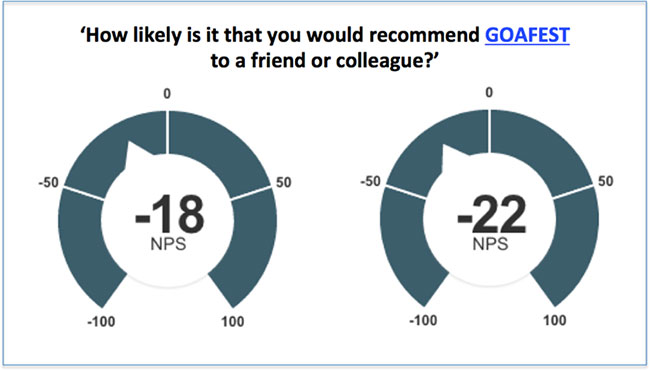
    This is reflected in the negative Net Promoter Score – 18 (Delegates) and -22 (Non-delegates) for Goafest. This is in response to the simple statement ‘How likely is it that you would recommend Goafest to a friend or colleague?’  with the standard 10-point scale. This is worrying, and I hope this year GoaFest will overall improve the score.


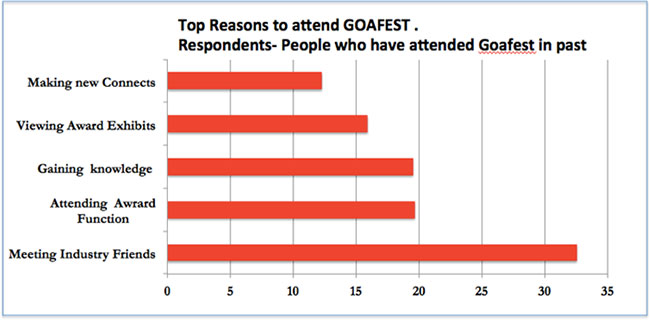
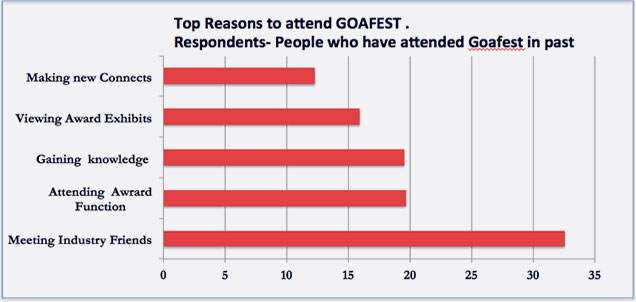
    Just concentration on delegates, the Top 5 motivations/ reason to attend Goafest seemed puzzling. Whereas non-delegates seem to be motivated on the thought of gaining knowledge! Making new business prospects and meeting industry friends among a host of other fragmented reasons.


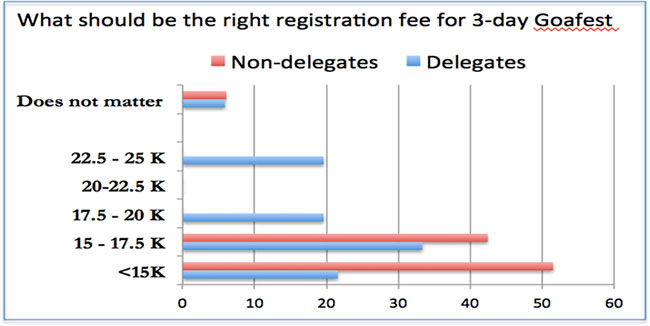
    Another interesting point to note is the spiraling cost of registration. Though it is much lower than the fee charged by international festivals, we cannot use that as a reference point. So, Rs 15,000 to Rs 17,500 seem to be a much-preferred band of the registration fee. Most do believe that the under-30 subsidised fee is un-necessarily inflating the fee they have to pay and the festival team should re-look at it.


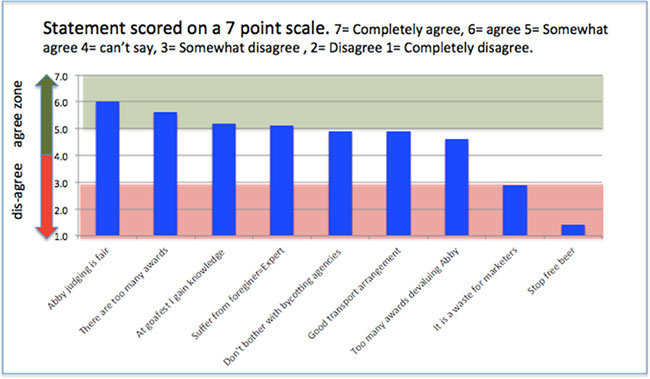
    Now, more importantly, the respondent believed that Abby judging is fair. However, they also say that there are too many awards, which devalue it.


    The delegates do gain knowledge at Goafest and they do believe that the festival suffers from ‘foreigner = expert’ complex. The data did capture a minority wanting to consider stopping free beer! Thankfully, they did not share their identity.


    Before I close, let me share that there is a strong demand for complete package that includes registration, stay, local transport, meals and travel. Before we deny it, we must realise that such packages are designed for events abroad. Maybe something like this will benefit a lot more individuals and small agencies. In my view, it is worth considering.


    So, here I close, wishing Goafest and the delegates all the best.


    PS: Before I say goodbye, let me plug something interesting. Last year, the last after-hours party was in full swing and by 2 am. I was a bit tipsy too. Right near outside the party area, I met a lady. What started with a cool borrowing of a smoke, extended long into highly engrossing conversation on nothing, in particular, here is the rider: I don’t know who she was, and it is equally likely that she may not remember me. I was the person who shared the last few cigarettes at a time when there was no place to get fresh stocks from. So, the young lady in question, if you are attending Goafest this year too, do connect with me. And yes, you can always find me around 1130, you know where!