Category: ADVERTISING

  • Center Fresh takes brand proposition further in latest campaign

    By A Correspondent


    Center Fresh, Perfetti Van Melle India’s flagship chewing gum brand, started the journey to establish fresh breath platform in 2015, with the introduction of an improved product and a communication campaign with a new tag line ‘Chali Hawaa Mastaani’.


    To further establish the fresh, cool breath benefit, PVM India and Ogilvy have together developed a new campaign for the brand. The campaign builds on a key consumer insight that people often come across unexpected interactions with others which call for a conversation. Handling the same in a confident manner is crucial for making those interactions work. And it is such moments wherein being fresh breath ready will surely come in handy.


    The new commercial tells a sweet and enjoyable, everyday story of a young boy, who has an unexpected visitor at the door, a beautiful girl. The girl at the door is looking for someone, who unfortunately doesn’t live there. But the guy decides to tell her so only when he is sure that he is ready to answer in the best possible way – with a mesmerising fresh breath, courtesy Center fresh. The TVC urges the consumer to keep fresh breath handy with “Taazi saans, hamesha rakho paas”.


    The new campaign is on air from 14th February 2017 and will air across all major national and regional channels as well as on digital media.


    Commenting on the campaign, Anurag Agnihotri, ECD, Ogilvy, Mumbai, said, “The new campaign builds on the platform of ‘Chali hawaa mastaani’ to create a brand story that is not just entertaining, but also delivers the product benefit in a relatable manner.”


    Commenting on the new campaign, Arun Sharma, Associate Category Director, Perfetti Van Melle India says “In our consumer interactions with youth, we come across multiple instances of consumers citing the need for being fresh breath ready, anytime & anywhere, as a key to be confident in the interaction. We are confident this relatable new campaign will be enjoyed by the consumers.”


  • Zivame makes a powerful statement with #FitForAll

    By A Correspondent


    Zivame, India’s leading lingerie brand, announced the launch of its new campaign #FitForAll. The campaign portrays real, relatable Indian women feeling their confident best in lingerie. With an inclusive approach, this campaign aims to create a fresh perspective on women and lingerie in India.


    This campaign revolves around the thought that when Indian women come in all sizes, so should lingerie. It has been developed based on consumer insights* that most women find it challenging to get lingerie in sizes other than ‘so-called popular sizes’ in the market.


    Sirisha Tadepalli, Marketing Director, Zivame says, “At Zivame, we put consumers at the core of everything we do.Being in the e-commerce business has given access to rich data. This, when combined with our understanding of various body types, has led us to creating the widest range that Indian women truly deserve – from 28A to 46H. To bring this alive, we’ve chosen a cast that’s diverse, in terms of body type and life-stages. This film is our endeavour to ensure that every woman finds her perfect fit, and doesn’t have to ‘fit into’ anything, be it lingerie or life.”


    The ad film runs for a duration of 45 seconds and 30 seconds each and will be telecast for a period of 4 weeks on leading English and Hindi general entertainment, movies and lifestyle channels.


    Rajesh Ramaswamy, Executive Director, Lowe Lintas adds, “Most lingerie ads feature lingerie models, and as a result, we felt like the category itself lacked a certain authenticity. Because lingerie is such a personal thing, we wanted our communication to be an honest representation of women in India today. We used real women from various walks of life to illustrate just how diverse and awesome they really are. A simple proposition that captured this spirit of#FitForAll”


    With its mobile app and Fit Studios, Zivame aims to make its promise of #FitForAll accessible to more and more Indian women, thus redefining women’s relationship with lingerie.


  • 13.5% AdEx growth in 2017: Madison


    By Labonita Ghosh


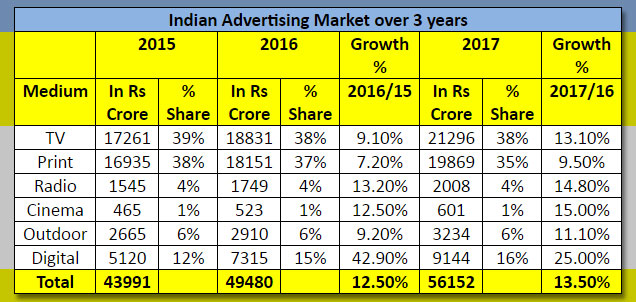
    In February 2016, when Madison predicted that the Indian advertising industry would grow by 16%, it seemed overly-optimistic. Now it seems that Madison’s annual forecast report for that year would’ve been on the mark but for a small detail: a ‘tsunami’ called demonetisation. This derailed the entire industry, which eventually grew by only 12.5% last year as against the projected 16.8 %. Demonetisation also knocked off Rs 1,650 crore to settle at an industry size of Rs 49,480 crore, in the wake of a cash crunch and a drop in consumer off-take, which led to a lot of advertisers pulling out of campaigns in the last two months of 2016.


    Sadly, we haven’t heard the last of it. In 2017, the industry is expected to grow 13.5% mainly because the months of January to April will be the ‘recovery phase’ from the currency crisis. “My advice to advertisers would be to intensify campaigns during this period, and also have new product launches,” says Sam Balsara, Chairman of Madison World (who released the Pitch Madison Annual Report on Wednesday), mainly to make good the damage wreaked by demonetisation.


    Still, 2017, says the report, promises to be an exciting year for advertising. At a projected growth of 13.5%, the size of the industry may be a likely Rs 56, 152 crore. And this optimism for robust ad expenditures, comes on the back of high government investment in infrastructure, lower corporate and personal taxes for small and medium companies, good government support for the disadvantaged, and the general expectation of yet another year of high GDP growth. While the projected growth in the first four months is likely to be only 8%, ad expenditure will pick up between the months of May and October, to stand at a projected 14% growth. And since adex touched a low in the months of November and December of 2016, growth in the corresponding period in 2017 might – by comparison –appear as high as 24%.


    Television: Sector-wise, TV was still the biggest contributor to adex, registering a 9% and Rs 1,570-crore growth to reach the industry-size of Rs 18,831crore. This was largely propelled by FMCG (Rs 692 crore) and Telecom (Rs 475 crore), even though it lost an estimated Rs 850 crore to demonetisation. In 2017, TV will remain brands’ favourite medium and is projected to grow by another Rs 2,460 crore (13%) to close on Rs 21,300 crore. The forecasted reasons for this are organic growth coming from established FMCG advertisers as well as aggressive new players like Patanjali, and new channel launches by the existing networks.


    Print: Print grew by 7% in 2016 (three percentage points lower than the forecast for 2016), to stand at Rs 18,151 crore. In 2017, it is expected to grow by 9.5% to touch Rs 19,869 crore. Most of this growth will be because of dailies, and regional publications and new editions introduced by current publishers. As well as advertising from ‘print loyalists’ like auto, education, durables and mobile phones


    Digital: This was the (not-so-big) surprise. Digital was hardly affected by demonetisation, and grew by a whopping 43% to register an industry size of Rs 7,315 crore. Consumption of digital video content, which sparked huge spends on online video advertising in 2016, coupled with mobile displays, fuelled the growth of digital advertising, and will continue to do so. In 2017, digital is expected to grow to 25% to touch Rs 9,144 crore.


    Radio: Grew by 13% to register an industry size of Rs 1,749 crore in 2016. BFSI, media and auto advertisers were the main contributors to this growth. In 2017, radio is predicted to grow by 15% to become Rs 2,008 crore, and the likely reasons are greater aggression by e-commerce and mobile-wallet companies; the emergence of new radio stations who have won bids in Phase III auctions, and organic growth among retail and local advertisers


    OOH: The out-of-home market grew by 9% to register an industry size of Rs 2,910 crore, on the backs of retail, hospitals, education, real estate and restaurants, who are the biggest advertisers. As per the forecast, in 2017 OOH will grow by 11% to reach a size of Rs 3,234 crore, as e-commerce, M-wallet apps and telecom and mobile handsets will start advertising more aggressively using this medium.


    Cinema: Big-screen advertising grew by 12.5% in 2016 to settle at Rs 523 crore – which makes it a marginal player of all advertising media. In 2017, it is expected to grow by 15% to reach Rs 601 crore.


  • Quick chat with CVL Srinivas & Sam Balsara on the adspend forecast by GroupM & Madison World respectively


    A quick chat with CVL Srinivas, CEO, GroupM South Asia and Sam Balsara, Chairman, MadisonWorld on the adspend forecast by their respective agency networks


    Writing has been on the wall on digital: CVL SrinivasTaking time off a string of interviews after the presentation of the TYNY report on Monday,  CVL Srinivas, CEO, GroupM South Asia spoke with PradyumanMaheshwari on whether the adspend forecast portends ‘achche din’ for A&M-land


    It’s the type of question we love to ask you: given the forecast of 10% AdEx growth in 2017, would you say it’s achche din or good days for the industry?

    In the current circumstances I would say good days, because of all the gloom doom projections going around in the media for a while… actually 10% is not a bad number.


    In October when we met last around Diwali, it was somewhere around 14%, and which now got from 10 to 12%, what would you have anticipated the growth this year to be?

    Well, it is such a dynamic world that nothing is a constant today. Everything from global commodity prices, to petroleum prices, to local economic political factors, to sectoral factors, to media-related factors. I mean there are just too many variables one is juggling with these days, so I don’t think any study or any estimate, can be a one-time number. We obviously have to keep looking at the numbers, and revisiting the hypothesis may be every quarter going forward, giving the kind of change going on.


    Would you think the numbers could possibly change after the UP election results?

    I won’t want to commit on this particular event, but there is no denying the fact that these numbers could go up or down depending upon the various factors. Which is why TYNY as a study is done twice a year, the first time its basis estimates for the 12 months, and the second time we do it is in the middle of the year around July-August when we have the actual data for the first 6 months…


    Would you say the first few weekshave been fairly decent in terms of spends?

    The first month hasn’t been very good at all and we see this continuing till April. In fact the first quarter is going to be pretty tight, things are going to start picking up fully from April onwards, and that’s the way we built up the report.


    Post-demonetisation therehas been a bit of a scare for media owners with some publications shutting down, some publications shaving off lot of staff. Television has also been down in sales.What do you see is the environment for media owners? Given that you are predicting only a 10% growth, is that good tidings for them?

    I think the big story coming out of all this is that we are living in an age which is so dynamic and which is getting so, I would say, which is all converging towards digital so fast that organisations have to kind of somewhere let go completely off the rules of the past when it comes to doing business… I think the base of change is so rapid that sometimes we are not able to kind of make adjustments and we are forced to kind of take some very very massive decisions in a very short span of time. I think if organisations are more on the ball, look at reality and start taking hard calls more often, things won’t reach a state that they have reached today. For example, the writing has been on the wall that digital is going to eat over the shares of traditional media companies for some time now. It’s not a new development. I don’t think demonetisation has anything to do with it. The consumer has moved to digital many years ago for consumption of various kinds of content.


    Do you think people are using demonetisation as an excuse too…?

    To an extent, I think so. I think there are so many other factors which are at play and even in this day and age there are organisations whether it’s in the media sector or whether it’s in other sectors who are continuing to do well because I think they have just been better prepared. I think they have been able to futureproof their business a lot better. For example, in our own case, we diversified our revenue streams many years ago. Today, given the presence we have across areas like content, sports marketing,  data analytics actvations and so on, we haven’t really felt as much of an impact because of the slowdown of the media sector than perhaps some of the more traditional agencies. And I guess the same holds true for other organisation and other sectors as well.


    In terms of the overall numbers that you see, as per your predictions which sector of the industry has the brightest future?

    See, these things change almost year to year. This particular year we are looking at auto, we are looking at BFSI, we are looking at one part of Ecomm which is Ewallets. We are looking at the media sector and we are looking at the government sector –


    And FMCG continues to be around 27%-28%.

    FMCG’s  contribution to the total AdEx will still remain around 27% or so.


    One of the sectors which was not included in the entire study is the SME sector and that’s where the future of the country is and what’s where everybody is saying that the growth is in terms of advertising. If you were factored into that do you think your final numbers could have been little different?

    Infact we factored in the overall base of advertisers. So that would include the long tail or the SME sectors as you call them as well. In fact a lot of the digital growth is not only coming from the established players but…


    SMEs

    …The first-time advertisers. We are finding in the last couple of years, first-time advertisers moving straight to digital because the entry costs are low because they are able to target the consumers a lot better and also measure the return. We see them continuing in the short- to medium-term.


    2016 growth would’ve been 16% had there been no demonetisation: Sam BalsaraTalking to Labonita Ghosh on the sidelines of the Pitch Madison Advertising Report presentation, Madison World Chairman Sam Balsaraspoke on the dangers of depending too much (or only) on data, on e-commerce advertising and why he thinks the 13.5% growth is realistic


    Some might say your forecast of 13.5% growth of AdEx or adspends in the year 2017 is very optimistic, especially since we had GroupM telling us just yesterday that it estimates growth to be 10%. Your comments on how realistic the growth estimate is…

    Obviously we think it’s realistic otherwise we wouldn’t have put it up. Asyou’ve seen, last year, growth was very low, which has made us bring us forecast down. We do recognise that in the period from January to April, growth will below and that is whyour forecast is 13.5%, otherwise it would’ve been higher.


    Tsunami is an interesting way to describe the impact of demonetisation. Had demonetisation not happened, what would you say the growth would’ve been last year?

    The growth would’ve been 16%. And that is almost exactly what our prediction was in February 2015. It’s because the market de-grew by 8% in the months of November and December, that growth is down to 12.5%.


    Your forecast on digital touching 43% growth is in line with the way it’s been growing in the last five years. Why do you think it wasn’t impacted by demonetisation?


    Ofcourse it was. But digital also looks at leads, and search and all that stuff.Also, FMCG [advertising] is very low on digital, the lowest [of all media]. We’re not saying digital was not affected, but we’re saying that it was much less affected by demonetisation.


    You have also said that January to April is going to be down. But this is also the time when we have elections. So no real impact of election spends?

    Assembly elections don’t pull in that much money. And I think that these elections, coming on the back of demonetisation, have been a bit of a dampener, if I may say so. I don’t think political parties were as flush with funds as they normally are. I think we are seeing a more conservative approach by most political parties in these elections


    ‘Don’t over-depend on media data to support business decisions. Use data as a guide and not as a crutch.’ Now that’s quite a statement from a media agency veteran who has been and led most industry forums. Do you really think there is too much dependence on data?


    What I meant to say was, don’t use data as a crutch. Don’t close your eyes and just blindly go by data. Use your common sense to question whether that data might be wrong or if it even makes sense. Take a holistic look at your plans, and don’t only say this is the data, so it must be like that, so let’s go with it.

    I think there is not enough lateral thinking bring applied to data. And I think a lot of plans are routine, andthey get mechanically done. There is a belief that as long as the GRPs and TRPs are met, I’ve donemy job. But it is possible, that despite all these being met, the brand doesn’t do well. And I think we’ve seen quite a few examples of that.


    E-commerce, as we have seen, has hit the adspend bottomlines. Madison has its own share of e-commerce clients and one of these which has been a big budget advertiser. Do you expect it to go down or up?

    I think e-commerce spends are guided more by the penchant of the investors, and I think investors in e-commerce behave in a very erratic manner. So I wouldn’t like to hazard a guess on what e-commerce investors are thinking of, or will think tomorrow


  • The Advertising Club unveils “#MADEOFABBY” ad campaign

    By A Correspondent


    Abby 2017 has unveiled an ad campaign titled #MADEOFABBY for promoting the forthcoming Abby Awards to be held at Goafest in April 2017. The campaign celebrates all iconic brands and campaigns that have been impacted by the award and could be called, #MADEOFABBY.


    Conceptualised and created by Scarecrow and mentored by Ad Club President Raj Nayak, Awards Governing Council Chairman Ramesh Narayan and team, the 3D rendering of the images was done by Cocktail Art Co. Forming the premise of the campaign thought has been the retrospective research statistics that showcases the large number of the renowned ABBY metal won by leading creative agencies over a period of 22 years starting from 1994 to 2016: DDB Mudra – 207 metals, McCann 113 metals, Taproot – 67metals, Contract – 183 metals and JWT – 290 metals.


    Speaking about the engaging campaign Narayansaid: “Our​ creative ​stars, great creative agencies, clients and even the legendary creative brands of our industry, all have a little bit of ABBY in them.​They have all had a very mutually complimentary relationship. In a sense, they​ are all #MADEOFABBY.  It is this emotion that we have endeavored to tap into. We are sure that this inspiring and emotive campaign will generate a sense of pride and belonging amongst the entire fraternity towards the ABBY’s”.


    Speaking about the campaign and its intent Manish Bhatt, Founder Director, Scarecrow Communications Ltd and Member – Managing Committee, The Advertising Club said “Showcasing the glory of ABBY, last year we articulated our differentiator of Indian-ness which insightfully synced with the current sentiment and mood of our country. Moving towards the next echelon, we have leveraged ABBY’s various other uniqueness over and above the Indian-ness of the awards”


    Added Nayak: “The ABBY awards have played a central and inspiring role in the personal and professional journey of all advertising professionals. The awards have been the single most decisive platform showcasing the strength and value of the Indian advertising industry to the world. With this moving campaign we have set out to take down memory lane every individual and brand that has been touched by the ABBYs”


  • What is the real size of Indian Ad Industry?


    By Indrani Sen

    Last week was exciting for the advertising and media industry as the two major reports on industry Adex were released on two consecutive days. GroupM released its ‘This Year Next Year’(TYNY) 2017 report on February 14 followed by the release of ‘Pitch Madison Advertising Report’(PMAR) 2017 by Madison on February 15. In the last few days, both the reports have been published and analysed in the business newspapers and websites, leaving hardly any scope for adding any comment on the same.

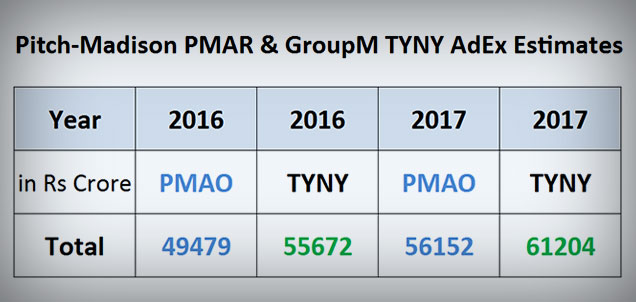
    As usual there is a difference between the two projections, this time it is of around Rs 5000 crore. The biannual report on advertising expenditure TYNY 2017 has forecast India’s advertising investment to reach an estimated Rs 61,204 crore in 2017 based on a growth rate of 10% over 2016. On the other hand, PMAR 2017 has projected a growth of 13.5% in 2017 over 2016 and has estimated the size of the industry to reach Rs 56,152 crore.

    According to Sam Balsara, AdEx dropped by Rs 1650 crore in the last two months of 2016 after demonetisation and as a result, the industry adspends narrowly missed the mark of crossing Rs 50,000 crore. On the other hand, the GroupM report, Indian advertising industry clocked Rs 49,758 crore in 2015 and crossed the Rs 50,000 crore mark comfortably in 2016 by scoring Rs 55,671 crores. Madison estimated Indian adspends as Rs 43,991 crores in 2015, Rs 49,480 in 2016 and has projected Rs 56,152 crore in 2017. The difference, between the two sets of estimates, has been hovering between Rs 5000 to Rs 6000 crore, which is not a small amount.

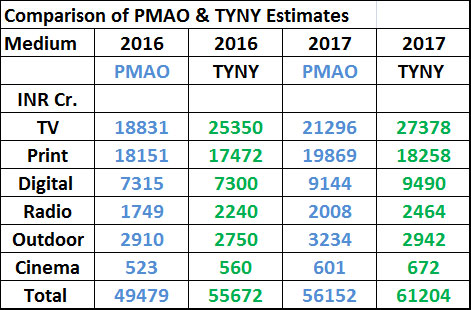
    If we compare the two sets of estimates by medium, we find that the major difference lies in the estimates of TV advertising expenditure, which is bit surprising as TV AdEx is very well-documented. Is there a difference in the way the two estimates are drawn up which leads to a gap of almost Rs 6000 crores between the estimated TV advertising expenditures?


    PMAR has shown more favourable estimates for Print and Outdoor than TYNY, while TYNY estimates for Radio and Cinema are higher than the estimates of PMAO. It is interesting to note that for Digital medium, the two estimates ran neck-and-neck for 2016 and are quite close for 2017.

    GroupM Report mentions that Media Adex reported do not include:

    • TV – special inventory like astons, L-bands, tickers, etc
    • Print – tender notices, appointments, classifieds/ matrimonial
    • Radio – activation spends
    • Digital – ad spends by SME segment
    • Outdoor – wall painting

    The above leads us to conclude that the numbers shown in the TYNY for the above five media would be actually higher than their estimations, particularly for Radio, where activation/ events tied up with digital has become a major source of earning for the FM radio stations.

    The Pitch Madison Advertising Report does not mention about the ad expenditures which are not covered in the report, but we can assume that Madison also has not covered the above expenditures which are not included in Media AdEx in their report.

    So, what is the real size of the Indian Ad Industry? Are we yet to cross the Rs 50,000 crore mark or did we cross it last year?


    Indrani Sen is a media services veteran, having worked with JWT, later Mindshare and then with Emami. In recent years, she is an independent consultant and academic. She is Adjunct Professor incharge of the Media Management programme at the Symbiosis Institute of Media & Communication, Pune. The views expressed here are her own.


  • FCB India’s Rohit Ohri to speak at Adfest

    By A Correspondent


    Rohit Ohri

    Rohit Ohri, Group Chairman & CEO, FCB India will be speaking at Adfest 2017 on ‘Never Finished Ideas’.  This year’s edition of Adfest will be held from March 22 to 25.


    Never Finished Story is a theory that suggests brands should by no way be static and unchanging. It implies an innate ability to change, evolve and grow with the times – a fundamental shift from ‘building’ a brand story that is large, monolithic and static to ‘dissolving’ a brand’s story so that it is fluid enough to be told in different contexts, in different ways. Ohri will explore FCB’s approach to telling stories that never end. His session is scheduled for 3.15pm on Thursday, March 23


  • Lenskart.com launches new ad campaign – ‘Specsy is the new Sexy’

    By A Correspondent


    Lenskart.com has launched its brand new advertising campaign, ‘Specsy is the new Sexy’, that aims to make eyeglasses a must have accessory for the upwardly mobile Indian.


    In the new ad campaign conceptualized by Taproot Denstu, Lenskart.com builds on the positives of wearing eyeglasses,positioning them as a cool accessory that helps wearers make the right impression no matter what the situation and demonstrates just how easy it is to buy a pair on Lenskart.com


    Speaking on the idea behind the campaign, Peyush Bansal, CEO, Lenskart, commented, “We wanted to expand the reach and appeal of our products to a larger audience. Gone are the days when spectacles were seen as an unwanted style killer. Today they have emerged as a cool fashion accessory, lending an edge and a signature style to wearers. We wanted to broadcast this idea to the whole world. We at Lenskart, love spectacles and do everything we can to make consumers, who need them, love wearing and buying them. We hope people who need spectacles will no longer feel shy of wearing them.Our brand essence is addictive playfulness and we wanted to bring it alive for our consumers”.


    Said Pallavi Chakravarti, Executive Creative Director, Taproot Dentsu: :Traditionally, wearing specs has been a bit of a handicap. Chashmish, 4-Eyes, Double Battery and other such nicknames have been given to people with specs and clearly not to flatter them. Today, the tables have turned and as India’s best-known eyewear e-tailer, Lenskart’s new campaign demonstrates why being specsy is actually an advantage, in the brand’s trademark tongue-in-cheek style.”


  • Moonbow urges India to drink clean water in latest ad campaign

    By A Correspondent


    Moonbow, the umbrella brand from leading sanitary ware company HSIL Limited launched a new TVC campaign ‘Ab India PeeyegaAchcha’ for its water purifiers.


    The TVC narrates the story about the innocence of childhood as children from different socio-economic background play together and share water since ‘Accha Paani Share Karna Acchi Aadat Hai’. The new TVC visibly captures Moonbow’s initiative to highlight that everybody irrespective of their race, caste or creed is entitled to pure drinking water.


    Speaking on the new brand campaign, Rakesh Kaul, President, Consumer Products Division, HSIL Limited, said, “One of the biggest challenges in India today is access to clean drinking water. With this TVC, we perfectly capture the brands commitment towards providing consumers across India with clean drinking water. The TVC will play on primetime TV slots across general entertainment channels, select English and Hindi news and movie channels from 14th February 2017 onwards.”


    Speaking on the TVC, a Contract spokesperson said: “In a fairly cluttered market, where every brand spoke of technology and gave rationale to why their water purifier works seemed very similar to each other. The idea really qualitatively talks about the collective spirit with ‘Ab India Peeyega Achha’. While the broader theme was about Sharing is good, and with Moonbow Water Purifier, you share good water no matter who you are sharing it with.”


  • LinEngage initiates an education-led program for Acuvue

    By A Correspondent


    Refractive error, defined as optical imperfections that prevent the eye from properly focusing light, causing blurred vision affects an estimated 30% of the population globally. This percentage is growing as more and more children are developing myopia at early age.


     

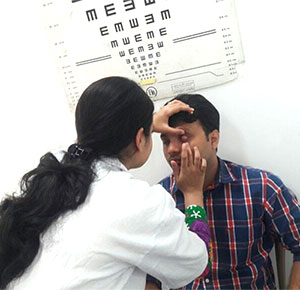
    Acuvue® Brand Contact Lenses along with LinEngage – the experiential marketing & activation agency of MullenLowe Lintas Group, have initiated a program to create awareness on the importance of eye health and promote early detection of refractive errors among young students in India. The diagnosis is conducted by trained optometrists and wherever appropriate, the students are encouraged to try contact lens, one of the effective vision correction options available today. This method of eyesight correction allows students to not only see better, but also feel more confident about their looks. It also enables them to continue with all their activities that could have otherwise been hampered due to use of spectacles.


    Acuvue® &LinEngage orchestrated this unique engagement initiative. It’s an initiative that needs a deep understanding of the campus dynamics, youth mindset and the sensitive nature of the product. The first such trial was conducted recently across 3 colleges in Mumbai and plans are afoot to organize it across more colleges as well. About 2000 students have already participated and benefitted from the positive outcome of the program.


    Commenting on the initiative undertaken by the company, Vivek Bhatnagar, Director – Vision Care, said: “Anchored by a vision to bring healthy vision to people in India, Acuvue® believes that this initiative will help the younger generation to become more aware and learn about the importance of eye-health at an early age itself. The initial feedback from students in Mumbai has been positive and we are looking to expand this initiative to other parts of the country.”


    Sharing the communication objective behind this initiative, Sriharsh Grandhe, EVP, LinEngage said: “Contact Lenses in India has been a stubborn category with very little momentum. Primarily, there is a big lacking in consumer familiarity and misinformation. LinEngage’s specialized approach using technology for engaging with audiences interestingly has shown promise. We are excited about partnering with Acuvue® in the consumer education initiative.”


    In India, Contact Lens as a category has not yet taken off and is used by a very small percentage of the population. Few reasons for its poor adoptions are:

    :: Potential wearers have very little knowledge about CL and they carry many myths about them in their mind

    :: The Optometrists are comfortable to offer specs instead of CL as the patient does not ask for CL; and also wearing CL is a more skillful job which many Optometrists do not possess or have low confidence in

    :: The owners of optical outlets prefer to sell spectacles for two reasons: they are perceived to have high margins and also the owner has freedom to decide the price as there is usually no MRP on the product


    With this initiative, Acuvue® and LinEngage seek to create awareness on the importance of eye health and promote early detection of refractive errors among young students in India.


  • Mirum India wins digital mandate for Banjara’s

    By A Correspondent


    Banjara’s, the herbal beauty care brand, has awarded the digital duties to Mirum India. Banjara’s has been a fast growing FMCG player in the beauty care segment with 60+ products in its portfolio under skin &hair-care. So far the brand has been operating predominantly in the South India, but from this fiscal year wants to aggressively target the Rest of India markets. This expansion plan will be majorly driven by digital marketing.


    As part of the digital mandate, Mirum India will manage all the social media platforms and create new digital touch points for Banjara’s, with focus on brand building. Mirum India will also be offering media buying services as part of the mandate. This account was won following a multi-agency pitch.


    Ramesh Vishwananthan

    Ramesh Vishwananthan, Managing Director, Vishal Personal Care Pvt., Ltd., said, “We are aggressively looking at expanding our footprint outside South India with digital leading the way. We were looking for partner rather than an agency, who would understand our ambitions. Mirum India with their diverse understanding of the digital landscape, fitted the bill. We are excited about this new partnership.”


    Hareesh Tibrewala

    Hareesh Tibrewala, Mirum India, Joint CEO, Mirum India, said “Banjara’s is one of the fast growing FMCG players in South India with a very ambitious brand DNA. Mirum recognises this and brings to the table its vast Indian & Global expertise in digital shopper marketing. I’m glad we’re the ones Banjara’s has put their trust in. Together we look forward to take the brand to the next level.”


  • Happy mcgarrybowen wins creative mandate for Duroflex

    By A Correspondent


    Following a multi-agency pitch, Bengaluru based mattress brand Duroflex has appointed Happy mcgarrybowen, now part of Dentsu Aegis Network, as the agency on record to lead the communication mandate.


    Duroflex has focussed on offering superior sleep and comfort experience to its consumers by developing innovative products. Today, it has a portfolio of over 30 different products, catering to distinct sleep patterns and comfort requirements of the consumers. Duroflex is also India’s largest exporter of sleep and comfort products.


    Mathew Joseph

    Happy mcgarrybowen has been bought on board to manage the integrated communication mandate for Duroflex& fuel the brand’s aggressive growth plans.


    On the partnership, Mathew Joseph, Director (Marketing) – Duroflex said, “Over the next few years, we have a range of new and innovative products made for the Indian market that we wish to introduce. It was therefore imperative for us to find a partner who could do justice to the vision we had for these products. We are happy to have found Happy mcgarrybowen, an exciting dynamic partner with who we are confident of achieving what we set out to do.”


    Kartik Iyer

    Kartik Iyer, CEO – Happy mcgarrybowen said, “Duroflex is almost like the Amul of mattresses when it comes to its legacy in India. The founders shared with us their plans and vision to absolutely disrupt the category. Nothing excites us more than that. We thank the young team of third generation entrepreneurs for placing their trust in us. We look forward to some exciting new launches in the coming year.”