Category: ADVERTISING

  • Typically quirky, Mudra ‘welcomes’ Bobby Pawar to JWT

    By Shubhangi Mehta


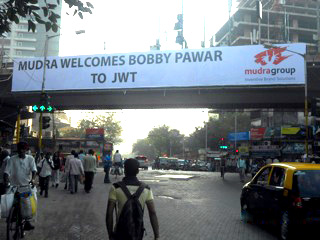
    Mudra showed that it is an agency with a big heart as well as an extraordinary creative bank, demonstrating both innovation and affection in its farewell to Bobby Pawar. In a billboard that has been put up right next to JWT, where Mr Pawar has taken charge of his new responsibilities, Mudra said “Mudra welcomes Bobby Pawar to JWT”.


    The billboard came as a shock to some and a pleasant surprise to some but it undoubtedly managed to catch everyone’s eyes.


    Pratap Bose
    Bobby Pawar

    Pratap Bose, COO, Mudra Communications, said, “Tuesday evening was Bobby’s farewell. The whole idea was to show Bobby how special he is for us. It’s a gesture to show that the fact that Bobby remains in advertising is good news for the creative industry.”


    A generous gesture like this makes one feel proud to be a part of an industry where relationships can be warm as well as professional.


    On the gesture by Mudra, Bobby Pawar, CCO and Managing Partner, JWT, said, “Both the agencies (Mudra and JWT) really touched me with the welcome I received. It feels great to get such a warm greet. My first day at JWT was spent knowing people and understanding the brands. Hope the fun and enthusiasm continues.”


    The way Mudra has wished luck to Bobby for his new innings will sure be remembered by the industry in a very special way. One hopes there are more such instances where people feel proud to be a part of such an industry.


  • Debrief: Female bonding with Tanishq

    By Anil Thakraney


    There’s not much of an idea in the new Tanishq Glam Gold commercial. But energetic and engaging treatment makes it come alive.


    The setting is an open air party, where lots of young people are dancing. It appears to be a pre-wedding do, given all the finery the ladies are decked up with. One girl tries to bring the couple together on the dance floor, but her plans go for a toss as it suddenly starts pouring. The party abruptly stops, but our spunky girl won’t let her close pal down. She begins dancing in the rain, and then everyone else follows. Much to her buddy’s delight, the party goes on. And yes, as you can imagine, the shots are layered with close ups of the Tanishq Glam Gold jewellery.


    [youtube width=”400″ height=”200″]http://www.youtube.com/watch?v=p9bcCW8GuBQ[/youtube]

    Like I said, the lack of a strong central idea has been compensated by a happening treatment. You don’t expect commercials for gold to go totally into lifestyle, and this refreshing approach works. The endearing attitude of the girl, unwilling to let her friend down, sets the tone for Tanishq’s brand personality. The power of girlie bonding. Which would aid in brand salience. And of course, the dance party makes for a very entertaining commercial. It’s shot well too, and one won’t mind repeat exposures.


    Rating: (On a scale of 1 to 5): 3. The full-on lifestyle approach pays off.


  • From agency maverick to ‘khadoos’ client…


    By Shubhangi Mehta


    Switching jobs is an avenue for growth. But how does it work when the switch is drastic – such as going from an agency which creates a communication for a brand, to becoming a part of that brand? With increasing numbers of agency heads moving towards the client side, it looks like a trend.


    A mix of work and pleasure is what agency life promises an individual. With that also follows a pattern of sleepless nights, tight deadlines and the pressure to impress the client. What happens when one moves to the client side? How does life change, and do the switchers miss the agency days?


    We have an ample amount of such examples already in front of us. Rahul Kansal, Sunil Lulla, Ajay Kakar, Abraham Alapatt and Sheran Mehra are some such examples.


    Kamal Basu, Head of Marketing, Skoda, who was working with Saatchi & Saatchi is the most recent example of such a move.


    On his new role, Mr Basu said, “Moving to the client side is all about trying something new for me. I personally feel that advertising agency and brands work very closely and cannot do without each other hence the changeover is fairly easy as compared to moving from an agency into banking. For me right now, the most important thing is to have the mindset of a student eager to learn new aspects of the business.”


    Ajay Kakar, CMO – Financial Services, Aditya Birla Group who has worked in a creative agency environment as well, said, “The grass is always greener on the other side. Having been on both sides of the table, at the agency and client ends, I can now relate and empathize with this sentiment. Throughout my 14+ years experience at the agency side I shared the sentiment of every colleague, ie, ‘Hum kaam karte hain, while clients aish karte hain’. And during my more recent six-odd years at the client end, I can’t deny having heard or felt the sentiment, ‘Yeh agency waale kya jaane, what pressure we face’!”


    On the agency side, one is usually thought to be a lot more casual about ideation, creative, deliverables etc and the perspective is that it changes completely when one becomes a client.


    Rahul Kansal, CMO, Bennett, Coleman and Co, said, “I moved to the client’s end nine years ago. I had experienced agency life for approximately 20 years and was itching to implement my own ideas rather than just being an advisor. Though the two lives or work culture cannot be compared, yet as a client there is an ownership of the brand which leads to a personal connect.”


    Certainly an agency person enjoys agency life. But an invitation to partner a client is a thrilling mandate which might be quite enticing.


    Abraham Alapatt said, “After 10 years in the agency business, I was keen to grow into a more complete ‘marketing’ professional (as opposed to remaining a pure advertising man) and when I was offered my first head of Marketing role in 2005 with Reliance Mutual Fund, I took it most eagerly.”


    For those in the agency, the universe tends to revolve around advertising and agency imperatives. But as a as a marketer, one comes to understand that advertising and the agency are key cogs in a very large wheel.


    Sheran Mehra, Head of Marketing and Corporate Communications at Dhanlaxmi Bank, said, “I had planned my career in such a way that I wanted to move to the client side after working with an agency, since I wanted to play a larger part than just being an advisor for the brand. The agency setup is more informal, and more like a family. Not that here it isn’t like family, but it’s more formal, more of a corporate environment.”


    Alapatt further explains, “In terms of effort and pressure, being on the client side is as challenging and difficult, because the line of responsibility and accountability, especially when it comes to ROI, budget accountability etc, is a lot more definitive. If earlier at the agency, I spoke to my clients every morning and then planned my day’s priorities before catching up with my team and then breaking up jobs to meet expectations – now as a client I have to plan my day ahead (based on current business and leadership priorities) and then along with my team, chart out tasks/timelines/deliverables. I also have a lot more information available to help prepare an annual plan, review it regularly, and then make more meaningful contributions to overall marketing and business strategy then when I was on the agency side. Overall it is a lot more organised, planned, systematic, and accountable.”


    A client initiates a brief. And his job is not complete till long after the agency hands over its input and output.


    The most obvious change after moving to the client side is that one can now plan a day or a schedule and prioritize a lot more, and there are far fewer firefighting situations than when working with an agency. This is probably because ad agency teams (who work with multiple clients) need to constantly re-align their priorities in line with their clients’ changing needs.


    Mr Kakar further adds, “Today I feel like the ‘complete man’, because I now have a realistic perspective from both ends. Having been on the agency side I believe that I can be more sensitive to the agency’s needs and constraints. But on the other hand, I am more demanding on what I know is possible. But life in an agency is what I miss… the masti and the laughter in the corridors, the camaraderie, the training sessions, et al.


    “As a client we can say that one is responsible for one’s team delivery (besides your own KPIs). These are directly linked to the company’s overall performance targets and plans, and every idea, plan, activity, campaign needs to be very clearly defined and measurable as one is accountable for every rupee spent to the CEO and the board of directors.”


    Most of the people who have made a move have stuck to the client side, which seems to indicate that working as a client is more enthralling.


    “I am not sure I yet have an answer to which part I enjoy playing more. But I do believe that the agency and client are two sides of the same coin. A marketer’s success depends on his agency partner, just as an agency’s existence depends on its clients. And only when both of them come together in harmony, is there real value in the form of fun, fame and fortune, adds Mr Kakar.


    While Mr Alapatt muses, “Looking back, I am glad I made the shift for the growth, learning and opportunities it has afforded me. But I can confidently say that the first 10 years of grounding/experience that I enjoyed with ad agencies like Ogilvy and the exposure to multiple clients/categories has been invaluable to my growth, both personally and professionally.”


    The big picture seems to be that the transition from one side to another is a natural evolution and part of the growth process. And this part of the journey as a client can be said to mature one as a person and marketing professional.
     

  • Anil Thakraney: Radio One is finally singing the right tune

    By Anil Thakraney


    According to market news, Radio One is all set to return to English programming in Mumbai and Delhi. And I believe that’s the right decision. It was quite late in coming, but as they say, better late than never.


    The station did start off as anEnglish channel, it played super music, and the RJs, at the time, packed in spunk. Some names that come immediately to mind include T Man, Tarana and Jaggu. The issues they discussed connected with the up-market urban audiences. However, along the way, for some inexplicable reasons, the channel joined the herd; it dumbed down, went all-Hindi, and totally lost its edge.


    Radio One became just another Hindi channel, essentially catering to the lowest common denominator. And it became a me-too radio station. What’s worse is they did this long after all the bigger radio stations had already earned brownie points with the mass listeners, and it became difficult to create a loyal base.


    In fact, speaking personally, Radio One’s dumbing down was the last nail in the coffin I had bought for my car radio. And I completely gave up on the medium and loaded my glove box with many CDs. I am quite sure this is the case with many other people. And, as a media professional, I found the station’s strategy to be quite bewildering, to say the least. Common sense suggests two things: One, there’s no point joining the rat race, as this kills the brand differential. And two, a whole lot of advertisers would want to target the up market audiences, as that’s the segment with the highest purchasing power. Even if all cab drivers tune into a channel, of what use is that to premium advertisers?


    Anyway, it appears the Radio One managers chose to learn the hard way. The station now seems to be coming full circle. And yes, I am quite thrilled. Looking forward to taking a break from my CDs, and enjoying some great music and some interesting chatter all over again.

    * * *


    PS: The London underground recently celebrated its ‘No trousers on the tube’ day. Which involves commuters travelling with their legs exposed. Hope Mumbai train commuters don’t ape this idea, and launch a ‘No shirt on the local’ day. Packed like sardines, we already have to smell armpits. Now imagine smelling naked armpits. The pits!


    Link: http://now-here-this.timeout.com/2012/01/10/in-pictures-no-trousers-on-the-tube-day-2012/#more-46049

  • Wow! Sandeep Goyal firm will now manage Airtel’s ad inventory & m-commerce

    By A Correspondent


    Bharti Airtel has outsourced all its advertising inventory management and mobile-commerce initiatives to Mogae Media, a firm promoted by former Dentsu India chairman Sandeep Goyal, in a first such deal in the Indian telecom industry.


    This means Mogae Media will sell all possible advertising space on mobile, DTH and broadband services of the country’s top telecom service provider and run its end-to-end mobile commerce initiative including giving special offers, discounts, freebies to subscribers and negotiating deals with companies, a person familiar with the development said.


    Mr Goyal confirmed the deal, but refused to share financial details.


    He said his Mogae Media has already begun selling the advertising inventory and that he saw great potential for his new venture. “My dream is to create an Amazon in the mobile space in India,” he said.


    Analysts said it’s the first time a telecom service provider has collected and outsourced the complete advertising inventory in the country.


    “No one has done that in India so far,” said Mr Prashant Singhal, telecom leader at Ernst & Young.


    Other operators such as Vodafone and Idea offer value-added services created by independent application and content and have outsourced some services.


    “The model has high potential since the mobile phone is the only medium to reach out to 800-900 million people,” Mr Singhal said.


    He says the concept of giving discounts and loyalty points will work among deal-loving Indian consumers. “This kind of selling could generate revenues upwards of $1 billion in two to three years for the industry,” he added.


    An analyst who did not wish to be named said Airtel could rake in around 40-50% of the industry’s revenue based on the sheer size of its postpaid customer base.


    Bharti Airtel’s advertising inventory includes space on text messages, multi-media messages, IVR and recharge coupons in mobile services.


    The default channel, pre-loading screen and messages from Airtel DTH and broadband also form part of the inventory.


    Airtel’s deal with Mogae will work on a revenue-sharing model, the person quoted first said.


    A Bharti Airtel spokesperson said the company would not comment on market speculations and partner relationships.


    Through this deal, Airtel will also offer location-based deals by using advance technology such as geofencing-or tracking users through GPS satellite navigation system-to give discount coupons of nearby retailers to its customers.


    Thus, an Airtel user may get a hefty discount on a particular brand or be the exclusive customers to be informed of a sale prior to it being opened for regular retail customers.


    Such exclusive and customized ‘Airtel Deals’ target small sample sizes.


    Mr Goyal said Mogae Media will invest in creating mobile analytics from data available with Airtel on their subscriber base. For instance, high ARPU clients with substantial roaming and using smartphones would be targeted for high-end car brands and deals in airlines and hotels.


    Similarly, youth with high Facebook usage and 3G connection may be targeted for offering deals on apparel, career institutes, cafes, movie theatres and music.


    This micro-targeting of consumers gives brand the opportunity to fine tune both their advertising promise, as well as avoid wastage and spillage inherent in other media, Mr Goyal said.


    Mogae Media sold 250 million impressions of Life OK, Star TV’s new broadcasting channel that launched mid-December on post-call notification-a message which appears after a pre-paid caller ends a phone conversation showing the amount remaining in the caller’s account.


    On the launch day, around 30 crore messages were sent out within four hours, asking subscribers to tune in to the channel.


    Airtel’s WAP portal also streamed an eight-hour concert for Life OK and 7 million plus Airtel’s DTH subscribers received mails inviting them to see Life OK on channel 104.


    Bharti Airtel is the world’s fifth largest telecoms company that has more than 175 million mobile phone customers in India, the largest share in the industry. Its digital television service has more than 6.6 million customers and more than 1.4 million broadband users.


    Source:The Economic Times

    Copyright © 2012, Bennett, Coleman & Co. Ltd. All Rights Reserved

  • Ad Strat: The Hero in everyone

    Anil Nair, CEO and Managing Partner, Law & Kenneth


    Name of the Campaign/Ad:

    Hum Mein Hai Hero – Hero MotoCorp


    The Brief:

    To come up with a thought that will help Hero honda to transform and establish itself as Hero MotoCorp.


    Research:

    Our job was not only restricted to understand the two wheeler market but the people of India on a whole who could be our perspective target audience. Our focus was on the prevailing problems like corruption in India and how an Indian would overcome it.


    The thought process behind the creative:

    Since our hub was India, we saw a tremendous positive attitude amongst the people and we wanted to bring it out. Our focus was on the fact that there is a possibility and we all have a hero within us to overcome any hurdle and ‘self belief’ is the key factor in that.


    [youtube width=”400″ height=”200″]http://www.youtube.com/watch?v=ulbchi7-N9c[/youtube]

    Media vehicles chosen:

    Complete 360 degree approach (TV, Print, Outdoor.,digital)


    Key issues kept in mind while executing the ad:

    Our motive was to not let it look like just an ordinary television commercial and at the same time we didn’t want to sound preachy. We wanted it to look realistic hence we used real people.


    Does the treatment do justice to the brief?

    Absolutely! Its spirit lies in the anthem.


    What according to you is the differentiating factor about the campaign?

    There are three differentiating factors:

    The Idea

    The Music

    Realistic Visualisation


    Market and client feedback:

    Hero MotoCorp enjoyed a higher sales percentage and went ahead of Hero Honda. The client is ecstatic and extremely happy with the work.


  • Anil Thakraney: Star India’s massive gamble

    By Anil Thakraney


    Actor Anil Kapoor, who played a smallish role (after hectic lobbying) in the cult American TV serial 24, now wants to re-make it in India. Have we totally run out of desi programming ideas? Well, that’s a topic for another day. What interests me urgently are media reports which suggest that Star Plus has bought the rights to the Indian version for a mind-numbing sum of Rs 85 crore. No TV show in the history of Indian television has commanded that sort of a price tag.


    One sincerely hopes Star is rejoicing over this sensational investment. Because quite honestly, I have serious doubts if the Indian cast and crew can pull this one off. I watched two seasons of 24, and I can tell you the show is simply unstoppable. I had to postpone work assignments and a lot of sleep in order to finish all the episodes, it was that riveting. Now, here are the reasons why I believe 24 rockedAmerica: the pace is extremely brisk, the script is powerful with many sudden twists and turns, the acting is superlative and the special effects, fantastic. However, what shines the most are the kickass dialogues, they keep you hooked.


    I am not sure if we can deliver all of that in India. And my scepticism is rooted in three huge areas of concern. One, Indian showbiz just does not have writers who can pen such superlative scripts and dialogues. The very average quality of writing in our movies and soaps is a clear indication of that. Two, our directors seldom deliver on both, form and content together. On 99 per cent of those projects, when it comes to producing with style and chutzpah, the content gets compromised. If a talented Farhan Akhtar can commit that folly (Don 2), you can easily imagine what a risk this is with others in the frat. And three, 24 is a gritty show that pulls no punches when it comes to featuring political debates and communal tensions. That’s one of the reasons the American audiences connected with it. In a hyper-sensitive and a vote bank politics-led India, where people are ready to protest at the drop of a hat; that will be a tough act to follow. And too much caution will kill this particular show.


    Well, all I can say is that Anil Kapoor and many others are about to hit the jackpot. Good for them. And I hope the Star network isn’t the only one left short-changed. Good luck to the channel!


    ***


    PS: BBC’s Top Gear presenter, Jeremy Clarkson, has pissed India off. The mischief-monger made fun of our ‘lack of hygiene’ in his India series. Now, instead of ignoring the man’s rubbish, even laughing it off, the Indian High Commission inLondonhas formally complained about the programme. And they have demanded an apology. Come on guys, the man is a comedian. Surely a billion plus Indians can’t be so under-confident as to take a joker seriously. When will this nation learn to be cool?


  • Trade bullish on bus shelter advtg

    By Robin Thomas


    Looking for a cost-efficient medium with high brand recall and healthy Return on Investments (ROIs) to advertise your product, then you should head to the nearest bus stop. The bus shelters, strategically placed in areas with the target group travelling either by foot or in a vehicle, are fast becoming coveted advertising mediums. FMCG brands, television channels and retail brands have increasingly started using bus shelters as a medium to deliver their brand message as ads placed at bus shelter make it easy to see the brand and its message.


    Many advertisers prefer to go for bus shelter advertising as it is cost-efficient and has a high brand recall, especially in the metros like Mumbai, Delhi and Chennai. Hindustan Unilever and P&G are two big instances of big OOH spenders which are very active in bus shelter advertising, particularly in Mumbai and Delhi. According to Bikas Verma, Associate Vice President, Outdoor Advertising Professionals (OAP) Pvt Ltd, bus shelter advertising contributes approximately 10-15 per cent of the overall OOH advertising spends.


    Gurjit Singh, COO, Crayons Advertising observed, “Compared to other OOH formats, bus shelter ads give more frequencies to the campaign as the strategic look gives an edge to the campaign.”


    “Bus shelters are primarily service-oriented street furniture item. They also prove to be a very effective OOH format as they offer an efficient channel for the brands to reach out to the consumers in every nook and corner of the city. Advertisers have acknowledged this medium as very cost-effective, offering best in class ROIs. Bus shelters also provide widespread exposure to their campaigns, catering to a wide range of target groups,” explained Ayush Kakkar, Assistant Manager – Marketing, JCDecaux.


    The road ahead

    Mr Verma is of the opinion that since billboards are now facing government restrictions, bus shelter advertising, which is high-impact and high-frequency advertising, is bound to grow further. “In markets like Mumbai or any other metro, bus shelter and likewise street furniture will be the future of OOH advertising, as these serve the dual purpose of being a utility as well as an ad revenue stream. This format of OOH media is very apt for the female TG and since billboards will not be permitted in these markets in future, their growth potential is nearing the end.”


    Mr Kakkar of JCDecaux noted, “The growth potential in case of bus shelter advertising is huge and it will continue to grow as more and more cities adapt to these service-oriented formats. Globally, bus shelters are already a very popular communication vehicle in the world’s best cities.”


  • Debrief: Kotak hits the clone zone

    By Anil Thakraney


    Another Bollywood classic lifted. Kotak Life promises you guaranteed second income in their new commercial, and the idea is ‘cloning’. The jingle borrows the popular Qurbani film song, and the tinkered words are: ‘Mere jaisa koi meri zindagi mein aaye’.


    In the commercial, people discover duplicates of themselves, much to their delight. And these clones happily assist the originals in their activity. A singer gets a partner to croon with. A chef gets a partner to aid in preparing a delicacy. Another chap gets a look-alike to help him board a moving bus. It’s not a bad idea at all. If the Kotak Life managers are alive to the long term possibilities of the cloning idea, then they are on to a good thing. It can become a powerful brand property. But if it’s just a one-off TVC, then the ad only serves as a cute entertainer, and no more. The real challenge is how they take this one forward.


    [youtube width=”400″ height=”200″]http://www.youtube.com/watch?v=MXvFZqxaEGw[/youtube]

    The one little problem is this: Because all the ad time gets used up in establishing the clones, there’s no chance of telling us exactly how Kotak Life will help us double our income. For that, we have to call/visit them to find out. That’s fine… because you can’t load a brochure on TV… but it also means the idea must be pumped with steroids, else it serves little purpose.


    All said, I like the core thought. Wouldn’t all of us like a duplicate to share our work load? For the politicians, that’s serious double ‘income’, hehe.


    Rating: (On a scale of 1 to 5): 3. Good long term potential


  • Corporate India loses interest in cricket with team’s loss

    By Rajiv Singh & Ratna Bhushan


    It’s being marketed as the ‘Agneepath’ series and Team India’s disastrous tour of Australia will most certainly leave brand cricket with severe burns as companies turn to non-cricketer brand ambassadors, pull cricketer ads off air and negotiate a cut in advertising rates.


    The Indian cricket team is staring at a humiliating second consecutive whitewash overseas after surrendering meekly in the first three Tests in Australia on the back of a debacle in England last year, and most cricket sponsors are unable to hide their disappointment as Indian TV viewers surf away from cricket.


    “We were planning to rope in one of the top Indian cricketers for our forthcoming campaign, but have now decided against having cricketers,” says a top official of a mobile handset brand requesting anonymity. “Going by their present performance, it’s not worth a gamble now.”


    Media experts predict that television advertisement rates will fall at least 20% after this series as cricket is fast losing mindspace after hitting a peak following India’s World Cup triumph last year.


    “There’s absolutely no doubt that advertising rates will fall in the forthcoming series,” says Ms Punita Arumugam, media group chief executive officer of Madison, which buys media for Bharti Airtel, ITC and Cadbury Kraft.


    A senior official of Maruti Suzuki, one of the key sponsors of the ongoing series, says the Tests have been a big disappointment for the country’s largest carmaker.


    “While we will continue to invest in cricket, we feel cricket is over-priced. Considering that results of the team have not been spectacular except for the World Cup, we hope rates will be rationalised,” says Maruti Suzuki Chief General Manager – Marketing, Mr Shashank Srivastava.


    While India’s tour of England had a low average television viewer rating of only 1.79, the first two Tests in Australia fared even worse, with ratings of 0.89 and 0.70, respectively, says rating agency TAM. “Several advertisers are in talks to reduce inventory or pull out from cricket,” says Madison’s Ms Arumugam, declining to mention names.


    ESPN-Star Sports, the official broadcaster of the current series, however, has ruled out a drop in prices for the one-day series. Mr Sanjay Kailash, EVP & head of sales, says the company has sold out 70% of ad inventory for the ODIs.


    He agrees that there has been a dip in advertising interest over 2010-11. “But that’s more to do with the general economic slowdown.”


    Media buyers say the broadcaster sold advertisement slots between Rs70,000-80,000 per 10 seconds for Test matches, and Rs2.75-3.25 lakh per 10 seconds for the One-Day Internationals.


    They say these rates will come down as India’s humiliating shows abroad have alienated millions of loyal TV viewers, already dealing with an overdose of cricket. “As long as you cheese off sponsors, it’s still okay. But this time the fans are feeling betrayed and extremely disappointed,” says Mr Shailendra Singh, joint MD of Percept, a sports and media entertainment firm. “No sponsor would put in money if there are no viewers.”


    SOOTHSAYER DRAVID


    It looks like the warning that Indian batsman Rahul Dravid had sounded during his Bradman Oration address in December is turning prophetic. “Empty stands (during Tests) do not make for good television. Bad television can lead to a fall in ratings, fall in ratings will be felt by media planners and advertisers’ looking elsewhere,” he had said.


    Maybe it’s coming true. No brand has signed an Indian cricketer as its endorser since Gulf Oil signed Indian captain Mahendra Singh Dhoni for its lubricant brand Gulf in September last.


    And there are not many television commercials featuring cricketers on air, despite it being a cricket season. Brands such as McDowell’s and Revital, which had been advertising heavily with their cricketer ambassadors till recently, have become conspicuous by their absence.


    Beverage maker Coca-Cola, which had planned to flood shop shelves with 6.5 million ‘Sachin’ special cans to celebrate Sachin Tendulkar’s 100th international century, is still waiting for the magical moment as 10 months have passed after the master blaster scored his 99th during the World Cup. So do many other brands.


    Also, there are not many potential brand endorsers as most youngsters are yet to cement their place and seniors such as Tendulkar, Dravid and VVS Laxman are set to retire. Captain Dhoni’s comment on retiring from one version of the game may impact his demand, while batting and bowling spearheads Virender Sehwag and Zaheer Khan may not be around for too long either.


    WAITING FOR REBOUND


    While Lady Luck may have deserted Team India, brands such as Emami, which had roped in Dhoni in February 2010, still cheer for the team. “Ups and downs are a part of the game,” says Mr Krishna Mohan, CEO (sales, supply chain and human capital), Emami.


    Source:The Economic Times

    Copyright © 2012, Bennett, Coleman & Co. Ltd. All Rights Reserved


  • Anil Thakraney: How the marathon has become an an outdoor Page 3 bash

    By Anil Thakraney


    I am no fan of celeb parties. The last one I went for, I think, was when the twin towers of New York City were still around. And I loathe them because I consider such soirees to be a total waste of time. The whole ‘networking’ bit is bollocks, I immediately trash all the visiting cards that get doled out, and I suspect so do others. But, people have the right to party, so let them do it. It’s a free country and people have enough free time to kill, so that’s cool.


    However, the one big party I cannot deal with and strongly condemn is that Great Outdoor Bash called the Marathon. Where a bunch of publicity hungry celebs and a whole lot of wannabes and wastrels collect and make a mess of our Sunday, as all sorts of traffic restrictions come into play. Last Sunday, because of the Mumbai Marathon, I had to cancel my plans of visiting South Mumbai on work. And that’s so damn unfair, why should we suffer because a few sods wanna have street fun, and are desperate for their ‘athletic’ frames to be featured on Page 3?


    Here’s why I think the event sucks:

    Hundreds of people claim to run for hundreds of charities. No one really remembers or even knows what charities these are, and more importantly, if the money really makes it into the right places. There are zero checks and balances on this, so the whole charity bit sounds very dubious.


    Over 90 percent of the hangers-on arrive for potential star-gazing. They have no interest in either running or in charity. All they do is create street nuisance.


    The kind of money that claims to be generated at the Marathon, it’s loose change really for sprinters like Ambani, Mahindra and Mallya. These very loaded gentlemen can so easily donate hugely to charity without creating a public spectacle, if they wanted to. But then, how will they get their hot bods on to Page 3?


    Each year the predictable happens. A broke Kenyan or a broke Nigerian wins the bounty prize. Because these are the only dudes who can run, as everyone else wants to simply party. Fine. As long as these boys use the money for the right purposes. And don’t end up in the back alleys of Juhu peddling you know what.


    [youtube width=”400″ height=”200″]http://www.youtube.com/watch?v=ILxjxfB4zNk[/youtube]

    Net Net: Guys and gals, please do this tamasha inside Brabourne stadium. The sponsors will still get their mileage, the Africans will still win, you will still get media coverage and a chance to show off. And the rest of us can continue with our routine lives. Thank you!


    ***


    PS: Brilliant public service ad from the British Heart Foundation. Making the act of reviving victims of cardiac arrest look not just a simple, but a fun thing to do. See, you don’t need to run street marathons if you want to do good work. Doing an ad like this goes miles in changing lives.


  • Debrief: Kit Kat: All about the birds and the squirrels

    By Anil Thakraney


    Recall Kit Kat’s dancing, crooning squirrels from last year? While the idea was quite insane, I did feel the approach imparted distinctiveness to the brand’s advertising. In fact, I remember social media was abuzz with the ad. Guess the positive reactions have prompted Nestle to make a sequel. And this time it’s parrots.


    The setting is a college classroom. A boring history teacher is in action, and one of the dudes can’t take it any more. He starts to record the lecture on a dictaphone, and takes a ‘Kit Kat break’. Once the choc is down, the hallucinations start. Two parrots suddenly appear out of nowhere and the couple gyrates to a romantic track. They even sit on top of the lecturer’s hair puff, much to our chap’s delight. Basically, pretty much the same stuff that happened in the squirrels commercial.


    [youtube width=”400″ height=”200″]http://www.youtube.com/watch?v=0HygFG-yvh4[/youtube]

    It’s good fun, no doubt. The key target audience, the youngsters, will connect with this situation. Also, Nestle has done a cool improvement over the previous version: they have set the new commercial inside a classroom. This allows the creative to have some irreverent fun with the boring lecturer, and it adds to the general masti. All in all, Kit Kat is on the right track. The animated creatures give the brand good recall.


    I wonder which animal/bird will feature in the next ad. Elephants? Well, if they do so, the ad must happen after the UP assembly elections are done, or the election commissioner will clamp down on it. 🙂


    Rating: (On a scale of 1 to 5): 3.5 The animal farm is buzzing!