Category: ADVERTISING

  • Sonia Khurana promoted at OgilvyOne

    By A Correspondent


    Sonia Khurana has moved to Mumbai as Sr. Vice President and National Head of Customer Engagement for OgilvyOne. Prior to this, she was heading OgilvyOne’s Bangalore office. While in Bangalore, Sonia was instrumental in growing the OgilvyOne business and building a team. Under her leadership, OgilvyOne acquired many new clients such as Dr. Reddy’s, SAP, Elle Fashionwear, among others.


    Speaking of her move to Mumbai, Vikram Menon, President, OgilvyOne Worldwide India said: “Our core promise to clients is to help them unlock the full value of customers, by turning big ideas and data insights into compelling personal experiences that help them win more customers, and make them more valuable. With her expertise and experience in CRM and Digital, Sonia is perfectly geared to deliver on this promise.”


    In her new role, Sonia will focus on building the CRM and Loyalty capabilities of OgilvyOne across India. OgilvyOne has a Data Analytics Hub in Bangalore that works on both local and international clients. BMW India, Titan and Dr. Reddy’s are some of the CRM clients that OgilvyOne has on its roster.


    Sonia has 15 years of experience in CRM, direct marketing and digital, and in the past has worked in DIREM and Wunderman International. Some of the brands that she has worked on include IBM India, Nokia, Microsoft, General Motors & Pizza Hut.


  • PN Gadgil ropes in Salman, Madhuri for global endorsements

    By Sutanuka Ghosal


    Pune-based PN Gadgil Jewellers has signed up Bollywood star Salman Khan to endorse the 183-year-old brand across the world, a top company executive said on Friday. The jeweller has also extended the contract of Madhuri Dixit, its present brand ambassador for the Indian market, who will now endorse its range of jewellery across the globe.


    The move comes ahead of the company’s plans to launch operations in the Gulf, where Khan has a huge fan following, and in the US, where both Khan and Dixit are popular among the Indian and Pakistani expatriate community.


    Saurabh Gadgil, managing director at PN Gadgil Jewellers, said while Khan has signed a three-year brand endorsement contract, Dixit has signed a twoyear one. “We have signed the contract with Salman Khan today,“ Mr Gadgil said.“He has a huge fan following in India and overseas, which will be accommodative of the future expansion plans of the brand and store launches in the Gulf countries, including Dubai, and the US.The association will aid in presenting the objective of our brand values to the global audience.“ It had been reported on January 14 that PN Gadgil Jewellers had plans to rope in Salman Khan as its brand ambassador.“Madhuri Dixit was promoting our brand in India. We have now entered into a two-year contract with Madhuri which ends in December 2017, with a threemonth cooling off period,“ Mr Gadgil said.


    According to Mr Gadgil, this is the first time Khan has become the ambassador for a jewellery brand. “He had earlier appeared for Gitanjali’s Sangini line of jewellery along with Kareena Kapoor Khan. But in our case, he is the full fledged brand ambassador and he will promote our gold, diamond, platinum and silver range of jewellery. Khan has a fair idea about jewellery as he himself adorns a turquoise blue bracelet and studs in the ears. The contract with us stipulates that he will not be able to become brand ambassador for any other jewellery firm,“ he said.


    Both Khan and Dixit have been roped in at a time when PNG has drawn up an ambitious retail expansion plan for the next 15-18 months. PNG is opening a store in Dubai on February 19.


    It plans to open more stores in the city besides Bahrain, Qatar and Oman in the next one-and-a-half years. The company also plans to spread its operations to the US, where it currently has only one store.“We have one store in the Silicon Valley. We will be opening one in Los Angeles in September. This will be followed by launching stores in Texas, Atlanta and New Jersey,“ added Mr Gadgil.


    Back home, PNG will add 19 new stores spread over Madhya Pradesh, Karnataka, Andhra Pradesh and Gujarat. Currently, it has 16 stores in Maharashtra and Goa. The total investment for retail expansion has been pegged at Rs 400-500 crore. “We will meet this through internal accruals, debt and private equity,“ Mr Gadgil said.


    Source:The Economic Times

    Copyright © 2015, Bennett, Coleman & Co. Ltd.

    All Rights Reserved, Licensed to republish


  • Rajnigandha unveils new TVC

    By A Correspondent


    Rajnigandha has launched a new TVC campaign for Rajnigandha Pan Masala with a fresh slogan -“Yunhi Nahin Main, Rajnigandha Ban Jaata Hun”. The new TVC illustrates the journey of the brand’s conviction, passion, expertise, consistency, uncompromising approach and hard work towards delivering the most premium experience through every pack of Rajnigandha Pan Masala.


    Conceptualized by McCann, the new TVC has been directed by Richard de Cunha under the banner of Bang Bang Films. The film showcases the arduous journey and passion that the Rajnigandha endures to source the best of ingredients for the product from diverse geographies.


    Rajeev Jain, Associate Vice President, Marketing, Dharampal Satyapal Ltd. said, “Rajnigandha, premium pan masala is perfect blend of precious ingredients and aromatic flavors including Betelnut, Catechu, Lime, Cardamom seeds, Clove, exotic Ruh Kewda, Ruh Gulab and premium Sandalwood oil. The new TVC is an effort to refresh the bond with our consumers and share the glorious journey which brings that unique, consistent taste to Pan Masala connoisseurs for decades.”


    Sanjay Nayak, President, McCann World Group, further added, “The idea here is to communicate the love, passion, sincerity and perfection that goes behind making Rajnigandha.”


  • Publicis takes the hunger route for Maggi in new campaign

    By A Correspondent


    MAGGI Noodles, Nestle India’s flagship brand has launched its new brand campaign for Masala Noodles. The campaign celebrates the age old bond between mother and child with a new-age twist.


    Partha Sinha, Director and Chief Strategy Officer, Publicis said “With years, the work on MAGGI is becoming more and more fundamental. We were looking for one such fundamental truth and we figured that ‘Hunger’ probably is the most primal bond between a mother and a child.”


    Left – Bobby Pawar, Right – Partha Sinha

    Since the last 30 years Maggi has been creating a stronger bond between a mother and a child their insight locates the brand in a more primal and fundamental space.


    Bobby Pawar, Director and Chief Creative Officer, Publicis adds “Once we had a powerful fundamental insight, the job of the creative was to tell a story contexted in current cultural shift. We came up with two stories that demonstrates the power of hunger bond.” The context is always modern, the content is always universal. That’s MAGGI for you”.


    The communication has taken off well with the campaign crossing 1.5 million views in just two days.


  • MudraMax’ Misunderstood Scorecard makes a cross-border impact

    By A Correspondent


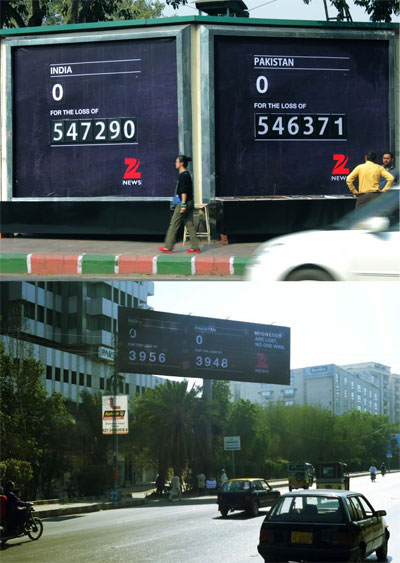
    On the eve of India-Pakistan WC 2015 match which took place on Sunday, February 15, DDB MudraMax executed a one-of-a-kind outdoor campaign for Zee News.


    As the tension built up, with fans exchanging videos of varying statistics of the past matches, DDB MudraMax installed manual scoreboards of a different kind in Jammu & Kashmir, New Delhi in India and Lahore, Karachi in Pakistan. While spectators felt that these were normal run-of-the-mill scoreboards which kept on-lookers updated with the status of the match, they were caught off-guard as the numbers didn’t tally.


    As India started to bat and the first wicket fell, the Indian wickets column displayed ‘1’. Within minutes, the wickets column read ‘2’. Our country neighbors standing in front of the billboards in Lahore and Karachi celebrated. The Indians on the other hand checked the score on their mobile phones and realized the second wicket hadn’t fallen. A few minutes later, the wickets column said ‘3’. Before long, onlookers on either side of the border decided that the scoreboard had gone faulty.


    To the surprise of the spectators, no one came to rectify the faulty boards, instead the wickets column seemed to be in a hurry. It moved briskly from tens to thousands to tens of thousands in no time. A similar pattern followed when Pakistan batted. The scoreboard at the end of the match read: India 0 for the loss of 546030, Pakistan 0 for the loss of 546228.


    After India won the match, the copy on the scoreboard changed. It read “WHEN LIVES ARE LOST, NO ONE WINS”. The numbers kept increasing and stopped at 547290 for India and 546228 for Pakistan – the numbers of lives lost by soldiers since 1947 during the battles fought between both the countries. Thus depicting that neither country won anything by losing her soldiers.


    The message was loud, clear and was well addressed by the passers-by who started lighting candles at the site, in memory of the fallen. Thus, a powerful statement on the futility of war was well-conveyed through the ‘Misunderstood Scoreboard’.


  • Call for Entries for Goafest Abbys 2015 announced

    By A Correspondent


    The Awards Governing Council (AGC) of Goafest 2015 has announced its “call for entries” for Goafest Abbys. The entry forms can be downloaded from www.theadvertisingclub.net. The last date for submission of entries is Friday, February 27, 2015. This year, Goafest will be held from April 9th to 11th at The Grand Hyatt, Bambolim, North Goa.


    Campaigns that have been released till February 15, 2015 are allowed to submit their entries at this year’s Goafest Abbys.


    The regular Award entry Fee is INR 7,304/- (inclusive of Service Tax). The entry fee for the categories – Integrated Advertising i.e. from 1e to 15e, 18(J) – a, b, c & d. Integrated Digital Campaign, 19h. Direct Campaign, 20h. Best integrated entertainment content campaign, 21w. Programmes that use multiple media platforms in one promotional campaign, 22u. Integrated Campaign led by PR is INR 10,113/- (inclusive of service Tax). For South Asian Countries the entry fee will be USD 22.47 (inclusive of service Tax).


    Goafest is in its 10th year and this is the 8th year that AAAI and The Advertising Club have come together to award ABBYs, India’s definitive honour that recognizes creativity.


  • Aditya Kilpady joins Contract as Sr VP – Strategic Planning

    By A Correspondent


    Aditya Kilpady

    Aditya Kilpady joins Contract advertising as Senior Vice President, Strategic Planning. He will head strategic planning for the agency’s Delhi office and will report to Shivaji Dasgupta, Delhi Branch Head.


    His mandate will be to lead integrated communication solutions across the portfolio and be a strategic business partner for Contract’s clients as well as partner the leadership team in maximising the new business thrust.


    “Having worked across India, China, Malaysia & Singapore, Aditya has diverse cultural contexts in unearthing insights to address a combined market of over 2.5 billion – that’s almost 40% of the world’s consumers, across audience segments that range from Moms to the Millenials!,” said Rohit Srivastava, Chief Strategy Officer, Contract Advertising.


    “We are all excited about having him on board as a key partner, as we head into 2015 with much ambition and great positive intent for our clients,” he added.


    Mr Kilpady, who joins in from Bates CHI & Partners’ Singapore, is a post-graduate in Business Management from Sydenham Institute Mumbai. He comes with over 18 years of cross-cultural experience in brand strategy, communications planning and consumer insights. During the course of his career he has worked with Bates CHI & Partners’ Singapore, Bates CHI & Partners’ Malaysia, FCB Shanghai, D M Pratama Jakarta, FCB Ulka India, Mudra-Interact Vision India & SSC&B Lintas.


    “I am excited to return to India where all the action is. Feels great to be with Contract, a rock-solid agency with an entrepreneurial spirit & an ambitious senior leadership team. Rohit is one of the most respected strategists in India and I am eager to work with him in building brands and elevate the strategic thinking with clients and creative,” said Mr Kilpady on joining Contract.


  • What ad veterans have learnt from the younger lot


    By Delshad Irani


    At work, like in any human tribe, there are two kinds of people – the Elders and the Young. The latter, of course, are eager to conquer the world. The elders, who have been there and done it all (or so they’d like to think) remind the impatient youth, Rome wasn’t built in a day.


    ‘No schnitzel, Sherlock!’ is the response, generally. While it’s not the elders’ job to shatter the young’s exaggerated sense of self-belief, it is however their duty to voluntarily impart pearls of wisdom and teach a lesson or twelve. That is if the children aren’t of the know-all variety with brains like sieves.


    However, at no other point in history has there been such a high premium on youth and the mad dash to make everything from buttocks to board rooms look younger is testimony to that fact.


    Yet, rarely are inhabitants of corner offices conscious of the learnings they’ve gathered from the younger tribe. It might not seem so but there are some important lessons to learn. And we’re not talking about teaching grandma to text and abbreviate every word known to man here.


    In advertising agencies, there are endless corridors of hormone-fields. It’s one of the youngest industries, where millennial minions slave day and night to create ads for unrelenting and often unreasonable clients so their award-winning bosses can scale the Palais in June, every year.


    So whoever said the millennial is fickle or needs constant validation and expects “Look maa, I drew within the line!” to be followed by a treat and a cuddle or that they are as loyal as a mercenary is nucking futs.


    Well, there are exceptions. But amid the myriad of contradictions, millennials have come to represent quite effectively, the new generation of adwallahs. They too have priceless wisdom to share with the generations that preceded them, even if they aren’t quite aware of this yet.


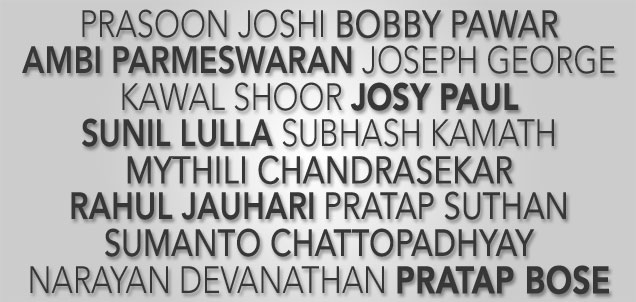
    In an attempt to bring these to light, Brand Equity asked advertising’s “seniors” about the valuable lessons they’ve learnt from their juniors.


    Striking the right work life balance, not being averse to risk and cultivating a very low embarrassment threshold, are just some of the beautiful learnings but let’s not get ahead of ourselves.


    Read on to see the lessons advertising’s heads have learnt from the legs that prop them up.

     

    Prasoon Joshi, Chairman Asia Pacific & CEO of McCann Worldgroup India

    What I have learned from the younger generation, is the work life balance. My generation (or at least speaking for myself) were very extremist, single minded and did too much work. We’d go to Cannes and it was like a project: go and return.


    The younger lot tie it up with travel and exploration. With youngsters, right from the start, there’s a more holistic approach to life. They believe it’s good to take breaks, even short ones. And so to someone like me, with a crusader mentality, I’ve learned a lot.

    Moral of the story: Take as many breaks as HR will allow.



    Bobby Pawar, Director and Chief Creative Officer, South Asia, Publicis

    The lessons I’ve gathered from my youngest colleagues? Holy-moly, where do I begin? Tenacity. Irrational passion. Being curious of the changing world. Trusting my instincts as much as my experience. Experiment. When to step in. When to sit on the sidelines and applaud. Rediscovering that this business is supposed to be fun. Patience. The list grows almost every day.


    I believe, if you aren’t learning from the people you are with, you have the wrong people, or more likely you have the wrong attitude. One day at work we were discussing ideas. It was a big brand, big brief, big budget, big stakes. This kid had an idea that sounded cool, but it was pretty much out there. And I said, I don’t think we can take a chance like this on a billion dollar brand. The kid looked bummed. He remained quiet for a bit, while we chatted.


    Then he said, “Bobby, failure is temporary, success is permanent.” I said, “Getting fired is temporary too, but it stings.” Everybody laughed. What he said haunted me. The next day I caught up with him and we spent time trying to make his idea work. Let go of your professional prejudices. A new marketing order is coming and it will be shaped by those willing to shape it and be shaped by it.

    Moral of the story: Don’t save your precious aphorisms for Twitter, try it in conference. Even if it sounds dumb. Never stop being bold and curious. Christopher Columbus wouldn’t have gotten far if he weren’t a nosy fella.



    Ambi Parmeswaran, Executive Director and CEO, FCB Ulka

    The youngsters taught me how use technology to solve problems. Sometimes what looks difficult is really a piece of cake.


    The younger lot have innovative skills that they bring to the table. It’s great interacting with trainees from management and creative. They are supposed to make a 20 minute presentation to us at the end of their stint, and I remember a boy making a video presentation in the form of a daily diary to his mom. It was great because of the ‘We haven’t seen this before’ feeling.


    Their approach to work is very different, which we often criticise, but there are plenty of takeaways. I remember the time when an employee was moving on from our agency, and I asked him to give me a call in case he wasn’t happy at the new place. I told him there was nothing to be embarrassed about and we could definitely work something out for him if he decided to return. “Why would I be embarrassed?” he asked me. And he was back in six months.

    Moral of the story: Never criticise before thinking. And if one is ever in need of a smashing presentation, commission the millennials in your employ.


    Joseph George, CEO, Lowe Lintas

    Their belief in the spirit of “moving on”, it allows you to not get stuck with any issue (good or bad) for too long. It allows you to accomplish a lot more. And it makes you a lot less emotional and more objective. It also allows you to stay focussed in meetings and conversations instead of the hangovers of an earlier issue or a previous meeting still clouding your head.


    Many times, we seem to dismiss and brand this trait of the youth as being fickle and superficial. Or even accuse them of being disinterested. It took me a long time to realise that those were erroneous and lazy conclusions. I was interviewing this young planner ( I personally interview all planners coming into Lowe Lintas ), and as we concluded with me saying that HR will get back to him, he said in a matter of fact way “to not let his youth come in the way of his salary or indeed his designation!” There are three brand lines that sum them up “Move on”, “Impossible is nothing” and “Poochne mein kya jaata hai”?

    Moral of the story: Life’s too short to cry over yesterday’s headlines, delusion of grandeur is a millennial condition and there is no such thing as a stupid question



    Josy Paul, Chairman, BBDO India

    One of the greatest things that my youngest colleagues have taught me is to be more authentic. They value that in themselves and they seek that from me. It helps me relax in their company and be who I am. It brings out the best in all of us. I feel the younger generation is a reminder medium of who we once were. They remind me of the strengths that I had, and have now forgotten. They revive and rejuvenate my authentic side. They point out things I once told them when I was a visiting faculty in their colleges. And they don’t let me forget. It’s a great source of energy.


    “We work differently from how you work. You guys work really hard and are obsessed with excellence about work. But excellence for us is how we manage both work and life. We need more breaks, more away-time. That’s how we create excellence at work. For you work is everything. We work for life” – Hemant Shringy, senior creative director, BBDO Ashram, age 29. It’s an insightful jolt and a beautiful truth, and I have accepted it. It is important to me. Which is why I remember it. Reverse internship, osmosis and learning are part of my world. I spend at least two hours a week speaking at colleges. The best thing that an experienced generation of marketers can learn from millennial marketers is to let go! The best way to contribute is to get out of the way.

    Moral of the story: Be real and weekends are not just Saturday to Sunday.


    Kawal Shoor, National Planning Director, Ogilvy & Mather

    I like their naivete and candour the most. I especially love their language, as yet un-corrupted by the dreaded ad lingo. And fresh language is often a window to new thoughts. No ‘target audience’, no ‘strategy’, no ‘360 degrees’ no bullshit. When they talk formally, they are pretty predictable and ordinary ; maybe they say what they think they’re expected to say, but when they let go, when they just chat with you, when they talk about how people are, and why they are the way they are, is when they can really say interesting things.


    The biggest life lesson is that there are no rules. Yes, there are a few rules on how you anchor a thought f o r clients to feel comfortable with them, but for creation of new thoughts and ideas, there are absolutely no rules. I also think today’s young are a lot more confident, sometimes even before they’re able.


    Exactly the opposite of how I was, or still am. And then I have a 14 year old at home who’s my anti-aging insurance. There’s a daily crash course I get on staying young. There are times I fail, times I pass, but I can’t say life’s boring.

    Moral of the story: Speak without thinking.



    Sunil Lulla, Chairman and Managing Director, Grey Worldwide India

    “I work harder.” It was a simple statement made to me by a fresher at JWT in the late 80s. It expressed the strength of the individual and the difference one can make to one’s success. i.e. Work Harder, than anyone else, until success is yours. He was working really late hours and was undertaking very simple and humble tasks. It was late and I asked him to stop working and go home and complete it the next day. This response, “I work harder”, got me to agree, smile and adopt this attitude.

    Moral of the story: Forget what was said about frequent getaways, work your backside off.



    Subhash Kamath, Managing Partner, BBH

    There are many lessons I’ve learnt from some of my young colleagues. Most importantly, I’ve realised that their youth is very different from how mine was. They’re growing up in a very different society, they’re far more optimistic and daring, far more capable of taking risks and exploring newer things than I was. And thanks to the digital age, they seem far more connected and have much better access to information than I did.


    Sure, it’s much more competitive now than it was in the 80s, but I think today’s youngsters are upto it. Our generation was taught to play safe, hold on to our jobs, save for a rainy day etc. Today’s youngsters have grown up in a more plentiful society. They have many more options to choose from, more entrepreneurial opportunities.


    Talent and ideas get rewarded more easily today than it did in my time. So the same values and priorities that I had don’t necessarily work for them. The one anecdote I remember very vividly that would perhaps illustrate this change was when, some years ago, I was doing an exit interview of a young star who’d decided to leave the agency. She had been doing extremely well, her colleagues and clients loved her, and she’d just been promoted with a hefty increment. But a month later, she put in her papers. I was completely taken aback. When I asked why, she said the job was keeping her too busy and that she was not getting any chance to spend time with her family and friends.


    Trying to give her some sagely advice, I explained that even I had to go through this phase in life. That it was important to give it one’s all at this early learning stage to build a long term career. That one day she’ll be able to balance it having come on top of this service business.


    To which she coolly looked me in the eye and said “But what makes you think I want to lead the same life as you did? I want to do it differently and enjoy both work and play now, not later.” I honestly had no answer to that. Just the strong realisation that things have indeed changed. This generation looks at things very differently. And the worst thing a senior person like me could do was to think of my own upbringing and youth in evaluating today’s generation.

    Moral of the story: Don’t evaluate the world through the prism of your life. It’s not that great a life, after all, if a millennial doesn’t want it.



    Rahul Jauhari, National Creative Director, Everest Brand Solutions

    I guess the number one lesson is that these kids don’t take shit for too long. They are not as tied down by stuff like loyalty to boss/agency as we used to be. So if they don’t get a good deal (monetary or opportunity) they move on. They have innumerable options – advertising copywriting is not bigger or smaller than content writing or opening a wedding ideas shop with friends or something else.


    I guess fundamentally, they are experimenting more than we did, they take less load than we did/do. Long ago, after I finished seeing a complete fresher kid’s folio, he asked to see mine. I kicked his butt for not doing his homework, but loved the attitude. We are in a people’s business.

    Moral of the story: You can’t take designations and dignity to the bank.


    Mythili Chandrasekar, SVP & National Planning Director, JWT India

    The youngsters absorb so much from the world around at a blistering pace, and are intuitive culture and technology experts. They challenge conventional wisdom and it is good to be constantly tested. Free flowing and lateral thinking is something we can learn. Some very young colleagues have stunned me with their depth of work and speed of learning.


    While one cannot generalise, I do find disrespect for dress codes, time and casualness in tonality ends up working against youngsters being taken seriously. They certainly seem to have better work life balance, and are able to switch off far more easily – too late to learn that! After a point it’s not about age, but character. Those who are tenacious, unrelenting, passionate, bold, and thorough are those who stun you and teach you every time.

    Moral of the story: Study hard, study fast. Dress for comfort, but save the ‘Frankie Says Relax’ t-shirt for under the comforter.


    Pratap Suthan, Managing Partner and Chief Creative Officer, Bang In The Middle

    This was when I was a CD in Grey Delhi in about 1999. I had a trainee for about six months – he was really good at his job and had a lot of spunk. I wanted to hire him as a junior writer, but apparently we didn’t have the budgets. I kept delaying telling him because I wanted him on board, till the time he asked me what the status was.


    When he realised that the branch head couldn’t bring him on board, he walked into his office, gave him a piece of his mind and got out, only to start his own agency. That boy is Sidharth Rao of Webchutney. That day I learned that if you are convinced about something, you should stand by it no matter what anyone says. All it takes is belief and some spine.

    Moral of the story: Never listen to your branch head. And go with the gut every time. (At your own risk.)



    Sumanto Chattopadhyay, ECD – South Asia, Ogilvy India

    The most obvious fact is that the young colleagues are digital natives and we are digital dinosaurs. That is one area I have learnt everything from my juniors; I harass them and pick up a lot of internet and socialmedia related things from them. I can now ideate on digital campaigns today, and the only reason I can is because I had juniors who were complete whizzes at this. They’re born into it and have been using technology since the time they were in school.


    Another thing that is amazing is their comfort level with all kinds of apps and software to get things done. They find ways to easily put together a little film for a presentation, for instance. These little things seemed so difficult but they’re not; they helped me break that barrier. We belong to the doctor-lawyer-professor-bano generation, where we were told to pursue our passions only after first securing an academic degree and a steady job.


    Our mentality was to stick it out whether or not you’re enjoying your job. While there are good and bad sides to this way of thinking, I am going to say that the changes in the world and economy give youngsters the option to not waste their time at a place they aren’t having fun. The flipside is that they decide in three months that they don’t like advertising and quit. Three months! At least give it a year?


    Sure, go ahead and explore if you like something or not, but three months is too short a time. Some people are too hasty in deciding if something is working for them. They just need to find their happy medium. I like that they explore and have the confidence, but just take your time.

    Moral of the story: It’s never too late to learn.



    Narayan Devanathan, Executive Vice President and National Planning Director, Dentsu India Group

    The natural ease with which they carry themselves, knowing their place in the world (at the centre). Their ability to keep me grounded with an “Ae, kidhar ja raha hai, pehle good morning toh bol de.” Knowing how to be wrong with complete confidence, and most of the times, with a good idea of what failure looks like. Being completely comfortable with uncertainty, with “maybe” as a valid life choice.


    Work hard, party harder (I haven’t been able to apply this as effectively as them though.) But time and again, the young ones have taught and reinforced to me the idea of embracing uncertainty. “We’re dating currently, but he’s at IIM Ahmedabad and I’m here in Delhi, and I’m not sure if we’ll be in the same city after he finishes. I might find somebody else by the time he comes back. Or he might. Ya, I know we’ve been together for five years, but who knows what will happen tomorrow? I’d like to marry him, but that’s too far away.”


    This was a 20-year-old intern who worked with me several years back. I have no idea who she is with right now, but I don’t think she’s worrying about it. The value of persistence: A girl applied for a position in a previous job of mine, and after I met her, I was pretty sure I wanted to be on the same team. Except we didn’t have the budget to hire her then. So I told her, “Listen, I’m pretty bad at keeping in touch. But call me regularly. And if I don’t answer, message me. And if I don’t respond even then, email me.” She did all three for three weeks continuously.


    I managed to wrangle a budget out of the management to get her on board after that. I hope I apply these lessons regularly. But those who work with me will probably be able to better speak about the impact. In life, I definitely am more actively trying to embrace the uncomfortable, the uncertain. As I said elsewhere sometime back, I’m discovering the joys of confusion. Clarity is overrated, if you ask me.

    Moral of the story: Don’t date anyone at IIM-A. Embrace uncertainty and confusion every morning and there’s no shame in being stalkerishly persistent. However, try and stop short of a restraining order.



    Pratap Bose, former COO, DDB Mudra Group

    I remember once going through my worst crisis ever on the IBM account, and by the end of the evening it looked like we would lose the account through a horrible mishandling which had the worldwide IBM CEO and CMO threatening hell and high water.


    At 9 o’clock in the evening, when I was in the depths of despair and totally at my wits’ end, a young colleague came over and said to me, “Sir, why don’t you go home and sleep on it? It never seems so bad in the morning after you wake up.” To this day, I follow that advice I learnt from my younger colleague. In life, no matter how disastrous or how enormous the problem, it always seems smaller after you have slept on it.

    Moral of the story: Snoozes, not weekend getaways are the pillars of success.


    (With Inputs from Ravi Balakrishnan, Amit Bapna, Shephali Bhatt, Mukta Lad & Priyanka Nair.)


    Source:The Economic Times

    Copyright © 2015, Bennett, Coleman & Co. Ltd.

    All Rights Reserved, Licensed to republish


  • Highlights of Sam Balsara’s presentation of the Pitch Madison Media Advertising Outlook 2015


    Hello and welcome to the Pitch Madison Media Advertising Outlook 2015.Thank you very much for coming this afternoon to find out about what happened in 2014 and what is our prognosis for 2015 in terms of media spends in different media and different categories.We have put together an interesting and hopefully educative afternoon with accomplished speakers talking about subjects ranging from Media to Fmcg to elections to the new age digital companies to corporate advertising.
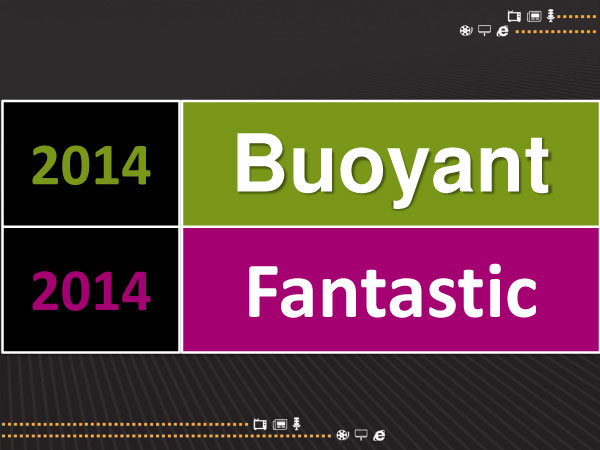
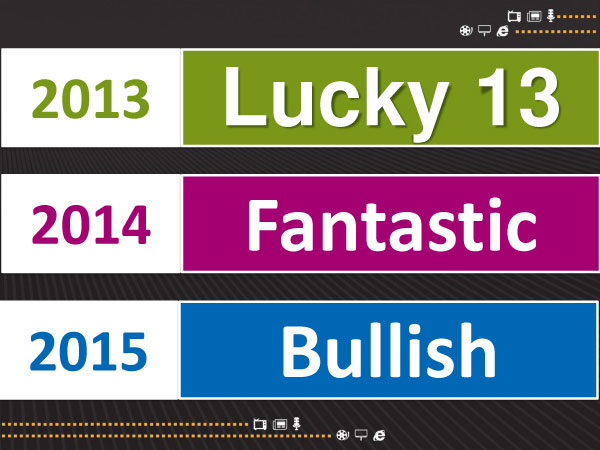
    Last year we said that 2014 would be a Buoyant year and am delighted to inform you that we were right!I would now describe the year just gone by as FANTASTIC!
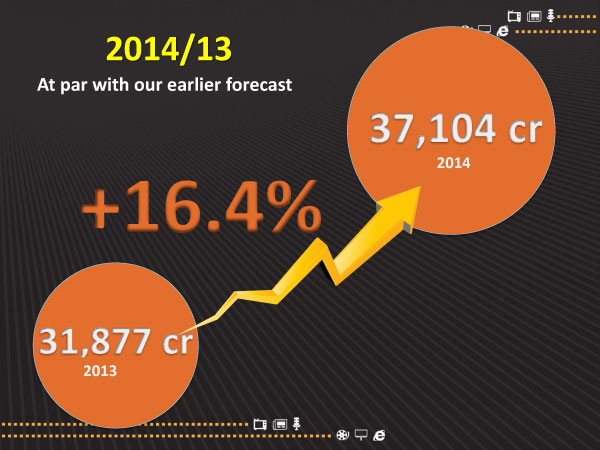
    Why do I say Fantastic?The Indian advertising industry in 2014 grew by 16.4%, almost at par with our forecast of 16.8%. When we projected a growth rate of 16.8% last February mostMedia professionals felt the projected growth was too high and Media sales professionals wondered if their bosses were going to increase their sales targets!

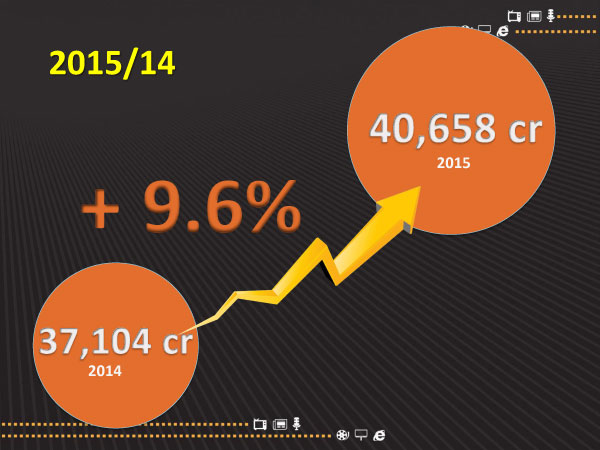
    In terms of absolute numbers, the advertising industry increased by Rs. 5,200 Crs and touched Rs. 37,100 crs in 2014.

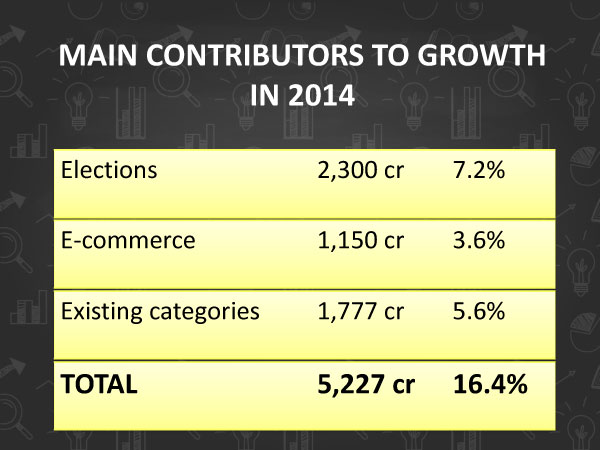
    The 2 main categories that have fuelled the overall growth in 2014 were the Lok Sabha general elections along with the 5 state elections, and E-commerce players contributing as much as Rs 2,300 Crs and Rs 1,150 Crs. respectively. Thus almost half the growth came from Elections alone and the 2 categories account for 2/3rd of the growth. Of the 16.4% growth rate registered in 2014 it is significant to note that nearly 7.2 percentage points is on account of elections alone, 3.6 percentage points is on account of E-commerce. It is again significant to note that existing categories contributed to only 5.6 percentage points of the overall growth.
    What is our growth forecast for 2015?
    Whilst the growth in 2014 was Fantastic, mainly because of election spends, we are equally bullish for 2015 too but our forecast has to recognize that 2015 is not an election year.
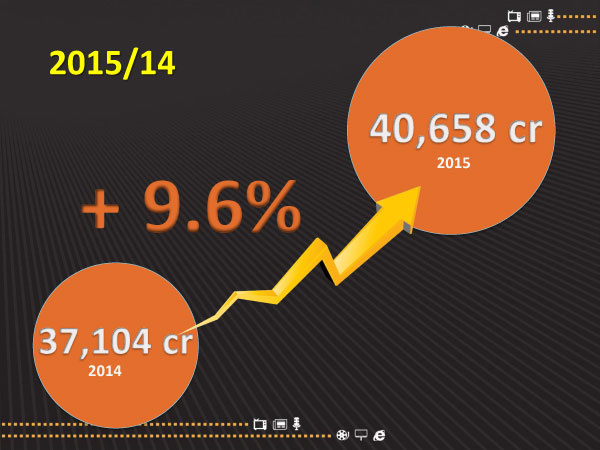
    A 9.6% growth rate, is what we forecast in 2015 which will take the industry further up to reach nearly 41000 crores. We expect the overall market to grow by more than Rs. 3500+ crores
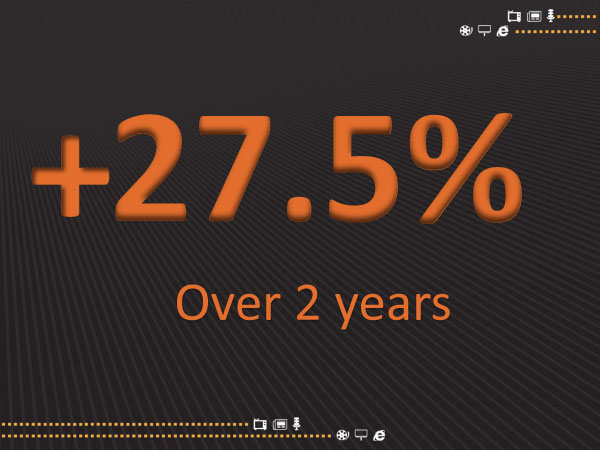
    That’s a spectacular growth of 27.5% over 2 years
    Note, this figure of 9.6% should be compared with the like to like category growth of 5.6% achieved in 2014 and not the overall growth of 16.4%. A stable government at the centre that is focusing on growth of the Indian economy, positive market sentiment, upbeat consumer confidence and India once again attracting global attention, are all the reasons why we are doubling our growth forecast to 9.6% from the earlier years like to like growth of 5.6%.
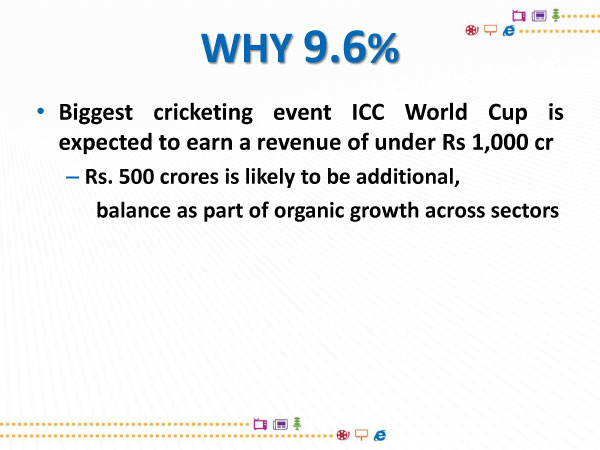
    Getting into the details of why 9.6% Biggest cricketing event ICC World Cup already underway is expected to earn a revenue of almost a 1,000 crores Rs. 500 crores is likely to be additional, just because of world cup and the balance as part of organic growth across sectors
    Other contributing factors to growth are likely to be: New advertisers Separate sales of HD channels, hopefully will attract new premium brands to advertising Facility of Geo targeting ads will attract more, local and retail advertisers on TV New channel launches from existing networks Further push by E-commerce companies and mobile and social apps Spends on Assembly elections in Delhi and two other states Increased government spending on print, since the new government strongly believes in communicating with their electorate about their new thinking, concepts, etc We are confident that government will finally launch phase 3 expansion no later than September 2015, and since a very large number of radio stations are expected to open up, this should pull in atleast Rs. 70 crores of additional advertising revenue in the last quarter of the year
    Here’s a 13 year review of the advertising market, having gone up from under 10,000 crores to almost 41,000 crores over 13 years. We have thus achieved a compounded annual average growth rate of 13% over these 12 years, but it is significant to note that the rate of growth in the last 6 years has been under 10%. Whilst, it appears that the advertising industry has grown steadily over these 13 years, the trend in growth rates as you can see is a wildly fluctuating one.
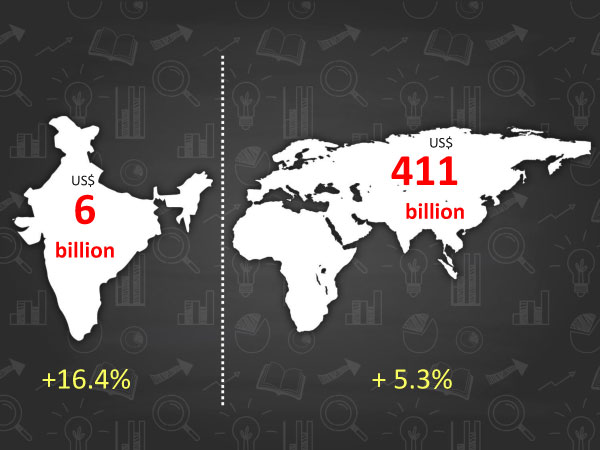
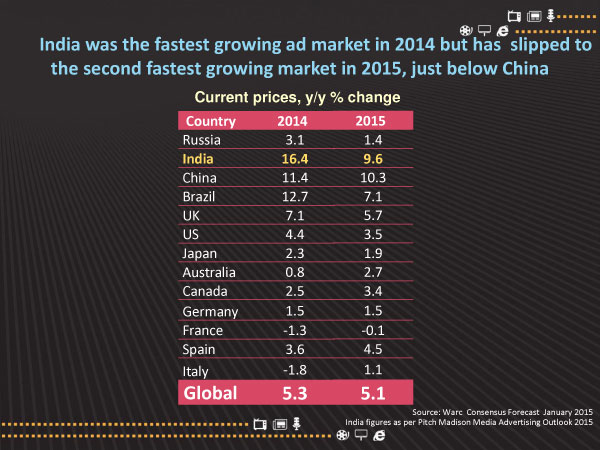
    Compared to India’s growth of 16.4%, the global advertising market grew by just 5.3% but of course in absolute terms the global advertising market is now estimated at US $ 411 billion where as India is at 6 billion which puts India’s share at a far from respectable 1.50%
    India maintained its 12th rank in the global ad market. The US further increased its share which now stands at almost 43% of the global market. China also increased its contribution from 11% to 14% and has overtaken Japan as the second largest advertising market. Japan has dropped significantly in terms of contribution from 13 to 9%.
    India was the fastest growing ad market in 2014 but may slip to the second position in 2015, just below China
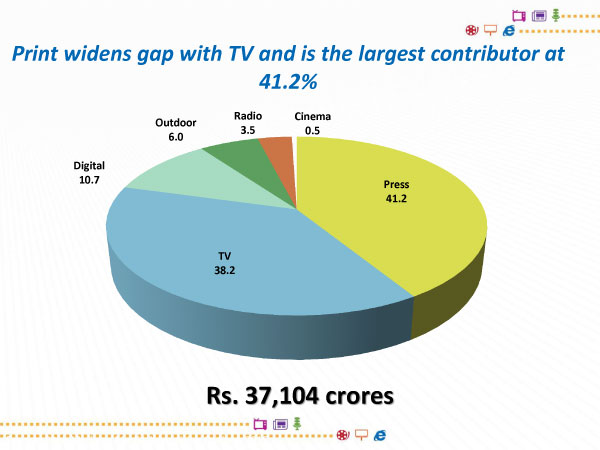
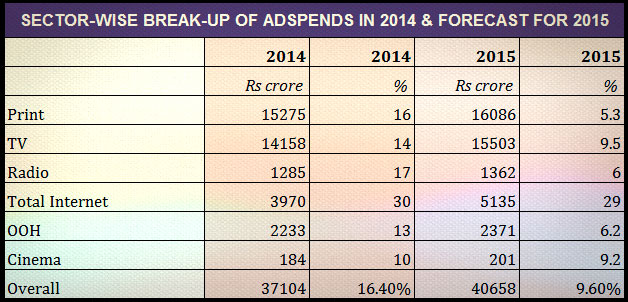
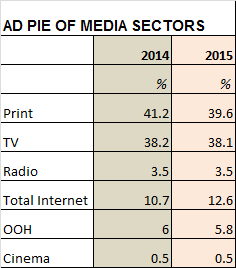
    Coming back to India, let’s look at the Medium wise figures. Print continues to be the largest segment and accounts for 41.2%, followed closely by TV at 38.2%. The gap between Print and TV has marginally widened. Digital has now got used to occupying the 3rd place with a 11% share. Outdoor, Radio and Cinema make up for the balance 10%.
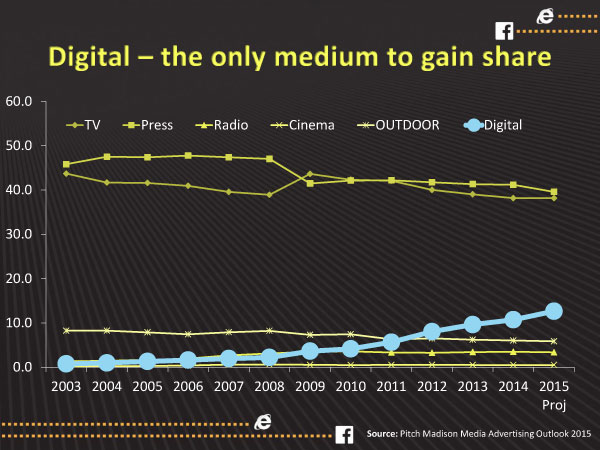
    Digital continues to be the only medium to grow share at the expense of TV + Print + OOH. Radio & Cinema have maintained overall share.
    Digital continues to be the only medium to grow share at the expense of TV + Print + OOH. Radio & Cinema have maintained overall share.
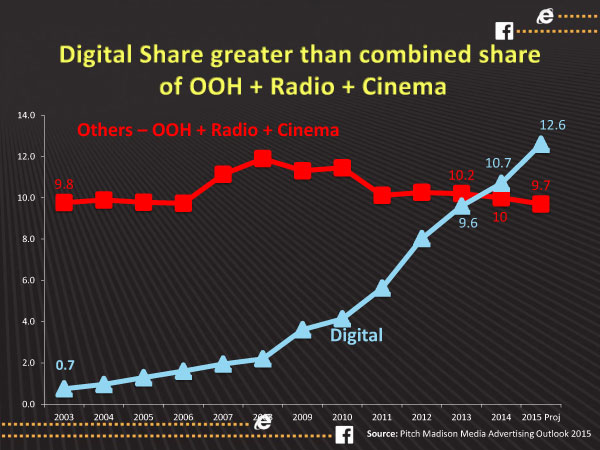
    It is interesting to note that the combined share of OOH, Radio and Cinema is lower than the share of Digital.
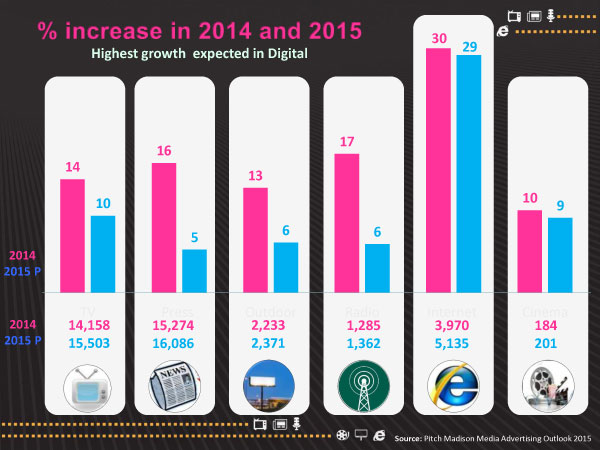
    In terms of growth rates, Digital grew the most in 2014 followed by Radio, Print, TV and OOH in percentage terms. In 2015, we expect TV to grow faster than all other media except digital at 10%.
    Moving to Television
    Television last year grew at 14% to reach Rs. 14,158 Crs but has dropped its contribution to total advertising and is now at 38%. The 2 main categories that have fuelled the overall growth of TV industry in 2014 are Lok Sabha general elections along with 5 state elections, and E-commerce players. The total spending by these 2 categories is in excess of Rs.1,050 Crs out of the total growth of Rs. 1,700+ crs. However this year we expect TV to grow by 9.5% on the back of ICC Cricket WC, Assembly elections in 3 states, HD Channels, Geo Targeting on TV, and new channel launches
    Hindi GEC contributes nearly 27% of the overall TV revenue and continues to remain the leader of the pack. A change in the pecking order saw Tamil Nadu C&S overtaking News to occupy the second rank with their ad revenues growing in contribution from 7.2% to 8.5%.
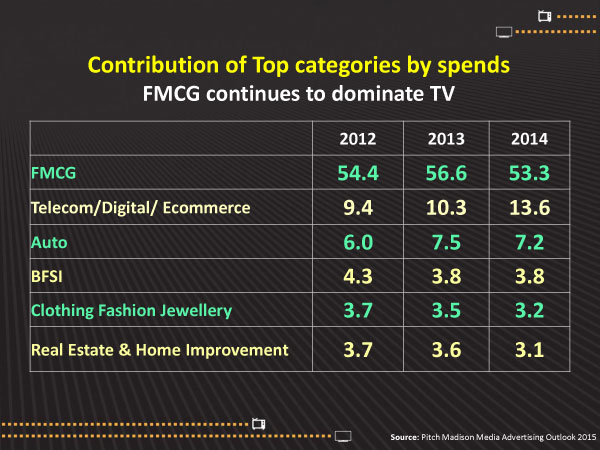
    In terms of category contribution, the pecking order remains the same with a marginal 3percentage points shift in contribution from FMCG to Ecommerce. FMCG, continues to rule the roost contributing 54% share of total TV spends (down from last year’s 57%), followed by Telecom/Digital/ Ecommerce (14%) & Auto (7%).
    In TV, the total FCT consumption has grown by over 18% in 2014. But if you take only those channels which existed in 2013, the growth in FCT comes down to 6.4%. Length of Average duration of a commercial seems to be inching up in the last 3 years and is now firmly at 24 seconds.
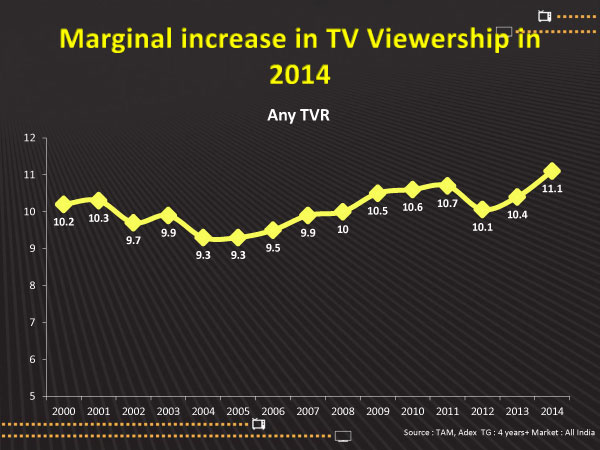
    There is a significant increase in average viewership of any TV channel of 7% in all day parts, but an even higher 11% increase in off prime. The drop that we had seen in 2012 has now been made up and more
    Let’s review Print
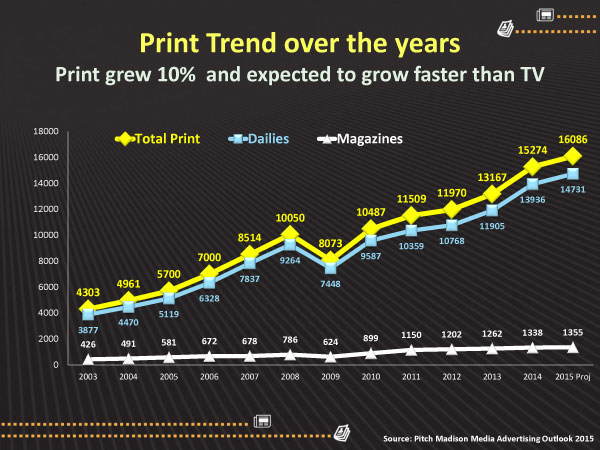
    Print grew by 16% to reach Rs. 15,274 Crs and continues to be the largest contributor in the total advertising pie with a share of 41%. Dailies has grown by 17% and is in line with our earlier projections. Magazines too have grown by 6% and is in line with our projections. Of the total growth of around Rs. 2100 Crs, nearly 85% or Rs. 1,800 Crs has been contributed by Elections & E-commerce players. Increase in advertising during festival season by smaller and retail advertisers has also contributed to the growth. And we expect Print to grow by another 5.3% in 2015.
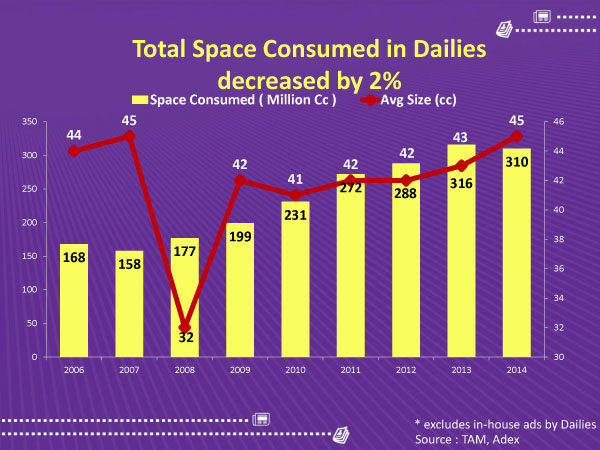
    Total space consumed in Dailies decreased by 2% but the average size of an ad also marginally increased to 45 col. cms.
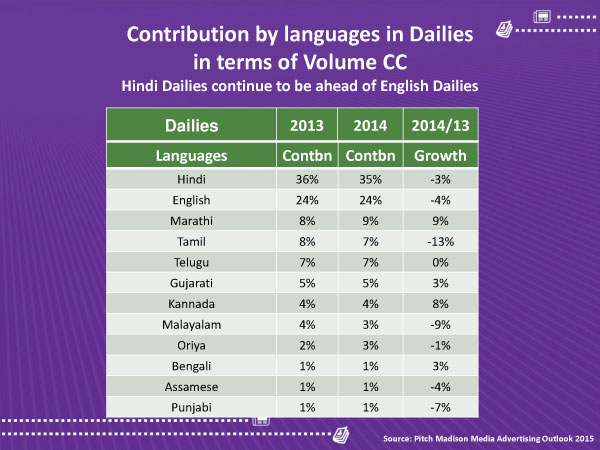
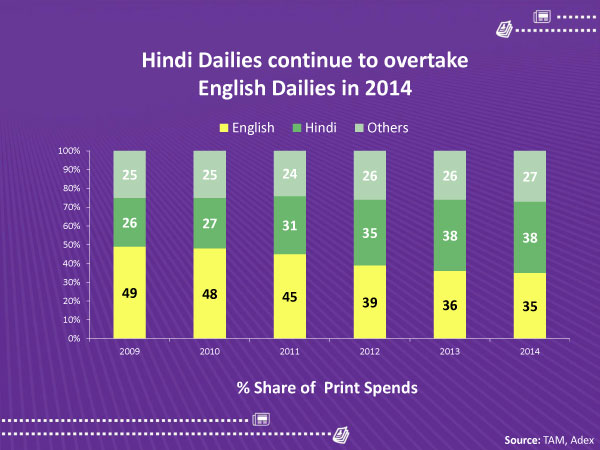
    In terms of Volume of advertising space consumed, Hindi Dailies continue to be ahead of English Dailies contributing 35% of the total volume from Dailies while English Dailies contribute 24%.
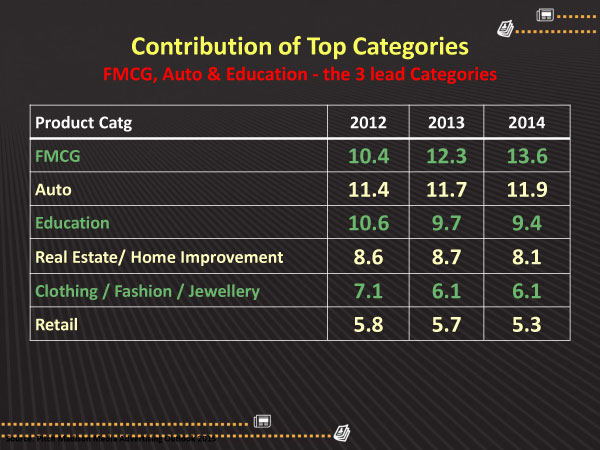
    It is significant to note that for the second consecutive year, FMCG is the largest contributor even in Print, although the contribution is only at 13.6% compared to TV where its contribution is 53%. For years FMCG was not a major contributor and it was Auto, Education and Real Estate that ruled the roost in Print. These categories along with clothing, fashion, jewellery and retail together contribute to only 40% of the total print spends.
    2014 also saw Hindi Dailies topple English with a share of 38% in spends. The dominance of English newspapers is declining for the second year. Hindi newspapers are now firmly the largest contributor to the Print advertising pie.
    Moving on to RADIO
    Radio being a local medium was extensively used by all political parties including individual candidates for campaigning during the Lok Sabha general elections & 5 State elections. Radio has grown by 17% as against earlier growth projection of 15%. This growth is despite Phase 3 not coming into force as anticipated at the start of 2014. E-commerce advertisers have also used the radio medium extensively for all their tactical offer based campaigns. The growth has also come on the back of higher inventory being sold across stations. Radio has maintained its share of 3.5% of the total advertising pie with total revenue of Rs.1,285 crores in 2014, an increase of nearly Rs. 190 crores over 2013.
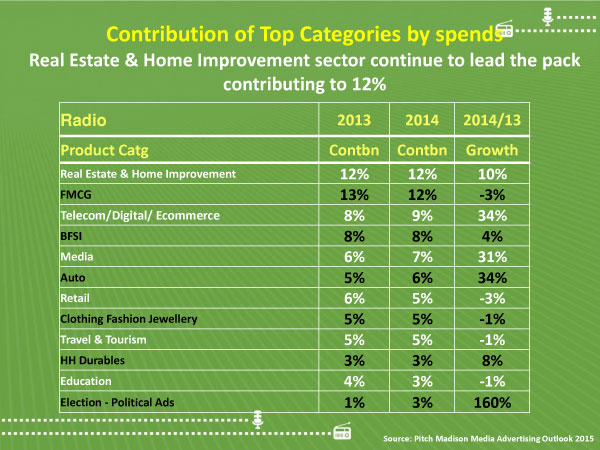
    In terms of category contribution, Real Estate & Home Improvement sector continue to lead the pack contributing to 12% of total Radio spends followed by Telecom/Digital and Ecommerce (9%) & BFSI ( 8%). Revenue from Ecommerce players sees the highest growth rate in 2015 followed by Auto and Media , while revenue from FMCG & Corporate sector shows decline in growth.
    Let’s see CINEMA
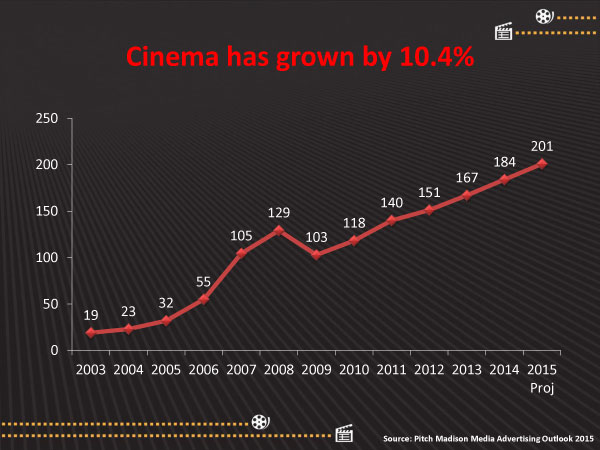
    Cinema has grown by 10% as against the projected growth rate of 7% and is at 0.5% contribution to advertising pie with total revenue of Rs. 184 crores in 2014. The rapid expansion of multiplexes in tier I and II cities is a big reason for the growth of cinema advertising in India
    Let’s see what’s happening in OUTDOOR
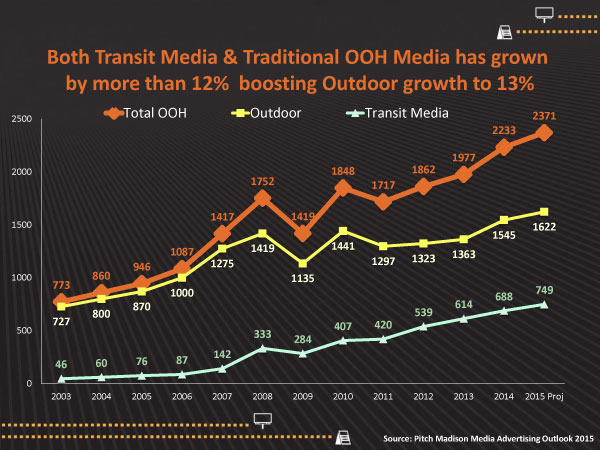
    The total Outdoor spends grew by 12.9% in 2014. Conventional Outdoor, against the projected 7% growth, grew by 13%. Transit Media too grew by 12% as against projected growth of 10%. Political parties spent heavily on OOH for both Lok Sabha Elections & 5 State Assembly Elections. E-Commerce category too gained momentum in 2014. Transit media rode on the back of new T2 terminal in Mumbai, initiation of Metro services in Mumbai & higher organic spends in Kolkata. Organic growth was seen in categories like Telecom, Automobile, BFSI and Retail. Outdoor has maintained its share of 6% of the total advertising pie in 2014 with total revenue of Rs. 2,233 crores, an increase of Rs. 256 crores over 2013.
    Finally we come to Digital
    Display including Video, Social and Mobile grows by 33% while Search increases by only 26%. With more FMCG and telecom players getting into the fray, Video, social and mobile formats saw larger traction. Given the explosion seen in smartphone adoption, we expect the trend to continue in the coming years
    So as you can see there has been a lot of action in the media world and to squeeze value out of this busy, noisy, media world, advertisers need to do a few things differently.I have 5 pieces of advise for my advertiser friends.
    My first piece of advise is to focus on effectiveness and not only on efficiency. Media seems to get the worst of everyone on rates. But Brands should not forget that the reason they advertise is to improve their brand health parameters and we have seen that certain properties, events and festivals, though expensive can impact brand health parameters in a substantial way, justifying the premium over vanilla buys.
    Experiment should be our mantra. And here our guiding principle should be “Fail often, fail fast”. I have often seen marketing teams are painfully slow on certain media decisions. We often suffer from analysis paralysis.
    Our recent experience with BJP and the aggressive e-commerce spends on Print and TV in the last year have ably demonstrated that “Media can Move Mountains”. But, in my view most brands fail to take full advantage of what media has to offer by under-resourcing their campaigns. Better to focus on few brands and advertise them heavily.
    A corollary point, I would like to make is that since budgets are finite and often limited by P&L considerations, you need to prioritize markets very sharply and in the priority 1 markets spend and exposure must be atleast twice that of priority 3 markets, otherwise prioritization is meaningless.
    For some unexplicable reasons I have noticed that as media spends get larger and larger, media decisions are been taken at lower and lower levels. If you want media to work its magic for you, greater involvement of corner rooms is required.
    Thank you
  • Adspend to grow 9.6% in 2015: Madison


    By Labonita Ghosh


    The advertising industry is likely to grow 9.6 per cent this year, says the Pitch Madison Advertising Outlook Report 2015 released last Friday. While this looks like a tepid sequel to a blockbuster year – in 2014, the industry grew by a whopping 16.4% – the forecast is not without promises. For one, the slight uptick takes the total advertising market to Rs. 40,658 crore by end of 2015, from Rs 37,103 crore last year. Last year’s spurt was largely because of the spend on the Lok Sabha and some Assembly elections, says Sam Balsara, CMD of Madison World, which put the report together along with Pitch magazine. “The projection for 2015 is bullish, though tempered by the fact that this is not an election year,” says Mr Balsara. “There are other options, like the World Cup, the continued aggressive push by e-commerce companies, the launch of new channels and the emergence of new advertisers and new brands.”


    Among the more significant findings, print media continues to be the largest sector in advertising, and is expected to grab a 40% share this year. Brand advertising in print is likely to exceed Rs 16,000 crore. TV is next in line, and expected to touch Rs 15,500 crore. Digital, which has grown phenomenally in the last five years, is now larger than Outdoor, Cinema and Radio put together, will corner 12.6% of the market.


     

    The report finds that the FMCG sector, which has always been a dominant player on TV (contributing over 50%) is now also the largest contributor to print media for a second successive year. Though this contribution is just 13%. “Projections for the FMCG sector appear rosy, which is heartening,” says GK Suresh, Head of Marketing (Foods Division) at ITC, adding: “If this continues, I don’t see any reason media spends should not keep increasing as well. This provides a lot of confidence to manufacturers to launch new products, and companies to invest more in existing brands. I think the report forecast is fairly accurate; perhaps even a little conservative when it comes to FMCG.” While the print market constitutes many categories, FMCG, auto, education and real estate together contribute 43% of the total. For TV, the big players are telecom, digital, e-commerce and auto.


    “I would’ve expected FMCG spends in print to grow more rapidly,” adds Mr Suresh, “mainly because it offers many more opportunities to sharp-focus your advertising, and has less wastage than TV. But we in FMCG are really struggling with digital media right now. Everybody knows it’s growing and we need to be out there, but many of us are using it as just another medium.”


    According to Piyush Mathur, President, Nielsen India, the 9.6 % projection, close to a double-digit growth, is a realistic one. “A lot is riding on e-commerce, which is at an early stage and that means a lot will happen in 2015 and 2016,” he says. “As e-commerce companies get bigger valuations, there will be more spending on advertising.”


    Still, there are a few things advertisers need to do differently, says Mr Balsara. According to him, they should focus on effectiveness, and not just on efficiency, while always keeping in mind that the reason they advertise, is to increase their brand parameters. “I have seen marketing teams to be painfully slow on certain media decisions,” he adds. “We often suffer from analysis-paralysis.” Mr Balsara says most brands fail to take full advantage of what the media has to offer by under-resourcing their campaigns. “They will be well advised to focus on fewer brands of theirs, ignore some brands and advertise those few brands heavily,” he adds. “A corollary to this is that since budgets are often limited by P/L considerations, you need to prioritise markets sharply. Spend and exposure in Priority One markets should be at least three times that of Priority Three markets. Otherwise prioritisation is meaningless, and only remains in the hands of the brand manager.” Worryingly, Mr Balsara says he also finds that as media spends get larger and larger, media decisions get taken at lower levels. “These require greater involvement of the corner-room,” he says, and more participation by senior media agency leaders.


    This story first appeared in ‘dna of brands’ issued dated Febuary 23, 2015


  • IAA hosts ‘World Goes Digital’ webinar with Sanjay Mehta & Hareesh Tibrewala

    By A Correspondent


    The International Advertising Association (IAA) India Chapter hosted Sanjay Mehta and Hareesh Tibrewala, veteran digital media specialist and Founders and Joint CEOs of Social Wavelength for its webinar conducted as part of the ‘World Goes Digital’ series.


    While evangelising the digital media, the duo spoke about the growing acceptance of the digital media by marketers and industry as a whole. “There has been a significant change over the years,” said Mehta. Added Tibrewala: “Digital Media should not be looked at by the ad spends, but also the way they can drive business activity.”


    Srinivasan K Swamy
    Abhishek Karnani

    “The industry – especially young professionals – gained much from the first-hand experiences that Sanjay Mehta and Hareesh Tibrewala shared at the IAA webinar,” said Srinivasan K Swamy, President IAA India Chapter & Vice President, Development Asia Pacific, IAA.


    “We are very thankful to Sanjay Mehta and Hareesh Tibrewala to have answered several queries and doubts that young marketers and advertising professionals have as they are embark on a digital foray,” said Abhishek Karnani, Director, Free Press Journal, who along with Manish Advani, Head – Marketing and Public Relations, Mahindra Special Services Group, is co-chair of the IAA Webinar series.


    The webinar that was viewed live by over 1250 students from different Management Colleges can now be viewed on the IAA YouTube channel –www.youtube.com /iaaindiachapter.


  • 15% annual marketing spends on social media: EY study


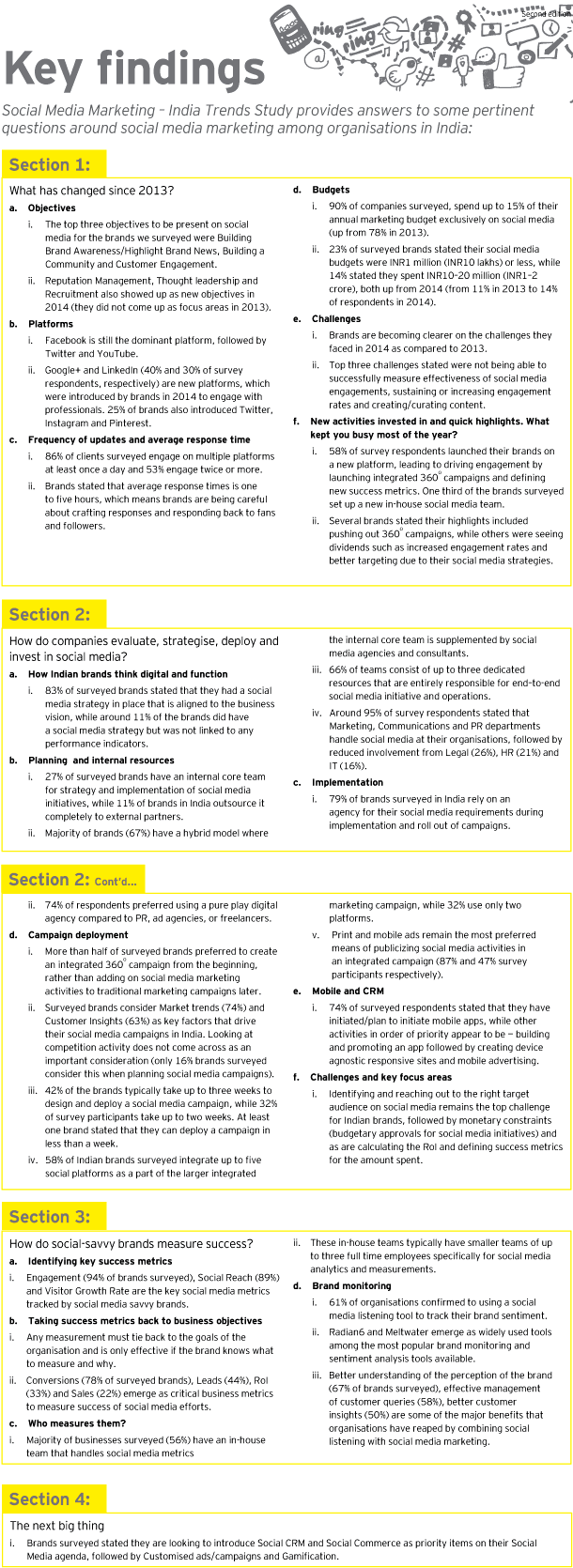
    The second annual Social Media Marketing India Trends released by EY has found that brands have significantly increased their social media spends even as they find it challenging to measure the effectiveness of their social media engagements.


    The study analyses how Indian marketers and organizations have been using the various social media platforms and how they go about tracking the performance of their social media initiatives. Brands across industries have realized the significance of social media and its peculiar demands. About 90 per cent of organizations reached out to in this study are planning to spend as much as 15 per cent of their annual marketing budget exclusively on social media, up from 78 per cent organizations in 2013.


    The study also addresses the key issues faced by digital marketers across sectors, attempts help them understand, leverage and navigate the social media space better. There is a distinct need for brands to analyse their maturity levels and explore disruptive opportunities for growth in the digital arena.


    This edition of the study focused on current and emerging social media platforms, how companies evaluate, strategize and deploy investments in social media, how social-savvy brands measure success and the outlook of social media marketing. Digital and social media presence is a key element in the marketing mix of most brands.


    It was also found out that social media is being increasingly used for thought leadership and internal communications, recruitment, and CSR in addition to marketing. About 35 per cent of the organizations said that they use social media for thought leadership and around 27 per cent said they use the medium for CSR. Increasingly the HR department is leveraging social media for internal employee outreach through unique platforms.


    Speaking about the study, Dinesh Mishra, Partner and Customer Practice Leader (India), Advisory services, EY, said: “Through this study we reached out to India’s top social and digital savvy brands from the third quarter of 2014 to January 2015. It is our observation that while brands have invested financially and in processes, there is a need for holistic customer engagement and strong community building strategies through the use of social media. That, in my mind, will strengthen the brand and allow for innovative and meaningful interactions between communities, as well as between the company and the community.


    “About 32 per cent of digital-savvy brands in India depend on the internal core team for strategy but the average team strength is small varying from 1-3 people. Given the mass reach and quick response time in social media, ownership plays a critical role in success. Every organization irrespective of size must focus on developing capabilities and creating a strong internal governance framework.”