Category: ADVERTISING

  • China, India to drive growth of global advertising market

    By Samidha Sharma


    Emerging markets like China and India will drive growth for the $464-billion global advertising market in 2012, according to Publicis Groupe, the third-largest communications group in the world.


    India (the 16th biggest ad market in the world), along with China, Russia and Brazil , over next three years, will account for 33% of the global ad expenditure growth, said a report by Publicis’ media agency ZenithOptimedia, released on Monday.


    Buoyed by this growth the French advertising conglomerate , owner of agencies like Leo Burnett and Saatchi & Saatchi, is on course to triple its business in India over the next three years, said Jean-Yves Naouri, COO & Executive Chairman of Publicis Worldwide. “In the next five years, India is expected to be among the top ten ad markets in the world,” Naouri, told TOI. Naouri is tipped to take over from Maurice Levy who has been at the helm of the Paris-based group for over two decades now.


    “For us growth will come organically, and also through acquisitions if we do not have the scale and capability in some areas. But so far we are progressing very well as far as closing the gap with WPP goes,” Naouri added. Publicis Groupe took over Gomye, a Chinese full-service digital agency, last week and has made several acquisitions in the local market there but has not replicated the model in India . China is already a top five market for the group.


    In Mumbai, for the annual board meeting, he said the importance of India is growing as now many of its agency heads in India are directly reporting into the headquarters . “We are not talking of Asia-Pacific as a region, now India and China are reporting directly to the group. It’s a sign that these are the markets for the future. I am spending most of my time in these countries be it Mexico, China , Brazil or India,” he said.


    With the growing focus on India, the group may also look to increase its digital offerings here, through the introduction of Razorfish, which it acquired from Microsoft for around $530 million in 2009. Revenue from the digital stream for the group globally touched 30% this year while developing markets contributed as much as 25% to the overall revenue. “We have been pretty much ahead of the curve in the digital space with Digitas already present here, we may look to expand our portfolio but it is not a necessity,” he added.


    Referring to the forecast made for 2012 by its media agency, he said the slowdown in the Western markets had not impacted ad spends like it did in 2008. ZenithOptimedia said the global ad expenditure will grow 4.7% in 2012 up from 3.5% in 2011 accelerated by the Olympics, the European Football Championships and the US Presidential election.


    “Businesses are cautious as the debt crisis has hit us hard but the impact is pretty moderate. In India, the inflation rate has been high and the growth has slowed but so far our agencies have performed pretty well with a double digit growth,” Naori said.


    Source:The Economic Times

    Copyright © 2011, Bennett, Coleman & Co. Ltd. All Rights Reserved

  • The world according to JWT, in 2012


    By A Correspondent


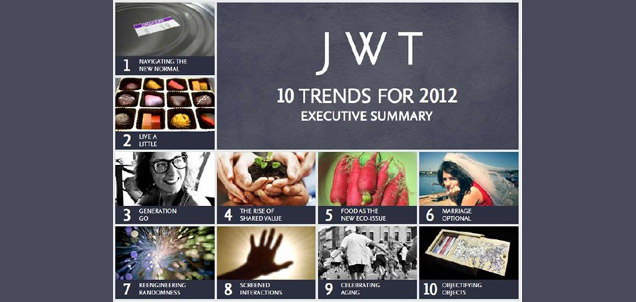
    Ad hotshop JWT feels that in 2012, the economy will push brands into opening up more entry points for cost-sensitive consumers as the “new normal” becomes a prolonged normal in the developed world while at the same time, tough times will generate an unprecedented entrepreneurialism, with the so-called Lost Generation of youth becoming a uniquely resourceful group that creates their own opportunity. The above findings and plenty more, are the result of their annual forecasting exercise – the seventh in the series – of key trends that will drive or significantly impact consumer mindset and behaviour in the year 2012.


    JWT’s ’10 Trends for 2012′ is the result of quantitative, qualitative and desk research conducted throughout the year for the report. It includes inputs from nearly 70 JWT planners across more than two dozen markets and interviews with experts and influencers across sectors including technology, luxury, social responsibility and academia.


    “With our annual trends forecast, we aim to bring the outside in-to help inspire ideas beyond brand, category and consumer conventions-and to identify emerging opportunities so they can be leveraged for business gain,” remarked Ann Mack, director of trendspotting for JWT. “Trends, like any complex and dynamic human phenomenon, are not preordained-once they are spotted, they can be shaped.”


    Previous trends that have been forecasted over the past years include: “De-Teching” in 2011 (more people logging off, at least temporarily, to get a break from technology); “Location-Based Everything” in 2010 (the explosion of location-based or -aware services that leverage data from mobile phones); The Small Movement” in 2009 (the shift away from “bigger is better” in everything from homes to cars to mobile technology); and “Radical Transparency” in 2008 (the “nothing to hide” ethos seen in some online behaviours).


    The top 10 trends that have been predicted for 2012 are as follows:


    1. Navigating the New Normal

    As the new normal becomes a prolonged normal in the hampered developed world, more brands in more categories will open up entry points for extremely cost-sensitive consumers. Marketers will find new opportunities in creating stripped-down offerings, smaller sizes and otherwise more accessible products and services.


    Example: In the US, Heinz is introducing several reduced sizes at a suggested retail price of 99 cents, including a 10-ounce ketchup pouch and a 9-ounce yellow mustard, as well as mini Worcestershire and Heinz 57 sauces.


    2. Live a Little

    Faced with constant reminders about what to do (exercise more, eat better) and what not to do (smoke, overspend), and fatigued from several years of austerity, consumers will look for ways to live a little without giving up a lot. People have been exercising more self-control, and increasingly they are looking to let loose once in a while: indulging in sinful things, splurging on treats and escaping from today’s many worries.


    Example: Whiskey in South Africa, premium beer in the U.K and cheap eclairs in India are small indulgences that consumers with little to spend are enjoying.


    3. Generation Go

    While twenty-somethings in the developed world feel they’ve been dealt an unfair deck, many are finding opportunity in economic adversity. Out of continued joblessness or discontent with the status quo will spring an unprecedented entrepreneurial mindset, enabled by technology that obliterates traditional barriers to entry. A so-called Lost Generation will transform itself into a uniquely resourceful cohort.


    Example: More than half of Millenials in the US agreed that if they lose or have trouble finding a job, they’ll start their own business, according to a JWT survey, up from 25 percent in 2009.


    4. The Rise of Shared Value

    Rather than simply doling out checks to good causes, some corporations are starting to shift their business models, integrating social issues into their core strategies. The aim is to create shared value, a concept that reflects the growing belief that generating a profit and achieving social progress are not mutually exclusive goals.


    Example: Philips is partnering with the Dutch government in a bid to provide affordable, sustainable energy solutions to some 10 million people across 10 sub-Saharan African nations by 2015.


    5. Food as the New Eco-Issue

    The environmental impact of our food choices will become a more prominent concern as stakeholders-brands, governments and activist organizations-drive awareness around the issue and rethink what food is sold and how it’s made. As more regions battle with food shortages and/or spiking costs, smarter practices around food will join the stable of green “best practices”.


    Example: U.K. supermarket Sainsbury’s featured a summer promotion in 2011 offering customers who asked for cod, haddock, salmon, tuna and prawns an alternative, more sustainable species such as herring or mackerel for free.


    6. Marriage Optional

    A growing cohort of women is taking an alternate life route, one that doesn’t include marriage as an essential checkpoint. Both in the West, where this trend is building, and in the East, where it’s gaining momentum, “happily ever after” is being redefined as a household of one, cohabiting or single motherhood.


    Example: In 2010, a third of Japanese women entering their 30s were single, while 37 percent of all Taiwanese women 30-34 were single.


    7. Reengineering Randomness

    As our individual worlds become more personalized and niche-and the types of content, experiences and people we are exposed to become narrower-greater emphasis will be placed on reintroducing randomness, discovery, inspiration and different points of view into our worlds.


    Example: Airtime, due to launch at the end of 2011, is being touted as a random real-time video chat platform where strangers will be “smashed together”.


    8. Screened Interactions

    More flat surfaces are becoming screens, and more screens are becoming interactive. Increasingly, we’ll be touching them, gesturing at them and talking to them – and becoming accustomed to doing so as part of our everyday behaviours. This is opening up novel opportunities to inform, engage and motivate consumers.


    Example: In New York, a restaurant at high-end department store Barney’s features 30 individual screens in a large communal table that’s covered in glass; diners can digitally order their meal, then browse the store’s catalogue while eating.


    9. Celebrating Ageing

    Popular perceptions of ageing are changing, with people of all ages taking a more positive view of growing older. And as demographic and cultural changes, along with medical advances, help to shift attitudes, we’ll redefine when “old age” occurs and what the term means.


    Example: To appeal to Gen Xers and Boomers, Polish beer brand Zywiec launched a campaign with the tagline “The best is ahead of you”. Commercials showed older male celebrities including actors, a boxer and a cartoonist, speaking about their lives, offering insights and advice.


    10. Objectifying Objects

    As objects get replaced by digital/virtual counterparts, people are fetishiZing the physical and the tactile. As a result, we will see more “motivational objects”, items that accompany digital property to increase perceived value, and digital tools that enable creation of physical things.


    Example: Sincerely’s Postagram app allows vacationers and others to turn snapshots into snail-mailed postcards. Similarly, Postcard on the Run reminds potential users that for recipients, a physical card is “a real keepsake they can hold close to their heart, put up on the fridge or display at work”.
  • The Anchor: 5 reasons you know your OOH campaign is working

    By Ishan Raina


    #1 Flexicreation:

    The medium offers an advantage of Flexicreation i.e. creating customized ads and content according to the medium. This can be done by customizing the existing ad for the medium or digitizing an existing ad / leaflet and making it an audio visual ad. Flexicreation for the same medium is impossible in any other audio visual medium. The future will be and has to be the contextualization of the content and advertising messages. For Colgate, we customized the ad for the medium by highlighting the important messages to make it more impactful.


    Example – Colgate Pro-Sensitive Relief:

    Ad Recall: Of the people who had seen the ad 39 % have linked it correctly to Colgate Sensitive Pro – Relief.

    Reach Builder: 32% of the respondents (in the exposed set) were exposed to the ad for the first time through OOH MEDIA screens.


    #2 Flexicasting:

    OOH Media has been the most flexible medium today and gives a chance to slice and dice the message of the campaign as per the kind of audience an advertiser would like to reach. The client can select the locations, cities, frequency and language as per their requirements. Flexicasting provides an advantage of getting as local as possible just like an outdoor but with the power and capability of Audio-Visual. Other mediums are struggling with it and it comes naturally to Digital OOH. For Maruti, we used Flexicasting to advertise different brands in different locations to reach the correct audience.


    Example – Maruti

    Screen Recall: More than 90% of the respondents recall seeing OOH Media screens

    Ad Recall: 65% unaided recall of the ads on OOH Media.

    Reach Builder: 45% of the respondents were exposed to the ad for the first time on OOH Media


    #3 Content Integration:

    Content Integration helps in creating a contextual connect for the brands. The role of content is thus becoming very important in this medium and OOH Media continuously experiments with content to make it more relevant for the audiences and thus attracting more eyeballs. We have always been creating many on-screen properties which are topical, social or based on current happenings. Content Integration is another important area with a huge scope of dynamism and properties like travelogue, home-sweet-home, calorimeter, Green horns etc creating L-Band, Aston Band with the brands which helps them build a perception rather than direct selling. OOH Media customizes in-house content as per the client’s requirement and offering to make it contextual. For GSK- Horlicks Foodles we had created an L-Band on the Content Property called Caloriemeter which was the calorie consumed in the food and Foodles was talking about healthy and tasty eating habits on the LBand.


    Example: GSK Horlicks Foodles:

    Screen Recall: More than 100% recall for OOH Media screens

    Ad Recall: 69% of the respondents recall seeing the Horlicks Foodles ad at a Spontaneous Level

    Reach Builder: More than 24% of the respondents at work and play were exposed to the ad for the first time on OOH Media


    #4 Static Fabrication:

    Static Fabrication is one of the important aspects developed lately. Any brand offering is fabricated around the screens in the static format to create a better impact and creates the visibility for the brand 24 X 7. While the campaign runs on the screens, the static fabrication around the screens adds to the visibility. For Samsung, had advertised for Galaxy Tab in selected screens to reach the target audience and had done static fabrication on these screens to create hype for the brand.


    Example: Samsung Galaxy Tab Campaign:

    Screen Recall: More than 100% recall for OOH Media screens

    Ad Recall: 43% of the respondents recall seeing the Samsung Galaxy Tab ad at an unaided level.

    Reach Builder: More than 26% of the respondents at work and play were exposed to the ad for the first time on OOH Media


    #5 Vicinity Marketing:

    Vicinity Marketing is something that can be used very well by clients in this medium and is ideal for retail. This helps in creating awareness about the brand or the offer in the vicinity to drive footfalls. We have a lot of case studies where the use of vicinity marketing has resulted in the increase of footfalls. Citibank, did Vicinity Marketing for high net worth individuals by selecting limited screens with a very high exposure in Mumbai, Delhi NCR.


    Example – Citibank Reward Points:

    Screen recall: 100% of the respondents recall seeing the OOH Media screens

    Ad recall: 80% recall amongst 157 people who were interviewed of which 52% recall it at a TOM level and 93% recall it at an unaided level


    Reach Builder: OOH MEDIA Reaches Out To MEDIA LIGHT/MEDIA DARK/HIGHLY MEDIA FRAGMENTED AUDIENCES : 35% Respondents Were Exposed To The Ad For The First Time On OOH Media


    Ishan Raina is MD and CEO, OOH Media (I) Pvt. Ltd.

  • 4 Indian names on Young Guns shortlists for 2011 awards

    By Shubhangi Mehta


    The shortlists for Young Guns 2011 have been announced and this year India has four nominations on the shortlist; Leo Burnett with three and Ogilvy with one.
    Leo Burnett’s Amod Dani and Ganesh Nayak have three nominations. Two for Tide Fold A Stain in the Art direction and Print Crafts category and one for Heinz Sketchup in the Consumer magazine campaigns category.


    Ogilvy & Mather’s Anupama Sirsalewal has received one for Unbearably Sour, Gun, Snake, Gullotine in the Illustration Campaigns category.


    Speaking on the shortlists, Arvind Sharma, Chairman Leo Burnett said, “We always believe in giving responsibilities to young and upcoming talent. We shall continue to do the same. We are happy that Amod and Ganesh are shortlisted in three categories and glad that the world is also recognising their talent”.


    On being nominated Amod Dani, ECD, Leo Burnett India, said, “The Young Guns award is a very prestigious international award. It is an extreme honour to be shortlisted for our efforts. We hope to convert this into a metal and continue to pursue creative excellence. Leo Burnett has always been at the forefront of promoting young talent, and this honour speaks a lot about the same”.


    Anupama Sirsalewal, Copywriter, Ogilvy & Mather, on her nomination said, “It’s a great feeling to be nominated. Piyush Pandey is God for me and I have grown up watching his ads, and now working in Ogilvy is anyway an award for me. This year has been great for me, be it Cannes Lions or Abby’s. Hope this one falls into my kitty too but there is still a long way to go.”


    Young Guns International Advertising Award is the world’s first and only award forum that is specifically for 18-30 year olds.


    To be named “Young Gun of the Year” is to be named the best young creative under 30 in the world.


    The “Young Gun of the Year” gets invited to join next year’s Young Guns jury.

  • The Anchor: 7 reasons why taking risks in ideas works

    By Rahul Mathew


    #1 You already took a risk by being in this business of ideas. You could have been working fewer hours for a lot more money in some other job. So why stop now?


    #2 It’s not an idea to begin with if it’s not brave. And how can you be brave if you don’t have a penchant for risks?


    #3 Considering the only other risk you will be taking on a regular basis is eating the canteen food, you might as well get a little adventurous with your ideas.


    #4 If a risk pays off, you’re a radical thinker. If it doesn’t, you’re a reckless one. Both of which are often used to describe rock stars. Safe and dependable sounds good for a condom.


    #5 There’s nothing like that incredulous/stupid/shocked expression on the face of a tight-assed client/account management/boss when you present such an idea. It’s worth the effort.


    #6 A more practical reason: There are fewer risk takers in the industry today. And many who don’t take any. So, who do you think will be able to negotiate better?


    #7 Most importantly, the biggest risk you would be taking in this business would be not taking any. It’s the one thing that keeps you and your ideas from becoming wallpaper in today’s media space.


    Rahul Mathew is the Executive Creative Director, McCann Erickson Mumbai.

  • Debrief: Thank you for the lesson

    By Anil Thakraney


    Tata AIG Life Insurance has released a new TVC to hawk their children’s ‘Gyankosh’ insurance plan, and I totally like this one. Instead of promising that our children’s future will be safe with Tata AIG Life, and that they’ll grow up to become doctors and engineers, the focus is on inculcating the right values in the kids.


    The commercial features a young family at the dining table. When the servant arrives to serve food to the kid, the dad demands that he must say thank you to the house help. The spoilt lad refuses, but the dad puts his foot down. Finally, after much prodding, the kid says thanks to the servant and learns a lesson he’ll hopefully never forget in his life. The VO explains that parents must focus on the right upbringing of their children and Tata AIG Life will worry about their future.


    [youtube width=”400″ height=”250″]http://www.youtube.com/watch?v=X9Hc7JcNLuc[/youtube]

    Good one. Very refreshing and unexpected communication. And very relevant for our times. Because Indian parents in general do not bother to teach good manners to their kids, and this is amply demonstrated by the little ones at public places.


    In addition the message emphasises the company’s core brand values. I also like the thoughtful execution… specially the part where the mother does not interfere when the dad is teaching his son a lesson. Wonder if all moms would do that in desi households.


    Rating: (On a scale of 1 to 5): 4. Also works nicely as a public service advert.

  • Remembering David Ogilvy

    By Sumit Roy


    As the Ogilvy India Alumni celebrates David Ogilvy’s 100th year at an event in Mumbai this evening, former Ogilvyian Sumit Roy pays a tribute to the Father of Advertising, and surely an inspiration for a million creative thinkers’. He shares with MxM India his experience of working with the ‘King of Madison Avenue’


    I have had the privilege of working with David Ogilvy when I joined Ogilvy & Mather as a copy trainee in the year 1973. This was my first job and what a training ground it proved to be! O&M is an institution which laid the foundation for my current avatar where I am the Founder Director of Univbrands showing people how to ride the brand communication motorcycle.


    It’s at Ogilvy I learnt about growing people who grow brands that is the driving philosophy behind Univbrands


    David Ogilvy’s relationship with his employees was just like that of a father with his children. Some of the lessons I have learnt from him have held me in good strength in my life and profession. One of my biggest learning is that he codified knowledge into slide and film presentations called Magic Lanterns which Ogilvy follows even now. It points out to things that works and not just idle words and the testimony to this lies in the outstanding works that Ogilvy does even today. He taught us that the consumer is not a moron; she is your wife thus teaching a huge lesson of valuing the consumer and not take him for granted. In fact, David Ogilvy used to often quote that Rules are for obedience of fools and the guidance of wise men (Douglas Bader).


    He also professed that one should always hire people who are better than you as it helps in the growth of the organization. Always look at qualities that are more than one had at a particular age and hire those people and we at Univbrands try to emulate this and have many talented people.


    I think being at Ogilvy at that time was like being at a University but the difference was that while you have to pay to get knowledge, here one earned knowledge. So the whole idea of earn as you learn that we at Univbrands profess has its genesis from David Ogilvy’s philosophy.


    I do endorse his saying that unless your ad is built around a big idea it will pass like a ship in the night. He also said that one should use their intellect to follow any principle and that would ensure that there is no repetition. Hence there should be a discipline of knowledge to the anarchy of ignorance. Another one his teaching that has stayed with me is that he professed that what we say is more important than how we say it. Somewhere today many are going wrong here as the focus is more on how you say it rather than what you say.


    David Ogilvy also said, We sell-or else and that is the foundation of advertising. It is not about the notion of reaching how many people but how much you spend for the prospect. That is the key of advertising which many tend to forget behind lofty ideas.


    I think every advertising professional should read his books as they are immensely relevant even in today’s world. While we may have progressed but the basics remain the same and that’s where David Ogilvy’s book come in useful. Every individual associated to advertising in some way must read his books which are treatise on advertising.


    David Ogilvy has been a great teacher and influencer and those who have not come in contact with him have missed a lot.


    Sumit Roy has spent 14 years at Ogilvy and is now Founder Director of Univbrands


    As told to Tuhina Anand

  • Rediffusion subcontracts Tata work to SBU with Edelman

    By A Correspondent
    We told you so. Rediffusion-Y&R and Edelman India announced a strategic alliance to take care of the Tata group business that starts today, November 1.

    The alliance brings together ad agency Rediffusion and PR firm Edelman. Edelman India is an independent public relations (as against others like Hanmer, Genesis and Sampark being part of international networks). The alliance will involve the formation of a separate business unit within Edelman to operate as Rediffusion/Edelman. Note: the SBU is part of Edelman. So, for all practical purposes, the Tatas have awarded the PR contract to Rediffusion which in turn has let it out to Rediffusion/Edelman. A spokesperson clarified that although the unit has been set up for the Tata account, in future it could also take on other businesses. A la Vaishnavi, which started out with the Tatas and took on other accounts.

    “The complexity of the Indian market favours an integrated communications approach that needs to seamlessly combine multiple marketing disciplines,” said Arun Nanda, Chairman and Managing Director, Rediffusion-Y&R in a communique. “Our partnership with Edelman allows us to partner one of the world’s finest PR companies and offer our clients the best in class thinking and capability in this area. This will enhance our already existing offerings in Advertising, Direct Marketing through Rediffusion/Wunderman, Media through TME/MPG and Digital. We will be able to add greater value to our clients across all of their marketing and communications requirements.

    “We believe this alliance will further enable us to push the boundaries of how PR is practised in India today” said Robert Holdheim, Managing Director, Edelman India in the statement. “We are seeing a significant shift in strategic stakeholder communications. An integrated marketing approach is crucial in addressing today’s communications challenges.”

    The spokesperson from Edelman was tightlipped about the staffing and who would be incharge of the SBU. It will evolve, he told MxMIndia.

  • Anil Thakraney: Sibal in Blunderland

    By Anil Thakraney


    I think Shri Kapil Sibal lives in a world of fantasy. Much like Alice in Wonderland.


    If you recall, the portly mantri made a sensational ‘discovery’ not too long ago. He claimed there was NO loss to the country in the 2G spectrum scam, and the figure being bandied about was in the media’s wild imagination. Yeah right, Alice.


    And now he’s back with another dreamy idea: To gag the internet. I guess the loyal minister had a wondrous vision the previous night in his journey to Wonderland. Where he imagined millions of Indians collectively sucking up to Sonia G and family, even as scams raged in her backyard. I like Kapilji’s idea of Wonderful India. Except that it in reality it isn’t Wonderful India. It’s Incredible India. Where politicians loot and plunder the nation freely, and lord over the junta on the basis of the good ol’ ‘Divide & Rule’ policy.


    In his fantasy, the mantri overlooked one critical ground reality: Leave alone the fact that it’s impossible to pre-screen millions of posts, the Indian Constitution guarantees every citizen the right to free speech. And when that right is misused, the courts decide on the fate of the alleged abuser. If we follow this principle when it comes to the traditional media, why must the digital media practise censorship?


    It’s simple, really: You defame someone, promote communal hatred or indulge in any writing/creation that’s illegal, you face a court trial and if convicted, you get punished. A tweet or a Facebook update can as easily be retrieved as a newspaper article or a television bite. In fact, Mr Suhel Seth is currently battling a lawsuit because of some allegedly defamatory tweets on ITC. So there you are.


    Basically, the man’s logic is so steeped in unreality, even little Alice would be confounded. What must worry us even more is that this nation is ruled by such fantastic ministers.


    ***


    PS: Great work from Coke. Very touching. Keep a handkerchief on standby.

  • Mediaah!: Aggie – well-deserved Impact Person of the Year

    By Pradyuman Maheshwari


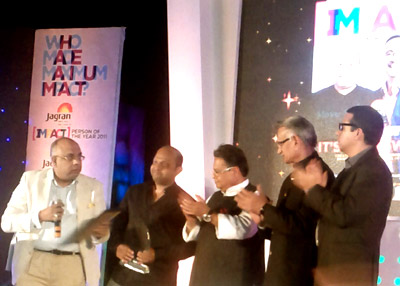
    So it’s Agnello Dias as Impact Person of the Year. For the first time in the seven-year history of Impact Person of the Year, an adperson has won the coveted accolade. Guess there have been times when people have come very close, but given the way the selection is done whoever is top of mind in the second half of the year, generally forges ahead (see disclosure).


    Deserving choice, and in every way echoes the sentiment of the industry. Aggie, with his Airtel ad, has been the toast of adland. I did a quick dipstick on Tuesday asking for names of the top creative folk in the country. The sample: 11 people from three metros. And this is what 90 per cent of the people said: Piyush Pandey, Prasoon Joshi and Agnello Dias.


    Feel sorry for the rest of the immense creative talent that India has, but guess these things happen and I don’t think anyone minds it. While Piyush is around, there is a laaarge creative pool at Ogilvy. Ditto in JWT, Mudra and the mom-and-pop shop based in Patna and Panjim.


    Should it have been one of the others?


    Haresh Chawla, outgoing Group CEO, Network18 and Viacom18

    Madhukar Kamath, MD & CEO, Mudra Group and Chairman, AdAsia

    Man Jit Singh, CEO, Multi Screen Media

    Rajiv Verma, CEO, Hindustan  Times

    Ronnie Screwvala, CEO and Founder Chairman, UTV

    Sandeep Goyal, Non-Executive Founder Chairman, Dentsu India

    Vineet Jain, Managing Director, Times Group


    Guess since it’s the fraternity who decides on who the award should go to, I think the question should be asked to each of us and not the exchange4media group management. For me, Agnello Dias represents the new face of Indian advertising. He is young, dynamic and has done some super work when with JWT and now as an entrepreneur running Taproot.


    What you can ask them (and the editorial team) is why they chose Haresh Chawla as Editorial Choice and not Vineet Jain, Sandeep Goel, Ronnie Screwvala, Man Jit Singh, Rajiv Verma and Madhukar Kamath? I think Haresh Chawla deserved it awesomely and since he’s moving out of the Network/Viacom/Web/etc 18 group, there can be no nasties like he was given the award to get more ads.


    So just as you may ask as to why cricketer x wasn’t selected for the Australia series, there will be questions asked as to why Haresh and why not Vineet Jain or Ronnie or Madhukar or Rajiv Verma or Sandeep Goel or Man Jit Singh?


    Pointless discussion. Many congratulations to Agnello Dias and Haresh Chawla.


    (Disclosure: I worked with the exchange4media group until May this year and ran the Impact Person of the Year for the last three years)

    Photograph: Bharat Kapadia


    The PR Channel

    Must mention here that I have been think of a specialised PR publication ever since Hanmer & PR founder-bossman Sunil Gautam asked me a question of whether it would work here in India. I didn’t think it would as a standalone, but in a broadbased site like MxMIndia, it should.


    SRK: India’s biggest endorser

    His Ra.One may not have worked as well as he would have, but the publicity around it was phenomenal. Clearly the biggest we’ve seen in India. Little wonder that an Economic Times report says that SRK emerged as the most visible celeb on TV followed by Katrina and Kareena. I missed reading it in the Mumbai edition of ET, but here’s a web link: http://economictimes.indiatimes.com/news/news-by-industry/services/advertising/shah-rukh-khan-fmcg-cos-lead-tv-advertising-charts/articleshow/11041079.cms


    Buzz me if you have a story to tell and gossip to share. Confidentiality assured. Andar ki baat will stay under. There are various ways you can reach me: pradyumanm[at]mxmindia.com, BBM @ 23050B5D, pradyumanm[at]gmail.com, @pmahesh, 98338 76278.


    Disclaimer: Although Pradyuman Maheshwari is CEO of MxMIndia other than being editor-in-chief, he chucks those hats while writing Mediaah! So, the views expressed here are entirely his own and not those of the website and the team that runs it (especially the National Sales Head!).

  • Keep those 3D glasses handy. TVCs set to add that extra dimension

    By Ameya Chumbhale


    Hollywood has mastered it. Bollywood swears by it. Now it’s the turn of advertisers to take to 3D and add a new dimension to marketing.


    So, if you watch Don 2 in 3D later this month, there are chances that besides the don, Zoozoos and Axe girls too may appear within touching distance. That’s because several marketers are working on 3D commercials to cash in on the technology’s increasing popularity.


    “Today, you name any brand that is advertising on TV and it’s asking for an additional 3D version for their commercial,” says Mr Bhaarath Sundar, visual effects CEO and advertising partner at Prime Focus India.


    An advertising official says Hindustan Unilever, GlaxoSmithkline, Vodafone and Tata Motors are all working on 3D commercials to be released shortly, but none of the companies confirmed this.


    Post-production companies such as Pixion, Maya Digital and Prime Focus said they are busy producing 3D commercials for Indian companies for release early next year, but refused to name any of their clients.


    Mr Rajesh Mishra, CEO (Indian operations) of digital film distribution company UFO Moviez, said 3D advertising will become big in the country within 6-8 months. “Producing 3D content is expensive but brands can afford it because commercials are shorter in duration, lasting anywhere between 10 seconds to one minute,” he said.


    The main driver for this rush for a third dimension is the popularity of 3D films. While at least one 3D film from Hollywood is hitting the screen every month, Indian filmmakers too are joining the rush with about 10 local language 3D films in various stages of production or post-production.


    Mr Merzin Tavaria, co-founder and chief creative director at Prime Focus, says, “As numbers of 3D films grow, so shall 3D advertising.” His firm has refurbished its facility at Khar in Mumbai to handle the growing 3D needs of the advertising sector.


    Of all the commercials shown during the screening of Ra.One the one that stood out the most was the 3D commercial for Google Chrome.


    Mr Harish Shriyan, managing partner of OMD India, a media buying arm of Omnicom Group, says greater recall value and greater connect are among the advantages of 3D advertising.


    Mr James Stewart, a 3D filmmaking pioneer and founder of Canada-based Geneva Film Co, recently quoted multiple studies by ESPN, Xpand and Texas Instrument to say 3D ads delivered 92% recall among viewers and viewer retention was on an average 15% higher than normal ads.


    But there is one overwhelming disadvantage: Cost. Post-production prices, or the cost of converting 2-D film into 3D, to create a regular 30-second commercial could be anywhere between 6-12 lakh. This would mean 50%-80% additional cost on a normal advertisement.


    That kind of extra expense only for exposure to cinema halls showing 3D films could make several marketers turn their backs on the idea at a precarious time when the economy is slowing.


    “I’m certain that a lot of people start with the idea of exploring 3D advertising for brands, but the idea is usually abandoned in the first few meetings with clients and production houses. The cost is substantially more than 2D,” says Mr Sajan Raj Kurup, founder and creative chairman of Creativeland Asia, which recently created a 3D campaign for Audi A8 luxury sedan. “The question to be asked is does the idea really warrant the extra dimension, and is the extra cost justified,” he says.


    Durables brands Whirlpool and Panasonic aired 3D commercials during the live 3D screening of the Indian Premier League twenty20 cricket tournament in April. “We were the first company to make a 3D ad in India,” says Mr Shantanu Dasgupta, VP, corporate affairs at Whirlpool India. He, however, says the company is not planning more 3D commercials because it’s focusing on TV as a mass medium. “You really cannot have a 3D ad on TV, at least today.”


    Experts expect most marketers to stay lukewarm about 3D commercials until 3D television catches up. But it may take years in a country where HDTV, a natural precursor of 3D television, is in a fledgling stage with only a few high-definition channels in the country.


    “There is still a lot of time for TV getting captured by 3D advertising,” says Mr Josy Paul, chairman and national creative director of advertising agency BBDO India. He says 3D advertising starts from outdoor before graduating to in-camera.


    Source:The Economic Times

    Copyright © 2011, Bennett, Coleman & Co. Ltd. All Rights Reserved

  • The Anchor: 5 reasons mobile advertising hasn’t gained momentum

    By Damandeep Soni


    #1 Digital is seen as an afterthought in the overall media plan. Ditto in the case of Mobile. While everyone talks about it, thinks about it and wants to do Digital, traditional media momentum starves marketers of time to think about utilizing the mobile medium. Many agencies often fail to recognize the importance of Mobile and miss out on opportunities to engage their audience.


    #2 You need a different mindset to think about engagement models using Mobile. It’s much more personal than other media consumption devices. A video, for example, created for a mobile ad should be very different from a TVC as there can be a huge amount of engagement hooks built for Mobile. While Mobile offers advertisers new opportunities for interacting with consumers, many agencies just use their web creatives for mobile ads. A lot more needs to be thought out on in-app experiences, mobile-optimized sites or landing pages rather than just repurposing creatives.


    #3 Apps have only started to take off in India very recently. In-app inventory is yet to be fully utilised. Smartphones have started making significant inroads into the country, which means apps (specifically Android apps) are set to proliferate. With a sizeable population of smartphones, an in-app ad revolution is around the corner.


    #4 Brands that are using Mobile are still thinking about the engagement model with the user – the push v/s pull debate. Do you show the user a location-specific advertisement when he is in a locality (and will that become an annoyance to the user and will he start ignoring the ad?) or do you want the user to pull the ad after checking in, using a service like Foursquare, and will there be enough users who would want to do this?


    #5 Lack of mobile sites is another issue. Most brands do not offer a tablet/mobile optimized experience to the user. Hence, even if they embark on a mobile campaign it does not give them the expected results.


    But it’s not all doom and gloom. Mobile advertising will pick up in the next two to five years. In India we are still in the early adopter stage of mobile advertising. However, once brands get to know of the engagement stats and get innovative with campaigns, there is no turning back. After all, even today, a person is six times more likely to click on mobile banners.

     
    Damandeep Soni is Vice President, Global Sales and GTM, Percept Knorigin.