Category: ADVERTISING

  • Creativeland appoints Srijib Mallik as COO

    By A Correspondent


    Srijib Mallik

    Creativeland Asia, India’s leading communications community, has announced the appointment of Srijib Mallik as COO of the company. Mr Mallik will initially set up and front expansion plans in the Delhi NCR region before driving the growth agenda internationally.


    Said Sajan RaJ Kurup, Founder and Creative Chairman, Creativeland Asia on the announcement: “It is wonderful to have Srijib as a part of the Creativeland community. His passion for creativity, sound business acumen coupled with an equal ease in both national and international sensibilities made us choose him after a vast search. There are exciting times ahead.”


    Sajan Raj Kurup

    Added Mr Mallik: “I am thrilled to be a part of Creativeland. The work is outstanding. And the culture, brilliant. My agenda will be to leverage the Creativeland equity, nurture our culture of ‘Good Creative Upbringing’ and drive our business across markets.”


    Mr Malik comes in with more than 15 years of advertising and marketing communications experience across W+K, London & India, Saatchi & Saatchi, Publicis, Singapore & India, and JWT, India, among others. His most recent title was as head of Bates CHI & Partners for Delhi and Mumbai. He has worked on brands including Pepsi, Nokia, HP, Cisco,  Pizza Hut, Royal Enfield, General Motors, to name a few. He is a Sloan fellow from the London Business School who dabbles in Vedic astrology and start up consulting.


  • Awards for excellence in printing announced

    By A Correspondent


    Buoyed by the success of the PrintWeek India Awards from 2009 to 2012, Haymarket Media India, has announced the PrintWeek India Awards 2013 to recognise excellence in the Indian print industry.


    This edition of PrintWeek India Awards 2013 is supported by industry majors including AGS, Bobst, Canon, Dupont, EFL, Epson, Galaxy Propac, Henkel, ITC PSPD, Kala Jyothi, QuadTech, Roland, Skyscreen, Sona Commercial, TechNova, Vinsak and Welbound Worldwide.


    There are two types of Awards: the ‘Quality Awards’ which judge the quality of output from different sectors, such as labels, magazines, catalogues and posters and the ‘Performance Awards’, which are judged on financial performance, strategy, capital investment and training programmes. Within those Awards types, there are 25 categories in all with the choice of multiple entries.


    The jury for judging the entries and samples will be drawn from a wide spectrum of print buyers, print specialists, professionals, designers and technologists. Last year it consisted of professionals from Aditya Birla Group, Olive Design, Max Mueller, Grey Barclays, HUL, JWT, Leo Burnett and others.


    Speaking about the Awards, Suresh Ramakrishnan, publishing director, Haymarket Media India says, “Rather than piling the jury members with all the work, print firms were selective. They showcased the best and most relevant print jobs. I expect PrintWeek India Awards for 2013 to be bigger and better than those from 2009 till 2012.”


    Last year, the PrintWeek India Awards saw 334 entries from 116 companies -which were judged by a 30-member jury.  The final date for sending in entries for the fifth edition of PrintWeek India Awards is July 15, 2013.


  • Debrief: National Population Register: Hello Early Nineties!

    By Anil Thakraney


    I have a bad feeling we are living in the early nineties. Madhuri Dixit is back, so is Anil Kapoor, and so is Sridevi. And the BJP is talking about Ayodhya all over again. Soon we’ll hear Sanjay Manjrekar is back in the Indian team. Not to be left behind, here’s an ad from the glorious past.


    If you are a new entrant to advertising, watch the commercial from the National Population Register very carefully. It will give you a good idea of the generally crappy television advertising we used to produce back then. A tired, laid-back, sleepy jingle. Indians from all walks of life doing the same activity, in this case, mud-slinging (though the copyright for that now belongs to Shri Arnab Goswami). And each visual a bloody living, breathing ad cliché. I have to say this must easily be the most annoying advert currently on air, and it’s on air all the time because we taxpaying idiots sponsor this trash. Each time it comes on, I want to fling some mud at my television set.


    So if these guys want us to register our names for the census, they should tell us why it’s important for us to do so. The communication trigger should be this and only this: Dude, you don’t sign up, you are screwed, and this is how you get screwed. It’s as simple as that. This is what will result in consumer engagement. Instead, these dolts have gone back into the past to re-create its worst. I’d rather register for the Pakistani or the Bangladeshi census.


    Rating: (On a scale of 1-5): 0. Poora paisa mitti mein mil gaya


    Anil Thakraney is a senior journalist and commentator. He is also Editor-at-Large, MxMIndia. The views of the writer are his own. He can be reached via Twitter at @anilthakraney


  • DDB MudraMax sweeps OAA outdoor awards

    By A Correspondent


    DDB MudraMax has bagged 17 awards including the coveted ‘Campaign of the Year’ and ‘Innovation of the Year’ titles at the recently concluded Outdoor Advertising Awards 2013 held in Goa.


    The Campaign of the Year title was given to Volkswagen’s  campaign titled ‘Post-It’ and the campaign for Adventure 18 titled ‘Window Washers’ bagged the Innovation of the Year.


    Commenting on the win of 8 Gold, 5 Silver and 4 Bronze awards, Pratap Bose, COO, DDB Mudra Group, said, “It’s a great result for the brave clients that we work with and a great thumbs up for the best Out of Home team in the country.”


    Information not verified as MxMIndia was not invited to the awards


  • Mahesh Bhupathi wins a Brand Slam with Andrew Murray

    By Ravi Teja Sharma


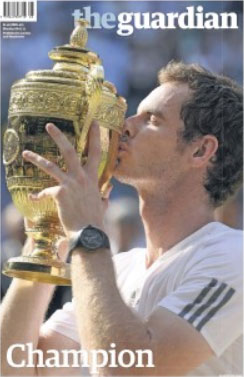
    An unlikely winner from this year’s Wimbledon is Indian tennis pro Mahesh Bhupathi whose company Globosport had signed up to manage the commercial interests of the new champion Andrew Murray a few months ago.


    Mr Bhupathi was in the box at the Centre Court for the finals on Sunday and was seen hugging Mr Murray’s mother after the Scot beat world number one Novak Djokovic in straight sets to become the first Briton to win Wimbledon in 77 years.


    Mr Murray’s win is a shot in the arm for Globosport, which is mandated to develop the tennis star’s off-court interest globally, with a specific focus on Asia and the Middle East, following a tie-up with London-based XIX Entertainment.


    Run by British entrepreneur, artist manager and the creator of the Idol franchise Simon Fuller, XIX has been managing Murray’s commercial activities since 2007.


    A person close to Mr Bhupathi said the world number six doubles player and the Globosport team led by his sister Kavita Bhupathi are working on a few contracts for Mr Murray. “A few discussions have happened with brands in recent months and some negotiations are at an advanced stage. There could be some announcements soon,” said the person, who did not wish to be named.


    The person did not confirm if any of the deals being signed are with brands in India. Mr Bhupathi, who is in London, declined to comment. Celebrity managers say Mr Murray’s win is a golden opportunity for Mr Bhupathi, particularly to grow his business abroad.


    “This is a great opportunity for Mahesh. I hope he has a business plan in place and he strikes when the iron is hot,” says Bunty Sajdeh, the chief executive officer of Cornerstone Sport & Entertainment, referring to Mr Murray’s win this Sunday.


    The head of another Mumbai-based sports marketing firm says Mr Murray’s win will help create a positive profile for Globosport in international markets and in India. “But it will all depend on whether he is able to get contracts for Murray.”


    India, where cricketers dominate the market for sports endorsements, will be a difficult market to crack for Mr Murray. “If he gets business for Murray, I am sure there will be more tennis players, especially in Asia, lining up to do business with Globosport,” he says.


    But since the mandate is a global one, and Asia and the Middle East are untapped territory as far as Mr Murray is concerned, the task is certainly cut out for Mr Bhupathi. After losing his first four Grand Slam finals, Mr Murray last year won the Olympic gold medal in London as well as the US Open in New York.


    There have been talks of Mr Bhupathi retiring after 2013 to focus on business. He is among a clutch of Indian tennis players including the Amritraj brothers and Leander Paes who have dabbled in business with a fair bit of success. His company has helped multiple brands connect with sports and Bollywood stars such as MS Dhoni, Saina Nehwal, Sania Mirza and Aamir Khan.


    Earlier this year, Mr Bhupathi had unveiled a plan for an International Premier Tennis League in the lines of Indian Premier League twenty20 cricket tournament and the World Team Tennis that was run in the US in the 70s. The league will have teams in eight cities and will be played during the offseason starting 2014.


    While some feel this plan is terribly ambitious on Mr Bhupathi’s part, the league is said to have commitments from star players like Djokovic, Rafael Nadal, Serena Williams, Maria Sharapova and Victoria Azarenka. Andy Murray too is on board now.


    There have also been talks of Messrs Murray and Djokovic getting equity stake in the tennis tournament, which already has investors like ATP board members and former players Justin Gimelstob and Boris Becker.


    Source:The Economic Times

    Copyright © 2013, Bennett, Coleman & Co. Ltd. All Rights Reserved

    Licensed to republish

     

  • Draftfcb Ulka creates new campaign for Indigo eCS

    In keeping with the marketing objectives of the Indigo eCS, Draftfcb Ulka has created an advertising approach where the new product features are aptly highlighted in light of the ‘new attitude’ of the Indigo eCS. The 30-second TV commercial features a first-of-its-kind ‘car flash mob’.  A group of young executives perform a series of dramatic synchronized stunts at a bustling corporate park.


    On the rationale behind the campaign, Kartik Smetacek, Group Creative Director, Draftfcb Ulka, said, “The task was to give the car not just a new positioning, but also a new personality. So while the commercial is designed to showcase the car and all its updated features, it’s also designed to engage with a new generation of potential customers.”


    Mr. Virat Khullar, Category Head – Sedans said, “Indigo eCS comes as a refreshing option for the young ambitious professional who seeks an aspirational offering. The car redefines the category with over a dozen first in class attributes.”


    Ranging from popular television channels, to print, outdoor and online, the 360-degree campaign endeavours to maximize the experience of the new Indigo eCS at various touch points.


    Credits:

    Client: Tata Motors

    Agency: Draftfcb Ulka

    National Creative Director: KS Chakravarthy (Chax)

    Group Creative Director: Kartik Smetacek

    Creative Director: Devendra Mankame

    Creative Team: Donovan D’Souza, Mayuresh Wagle, Tushar Sawant, Roshan Pawaskar, Vishal Rajpurkar

    Client Servicing: Kailash Kondath, Sneha Shenoy, Ekta Verma

    Planning: Sunil Shetty, Mayur Kaku

    Films: Alpa Jobalia, Stanley Christian

    Production house: Cutting Edge Pictures

    Director: Andrew Hardaway


  • Anil Thakraney: Need fresh gas on TV

    By Anil Thakraney


    All the Indian news channels have turned into clones of each other. It’s a pat formula on primetime: Run a quick snippet on a story with a reporter, this lasts for only a few minutes. Cut to the anchor who takes a clear, biased position on the subject. This follows a marathon session involving a ‘debate’ with many faces (always the same set), and the anchor’s key result area is to create friction and sit back and enjoy the gas blast. And hope for a pay rise.


    Why and when did news television become so moronically formulaic? And why are they all doing the same thing? Lack of imagination? Competitive pressures? I suspect it’s both, and also lack of respect for good journalism. I was talking to BBC’s Nick Gowing (for GQ), this is what he said: “Whenever I am invited to participate in a discussion on an Indian news channel, I make it clear that I will not shout at anybody. I think there’s a tendency to jump to a polarized view on air, as opposed to finding a more nuanced middle ground. And I find it interesting how opinionated the presenters can be. I wonder how long that may last. They do certain things which I wouldn’t and can’t do.”


    Mind you, Gowing, being a pucca gentleman that he is, presented a nuanced opinion. Am sure secretly he must be appalled at the way we are going about things. So is there any chance that sanity will happen on our news programmes any time soon? I seriously doubt it. This is because the ‘star’ anchors have grabbed the slots, and they will be reluctant to make way for new blood. There’s too much power and pelf being a TV anchor in India, not easy to delegate. So then what is the least they should do within the existing system? The answer is: Always invite fresh faces in the debates. We must get to hear new voices, and this should be easy, India is a vast country bustling with argumentative people. News production teams have to cut their sloth and find ways to inject new energies into the studios. And I use the word sloth because this is what typically happens: ‘Guys, we need to discuss the depreciating rupee, who can we quickly get as an expert?’ ‘Prahlad Kakar is available, should I call him? Also, Shobhaa De is free.’


    Point being, if we have to be stuck in a gas chamber each evening, can we at least be subjected to fresh gas?


    PS: Haha. So much for all those comments by ‘judges’ on reality shows. I can imagine Lata auditioning for ‘Aye mere watan ke logon’ and receiving this sort of feedback: ‘Energy level thoda kam tha.’ ‘Jyada mushy ho gaya, you need to tone down the emotion’. ‘Rocking performance! Lekin beech mein sur miss ho gaya, aap nervous ho gayeein.’


    Anil Thakraney is a senior journalist and commentator. He is also Editor-at-Large, MxMIndia. The views expressed here are his own. He can be reached via Twitter at @anilthakraney


  • Debrief: Renault Pulse: Pulsating with boredom

    By Anil Thakraney


    On Tuesday I reviewed the crappy census ad, and had said that the bad old nineties are back. As if to prove the point, Renault has signed up Anil Kapoor as brand ambassador for their hatchback called Pulse. Before I proceed further, I must share what Shah Rukh said to me in the year 2007. He said Anil Kapoor used to scoff at him for acting in TV commercials, boasting that he (Kapoor) would never do ads. Soon after the success of Slumdog Millionaire, Anil Kapoor was seen selling Mont Blanc pens, which must have made SRK snigger quite loudly. But at least that was a half decent ad. With Renault, the yesteryear actor has made a complete fool of himself.


    The idea isn’t terribly bad, but the rendition is awful. Kapoor borrows his son’s Renault Pulse, and this, well, sets his pulse racing. And he suddenly starts behaving like a ‘crazed teenager’, in his office and at his home. Extremely poor interpretation of pulse-racing, they could have had so much fun with it. To make matters worse, the direction sucks, the expressions are forced, and Kapoor ends up looking like a bumbling idiot. And because he ends up looking like that, as a viewer, my mind stays focussed on him, and the brand gets completely lost in the process. I don’t know, at the end of the commercial, what it is about the car that will send my pulse racing. Renault Pulse remains at the level of yet another hatchback in the market. In short, a total flop show.


    As for Kapoor, he should practice what he once preached to SRK: Stay away from advertising, more so if this is the kind of creative that sets his pulse racing.


    Rating: (On a scale of 1-5): 0. Poor script. Poor direction.


    Anil Thakraney is a senior journalist and commentator. He is also Editor-at-Large, MxMIndia. The views of the writer are his own. He can be reached via Twitter at @anilthakraney


  • Ogilvy’s ‘anti-boring’ TVC for Alpenliebe Pop

    By A Correspondent


    Leading confectionary player Perfetti Van Melle India (PVMI) has made yet another attempt to offer clutter-breaking advertising for its products.


    PVMI has launched a new TVC positioning its lollipop product, Alpenliebe Pop, as ‘Anti-Boring’ devices. The insight behind the ad stems from the fact that subjects like history and science are fascinating – but only to historians and scientists and not to the poor students who are forced to study them for their examinations. In the tongue-in-cheek ad film, Archimedes comes to life and offers the student an Alpenliebe Pop to deal with the boredom.


    Commenting on the launch, Nikhil Sharma, Director-Marketing, Perfetti Van Melle India said “In many markets across the world Lollipops have a significant consumption amongst youth while in India it is dominated by Kids. Seeing this as an opportunity, the challenge for us as leaders is to not only increase consumption among current users but also convert non users to users. This communication is hence targeted specifically at the youth and is based on an insight that they can easily relate to”


    Said Anurag Agnihotri, GCD, Ogilvy & Mather, the creative agency that handles the brand, “We borrowed the insight behind the ads from life. Every youngster, at some point or the other, grows bored of studying and says or at least thinks that if only he could get hold of the mathematicians, scientists etc. who formulated such complex equations, he would give them a piece of his mind.”


  • Ritu Midha: Deliberating CPT with a twist!

    By Ritu Midha


    While researching CPT and CPRP, I stumbled upon an interesting article in the September 9 , 2009 issue of Brand Equity. The article indicates that the cause of concern if any in implementing CPT-based pricing for FCT would be raised by the channels, while the advertisers and agencies would rather prefer it. Well, things sure have changed in the last four years with television owners in favour of CPT as agencies and advertisers are, as per reports, favouring CPRP.


    In internet advertising parlance, Cost Per Thousand is about number of impressions an ad placement generates.  However, as online advertising is coming of age, CPT or CPM is increasingly giving way to performance-based parameters – most basic of them being CPC or cost per click.


    CPT is a key factor in print measurement too with readership numbers being the main measurement force here.


    And now the push by media owners for CPT instead of CPRP. To an untrained brain like mine, none of these are really performance metrics for the ad, they are plain vanilla viewership metrics. Though it might be an uphill task to convert per cent ages to actual numbers or vice-versa, and hence the CPRP and CPT debate.


    Having said that, if CPT does not take into account time spent and stickiness, how does one know whether the ad has really been viewed or not. It, then, comes close to CPT in print medium.


    But what if CPT really takes into account the viewership profile – which from whatever I have read on the subject is going to happen – mapping the numbers to the target audience for a brand. If a brand wanting to target 18- to 25-year-old males can really identify that its ad was actually viewed by 20,000 men that age – and that’s how CPT is worked out! Utopia!


    That is how it works in the digital world when there is a call for action attached to the ad! Specific demographics and, in some cases, psychographics too!


    In the case of television, this is impossible as it is not a personal medium. But can the digitised universe now make it possible to track the actual number of households watching a show instead of it just being a sample survey? Even if it is only for 25% of the universe to begin with? Of course, factors like who is watching can be captured on a small sample size – like TAM does now – and be extrapolated.


    It might sound quixotic to many, but imagine if the same could be done, the amount of wastage that can be avoided is just not funny! And the planners too would have to put in a lot more effort just to figure which programme they should go for… as it would no longer be a small sample size-based reasonable error quotient, but nearly the entire universe.


    And if that is a possibility, we can then look at CPT being the common thread when measuring the consumer’s media consumption behaviour on a single measurement platform.


    Ritu Midha is a senior journalist and web strategist based in Mumbai. She is also Consulting Editor and Editor – Special Projects, MxMIndia.


  • 1 Minute View: TAM goes monthly for some. And weekly for the rest

    It’s a twist to the tale pulled out from the books of the various soaps that you see on entertainment television. After the tu-tu-main-main like the kind you find on news television, TAM has decided to offer monthly data and in the CPT format to those desirous of it. This is with immediate effect. However, those who don’t want that, will get it weekly.

     

    Bizarre. We asked a few media agency biggies and bizarre and weird are the words they used. And added: whether you report weekly or monthly, we will use the metric that we  think is appropriate for our advertisers.


    Evidently, we haven’t heard the last on this one. Also, the whole idea of two different sets of numbers coming in – weekly and monthly, could only lead to more confusion. Note this move is not a result of the series of meetings that the various stakeholders (the ISA, AAAI, IBF and TAM) have been having over the last few weeks. There is reportedy no consensus yet from those meetings.


    However, what is a welcome move is that a settlement has been found to the problem and all stakeholders can now wait for the BARC-managed measurement regime to commence.


    On its part, TAM – a joint venture of Nielsen and WPP-owned Kantar, issued a statement from a spokesperson saying: “TAM, purely as an act of professionalism, is fulfilling and respecting its contractual duties and obligations that it is bound by, with individual broadcaster clients. This decision is basis individual client letter requests received by TAM from only specific few TV Channels.  Data for all other TV Channels will be reported as earlier.”


  • Anil Thakraney: The Great Desi Soap Factory

    By Anil Thakraney


    In a two-part series, I shall examine the key challenges confronting the Hindi GECs, as well as the road map for the future. Today, let’s examine the current scenario.


    As I mindlessly surf the channels, I realize that not much has changed in the last decade plus. For years together so many critics and viewers have been carping about it, but it all seems to have fallen on deaf years. Almost all of the Indian television soaps are still stuck with the same old family dramas, the same old kitchen politics. Each year one channel or another launches a new serial that comes with the promise of freshness, it even starts nicely, but by the tenth episode the story regresses into a family natak, laced with plenty of cat fights.


    To understand this situation, let’s assume for a minute that the channel chiefs know what they are doing, that they aren’t stupid. The easy explanation is that audiences for television soaps essentially constitute housewives, and that these ladies like to watch gharelu khitpit. Well, this could be true to an extent. But then, housewives in America also like to watch Homeland and Prison Break, and by that logic, surely bored housewives out here would like to consume high octane stories. So to blame the viewer, as in ‘we are only dishing out what she wants’, is unfair. Think about this: The same housewife, when she goes to watch movies, prefers zippy, edgy, offbeat content… family dramas are a thing of the distant past in Bollywood. So why would she not want novelty in her soaps? The real problem is that so far, the Hindi entertainment channels have refused to take chances, they have played safe, and this has led to photocopy content across board. So it’s a problem of lack of courage.


    However, in the recent past, winds of change seem to have started blowing. Anil Kapoor is busy doing the desi version of 24. Amitabh Bachchan has begun shooting for a fictional TV show. Anurag Basu wants to create a new TV serial. Ekta Kapoor, the queen of family dramas, has launched the historical Jodha Akbar (though the family squabbles continue here too, not surprising that, Ektaji can’t avoid those!). Soon, other big stars, movie producers and directors will join the party, and that can only be great news for the Hindi GEC audiences.


    So can we look forward to an entertainment revolution on TV? Er, not really. Because the change, even if it happens on a large scale, will present its own set of problems and challenges. On Monday, we’ll discuss these, so have patience. When the subject is soaps, even I must be allowed to serialize the article. 🙂


    PS: Nice press ad from Apple. Good body copy, something that’s now extinct in India. I like how Apple has distilled its entire philosophy into simple words, so that the aam aadmi can connect with it. Another example why Apple is such a loved brand.


    Anil Thakraney is a senior journalist and commentator. He is also Editor-at-Large, MxMIndia. The views expressed here are his own. He can be reached via Twitter at @anilthakraney