Category: ADVERTISING

  • With animals, what you see is what you get. With human beings, it’s more complicated


    Make no mistake about this: Lynn de Souza has a soft, warm, chilled out, happy exterior. But inside that resides a steely, tough, hard-edged professional. And she needed all that internal strength to survive and thrive in an industry notoriously dominated by what she calls the ‘Old Boys Club’. Lynn and I go a long way back, and this made our conversation frank, fun and, yes, highly argumentative. And we discussed many issues ranging from the dubious media research, the future of various media, her role in promoting gender equality, her formula for cleaning up the otherwise scandalous Goafest. And why she, er, chooses dogs over men.  


    By Anil Thakraney


    What’s your exact job portfolio at Lintas?


    I look after Lintas Media Group, and our subsidiaries Karishma Initiative, Aaren Initiative and Lin TV. LMG and Karishma are media agencies, Aaren Initiative is the largest OOH agency and Lin TV produces and distributes branded content. I am responsible for their overall financial and reputation, health, corporate governance, etc.


    Who do you report into?


    Michael Wall, the global CEO of Lowe Worldwide.


    Would you not like a global role now, having been there and done that in India?


    Have I been there and done that in India? I don’t think so. India’s potential story is not even the tip of the iceberg, and I haven’t even travelled the whole tip yet! I would love to have a global role that is based out of India, because this is where it’s all happening. I am fiercely proud of India and all things Indian and it’s our time to show the globe a thing or two. We don’t need to be sitting in Manhattan or London to do that, in fact, that could be counterproductive.


    Would it be correct to say you’ve reached the top of the Indian media peak?


    More like the bottom of the ocean, which has the most beautiful creatures and colours in the world. There are so many challenges ahead, so much to learn and so much to do. Our lives as consumers of media are being transformed so rapidly it’s really hard to keep pace, and this rate of change is even faster in an emerging market like ours. What we thought we knew yesterday is no longer relevant today, and what we think we know today will not be relevant tomorrow. The only people who can be on top of all of this are those who want to keep learning and keep evolving and keep travelling. There is no place for those who think they have arrived.


    What’s your goal for the next 10 years? What else would you like to achieve?


    Goals are for footballers and 20-year-olds. I don’t have any. I am just happy to be alive, to have a wonderful family, to work with some awesome people, to have a few good friends, and to do my little bit for my four legged friends. I take each day at a time, that’s all, and just try to do the best I can for that day, honestly. When I was young, I did have plans and was ambitious, too ambitious. My values have changed. It’s important to be good at what you do, but it’s also important not to be so good that you become bad for everything else around you.


    Key challenges ahead for the media buyers.


    Look beyond the colour of money to the colour of advertising and media content, and the kaleidoscope of consumer insights. Get away from the keyboard and play some real piano now and then. Visit places they have never been to, in reality, and not only on 3G. Meet and talk to people from all cultures including, especially including, our villages in the length and breadth of our country. Data will never be a substitute for reality and as long as we hold on to it for dear life, we will continue to reduce the value of the media, and the consumers they deliver, to the lowest common denominator – a CPRP.


    Are our creative people ready for the new media? And the clients?


    I think the younger ones are. I have been meeting a lot of independent digital agencies recently, and it’s always great fun to meet their founders – usually young creatives and techies who have left traditional agencies and employers to write their own dreams and ‘apps’! You would also be surprised how many clients are now taking to what you call ‘new’ media like fish to water. There are lot of questions and uncertainties and domain knowledge issues of course, but there is no dearth of desire to learn, because user technology has become so easy and enjoyable that once they use the digital spaces for themselves, they want to start using them for their brands.


    Was media unbundling a good thing? You pioneered it.


    It was the best thing to happen to the media function. Till then, media planners were languishing in the backrooms with their big red NRSs and estimates, always at the tail end of a presentation and often sent home without even presenting. Making the function profit seeking in its own right attracted the right kind of front-room talent, investment in tools and databases and the ability to then cope with a magnifying media world. Which industry has seen such an explosion of new offerings in such a short time – 600 TV channels, 70,000 print titles, 350 radio stations, and countless websites, all in 15 years or less? Unbundling has allowed us to specialize enough to cope with this growth, possibly even enable this growth.


    Predict the future of the print media in India. Newspapers are shutting down all over the world.


    You need to separate form from content. Newspapers abroad have digital versions that have a much larger following than the newsprint version. I read the NY Times every day because the reading experience is so enriching, it doesn’t matter that I don’t live in that city. As long as people have eyes, they will read, and as long as they read, there will be something delivering the news to them in a written form… in newsprint or cyberspace, or Kindles, how does it matter? About India, do you know that the highest read newspaper in the world is a Hindi daily? Regional language papers have trebled in readership in the last ten years. Tier two and three cities, where literacy is still not even 70% and growing, register the highest growth.


    And what about television?


    TV will be fully digitized very shortly and this means that the convergence of content across digital broadcast, web and telephony platforms is almost here. My agency is already producing content for television, re-purposed for mobile, and developing web apps to go along. As are many others. Consumers follow and lead content, so to track them and predict their behavior will be very important, our measurement systems will need to keep pace and adopt new technologies to capture, retrieve and analyze data.


    There are too many complaints about media research in India. What can be done to change things?


    There’s an overload of data in some aspects. We have different data sources for different media. And there’s no one single source available. That’s why many of the media agencies invest in their own studies. We have our own, for example. What worries me is that nobody’s looking at the future. So that we have future-ready research which is truly centered around the consumer. I told the IRS people that they need to think ahead. They have a 10-year-old way of collecting data and that has to change.


    Also TV viewership measurement.


    That’s why you can’t recommend media only on that basis. Which is why a lot of us have our own proprietary research which picks up a whole lot of other aspects. You cannot rely only on these data sources.


    That’s no solution. We need few but reliable research studies which the whole industry can follow.


    It’s not necessary for everything to be done at the industry level. You do things at an industry level when you want a currency. When you want a common parked research where both the buyer and the seller access it, so it becomes a currency. But if you want to do things that are genuinely good for the brand, you develop a whole lot of other proprietary studies, which many of us do.


    Lynn, frankly I am disappointed with you. You’ve spent a lifetime in the media industry, you’ve done it all, you’ve made your money. Isn’t it time for you to think of the industry and take on the challenge of reforming media research so that everyone benefits?


    If I did that, I wouldn’t say it to you. If I had any ambitions that I want to change something, I would quietly go about doing it my way. Three years ago, I didn’t want that there should be two research agencies, the IRS and the NRS. I was sitting on both the committees and I found both doing the same things, both saying the same things, so I said why can’t they be together. So quietly, at both meetings, I would suggest let’s have only one study. It took three years of doing this before the RSCI got formed. They’ve elected me as the first Chairman and we had our first meeting only last week. I am hoping we will change the readership agenda of this nation. Print is still the largest medium in India, and if the RSCI works out, we will make a big change. But I won’t thump my chest and say ‘Hum yeh kar rahe hain, hum woh kar rahe hain!’ (Laughs.)


    Not enough. You should take on media research full-time, and become the Queen B who made a huge difference.


    (Long pause.) I promise to give it a serious thought just to please you. (Laughs loudly.) But I will not commit to anything you wish me to commit to!


    You’ve cleaned up Goafest. There were no scandals this year. How did you do it?


    I am a great delegator. And I give a lot of respect to people I delegate to. So we had Shashi (Sinha) completely given the role of running the awards. I gave Sundar the role of running the conclave. I looked after the organizing and the venue. The most important thing I did for Goafest was to create an impression of being clean. I looked for a very clean looking place, I changed the venue itself. So it looked fresher, cleaner, greener. That had a very subtle effect. Then, I roped in the ASCI and the IAA with the responsibility agenda on the first one and the sustainability agenda on the second one. That gave the impression we are doing something good for the industry, and not just pampering creative egos.


    How did you handle the problem of self-voting?


    Shashi led that and he did a fantastic job. People were not allowed to self-vote. One or two individuals who were supposedly high on self-voting in the past were not included as judges this time.

    But Lintas still won’t take part in the awards…


    We do not have any confidence in the awards given by our peers. I was given a job to do, to chair Goafest. I was forced to do it, and I did it to the best of my ability. But that’s different. You know, I served at the Cannes media jury in 2009 and it was a fantastic experience. It was professionally run, it was technically advanced. I have served on the Indian juries as well, and it was nonsense, though am sure this time around they did a better job. I have seen the behaviour of our peers, the kind of lobbying and planning that goes on. As an agency we are not into chest-thumping. But when our agency wins awards because our clients have won, I value those because the consumers voted us.


    But now that you’ve cleaned up the place, will Balki take part next year?


    That you have to ask him. But it has to do with the value you place behind awards. Not everyone thinks awards are the best thing in life.


    Looks like you’ve fallen in line with Balki’s ideology.


    (Laughs.) On the contrary he may be falling in my line! We have our own independent reasons.


    What’s this about women’s rights you’ve been promoting?


    Internationally, diversity and inclusion is a big agenda. As a part of that agenda, two years back, IPG asked me to set up and lead the women’s leadership network. Initially I refused. I didn’t think there should be segregation of any kind. Later I studied the subject in detail, and I realized there’s a very powerful economic reason why you have to support women. There are three ‘Ws’ that will transform this century: Web, Weather and Women. And the power that women are exerting on this century is enormous. It’s said if women were empowered at Wall Street in 2009. things wouldn’t have been the way they were. In India we have 29 women heading banks and financial institutions. So there is an approach that women bring to the table that improves the productivity of a team. So it’s important to keep and retain women. At IPG, 30% of our staff are women, and when you come to the top, it’s just 11%.


    How do we change this inequality?


    We need hardcore practices in place. We can have a hiring quota set aside for women. I believe last month Hindustan Lever hired only women. We need to make everybody conscious we are not doing anything special for women. We have to make men and women understand that when you work together, you do well. For example, Coca Cola has something called the ‘Power of 3’. They believe that in any big team, the minute you have three women in the team, the group becomes far more productive. And if you have just one woman in the team, she gets eaten up.


    But Lynn, women falling out along the way is a social problem. Babies have to be looked after. How will you change that?


    You try and keep them engaged in the work orce. Some of the things we’ve done include giving them the option to work from home when they are pregnant. By giving them a desktop mirroring system at home. That’s literally like working in the office. There are lots of such ways in which you can keep women productive even if they have babies.


    Personally, I am quite cynical about this whole thing. You can’t change deeprooted beliefs and attitudes so simplistically.


    Anil, you are basically cynical about everything! Anil ‘bloody cynical’ Thakraney! (Laughs.)


    Why are all ad agencies headed by men?


    In the creative agencies there is a very strong old boy’s club. It’s very difficult for women to break through into that club. And if they don’t play by those rules, they will not break into it. Read my blog on this (link).

    Exactly why were the 3As of I guys giving you stress? Why didn’t they want you in?


    (Long pause.) Because I am clean.


    You found corrupt activities going on?


    (A longer pause this time.) No comment.


    One rival media chief you admire.


    Sam Balsara. He’s awesome. A hardcore desi boy with so much energy, he does so much.


    The best boss you’ve had.


    Ravi Gupta. And Steve Gatfield.


    One thing you learnt to do from Roda Mehta?


    Two things. Precision and integrity.


    One thing you learnt NOT to do from Roda.


    (Thinks.) Over-precision. Beyond a point you have to just let it go, you don’t need perfection.


    Roda didn’t just do the media job, she built the media planning and buying industry in India. None of you guys have been able to do that. She was a game changer.


    It’s not needed. You don’t need a crusader in today’s world. You need inventors and innovators. In today’s world we need enablers. Twenty years ago it was different, it was the licence era, there were strictures and rules. Today there’s far more freedom. No one wants a crusader. Everyone wants an enabler.


    Would it be correct to say you love dogs more than men?


    (Laughs.) Why only dogs, any animal. With animals, what you see is what you get. With human beings it’s more complicated.


    Is that the reason you are still single?


    No, it has nothing to do with that. I didn’t find anyone as intellectually stimulating as… my dog! (Laughs.) Are you happy to hear that?


    Have you watched Balki’s two films?


    I haven’t watched ‘Cheeni Kum’ yet. And Balki hasn’t forgiven me for that. But he sent me the ‘Paa’ DVD, and I really liked it. I didn’t watch the last five minutes of the film though. Because I wanted to make my own ending. I wanted the character to live. So I made him into a dog. (Laughs.)
  • Prathap Suthan: It’s great to be in the creative business

    By Prathap Suthan

    I can be forever young. I can keep on vicariously living my teenage life, rewinding, recasting, redubbing, and capturing all that in different stories, in different media.

    I can be anyone. I am hired to be schizophrenic.

    I can be Captain Cook on a voyage across the Pacific. I can be an acid rocker tripping on psychedelic life. I can be Sobers playing T20 in Hawaii.

    I can be passionate, energetic, moody, trendy, whacked out, sober, argumentative, flaky, sober, drunk, devious, intelligent, dull, unshaven, rude, and silent on occasions.

    I can be a prism of complications, and a spectrum of vibrancy.

    I can be in the middle of the Sahara, watching sharks ski down snow slopes, chasing long necked hippos, snacking on broccoli burgers and drinking pumpkin champagne.

    I can be inventive, innovative or boringly conservative, with a Gothic skew.

    I can create anything in my head, and it doesn’t have to respect gravity. Or consider the consequences of anything that Einstein theorized.

    I can buck rules. I can duck rules. I can rewrite history. I can draw new geography.

    I can borrow Spain. I can import Russia. I can buy Neptune. I can sell Pluto.

    I can officially sit at home all day and brood over karma.

    I can build space rockets. I can trash missiles. I can chomp nuclear bombs. I can burp oxygen. I can eat anything. I can drink everything.

    I can do whatever inside my mind. I can be holy, or unholy. I can be a father, or mother, or son, or daughter, or cousin, or pet dog.

    I can be a sofa, a couch, or a dining table with three legs.

    I can get inside a goat’s stomach. I can talk to a pebble. I can discuss world economics with an earthworm. I can want cyanide.

    I can fall in love. I can fall out of love. I can have four mouths, and 11 eyes. I can be articulate. I can be respectful. I can be middle class at 2.30 pm.

    I can declare wars. I can start revolutions. I can explore everywhere. I can go ahead in time. I can go back into the past.

    I can be sensible. I can be illogical. I can be commonplace. I can be exotic. I can find relevance. I can find meaning. I can be original. I can be fake.

    I can be anywhere. I can travel on the back of a bumblebee. I can breathe nitrogen. I can barbecue a not so friendly barracuda underwater.

    I can fly with an eagle, and pluck its feathers.

    I can be Hitler. I can be your neighbour. I can be Pele. I can be Hannibal. I can be Cupid. I can be a cow with a hangover.

    In fact, I can be what I want to be, and pretty much do what I want to do. I am only limited by my imagination, civility, and budgets.

    Thank goodness for our business. And thank goodness I can have more fun tomorrow.


    Prathap Suthan is Chief Creative Officer at iYogi.

  • The Diwali ads that crackle


    By Shubhangi Mehta

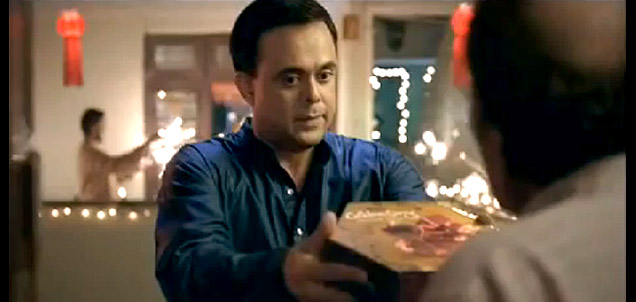
    Though the Diwali campaigns this season did not create much hype as they were fewer than in the past, going a little back in time we have seen some absolutely delightful campaigns, from Cadbury’s “Iss Diwali aap kise khush kar rahe hain?” and Coca-Cola to Samsung’s Diwali commercial or the latest Tanishq campaign featuring Amitabh Bachchan and Jaya Bachchan.

    Which is the Diwali commercial that has been an all time favourite for the industry? MxM India asked the biggies themselves.

    Mr KV Sridhar aka Pops, NCD, Leo Burnett, said, “My favourite Diwali commercial would be ‘Iss Diwali aap kise khush kar rahe hain?’ by Cadbury, which was out almost a year ago. For me and I’m sure for everybody else, the best way to celebrate Diwali is to catch up with near and dear ones and make them happy. Hence I found the commercial very real.”

    Mr Dheeraj Sinha, Regional Planning Director, Bates, said, “The Diwali campaign that has appealed to me the most is the Fiat Festive season campaign done by Bates. The campaign goes a step beyond the Diwali promotional offers etc and talks about the philosophy of Fiat, therefore I find it more appealing.”

    Mr Rajiv Rao, NCD, Ogilvy & Mather, said, “I know it’s my own agency work but I can’t resist saying that it is Cadbury’s ‘Iss Diwali aap kise khush kar rahe hain?’ There is so much of humanity and it breaks the clichéd concept of just greeting only your family and close friends on Diwali. It is most definitely my favourite Diwali campaign.”

    Mr Bobby Pawar, COO, Mudra, however took a different tack, saying, “No ad campaign has been able to capture a place in my mind; I really cannot think of any Diwali campaign that has appealed to me so much as to be called my all-time favourite campaign.”

    Cadbury’s seems to be the brand and campaign to have captured minds and hearts, and the sweet taste of success is certainly well deserved. But with such a wealth of creativity on tap and such a rich diversity of cultural references available all over India, it is high time a new, iconic ad or campaign came forth.

    We’re waiting.

    [Link] Debrief: In the midst of the drought, the Diwali ads that caught Anil Thakraney’s eye.

  • Hard Knocks: Event mismanagement

    By Anil Thakraney


    Whenever I get invited to participate in an event, my first reaction is to hesitate. And this is because, of the many I have visited in my life, most have turned out to be shoddily organized. Mismanagement of crowds, late start, poor banquet service, clueless hosts/hostesses… it’s a long list of gripes. And this turns out to be the case even when professional event managers have been hired. I must also add here, the few events I have visited in London, Cannes and New York, were a pleasure. Which is why I have always wondered why we screw things up in India.

    Since most events are usually private/low-scale functions, no one discusses the bloopers, and life simply goes on. But we get caught with our pants down when they are held on a mega scale, when the world is watching. Our pathetic show at the Commonwealth Games, and now with the mess on Metallica’s performance in Gurgaon, has made us look like bloody jokers.


    [youtube width=”400″ height=”300″]http://www.youtube.com/watch?v=VELQ39QAYP4[/youtube]

    I really don’t understand why we Indians make for such poor planners and executors. Maybe it’s in our DNA. Or, we can blame it on bad karma, as we usually do for everything! However, here’s a hunch: I suspect our event management companies are not being run professionally. And they aren’t being held accountable for flop shows. Perhaps a hefty fine for botched events may make them pull up their socks. I wonder if these people train their staffers on the skills required to run an event. If there’s any quality control in place. I would stick my neck out and say that most staffers are hired based on their general enthusiasm and little else. When the ground reality is that running a huge event takes a lot more than enthusiasm. It needs astute planning skills, a resourceful temperament and a jihadic passion to execute a successful event.

    Our event management companies need to clean up their houses. Or be ready to get penalized for bringing embarrassment to the host. Or to the whole country on occasion.


    ***


    PS: Haha. Came across this funny ad on the need to wear proper lenses. Must say the dude reminds me of a bumbling Indian event manager. Just kidding!

  • Debrief: A shining ad!

    By Anil Thakraney


    Here’s the Micromax ad that did not leave actor Shiney Ahuja very amused. And he’s taken legal action against the advertiser.


    Now, Micromax is notorious for over-the-top and often offensive advertising, so this commercial came as no surprise to me. It sits in well with their brand personality. A young lady excitedly tells her female friend that her hubby, whose name is Shiney, has bought her a new Micromax Bling handset. And she’s surprised to find that the naughty Shiney has bought the same instrument for her pal too. But she gets the shock of her life when the housemaid declares Mr Shiney has bought one for her too!


    Hahaha. I think the ad is very funny and very Micromax. I like advertising that cleverly ties in the brand’s message with current affairs. It just makes the communication that much more engaging. It’s a pity that Shiney Ahuja lacks a sense of humour. Also, if he had kept quiet, some people would have noticed the ad. Now that he’s protested, many more will. Enjoy!

    [youtube]http://www.youtube.com/watch?v=iBascDwOIiQ[/youtube]

    Rating: (On a scale of 1 to 5): Full 5! I am still laughing! 

  • Analysis: Will Omnicom upset the applecart?

    By Tuhina Anand

    Now for years, Omnicom has been trying to gain a greater share in the Indian market, but it has finally managed to get it right with the Mudra acquisition.

    It has been making moves recently to gain a foothold in the Indian market by debuting in the country its media agency OMD and then by bringing creative agency BBDO. Omnicom also acquired 100 per cent stake in TBWA but the coup is definitely getting Mudra and the talks of majority stakes turning to 100 per cent stake, Omnicom will in one sweep manage to pocket a sizeable chunk of the advertising pie in India.

    In fact, the seriousness of India as a market could be gauged from the fact that Tim Love , the Chief Executive Officer of Omnicom, Asia Pacific India Middle East Africa (APIMA) region has always pointed to his business card which puts India separately and not club as part of Asia or APAC as is the norm. He had stressed during his meetings that this showed how important is India as a market for Omnicom and its commitment to the country.

    Many youngsters in the agency have applauded Omnicom’s present move in Mudra, hoping that it would give the agency a fresh lease of life. Not to forget that Mudra has been on an overdrive in the last two years, with the agency winning awards at the national festival. Recently the network (DDB) also won at SpikesAsia so there has been a buzz. Its sub-brands Water, its strategy and design consultancy unit and Terra, bottom of pyramid marketing had also been launched earlier with much fanfare.

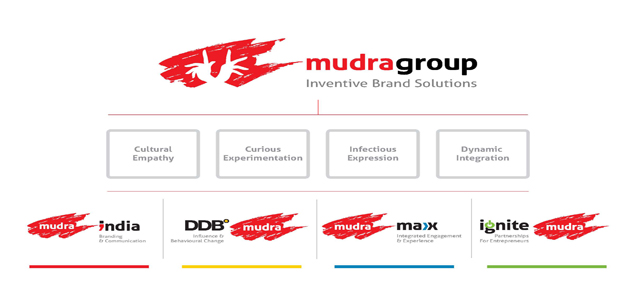
    In fact, with Mudra’s acquisition, Omnicom gains in getting hold of a fully integrated advertising services agency which otherwise would have been difficult if the latter had gone doing things on its own. Currently, Mudra has- Mudra India, DDB Mudra, Mudra Max and Ignite Mudra and each of these have their own strategic business units like Mudra India has 5 SBUs including Mudra West, Mudra South and Mudra North & East. Water, a strategy & design specialist, and Maatra, a localization & pre-media specialist. DDB Mudra comprises four strategic business units, DDB India, Tribal DDB India, RAPP India and DDB Health & Lifestyle. Mudra Max consists of 16 strategic business units that provide clients seamless solutions across a wide array of media touchpoints.

    In the months to follow, it would be interesting to see how Omnicom would try to bring its own flavour to Mudra. Also how would its other agencies like BBDO, TBWA and OMD be placed in the scheme of things and continue as independent units would be worth the watch. But one thing is sure with this move Omnicom has suddenly leapt in the big circle as there is no denying that Mudra has the pedigree that can give Omnicom though a late entrant, a name and grip in the industry that it has been trying for long but had not succeded ealier.

    More importantly, will this move shake the WPPs who have well-settled in the Indian industry? After all, any new player comes with the big intentions which if not shakes the sedentary life of the oldies but definitely puts them on their edges. Only time will tell.

  • Omnicom moves to rule India with Mudra buy


    By Rajiv Banerjee, Amit Bapna & Sonali Krishna


    After a decade of on-and-off parleys, US advertising giant Omnicom has sealed a deal to gain control of the Mudra group, the last of the major homegrown advertising networks left in the country.


    The deal for a 41% stake will fetch Mudra’s majority shareholder and ADAG boss Mr Anil Ambani around Rs 700 crore, making it the biggest deal in the history of Indian advertising, a person involved in the transaction told ET. Omnicom agency DDB Worldwide has held a 10% in Mudra since 1993, and the latest transaction effectively hands control of the firm founded by Mr Anil Ambani some three decades ago to the US-based firm.


    Ambani will continue to own a 49% stake in his personal capacity in the agency, which has revenues of around Rs 200 crore in revenues and Rs 33 crore in net profit. The deal values Mudra at a little over Rs 1,700 crore, around eight-and-a-half times its top line. Omnicom has the option of acquiring another 25% in three years and the entire network in five years, according to the agreement. Reliance ADAG chairman Mr Anil Ambani, add those privy to the details, was offered a board position but opted for a berth on Omnicom’s international advisory committee.


    “I am happy for 1,100 families of Mudra professionals, who will now be part of the global network of Omnicom. It’s been a fulfilling journey for me, having started this agency from the shop floor of Reliance Industries’ textile division in Ahmedabad (in 1983),” Mr Anil Ambani told ET.


    As per the agreement, Omnicom will now control the Mudra group’s four agencies – Mudra India, DDB Mudra, Mudra Max and Ignite Mudra. Along with these, Omnicom also gets access to 26 pan-India offices. Those close to the deal say that Mudra’s focus on diversified advertising services (DAS) was the primary attraction for Omnicom. Along with branding, communication and marketing, Mudra also has an ‘integrated engagement and experiential agency in Mudra Max and perhaps India’s only agency for entrepreneurs in Ignite Mudra.


    Significantly, the Mudra Institute of Communications, Ahmedabad (MICA), a communications management institute, is set to become a global school for Omnicom.


    Omnicom Gets Foothold


    “Over the past few years there have been heightened levels of discussions that finally culminated in this partnership. We now get aligned in with DDB, and then perhaps can look forward to several tie-ups with Omnicom brands or working closely with several Omnicom brands that come to the country,” says Mr Madhukar Kamath, MD & CEO, Mudra Group. Other than DDB, the Omnicom network includes BBDO, TBWA Worldwide, and public relations firms like Brodeur Worldwide and Fleishman-Hillard.


    Omnicom for its part gets a solid foothold in a fast growing market in which it has been distinctly overshadowed by the big boys like WPP, the Interpublic group (IPG) and Publicis. Mudra would rank amongst the top five agencies in India in billings, behind JWT and Ogilvy & Mather, and in a similar league as Draftfcb Ulka and Lowe Lintas (both a part of the IPG network).


    Says Mr Tim Love, vice chairman, & CEO, Omnicom Group APIMA (Asia-Pacific India Middle-East Africa): “The deal is an important confirmation of the importance of Asia and India for Omnicom Group’s long range plans for our clients.” “The partnership gives us unprecedented scale across India,” adds Mr Randall Weisenburger, CFO, Omnicom. That scale may still not be enough to unseat the big boys. As IPG CEO Mr Michael Roth says: “Even after the acquisition of Mudra, IPG is still larger.”


    Mr Ambani started Mudra in 1983 with a capital base of Rs 10 lakh. The story goes that patriarch Dhirubhai gave the younger son Rs 10 lakh to start the agency, which essentially was an in-house division of Reliance back then. Fresh out of Wharton, Ambani converted it into a separate agency with the Reliance-owned Vimal brand being its first and only account. Ambani came close to selling Mudra in 2002 to Sir Martin Sorrel-lheaded WPP, which offered Rs 170 crore back then for a 70% stake. The wait has been worth it.


    Source:The Economic Times

    Copyright © 2011, Bennett, Coleman & Co. Ltd. All Rights Reserved


  • TME to have a strategic alliance with MPG

    By A Correspondent

    TME (the media planning and buying arm of Rediffusion – Y & R and Everest Brand Solutions) and MPG (the flagship brand of Havas Media) have entered into a strategic alliance to provide value added media planning and buying services to clients of Rediffusion – Y & R and Everest Brand Solutions.

    This alliance came into effect from November 1.

    As per a communique, TME and  MPG will leverage their individual strengths to partner and provide greater value to clients and collaborate to tap opportunities for growth in the market. The alliance will enable TME clients to benefit from Havas Media’s extensive network knowledge resources, the integrated buying clout, MPG’s well-regarded proprietary Decision Support Systems and their touch point platform “CONNECT” bringing together a more effective and optimized investment plan. TME will continue to be built as a media independent brand under MPG’s stewardship.

    Statements issued in a press communique:

    D Rajappa, President, Rediffusion – Y & R: “This alliance is a collaborative effort to grow the business and also add enhanced value to existing and prospective clients of RYR”

    Dhunji Wadia, President, Everest Brand Solutions: “This is one of the deepest integrations to date, marking yet another milestone in the Group’s plan for a consolidated media investment management operation. The focus is to bring competitive advantage to our clients and our companies.”

    Anita Nayyar, CEO of Havas Media, South Asia: “This strategic alliance is a synergistic relationship between MPG and TME wherein both brands will co-exist and continue to provide benefits to each other working towards a common goal of delighting clients.”

  • Anil Thakraney’s Debrief: Nice idea

    McDonald’s has launched an icy new dessert called McFlurry. I did try it out the other day and was left quite unimpressed. Would like to discuss that in detail, but since I don’t get paid to do food reviews, let’s cut to the chase.


    The idea is ‘Slow down in life with McFlurry’. The commercial features very busy people taking a leisurely break over a McFlurry. Essentially corporate execs and other rushed souls. I like the idea of taking a quiet break from life, of taking some time off on a hurried day. And a nice, delightful dessert goes well in that situation. The execution is cool, too. A laidback jingle, assorted people cooling off… the commercial does catch the spirit of slowing down. The situations could have been more interesting, but that’s fine. That can be corrected as the idea evolves. So, all in all, a good one.


    However, here’s a request for McDonald’s: They must make it clear that the McFlurry is a ‘take-away’ dessert that people must purchase and scoot. And that’s because youngsters and families often spend hours doing time-pass at McDonald’s over a single Fanta, happily ignoring the long queues outside. And forgetting that McDonald’s is a ‘fast food’ joint. With ‘slow down’ as the message, I fear these guys will hang out over a McFlurry for hours together!


    [youtube width=”400″ height=”250″]http://www.youtube.com/watch?v=r3tK9K6W_po[/youtube]
     Rating: (On a scale of 1 to 5): 3. Good idea. Neat treatment.


  • The Anchor: Anil Thakraney’s 4 reasons why Steve Jobs was so special

    The entire world seems to be in collective grief over the death of Steve Jobs. As if people have lost someone close. Does it make sense? When you consider he was just another businessman out to make a lot of money. And there are thousands of very loaded industrialists all over the world. Most of who we don’t care much about. And Jobs, unlike rival Bill Gates, wasn’t even big on charity work. So then why do we all adore him? Even those of us who have never touched an Apple product in our lives. (I certainly haven’t.)


    There are many reasons behind the cult of Jobs. Here’s my little list on what made the man so special. And my reasons actually lie within Apple’s own legendary ‘Think Different’ advert. It’s as if the script was written with Jobs in mind. Businessmen and industry leaders must pay close attention to what it takes to catch consumers’ hearts and minds. From across the world.


    #1 Because he was a rebel: Jobs did not conform to the industry standards, nor did he try to surpass them. Instead, he showed them the finger. He was a true inventor, a visionary, who believed he could do it his way. Self-belief was at the heart of his success. And that’s how a lad working out of a car garage went on to build an international tech empire.


    #2 Because he didn’t just make and market products, he pushed the human race forward with his bold innovations. Product innovations that are not just technologically marvellous, but are slick and aesthetically rich. Consumers don’t just wait for a new Apple product. They queue up for it. They save up for it. They dream about it. Jobs never short-changed his buyers by taking short-cuts. He thought big. He delivered better.


    #3 Because instead of throwing out the ‘square pegs in the round holes’ from his organization, he trained, nurtured and cherished the misfits. He saw the genius in his crazy, offbeat employees. He knew he needed people who thought differently, if his vision for Apple was to come good. Look around you… very, very, very few leaders in the corporate world are capable of such an ideology. That’s why we have just one Steve Jobs.


    #4 Because he genuinely, passionately believed he could change the world. And he did.


    Links: The unforgettable Apple advert.
    [youtube width=”400″ height=”250″]http://www.youtube.com/watch?v=4oAB83Z1ydE&feature=related[/youtube]
    A touching tribute to the tech king.
    [youtube width=”400″ height=”250″]http://www.youtube.com/watch?v=XzWft8ZtTTY[/youtube]

    ***


    PS: Apparently there’s a TV journalist called Mandeep Something inside the Bigg Boss mad house. And she wailed on national television that she hasn’t gone to crap for four days. If a journo is doing stuff like this, can we really blame the other bimbettes on the show for all the nonsense? Anyway, guess now you know why it’s called a crappy show.

  • Hard Knocks: Sadly, Mr Katju may have a point

    By Anil Thakraney


    The Chairman of the Press Council of India, Justice Markandey Katju, is determined to sort the Indian media out. Some days back I expressed skepticism on whether he’ll succeed in his noble endeavours. Here’s the link to that piece.

    http://www.mxmindia.com/2011/10/hard-knocks-katju%e2%80%99s-unreal-expectations/

    It appears Mr Katju read my post (hehe), and perhaps out of frustration, has lashed out at the Indian media. He’s basically questioning our skills, integrity and competency levels. Naturally, there’s collective outrage in the media frat, and an angry desi media is a dangerous beast, you don’t mess with it. I would be quite surprised if Katju remains for very long in his chair.

    Having said that, and having been sufficiently offended, we need to once again take a hard look and check if what the man says is entirely wrong. Some soul-searching would actually do us good, and perhaps we’ll hire better personnel in the media. So let’s examine Katju’s critique and his three key problems.

    He says the Indian media divides people on religious lines and is anti-people. A sweeping generalization, no doubt. But there IS a section of the media that caters to specific communities and their respective communal biases. A section is even aligned with political parties. And this ideological bias comes to the fore during riots and elections. So what Katju says isn’t entirely wrong.

    He says TV channels focus on cricket and other celebrities. And Katju doesn’t like that very much. Well, that’s true. We do pay too much attention to entertainment and celebs, and I am guilty of that too. And often hard news gets buried somewhere. Yes, we do need to worry about excessive flooze in the media, for sure. But I don’t know how this will ever get sorted out. Because the truth is: Advertisers are more interested in Katrina Kaif’s fashion mantra rather than the survival plans of the family members of that RTI activist who got killed. That’s the sad commercial reality.

    He believes journalists have not studied economics, politics, literature and philosophy. Is he entirely wrong? Switch on the news channels and you’ll notice the general knowledge skills of most anchors and reporters. Yes, it needs a lot of beefing up, we have to admit that. Most journalists are too busy chasing celebs to find time to read Shakespeare, that’s another fact of media life.

    Bottom line: It’s easy to get offended by Shri Katju’s crazy generalizations. And dismiss them as outbursts of an angsty uncle. Still, it will serve us well to pay attention. He isn’t entirely inaccurate.


    ***


    PS: Watch this show as Barkha Dutt interviews a Google chief. You’ll notice what a struggle it is for her to have a meaningful conversation with a new media specialist. It’s not her fault, really. Most of us old-world journos would find it tough going. A glaring example of the schism between the old media and the new media. Also, hope Mr Katju didn’t watch this one. Else he’ll accuse us of being zero on media, apart from literature and philosophy!


    Link: http://www.ndtv.com/video/player/news/in-the-google-of-things/215082

  • AdAsia: Big Ideas in the Age of Now

    By Akash Raha

    Emerging from the real-timeness of the ‘anytime, anywhere’ economy, the ‘present’ has never been so dominant in the life of business / marketing professionals and consumers. There is a surfeit of ‘so-called’ ideas but there is always a short-supply of the ‘big’ idea that results in creative disruption. Robert Senior, Creative Chairman, Saatchi & Saatchi in the ‘The Pursuit of Big Ideas in the Age of Now’ showcased some of the big ideas that have made a difference and also highlighted the taxonomy of pursuing big ideas.

    The word ‘new’ has lost its significance in today’s world. For the new generation ‘new’ is disposable. New keeps changing every moment and what matters to them is ‘now’. There has been a movement of era of ‘new’ to age of ‘now’. With the change of this era changes the shift from attention to participation, inform to inspire, interruption to interaction, return of investment to return of involvement and local to global.

    It’s a volatile world we live in, and in all spheres – from political to financial. Also, the future is uncertain, complex and ambiguous. In such a scenario, it is very hard to plan for the future, because the future is so dynamic. So the question one asks is, we are uncertain about the future… what do we do next? The creeping in of fear at such a point is inevitable. The creative mind isn’t immune from fear. But the creative mind deals with fear. A creative mind loves problems and loves to solve them. With the problems, also come possibilities of creating newer things, newer ideas, and better ideas. Ideas like these can be the prism of hope. Amazing things can happen when you have ideas and are innovative. The essence is to capture the moment and be creativity.

    Creativity in a way, said Mr Senior, is like science, it’s meant to be experimented with. It has to be tried and tested in order to get to the desired result.

    One of the biggest clichés of the advertising industry, he said, was the concept of ‘Big Idea’. The question one asks is, how big is the idea, and is the idea really that big? There is no such thing as a big or small ideas, it all about having ideas in general and then nurturing them. Anyone can kill an idea, even a moron can. But the essence is to find value in a idea and then make it big. Nurturing a tiny idea into a so-called ‘big idea’ is the key.

    One of the things important in today’s world is speed. The world is moving so fast that by the time you nurture your idea, the time when the idea could be implemented is gone. Hence, speed, agility and being nimble are essential.

    He urged advertisers to believe and trust in the strength of ideas. Ideas that can create a difference, ideas that can make an impact. Talking about the current world scenario, he said it is of the essence that we try and make a difference, however small. It is okay to be a little enraged, a little angry; it is okay to dream and do something crazy. Ideas have a lot to do with emotions, and an upsurge of emotions causes action.

    Talking about the Israel and Palestine issue he gave example of how an idea (a campaign) tried to make a difference in the war-inflicted area. He went on to say that ideas are nice and creating ideas is nice, but the next step is more important. It is important to bring some action to it. It’s good to be enraged and angry with something you feel passionately about. Such anger and resentment often appeals to the heart. “Let’s give some context to the world which is fast losing its plot.” Let our heart work wonders and then we should do something that might not change our world, but do something that our children can be proud of. The speaker brought the power of ideas and connected it with emotions, and touched everyone’s heart.