Category: Media Agencies

  • Banerjee scales creative heights of Everest

    By A Correspondent

    The Delhi office of Everest is set to see a creative shakeup with Mr Arnab Banerjee coming in as Head of Creative  Art. Mr Banerjee has had extensive experience of over 11 years in mainstream advertising with Ogilvy, Euro RSCG, Redifussion DY&R, Grey Worldwide, McCann Erickson and DDB Mudra, and his last stint was as a Creative Consultant with August Communications. He will be reporting to Rahul Jauhari, NCD, Everest Brand Solutions.

    Everest is the 2nd oldest agency in India, born in 1946. The agency is a creatively led, full-service agency with a reputation for delivering fresh, original thinking. Mr Banerjee will add to the agency’s team of seasoned professionals from diverse backgrounds. He has handled multi-national clients like Wrigley Orbit and Boomer, Philips, MasterCard, Hutch (now Vodafone) and national brands like Airtel, ITC, ONGC and others. His experience in handling media and publication clients includes The Statesman in Kolkata and the India Today Group in Delhi.

    A nature worshipper, Mr Banerjee is devotedly interested in photography, trekking, cycling, and also film studies, ancient civilization and graphic design. He was nominated for the BBC Photographer of the Year in 2006, the only Indian among twelve finalists. On his joining, Mr Jauhari, Arnab brings just the mix of talent, experience and enthusiasm that we seek to inject into our creative pool. His passion will be felt equally by our clients and people within the agency.

    Mr Naveen Saraswat COO, Everest Delhi said,Arnab is a great ideas person. He is passionate about doing good work and his excellent sense of design makes his creative output stand out visually. These abilities combined with his strong leadership skills will enhance the quality of the work that we do for our clients and add value to their brands.


  • Kyoorius DesignYatra returns to Goa

    Kyoorius DesignYatra gets underway in Goa today, with a line-up of speakers across diverse design disciplines, including corporate identity, branding, graphic design, digital strategy, installation design and architecture design. The conference is from September 8th (evening) to Septemeber 10th. The theme for this year’s conference is Next- what’s next in the field of design, branding and visual communications.

    This year’s speakers include legendary Dutch book designer Irma Boom; digital strategist and once described as the Godfather of Guerilla (Marketing)-Mark Chalmers, founder, Perfect Fools; bestselling author of How to be a graphic designer without losing your soul and independent publisher Adrian Shaughnessy; the founding trio of Eva Rucki, Conny Freyer and Sebastien Noel from UK’s leading experiential design agency Troika; Nathan Cooper, creative director at Anomaly, London; Richard Holman, founder and lead creative director at UK’s leading agency devilfish, the chatty Liza Enebis more popularly known as Loveliza to the loyal audience of 5000 listeners who tune in to her radio show Typeradio daily; Michael Johnson of johnson banks, often referred to as one of Britain’s foremost designers; noted creative mind Hermann Vaske, well- known British installation designer Peter Higgins and leading figure on the Indian architecture scene Sandeep Khosla.

    The organisers say what will make this year especially meaningful for delegates will be the screening of a special short film, directed by celebrated web designer and documentary director Hillman Curtis and produced by Kyoorius, featuring noted design commentator Debbie Millman in a conversation with the legendary Massimo Vignelli.

    In addition, the two-day conference will screen the edited version of a film on the life and times of one of the most iconic design partnerships in the history of design- Lella and Massimo Vignelli in the documentaryDesign is One- The Vignellis,directed and produced by Kathy Brew and Richard Guerra.

    Kyoorius DesignYatra, now in its sixth year, celebrates excellence in design across disciplines and has brought together speakers like Sir Martin Sorrell, Stefan Sagmeister, Tyler Brule, Paula Scher, Bruno Maag, Michael Ian Kay, Gert Dumbar, Wally Olins, Kyle Cooper and Neville Brody among others.

    Says Rajesh Kejriwal, founder, Kyoorius, DesignYatra has served as a valuable meeting point for agencies in India and abroad in the sphere of design, branding and visual communications. It has been an opportunity to understand and learn from some of the finest minds in the field, delve into their creative process and be inspired by their work.

    Adds Bindu Nair Maitra, editor, Kyoorius Design magazine, This year, we embarked on a special initiative, which is a property we plan to sustain well after DesignYatra this year is done and dusted. It’s our Tumblr blog- Road to DesignYatra, where we plan to document all the special memories and images from previous editions of DesignYatra and build a hearty online conversation about how the conference has influenced delegates and speakers alike.

    Incepted in 2006, Kyoorius DesignYatra is an annual design conference that has attracted a cumulative audience of 8500 delegates over the last five years. In 2008, a special edition of DesignYatra was held in Malaysia on the invitation of that country’s advertising association. Past speakers at previous DesignYatras have included names like Sir Martin Sorrell, Paula Scher, Tyler Brule, Wally Olins, Michael Wolff, Piyush Pandey, Ross Lovegrove, Erik Kessels, Stefan Sagmeister and Sir Rodney Fitch, to name a few.

    Kyoorius DesignYatra is one of India’s foremost platforms for the intersection of design, branding and visual communications. The conference has served as a valuable meeting point for agencies in India and abroad in the sphere of design, branding and visual communications; an opportunity to understand and learn from some of the finest minds in the field, delve into their creative process and be inspired by their work. Kyoorius DesignYatra is a must-attend event for anyone involved in brand communication.

    You can check http://www.designyatra.com for further details.

  • Suzlon goes for youth connect with green message

    Why would a wind turbine supplier’s campaign target the youth? That’s just what Suzlon has done with p.a.l.s (Pure Air Lovers Society). The campaign, which was kickstarted with a teaser and culminated in highly visible print advertising, aims at driving audiences to its website (http://pals.in/) which indicates that it is looking at bringing the young population into its ambit as they are the ones most active on the digital platform. The website too is unlike what one would imagine from a company that’s into wind power, as p.a.l.s is young, refreshing and interactive  in short, everything that would seem inviting to the youth.


    If one were to look at the link between Suzlon and p.a.l.s, it is really the issue of clean and energy-efficient quality of air. The inspiration for the initiative came from the truth that air pollution and the quality of air in our cities is becoming a serious issue today. This, coupled with research which suggests that Indians are concerned about this and address it as their number one environmental concern, was reason enough for the crusade exhorting people to stop air pollution. The company in fact quotes that more than 5 lakh people a year die of air pollution-related ailments in India.


    Ms Dharini Mishra, Global Head for Brand, Suzlon Group, explains, Suzlon has always been committed to sustainable development of the country. Since we are in the business of clean, pollution-free energy from the wind, we thought Pure Air was the best way to connect our philosophy with the youth of India and the country in general.


    The timing of the initiative is well thought of, as Indian wind energy is attracting global attention. Also, Suzlon’s order books are looking strong and giving the company the confidence of being well placed in the Indian market.


    Suzlon is India’s leading wind energy company for more than 13 years now. We already

    had a cause which is inherent to our business but we were waiting for the most

    engaging manner and right time to take it to the people, that’s how Ms Mishra explains the timing of the initiative.


    The youth connect may not be apparent at the outset but it’s clear when one understands the vision of Suzlon, which is all about a better tomorrow, a change for the better and renewable energy. Ms Mishra added, These attributes are directly related to the young. India’s

    youth is bringing in wide sweeping changes to the way we live and do business. We strongly feel that connecting our brand with people of a young mindset will see a revolution of change across this country which is very critical for our sector and our business as a whole.


    The campaign, which is conceptualized by LoweLintas, has seen a huge response with the number of p.a.l.s growing by more than 1,400 a day. The website has stories, videos and real-time updates on what pals are up to, besides other engaging and interactive features. The company sees it as one of the most successful social cause campaigns for the youth. In the first phase the advertising managed to create awareness about the cause, but now Suzlon will move on to activations and tools that encourage p.a.l.s to make a tangible impact. In this phase the focus will be on partnerships, school connect programs and creating a digital stir.


  • We have broken the shackles: Josy Paul

    BBDO India celebrated its third anniversary on August 30. Mr Josy Paul, Chairman and Chief Creative Officer of the agency, is a happy man as in an existence of just three years, BBDO India has established its credentials as an agency nurturing creative excellence that incubates impactful ideas. As Mr Paul puts it, We create acts and not ads.

    Ritu Midha of MXM India caught up with Mr Paul on the anniversary day. Presented below are excerpts of the stimulating conversation encompassing 25 years of Indian advertising, Mr Paul’s journey through these years and of course BBDO  and what makes the agency the creative powerhouse it is today. Enjoy!


    You are celebrating the third anniversary of BBDO India. How does it feel?

    It feels great. We are celebrating three years of not being in advertising. We started three years ago with the thought that India needs more acts than ads. We started with a belief that there is a greater social consciousness in consumers, and the consumer is not only father, mother daughter… or any other relationship. Besides, the family or personal values, a social value is also creeping into the human beings. India is far more socially aware, and we felt that brands must be able to resonate with that. And that is what we are trying to achieve.

    This year, we won four Lions at the Cannes – one of them a Black Lion. This year, for the first time, Cannes has created Black Lion for advertising effectiveness  there are only six of them. One that we have is the only one in Asia. We are celebrating that as well.

    You sure must be a very happy man.

    Yes, of course. The awards are a big testimony to the team thinking together. It is a young team and all the accolades help in our continued strive for excellence.

    Tell me something more about the environment at the time of your launch.

    Well, at that time media fragmentation had started, and the only way to bring them all together was and is, with an excellent idea. A fancy line was just not enough – you needed an action-oriented idea based on behavior, which then allowed all mediums to get involved. It holds true today as well.

    We have proved the power of action oriented idea with campaigns like women against lazy stubble  it started on Facebook, Aviva great wall of education that started as a wall on the road, Quaker healthy heart mission that was a website and invited people to take healthy heart test and Quit India Movement for Nicorette which spanned various media. An interesting one down South (Tamil Nadu) was Lemon Patalum, which we did for 7up. It is a whole platform to invite kids to play light-hearted, lemony, rubber ball cricket with their superstar CSK. Today more than 2000 teams participate in it. We are creating platforms. Many such things are in the pipeline.

    Would you then say that television might cease to be the lead medium?

    TV will continue to be at the core, because it allows you to reach a lot more people faster, with a singular message, but the TV would not be just a 30-second spot, it will be more about content. For example, the Anna Hazare movement does not have any ads but it is there as news, views and debate and also images. What you create may be a documentary, just a vignette or a quick news item. The message can keep changing.

    If television is only a standalone thought where you are just cracking a joke or saying something in an entertaining manner, it becomes just for that moment, but if it is part of a larger consciousness, or a larger behavioral activity  it is part of the continuum, it is part of one energy wave  and hence it is 10 times more effective. A lot of our work is in that area.


    How can one maximize the creative impact?

    There are so many kinds of people with so many different mediums at their disposal  you have to maximize based on the budget you have. If you don’t have a great budget, and you have to just do a car sticker, it still has to be a great sticker. It is your ambition, together with what the environment allows and offers you. It is all about how you react to the world around you.


    To a very large extent, media effectiveness is a game of budgets; to what extent does it hold true for creative?

    It is a very interesting question. Honestly, as a creative person I can’t answer the question on the budgets  I can only chat about the impact. And when you have an effective idea, you know it has great impact value.

    If you have a larger budget, maybe a big celebrity in the ad, it might have a bigger jump. However, the core of good communication is ALWAYS an impactful idea. Some companies have the ability to take an impactful idea and distribute it widely to make the impact much larger. Others put it in a specific medium because that is the only money they have and that is what they need at that point. So big budget or small, you need an impactful idea.

    I will give you an interesting example. We did a piece of work for a company called White Collared Hippies  an alternative travel company set up by young Gujarati guys from California. It won us an award, and quite a few nominations at Cannes. They do not have large media budgets, so they have posted the campaign we did for them on their own website and their Facebook page. While it may not be distributed widely, and they might not be getting customers, this campaign is getting them partnerships. They are getting famous in the B2B space, the campaign is helping them in creating the echo system.

    To what extent does gut feel help a creative person?

    Gut feel is essential to a creative person. If there is no gut, no leap, no personal filter, you cannot add to the world. The unique point of view that comes from your own gut, from your own perspective of the world, is what makes it fresh. Freshness is a must in a creative person.

    However, gut feel does not work in isolation. We are also studying consumer behavior at media level. Though we have not set up any system to segregate content and understand it in different ways, we are watching what consumers are viewing and what they are gravitating towards.

    Moving to another oft discussed phenomenon – user generated content. Do you see it happening in creative?

    Well, in creative, there are a few examples but I do not know whether they fit into your definition of user generated content. The user is generating more content  not because he is creating the content but because he is forcing the content  for instance in the case of Old Spice campaign: The man your man could be. It started with one television spot, became three television spots – people started getting excited about it. They wanted their own version on the Net. So Old Spice said you speak to us, and we would start creating it online. So the consumer was talking to the advertiser  and he was creating it live for them. It is a very interesting format.

    A slightly different question, how has the ad world changed from the time you returned from the Himalayas about 25 years ago?

    Some things have changed and some things have not changed  but everything has definitely evolved. Interestingly, advertising is teaching us, especially me as an individual to also evolve.

    I am going with the flow…

    There was a time when we were doing a lot of print. There were many good print writers in mid-80s, around the time I joined. It gave way to a bit of cinema, and then to a lot of television. You started enjoying that.

    In 2005, we launched CNN IBN, with Rajdeep Sardesai and Dilip Venkatraman, and with that we pioneered two-way television in India. You realised that television is no longer the medium that just beams down on you.

    It isn’t just the acceptance of new worlds, and knowing that your past is irrelevant. It allows you to enjoy what is happening. It is just explorative  you are doing it because you are enjoying new things. It is not that you know something very well, it is that you don’t know enough about anything and that allows you to enjoy everything. That is a nice space to be for me personally.


    And how has Indian advertising changed in terms of quality?

    Advertising has really opened up and it has become very free  it is not really as structured as it was before  it has changed with the changing times. It is getting better and better and integrating with the real world. It was not so real earlier. I remember David Ogilvy asking me during his India visit in 1989, Why are all the women on Indian television completely pink-faced  pasted with makeup  while I have never seen any such lady in a five-star hotel or on the road? I had no answer, and the reason was we had become so used to seeing two different worlds on television, and in real life. Today when I look around I realise that we have broken all those shackles. Openness, freedom and new ways of looking at the same problems, is there. There are young, open-minded people  who are far better than us, far better than me at least.
    Is there a dearth of talent in advertising?

    There is a lot of talent  but talent over time starts becoming solidised… fossilised. They accept only what they know from before. Cholesterol starts getting into the system  and the only way to beat that talent cholesterol is continuously asking questions. The solution is going out and getting new people into the system  so that the whole system gets energised.


    Coming back to you, how is the experience in BBDO different from that in David?

    I have never seen it as difference. I see it as a continuum. The spirit of David was the spirit of challenge  the ability to question everything. It operated in a small space, with young clients who in most cases did not have a national footprint. We never had giant businesses. In a way it was the seed of BBDO. What BBDO gave you was space, size, ambition… the ability to integrate with the larger world and to be a part of one world philosophy. BBDO Worldwide is just a giant David – it is a great agency that is doing great work across the world – not only for challenger brands but also for leadership brands. What has stayed is the spirit of challenge  and what has changed perhaps is size, ambition, the platform, the dream, the people you are working with  the osmosis  the ability to integrate with the larger world.


    So, what plans for the agency?

    BBDO is not about me, it is about brilliant talent led by a fantastic team. We are an organization  and not a one-man band. Three years, and we have built a fantastic foundation.

    We want to build on that, and we want to build through national clients. We are a very cohesive agency with a new world mindset. We can solve lot of national problems from a non-advertising perspective, and that’s why we say we create acts not ads. We are in the business of solving a communication issue or using communication for solving a national or social issue or using communication to build something or to create relationships. We feel confident vibrations that we can do anything today.


    My last question, do the mountains still beckon you?

    It is important to try to find space to the assimilate speed of what you are receiving. Running away to the mountain again is great. It gives you time to catch up with what the world is telling you. You need time to receive. You are using that time to reflect. You are trying to find pauses and spaces in mountains, nature, mist and rain, to catch up with incredible experiences so that you can learn from it.

  • Indian agencies bag 34 metals at Spikes Asia


    By A Correspondent

    If the Cannes Lions is the Olympics, Spikes Asia is the Asian Games. Competition is stiff, but heck there is no North and South America and no Europe.

    But this is no attempt to undermine the rep of Spikes Asia, the annual congregation of ad, marcom and marketing professionals in Singapore. At the three-day event which concluded last evening with much merrymaking in Singapore, Indian advertising boys and girls came back with 34 metals.


    It may be remembered that the score at Cannes Lions this year was 24 metals, but then not everyone at the Lions goes in for a Spikes.


    So, here’s the agency-wise tally:


    Agency

    GP

    G

    S

    B

    Total

    BBDO India

    1

    1

    6

    8

    Beehive

    1

    1

    Contract

    1

    1

    Creativeland Asia

    1

    1

    2

    JWT

    1

    3

    4

    Leo Burnett

    1

    1

    McCann

    1

    1

    Mediacom

    1

    1

    2

    Mindshare

    1

    1

    Mudra

    2

    6

    8

    Ogilvy

    1

    1

    2

    Taproot

    1

    1

    TBWA

    1

    1

    2


    In the metal types, here’s how it appears:


    Tally
    Grand Prix

    1

    Gold

    3

    Silver

    9

    Bronze

    21

    Total

    41


    Note, Indian entrants came back empty-handed in PR, Mobile and Outdoor.

    In the special awards category, Mudra Communications, Mumbai gets the third place as the Agency of the Year. O&M Malaysia gets first and DDB Group Singapore scores the second place. The big one definitely is for Raj Kurup’s CreativeLand Asia which is the Independent Agency of the Year, an award which celebrates the spirit of entrepreneurship. Samsonite won the Advertiser of the Year. In the category for Network of the Year, which is awarded to the Network which gets highest scores for entries across categories include DDB, BBDO and JWT in that order. India drew a blank in the Media Agency of the Year Category. Last year, Mediacom was runner-up.

    The Spikes Awards has been around for around a quarter of a century and the Spikes Asia Advertising Festival is a collaboration between the International Festival of Creativity, organisers of Cannes Lions, Dubai Lynx and Eurobest, and Haymarket, publishers of CampaignIndia. According to the organisers, Spikes Asia provides “the region’s growing creative and advertising industry with a platform to network and exchange ideas, bringing together some of the finest creative thinkers from across the region and around the world”.

    The Awards, judged by leading international and regional creatives including many from India, recognise top creative work in the categories of Film, Film Craft, Print, Print & Poster Craft, Outdoor, Radio, Digital, Integrated, Direct, Sales Promotion, Media, Design, Mobile and PR.

  • O&M, OMD get Bosch Home Appliances mandates

    By A Correspondent

    Bosch Siemens Home Appliances (BSH Group) is all set to launch in India. Their new TVC created by the creative team of O&M will be launched today.

    The company has appointed OMD as their media agency and O&M as their creative agency.

    The company will address the media today to officially announce their India entry and launch of their home appliances product range

    Mr Marc Hantscher, Managing Director and CEO of BSH Home Appliances Pvt Ltd will discuss the new product range to be launched and the company’s retailing strategy for India.

    BSH Bosch und Siemens Hausgeräte GmbH, (or Bosch and Siemens Household Appliances, BSH) is manufacturer of home appliances in Europe and one of the leading companies in the sector worldwide. The group stemmed from a joint venture set up in 1967 between Robert Bosch GmbH (Stuttgart) and Siemens AG (Munich) and posted annual sales of 9,073 billion Euro (13,000 billion US Dollars) in the year 2010. Today, BSH operates 41 factories in 13 countries in Europe, the USA, Latin America and Asia. Together with a global network of sales and customer service firms, the BSH  today is made up of about 70 companies in 46 countries, with a total workforce of close to 43,000 people.

    The BSH product portfolio covers a wide spectrum. It includes large home appliances for cooking, dishwashing, laundry (washing and drying), refrigeration and freezing, as well as a multitude of high-quality small appliances, such as fully automatic espresso machines, floor care and hot water appliances (consumer products). One of BSH’s particular areas of expertise lies in built-in appliances.

  • My Way: Shashi Sinha on his priorities as President of Ad Club Bombay

    Shashi SinhaBy Tuhina Anand

    The Advertising Club Bombay has appointed its new officebearers for the year 2011-12 with Mr Shashi Sinha as its President. As revealed first by MxMIndia on September 9, Mr Sinha’s appointment was confirmed on Friday after the Club’s annual general meeting. Mr Sunil Lulla, the MD and CEO of Times Television Network, is Vice President. Mr Ajay Kakar, CMO – Financial Services, Aditya Birla Group is the new Secretary, Mr Sujay Ghosh of Bennett Coleman and Co Ltd is the Joint Secretary and Pratap Bose, CEO-Mudra Max the Treasurer.


    Mr Sinha, the newly elected President of the Advertising Club Bombay and CEO of Lodestar Universal India, talks about the priorities that he and his managing committee will take on this year for Ad Club.


    Continuing education:

    The Ad Club has been organizing knowledge series and training programme for the fraternity. We are looking at increasing the frequency of these knowledge sharing session which would help the fraternity.


    Making the ad club relevant to youngsters:

    While we have big tickets events like the Abby awards, Effies and Emvies which sees participation from young in our industry, we have to look at ways by which the Ad Club can be relevant to these youngsters. We want to encourage them to become members and want them to feel proud to be a part of the Ad Club.


    Make it inclusive:

    When the Ad Club Bombay was started, the city being the hub for the industry was a leading body but was also inclusive in its approach as other cities did not have such representative bodies. Now many cities have their own Ad Clubs but we would want to adopt the approach of making Ad Club Bombay a place where fraternity from other places is also welcome. We already have our Abby Awards which sees participation from across the country and the idea is to involve lot more people like in the judging process who belong to our industry but are in different city.


    Restore credibility:

    The Abby Awards has come under much scrutiny and has been criticized in the past. This year we tried to set things right by making the awards more transparent and tried to curb the accusations which were on votes being sold. We hope to restore the credibility of the awards so that fraternity truly holds it in high esteem. But one has to also understand that flak has come only for Abby’s and not for our other awards be it Effies or Emvies. We have tried to plug the hole when it came to creative awards but it becomes difficult beyond a point. Nevertheless, to restore credibility of our awards is our biggest priority.


    Asia-Pacific Effie to India:

    We have got the licence to host the Asia-Pacific Effie in India next year and we see this as a great opportunity. The Effie Awards recognize excellence in effective marketing communications and involves marketers in a big way. In fact, the grouse of the industry on awards is often that the marketers are not interested in these awards but Effie is different in that context. Hosting the Asia-Pacific Effie in India will give us a bigger platform to involve the marketers and the fraternity from the region.


  • Shashi Sinha will be Big Boss at Ad Club Bombay

    After two terms as President of the Advertising Club Bombay, Mr Bhaskar Das of The Times of India Group will make way for Mr Shashi Sinha, CEO of Lodestar Universal India. Mr Sinha is set to assume responsibility this month. Mr Sunil Lulla, the MD and CEO of Times Television Network, will be Vice President. Mr Ajay Kakar, CMO – Financial Services, Aditya Birla Group will be the new Secretary and Pratap Bose, CEO-Mudra Max the Treasurer. The managing committee is reported to have been elected unopposed.
    Mr Sinha has been Vice President of the Club and is also an active member of various media industry forums. After running the media awards effectively, he was entrusted with responsibility of Chairman of the Awards Governing Council following disagreement between the Ad Club and the Advertising Agencies Association of India (AAAI) on the issue of the Abby Awards at GoaFest.

    After being mired in controversy for three years, thanks to Mr Sinha’s leadership, the high profile Creative Awards were held without any leaks and raging controversies.

  • Mediaah!: Is Arnab Goswami the “over-the-top anchor” in the TOI ad?

    By Pradyuman Maheshwari


    This is not the first time that someone from within the Bennett, Coleman & Co empire has taken on Arnab Goswami and Times Now. In the past, Prashant Panday went hammer and tongs at Arnab. The post was on Prashant’s Facebook wall, and didn’t beat about the bush. I must say I was quite surprised that the CEO of a group company which runs the very popular Radio Mirchi network could write all of it so openly (read: An open letter to Arnab ).

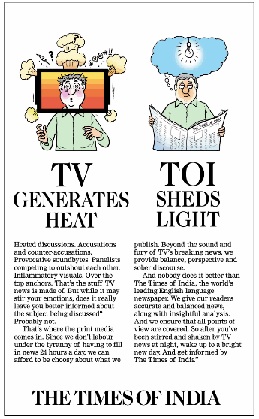
    The fact that Prashant wrote it and still has his job speaks volumes for the internal democracy that exists in the group. Though my wicked brain thinks there’s more to it… especially when I saw this ad on the sports pages of the Mumbai edition. Chhota 15×3 ad, but very interesting.

    You must read the text… all of it.


    Heated discussions. Accusations and counter accusations. Provocative soundbytes. Panelists competing to outshout each other. Inflammatory visuals. Over-the-top anchors. That’s the stuff TV news is made of. But while it may stir your emotions, does it really leave you better informed about the subject being discussed? Probably not.

    That’s where the print media comes in. Since we don’t labour under the tyranny of having to fill in news 24 hours a day, we can afford to be choosy about what we publish. Beyond the sound and fury of TV’s breaking news, we provide balance, perspective and sober discourse.

    And nobody does it better that The Times of India, the world’s leading English newspaper.We give our readers accurate and balanced news, along with insightful analysis. And we ensure that all points of view are covered. So after you’ve been stirred and shaken by TV news at night, wake up to a bright new day. And get informed by The Times of India.


    Not all of it is untrue. Panelists do outshout each other on news TV. Put Jayanthi Natarajan and Ravi Shankar Prasad in one discussion and there’s more noise and less discussion. Also you can be sure you won’t find all the news on television… esp the private channels. Doordarshan News has a lot more meat, but it is soooo boring.

    What deserves another look and no real reading between the lines is a bit from the first para:

    Heated discussions. Accusations and counter accusations. Provocative soundbytes. Panelists competing to outshout each other. Inflammatory visuals. Over-the-top anchors. That’s the stuff TV news is made of.

    So let’s look at the people who dominate the nightly news on the English non-business news channels, which I guess is what the TOI ad is talking about: Rahul Kanwal (Headlines Today), Rajdeep Sardesai and Sagarika Ghose (CNN-IBN), Vikram Chandra, Barkha Dutt, Prannoy Roy (NDTV 24×7) and of course Arnab Goswami on Times Now. There’s also Rahul Shivshankar on NewsX, but my cable operator doesn’t offer the channel, so would reserve comment on him.

    Rahul Kanwal is aggressive and provocative, but he is not sound and fury. Rajdeep has mellowed (and become very good once again), but Sagarika can go high-pitched. On NDTV, Dr Roy and Vikram C are exceedingly softspoken and can’t harm a fly. Barkha still attempts to ask some tough questions, but like Rajdeep isn’t what she used to be around the time of the Gujarat riots.

    The one man who fits most of the attributes described in the Times (of India) ad is Arnab Goswami. I don’t agree with him being over-the-top, though there are many who believe so. I think he asks the tough questions, and is possibly the only one to do so day after day. Yes, he gets carried away, but needs to be cruel with our politicians. And even as I join others in lampooning Arnab for his the-nation-wants-to-know-line, the fact of the matter is that we all really want to know.

    I do feel that Times Now overstretches itself on issues like Pakistan, China or racism, but heck we need it.  As for inflammatory visuals, I think the print media is also fairly irresponsible. Though the impact of television is a lot, lot more on the common man or woman.

    Let’s keep this discussion on. Email Mediaah! at pradyumanm@mxmindia.com and I will carry the best comment here when I am back on Tuesday.


    Pataudi, RIP


    But for the time when he patted me on the back and gave me an autograph, I’ve never met him. But heard loads about him.

    When the news of Tiger Pataudi’s passing came in last night, almost by reflex I called a colleague to check if we could get someone in adland to reminisce dealings with him for endorsements. Then we tried checking on his connections as editor of Sportsworld and for his stint at Dev Features. The Sportsworld team is scattered all over. There’s an interesting tribute by Derek O’Brien in The Telegraph.

    I called Vivek Sengupta on reading his tweet, and finally convinced him to write a few lines. That was around midnight. Vivek may have turned into a public affairs and PR practitioner for a while, but he’s essentially a journo. He knew I wanted him to write, and sent his copy in an hour.

    Meanwhile, we had no luck with getting an adman to write on Pataudi’s ads. But here are two of his TVC that I found on YouTube (the  first a rather long Gwalior Suitings ad and the other being the recent Lays TVC with Saif)

    [youtube width=”350″ height=”260″]http://www.youtube.com/watch?v=iei989o4l-I[/youtube]


    [youtube width=”350″ height=”260″]http://www.youtube.com/watch?v=dTVIrhnt5x4[/youtube]


    Buzz me if you have a story to tell. Confidentiality assured. There are various ways you can reach me:

    pradyumanm[at]mxmindia.com, 23050B5D, pradyumanm@gmail.com, @pmahesh, 98338 76278.

  • Are ads crossing the line too often these days?

    By A Correspondent


    Sinful minds must be at work in the advertising world these days. Or we are simply not getting it. Of late, the Advertising Standards Council of India (ASCI) has been deluged with a flurry of complaints about “offensive” ads.


    This year the council has received 777 complaints regarding 190 ads, a steep jump over the 200 received last year about 153 ads. The most vociferous complaint has been about increased sexual content, with parents saying it is difficult to watch the ads in the company of children.


    They cite the recent Tata Docomo ads for their suggestive content and alleged class bias. One of the ads shows a rocking SUV which stops when a cellphone rings. “How do I explain that ad to my daughter when she asks me what it means?” asks mr Sunil Krishnan, a media executive in Chennai.


    Another father, Bollywood icon Shah Rukh Khan, has the same problem with other ads. He says he cracks a joke to divert the attention of his children. “The deo ads can get naughty,” he said. “Like the one that showed a batsman getting out. But the girls run after him rather than the fielder who’s taken the catch, because the batsman’s wearing a particular deodorant.” Incidentally, the star says he “turned down a deo ad because he didn’t like the idea of women chasing him.”


    Obviously, it doesn’t work that way in real life. An aggrieved user, Mr Vaibhav Bedi, took Unilever to court in 2009 saying he’d been using the Axe deodorant for seven years and not one woman had found herself inescapably attracted to him.


    Do the parents have a point? The problem, says Mr Anand Halve of the brand consultancy firm Chlorophyll, is that a number of ads have begun to use sexual attraction gratuitously. He cites an SUV ad in which “the woman is so taken in by the driver that she tries to hide her mangalsutra from him” . He adds, “In such cases the use of sexual attraction is built on the assumption that, ‘Arrey, audience ko sex achcha lagta hai’.”


    But that does not work every time. According to ASCI secretary-general mr Alan Collaco, there’s only so much leeway a company or its advertiser should take. Not for moral reasons, but financial. He cites the earlier Fast Track ads – “which depicted young men and women being promiscuous” – that were shown to college students to elicit their opinion. Mr Collaco says the students turned around and told him, “But that’s not us” .


    Which is why Mr Collaco believes that “an ad which grabs eyeballs when it is first released might at best garner some sales but all future sales will depend on the quality of the product, not the ad” .


    Flying Machine recently ran into trouble with its latest ad campaign for jeans. The tagline said: “What an Ass!” It punned on the word for bottom, then went on to say the “ass” was “the man who didn’t call me after the first date” or “the friends who wanted to give me a makeover” . That wasn’t how women’s rights activists saw it. They protested to the National Commission for Women (NCW) saying the ad was “vulgar” . The complaint is now with the ASCI, which will decide on the case next month.


    Mr Arun Iyer, national creative director of Lowe Lintas, defends his ad for Flying Machine, saying the idea was to grab attention. “The ad is tongue-in-cheek and progressive,” he says. “It shows a woman with attitude.”


    Just as nonplussed is adman Mr Prahlad Kakkar, who was recently sent a notice by the Information and Broadcasting ministry for his tagline in the Lilliput children’s wear ad – “There’s another man in every woman’s life.” Once the suspense has built up, you realise the “other man” in every woman’s life is the son. “I really don’t understand why they’re objecting ,” he says.


    Source:The Economic Times

    Copyright © 2011, Bennett, Coleman & Co. Ltd. All Rights Reserved

  • Slowdown? McCann, Dentsu are hiring like crazy

    By Ratna Bhushan & Neha Dewan


    After a lull of about two years, largescale hiring is back in advertising agencies such as McCann Erickson and Dentsu. McCann Erickson has recruited at least 50 people over the past two months, 30 of them at the senior level, to service new businesses like Aircel and General Motors , a person familiar with the matter said . Dentsu is in the process of recruiting 15 senior-level officials and more at the junior level as it revamps its business.


    McCann Worldgroup Executive Chairman Mr Prasoon Joshi said the size of his agency’s India operations has grown by about 40% and business from its Delhi branch alone has almost doubled this year . “The new talent we have brought in is completely growth driven ,” he said. In the past few months , McCann Erickson has bagged some big accounts such as telecom services provider Aircel , auto major General Motors and paints maker ICI Dulux.


    Dentsu India Group Executive Chairman Mr Rohit Ohri , who quit the country’s largest ad agency JWT this June to join Dentsu , said he will hire 15 people at the VP and higher levels across its nine offices in the country , besides hiring at junior levels. “We are looking at restructuring the agency and creating the Dentsu India group holding company ,” he said.


    All agencies including Dentsu Communications, Dentsu Creative Impact and Dentsu Marcom will report to this company. But he denied rumours of poaching people from JWT as had been the buzz earlier. McCann’s recent top-level hires include executive director Mr Alok Lall , planning head for Delhi Mr Jitendra Dabas , who moved from JWT , creative directors Mr Mayur Hola and Mr Anshumani Khanna, who came from Ogilvy and Mudra , respectively , and senior VP Mr Ashish Bahl. They will mostly service the big ticket accounts the agency has won in recent months.


    The Aircel account is estimated at Rs 200 crore while the GM account could be worth close to Rs 150 crore . This is the first time the US carmaker consolidated its brands Beat, Cruz, Optra, Spark and Captiva with a single agency. McCann won the deal after a four-month-long pitch .


    Other new businesses with McCann this year include ACC Cement, Britannia Dairy, History Channel, Parx from Raymonds, quick service restaurant chain Subway and mobile phone brand Lava. Globally , there is a freeze on recruitments across many leading agency groups such as WPP, Publicis and IPG.


    In 2009 , the world’s largest agency group network WPP, with agencies like JWT, Ogilvy & Mather, Young & Rubicam and Grey in its fold, had laid off 14,000 employees , and in fact that year the ad industry saw layoffs amounting to 200,000 jobs. WPP Group Chief Executive Sir Martin Sorrell had said in an email to employees that any job offers made but not accepted must be withdrawn immediately .


    But in India, agencies have been hiring on and off on account of new businesses. Ms Usha Hephzibah, promoter and owner of Head & Tail Hunters, a search firm specialising in recruitments for advertising and media , said : “Tremendous hiring is happening at all positions, from top to bottom, in the advertising industry.” Agencies such as Leo Burnett said they are doing limited hiring, depending on requirement . “There has been no large scale hiring; we haven’t done it in bursts,” Leo Burnett Executive Director Mr Samir Gangahar said. He said the agency hired 4-5 people in Delhi last month .


    Source:The Economic Times

    Copyright © 2011, Bennett, Coleman & Co. Ltd. All Rights Reserved

  • Don’t poach our employees, JWT tells McCann

    By Ratna Bhushan & Rajiv Banerjee

    India’s largest ad agency, JWT, has asked its fast-growing rival, McCann Erickson, to refrain from poaching its employees. The move comes after JWT lost a dozen staff to an expanding McCann over the past few months.

    JWT has written to McCann more than once, two top executives familiar with the development told ET. McCann has not responded to this communication. Industry insiders characterise these letters as rare and unusual.

    JWT India CEO Mr Colvyn Harris said, in response to an email query, that the agency had merely cautioned its former employees. “We have a clause in our employee contracts which prevents ex-employees soliciting staff for a stipulated period, and as a process we remind them of their contractual obligation,” he said.

    Mr Prasoon Joshi, executive chairman at McCann Worldgroup and Mr Jitender Dabas, the agency’s senior VP and head of strategic planning, declined comment.

    McCann is on a hiring spree as it has bagged plum contracts, including those of telecom services provider Aircel, carmaker General Motors and paints company ICI Dulux. The agency has recruited at least 50 people over the past two months, with 30 in senior positions.

    JWT, on the other hand, has been struggling to fill 20-25 vacancies, an executive with a search firm told ET. The agency has recently lost half a dozen senior employees. “It is clear that JWT is trying its best to retain talent, particularly the people who have been working on the Airtel account,” another executive said.

    Mr Harris, however, disputed these claims. “This is the figment of someone’s imagination,” he said, “Factually, should we require people we have enough people applying to us.”

    JWT has been under pressure from some of its key clients who have entrusted independent agency Taproot with one-off plum assignments this year. These include beverage and snacks firm PepsiCo, which did not assign its biggest commercial of the year – the world cup campaign – to JWT, its creative agency for two decades. Bharti Airtel, too, turned to Taproot for a one-off campaign two months ago. Taproot is similarly working on a creative pitch for Mountain Dew, another brand handled by JWT.

    At the same time, McCann has been scouting for advertising professionals to service the two big accounts it has bagged recently – the Aircel contract, which is estimated at 200 crore, and the General Motors contract estimated at 150 crore.

    Source:The Economic Times

    Copyright © 2011, Bennett, Coleman & Co. Ltd. All Rights Reserved