Author: mxmadmin

  • @FF12: Time to experiment with technology

    By A Correspondent


    Now that digitisation is set to come into effect from July 1, the convergence of media assumes greater significance. This was the topic of discussion in the second session on Thursday at FICCI Frames 2012.


    In a session moderated by Neeraj Roy, MD & CEO, Hungama, Sanket Akerkar, MD, MicrosoftIndiatalked about “The Converged future – Multiple platforms, technologies &transforming applications for media and entertainment”. The theme of his keynote address was significance and emergence of digitisation.


    To illustrate how connected we are today, he cited an example of how a teenaged son of a friend uses Xbox to connect with friends he was with at school and play games. Though this may common enough, he added that the group of friends used the very same environment to connect and do their homework. This can also be taken as learning life lessons of surviving in the digital world.


    Mr Akerkar said that the consumer lifestyles are controlling the conversation, citing the example the “Occupy Wall Street” movement. The industry has to takes its cues from what the consumers want. According to him, even ads will now be consumed as per the consumers’ choice and the advertisers can’t dictate the place and time for the consumption. Now the people are going to become the content creator and content consumer. The main challenge for the industry is now to seamlessly blend and enable technology to become user friendly.


    Jonathan Bill, SVP Internet and Data Services, Vodafone joined the conversation to discuss how the telco-eco system can offer better opportunity to the media and entertainment industry to monetise the services.


    Mr Bill said thatIndia’s telco-eco system is a hyper competitive market which the lowest price points in the global market. It generates the lion share of revenue in the entertainment stream for Vodafone.


    Mr Roy said that technological progress has enabled applications that recognise the customer preferences, be it the Internet or the phone.


    Mr Akerkar agreed and added thatIndiawill have 25 million smartphones by the next year and this connectivity gives the opportunity to the industry to experiment in creating applications for the users. He said that the technology is moving ahead at such speed that one only needs to use their imagination to think ‘what next innovation’.


    All the speakers were in agreement that once the digitisation bill comes into effect, the choice of content available to the user will be limitless. As Mr Akerkar said, “the challenge will be to separate content, be it mainstream or user generated into what is relevant or not.”


    They also discussed the feasibility of creating video content for mobile devices. Mr Bill was of the opinion thatIndiahas huge possibilities as it is the largest internet video consumption market. Mr Roy said thatIndiais poised to become the largest internet market in the next 3-4 years, surpassing evenChina.


    The speakers discussed how even gaming had huge possibilities if one was to look at co-developing games along with films. Mr Akerkar said that there was a business model waiting to happen if one figured how to reduce the initial cost of investment and figure out how to connect a known brand (film) and gaming.


    But the biggest challenge is the transition to the digital eco system. It is not enough to rely only on advertising revenues. Mr Bill said that the way forward is moving from free Internet content to paid content.



  • @FF12: Dedicated tee time as Ten Golf is launched

    By A Correspondent


    Taj Television India Pvt Ltd has announced the launch of Ten Golf, a dedicated 24-hour golf channel. Ten Golf is the fifth channel from Taj Television India Pvt Ltd and began transmission on March 15, 2012. The dedicated golf channel will showcase a mix of live, non-live and feature programming. The channel will also broadcast live, high quality Golf action from around the world.


    Speaking on the occasion, Atul Pande, CEO-Sports Business, Zee said, “India as a sporting nation is fast transforming from a single sport to a multi-sport nation. As India’s leading sports broadcaster we understand that the sports consumption pattern of the Indian viewer raises the need for specialized differentiated sport channels and this is what we hope to deliver to our revered golf viewers. Along with live golf action, Ten Golf will also showcase feature programming on golf including magazine shows and archival programming; making Ten Golf the most comprehensive golf channel in the broadcast space.”


    Ten Golf has acquired rights for European Tour and Asian Tour till 2016, and has also entered into partnership with PGTI for three years to telecast the Indian Tour. Further, Ten Golf will be telecasting 400 hrs of golf programming in association with NBC.


  • Anil Thakraney: Are you cultured?

    By Anil Thakraney


    A senior executive quit Goldman Sachs, and his resignation letter has gone viral. In fact, it’s a hot topic of discussion on Wall Street even as you read this. Full marks to the man for standing up for what he believes in. For sure the officer will be black-listed in the corporate world (as most whistle blowers are) but he will walk with his head held high for the rest of his life. Here’s the full text of his resignation letter, in case you haven’t read it.

    http://www.ndtv.com/article/world/why-i-am-leaving-goldman-sachs-186001


    What got me interested in this issue is the said executive’s reason for quitting: the organization’s culture had eroded and that was unacceptable to him. Haven’t many of us experienced this situation in our careers? Most of us don’t chuck our jobs because of this, but it’s a fact that an organization’s culture is important to its success. And yet, in the chase for profitability, this truth is often ignored. The result is loss of focus and staff friction across all levels.


    The best definition of an organization’s culture is the one I learnt in management school and it’s stuck into my head. It’s about ‘How the employees behave when no one is looking’. If there is a culture existent in an organization, then all employees would behave identically in a given situation. For example, at the Taj, if a piece of paper is found lying in the lobby area, chances are any staffer would quickly pick it up, right from the general manager to the waiter. That’s culture.


    I have noticed that organizations do start out with a clear, identifiable culture. But as the leadership changes, or as more money comes in, it’s quickly forgotten. I’ll give you another example. I once worked in a large ad agency and it used to be entirely client-led. Pleasing the client at all costs was the culture. The sort of people who were hired believed in that. And this percolated down the line. Even the peon treated the visiting client as god. Later when the top leadership changed, the agency’s culture changed to creativity. I don’t work there any more but I suspect every employee, perhaps even their admin staff, thinks of different ways to do routine things.


    [youtube width=”400″ height=”200″]http://www.youtube.com/watch?v=yotq4zr0dRc[/youtube]

    Shut your eyes and ask yourself a question: What culture does my organization have? If the answer is a blank or if it’s something that goes against your core values, it’s best to move on. Like the gentleman from Goldman Sachs.


    ***


    PS: Johnson’s captures the mother/child relationship wonderfully. A simple idea. Instead of a regular voice-over, they have imagined what a child might think of his/her mum. And that makes the emotions flow.


  • @FF12: Phase III will bring more innovation in radio


    By A Correspondent


    Radio has often been criticized for lack of content innovation, that all radio stations sound the same and that there is no differentiation in the medium currently. Although contents across all radio channels are more or less restricted to music, it is believed that once FM phase III is rolled out and multiple frequencies allowed by the government, it will lead to more innovations in content and differentiation within the medium itself.


    One of the sessions at the FICCI-Frames 2012 was on ‘Radio: Innovations in Content’ wherein industry veterans discussed at length on the innovations in content radio is witnessing currently and the enormous innovation opportunities FM Phase III would allow. While the session was moderated by Apurva Purohit, CEO Radio City, the panel members included Rabe Iyer, Business Head, Big FM; Abhijit Avasthi, Executive Creative Director, O&M; Bhavna Somaaya, Columnist and Writer; and Charles Falzon, Chair of The Radio and Television Arts School of Media, Ryerson University.


    Ms Purohit kick-started the session stating that radio currently is in a schizophrenic stage wherein on one hand the medium is witnessing immense growth, it has a huge reach in the country and the FM listenership has also further increased with higher number of mobile phones, whereas on the other hand the overall ad pie of the medium is merely 4 per cent. Ms Purohit also pointed out that in the next two years the industry anticipates another phase of growth which will bring news, sports commentary, multiple frequencies, besides further expansion into towns and cities.


    According to Ms Somaaya, “Innovation is a very subjective term and the definition changes from person to person and the state of mind one is in. I believe innovation comes only in content because technology has been exhausted and there is a whole rainbow waiting for us as there could audio books, short stories, debates, helpline etc. Radio therefore is much more immediate that any other medium.”


    Speaking about the strengths of radio Mr Avasthi first admitted that out of all the media, it is the toughest to write radio spots. He explained, “The strength of radio I believe is one can conjure up a world in the listener’s mind. What you hear on radio today is mainly restricted to Bollywood music. There are so many kinds of music still to be explored and so many types of content that can be experimented, and to break this format I believe the industry requires some amount of courage to do so.  The moment programming in radio opens up then there will be plenty of interesting opportunities for advertising in radio itself.”


    Mr Falzon highlighted the use of digital medium as a complement to engaging the listeners, “We are all experiencing a paradigm shift on how entertainment is being consumed, across the world. India has infact a better opportunity especially with the phase III expansion coming that too at a time we can think about how to use the digital medium. Digital and social media in Canada for example is being used in many ways wherein the entertainment experience of radio has been extended beyond radio.”


    According to Mr Iyer, although 80 per cent of content on radio is music and 20 per cent on the packaging of music, there has been some innovation in the medium and with the phase III launch it will bring with it immense opportunities especially on the innovation and differentiation front. Speaking on the reason radio being left out at times during advertising campaigns, Mr Iyer believed the possible reason could be because the industry has not encouraged radio creativity which in itself is a huge opportunity.


    The Q&A session which followed the panel discussion saw many people questioning the lack of innovation and the dominance of Bollywood-centric music on radio. The panelists more or less agreed that radio in India has seen lack of innovations primarily because of government restrictions which is most likely to change with FM phase III is rolled out.


    Photograph: Fotocorp

  • @FF12: Niche isn’t niche any more


    By Rishi Vora


    It is a fact that Hindi GECs command a premium position in the TV space in India and the primary reason behind that is its mass appeal. And thereforea lot of advertiser interest tends to go in favour of the so-called mass channels.


    But there is another set of audiences that prefer a certain kind of content – speciality content such as Action, Comedy, Food, Music and so on; channels that cater to the tastes ofaudiences with a peculiar taste. These channels are termed as niche channels.


    The concept of niche channels started about 18-20 years ago, and now, as experts believe, niche isn’t niche any more as all niche channels put together command a share that is equivalent of the share of Hindi GECs and the mass channels, so to say.


    On day 2 of FICCI Frames, in a session titled “Building Sustainable Models for Niche Content” honchos from the broadcast industry such as Paritosh Joshi, CEO, Star CJ (session moderator); Smeeta Chakrabarti, CEO, NDTV Lifestyle; Monica Tata, General Manager, Entertainment Networks, South Asia for Turner International India; Ajay Chacko, President, A + E Networks I TV 18 JV; Atul Pande, CEO, Sports Business, Zee; and Rasika Tyagi, Sr VP – English Programming, Star India discussed on revenue models to sustain TV content catering to niche audiences and its long-term sustainability.


    Atul Pande talked about the launch of Ten Golf, a speciality channel for Golf followers in India. He stressed on the need to charge premium to audiences who really are on the lookout for speciality content.


    Smeeta Chakrabarti said that as a speciality channel one cannot talk about TRPs, rather it is the brand connect that what needs to be spoken about as far as ad sales was concerned. Rasika Tyagi on the other hand remarked that the whole idea of measuring a speciality interest channel should be relooked at. “It’s not about how many people are watching you, it’s more what kind of people are watching you.” She also said that the audiences of niche channels are of such quality that they do not mind paying, and that broadcast companies should look to tap into that opportunity.


    Atul Pande remarked that the Pay TV as a concept does not yield great deal of revenue as the pricing of the niche channels are on the lower side. “We keep the pricing on the lower side because we don’t want the consumers to be shocked despite the fact that some of the content that we do justifies a price in the higher range.


    On whether the industry requires a different approach as far as measurement for these channels was concerned, Paritosh Joshi said, “The big challenge with respect to measurement is that we need to find a way to measure both quantity as well as quality. The quality aspect is very critical for a speciality channel.” Monica Tata added, “We need to have a different measurement system to evaluate special interest channels.”


    As for the digitization mandate that all channels have to follow, Ms Tata was of the opinion that to move from the present model of advertising to embracing the digital opportunities will be a challenge, and something that will take time before becoming an industry norm.


    The panel also discussed the need to create global content, thus opening up monetisation opportunities across markets.


    Photograph: Fotocorp

  • @FF12: Financing, a cause for concern in media and entertainment


    By A Correspondent


    The media and entertainment industry of India has scripted a glorious growth story in the past decade or so, and the future looks even more promising with digitization and the advent of technology across media verticals such as broadcast, print and also films. But one area of concern is the lack of private equity and VC funds showing adequate interest.


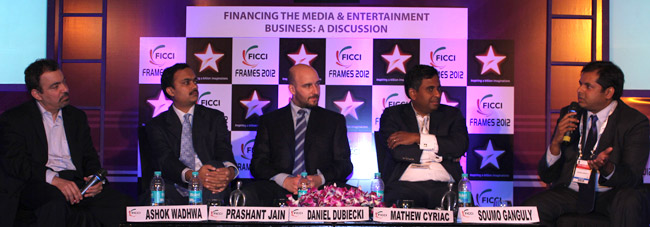
    In a session titled “Financing the Media and Entertainment Business” eminent personalities such as Prashant Jain, Executive Director, HDFC Mutual Fund; Matthew Cyriac, Sr Managing Director, Private Equity, Blackstone; Soumo Ganguly, Managing Director, Moxie Entertainment Pvt Ltd; and Daniel Dubiecki, Founder and Partner, The Allegiance Theatre, Hollywood shared their views on the subject. Ashok Wadhwa, Group CEO, Ambit moderated the session.


    Matthew Cyriac started off the session by pointing out that majority of the investments within the media and entertainment industry were made in television and print as they represent a fairly large share in terms of sheer numbers as against Internet and Radio . The Hindi GECs in TV is where typically where a lot of money into followed by regional GECs and sports channel. For print media, it was the regional publications command a lot of attention as regional advertising is very robust – one which extracts a lot of profit.


    Prashant Jain pointed out thata lot of companies in India have managed to get good funding and that it is not reflective of a very, very sorry picture as is being talked about. “It’s not that all of India in the media entertainment space not attracting funds. Companies like UTV and a few others have attracted investors.”


    Ashok Wadhwa remarked that the film industry in India is not institutionalised enough to attract private equity. Daniel Dubiecki spoke about the need to be more global in concept, widen the scope of the market and thereby making it more viable to attract investments in the films business.


    Photograph: Fotocorp

  • @FF12: Entertainment has become a revolution


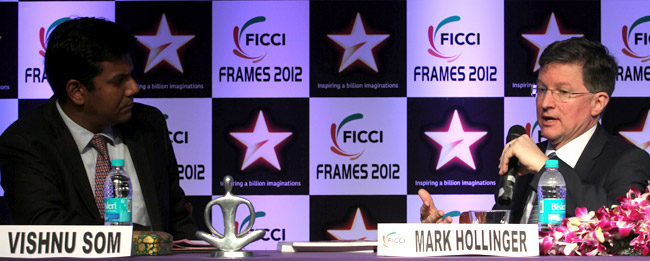
    The second session of FICCI Frames had ‘industry doyens, including key enablers, shed light on challenges and opportunities for the times ahead’. The session was moderated by Vishnu Som, Editor, Documentaries and Senior Anchor, NDTV.


    The session was opened by Mr Som welcoming Mark Hollinger, President & CEO, Discovery Networks International (DNI), who took the stage to talk about DNI’s journey in India. From a single network launched in 1995, today DNI has grown to seven channels. Mr Hollinger gave the credit of this success to DNI’s advantage of being an early mover in the Indian market.


    While talking about the process of digitisation, Mr Hollinger said that it is a great opportunity for a truly interactive pay TV experience. He appreciated the investment  made by the C&S community (the set top boxes and the marketing for the same).


    Mr Hollinger was of the opinion that the viewers today prefer sophisticated technology and the same applied for TV too. He said that digitisation is a win-win situation for all. The consumer gets a better product with ‘wider choices’ and the broadcasters will get a better business model which allows ‘faster and broader penetration of HD channels’. He stated that embracing digitisation will push broadcasters to perform better.


    In the Q&A session with Mr Som, when he was asked about the benefits of producing content v/s revenue, Mr Hollinger said one-third of their operational revenue and profits is recovered from the market due to their early mover advantage. He revealed that they spend almost $1 billion on producing content.


    Being an international channel which enteredIndiain 1995, Mr Hollinger talked about howIndia, as a country, is more open to foreign content. He also said that even then they offer regionalised content created specially for the local viewers and also the option to view the international content in the local language. Mr Hollinger stated that their strategy worked as was evident from the Brand Trust Report which has named Discovery as the third most popular channel and TLC as the fifth.


    In the Q&A session, when Mr Som questioned him about the pros and cons of local v/s international content, Mr Hollinger said that the local staff keeps them appraised about how the content is received. He said that the mix of international and local content is almost 50-50.


    Mr Hollinger saved the best for the last. While closing his speech, he announced that DNI is launching Discovery Kids in India, which is the launch pad for theAsialaunch. The channel will also be launched inIndonesiaandPhilippines.


    He also revealed plans to expand DNI’s scope to DVDs, retail, publishing and merchandising in the “biggest satellite market today”.


    Next up was Puneet Goenka, CEO and MD, Zee Entertainment Enterprises Limited (ZEEL). Mr Goenka opened his address by stating entertainment is no longer an evolution but has become a revolution. He said that digitisation of content is a good move as the drivers of today’s content are “highly motivated youngsters who are high risk takers and have large disposable income”. They have the power to influence products to be customised and digitisation will help achieve just that.


    With the help of a powerpoint presentation, Mr Goenka listed out the pros and cons of digitisation. He listed the fact that the penetration of private channels is still low and there is a lot of scope to grow as a benefit. Citing the example of Ditto TV, he said that now new media is the media to go to.


    During the Q&A session, when asked about the benefits of digitisation, he said that the sheer choice that the consumer gets is the benefit which will also be beneficial to them as the number of channels being offered in HD will go up.


    While talking about self-regulation in media, Mr Goenka said that it is still early days, as the norms have just been laid out by the news and entertainment industry. Time is needed to let them evolve and make a difference.


    Next to address the audience was Carolyn Everson, VP, Global Marketing Solutions, Facebook, whose address featured on how Facebook can benefit the media and entertainment industry. Giving the example of Open Graph, Ms Everson illustrated how Saavn in music, Zinga in gaming and films being released in theUSuse Open Graph by sharing stories built their brand on “top of Facebook”.


    Her ‘Aaha’ moment about Facebook came when, while talking to an anthropologist, she realised that communities and networks have always been around us but Facebook brings them to us at a scale never seen before due to the technology available.


    She said that Facebook is a reflection of the unique individual identity and the social graph is created using the information shared by the individual.


    Ms Everson also dealt with how Facebook is trying to take marketing from ads to stories. The thought behind the idea is that ads may be remembered once but stories are shared and remembered by millions. The best example of this is the Timeline pages for the brands which allow them to communicate one-on-one with their fans.


    During the Q&A session, Ms Everson faced some tough questions from Mr Som, when he asked her about how Facebook has been dealing with objectionable content. She answered that they work very hard to regulate content and address complaints regularly. When she was asked how and why do they decide what is unsafe or objectionable, she answered that the communities regulate the content and Facebook takes their input very seriously.


    Photograph: Fotocorp

  • @FF12: Financing, a cause for concern in M&E

    By A Correspondent


    The media and entertainment industry of India has scripted a glorious growth story in the past decade or so, and the future looks even more promising with digitization and the advent of technology across media verticals such as broadcast, print and also films. But one area of concern is the lack of private equity and VC funds showing adequate interest.


    In a session titled “Financing the Media and Entertainment Business” eminent personalities such as Prashant Jain, Executive Director, HDFC Mutual Fund; Matthew Cyriac, Sr Managing Director, Private Equity, Blackstone; Soumo Ganguly, Managing Director, Moxie Entertainment Pvt Ltd; and Daniel Dubiecki, Founder and Partner, The Allegiance Theatre, Hollywood shared their views on the subject. Ashok Wadhwa, Group CEO, Ambit moderated the session.


    Matthew Cyriac started off the session by pointing out that majority of the investments within the media and entertainment industry were made in television and print as they represent a fairly large share in terms of sheer numbers as against Internet and Radio. The Hindi GECs in TV is where typically where a lot of money into followed by regional GECs and sports channel. For print media, it was the regional publications command a lot of attention as regional advertising is very robust – one which extracts a lot of profit.


    Prashant Jain pointed out thata lot of companies in India have managed to get good funding and that it is not reflective of a very, very sorry picture as is being talked about. “It’s not that all of India in the media entertainment space not attracting funds. Companies like UTV and a few others have attracted investors.”


    Ashok Wadhwa remarked that the film industry in India is not institutionalised enough to attract private equity. Daniel Dubiecki spoke about the need to be more global in concept, widen the scope of the market and thereby making it more viable to attract investments in the films business.


    Photograph: Fotocorp

  • Budget 2012: Ranjona Banerji on how TV Channels fared with their Budget specials

    By Ranjona Banerji


    Soon after India liberalised her economy, the late great Nani Palkhiwala, whose budget analysis speech would fill up Brabourne stadium, decided that there was no longer any need to discuss the budget. Yet in India, it is still a grand tamasha event and even more so, with the massive explosion of television. Before the TV days the best we had to contend with were the massive graphics on the front page of The Economic Times, with the “fin min” portrayed as some kind of super hero or failing that, a comic character.


    (By the way, thank god they don’t call them fin mins any more or maybe Pranab Mukherjee threatened dire consequences.)


    From early on Friday morning, all the channels were in a high state of excitement as they discussed what the budget could be, what they wanted it to be and so on. Despite the Economic Survey of the day before, no one had too many clues though everyone wanted reforms. Some business types even conceded that the poor and less fortunate needed help while the economists looked askance at the idea. This continued till 11 am when everyone had to switch to the feed from the Lok Sabha channel.


    After that, it was a juggling act to get the best interpretation of the budget as it happened. I started with juggling between NDTV and NDTV Profit because the discussions headed by Prannoy Roy on one and Vikram Chandra on the other were interesting. But then they filled their screen with so much other information that I lost track of the “fin min” (oops).


    So I surfed till I reached CNNIBN which had the cleanest screen of the lot. No millions of shares going up and down, no “insta analysis” from experts as provided by Times Now and no tweets from the general public. Suddenly however CNNIBN started running a little cartoon man with placards saying “cool”, “good idea”, “bad idea” to several budget proposals which became a tad distracting. When I started spending more time figuring out if the cartoon man’s moustache changed position as he changed placard from cool to bad idea, I realised CNNIBN was also a bad idea and shifted to the Lok Sabha channel.


    I did surf through the business channels but not only were the screens cluttered with shares going up and down, they were also full of acronyms which I could not decipher. Seemed like maths class after some time – if you put the ELSS on the SME and divide it by the ECB you realise that the squaw on the hypotenuse is actually sleeping with the Big Chief. Or something like that but probably not as exciting.


    The speech took two hours, after which the viewer was exhausted but the analysts were chomping at the bit to take off and expound. The economists and journalists all hated the budget while the industrialists, bankers, investment and money people did not think it was so bad. It was clear that the journalists and economists were deeply hurt that Air India had not been sold, petrol prices had not been increased to Rs 150 a litre and even worse, so much money had been given to NREGA, rural and urban health and education and so on. Others talked about how “inclusive growth” was necessary in a politically correct manner, except for one man on one of the business channels who talked about “socialist stuff… health and all this blah blah”. One can only hope no one he knows ever has need of “blah blah”.


    As the evening progressed, Times Now looked at the politics of it and Headlines Today and NDTV went quite quickly into Sachin Tendulkar’s 100th century (glory be, at last, what a joyous day for Pranab Mukherjee). The business channels divided themselves us as some looked at property, others at investment and others at the stock market.


    Interviews with Pranab Mukherjee were shown on NDTV with Prannoy Roy and TN Ninan, on Times Now with Arnab Goswami and Navika Kumar, on CNBC with Raghav Bahl and on CNNIBN through Lok Sabha TV with a young man who Rajdeep Sardesai told us was a TV18 staffer. Whatever. Mukherjee’s famous temper was on display only with Raghav Bahl when he told him quite categorically that he was not going to get into a “school debate” with him. For all the posturing that the experts did on the other channels about the budget and the deficit and so on, only Bahl asked the really tough questions. Not that it came to anything.


    The verdict at the end: a choice between CNNIBN, NDTV for regular channels and Bloomberg and CNBC at the business end. The winner is possibly the remote, in that case.


  • Budget 2012: What it means for India Inc

    Local Deals Under Transfer Pricing

    This is bad news for companies as their tax outgo and compliance burden will rise. Firms use transfer prices to shift profits to tax havens. The new rule will increase documentation for companies. Right now, these rules cover only deals between a domestic company and its overseas subsidiary.


    No More Tax Surprises

    An advance-pricing agreement is good news for MNCs investing in India. It will reduce disputes as taxpayers would know their liability on transactions within their group companies in advance. These pacts are binding on both the taxpayer and the government, but can be quashed if the taxpayer misinterprets facts. The agreements will end aggressive assessments and reduce tax arrears locked up in litigation.


    Declaring Foreign Assets a Must

    Taxpayers must declare overseas assets and income-tax offi cers can reopen their books for the past 16 years. The fi rst development could pave the way for an amnesty scheme while the second will increase compliance burden on taxpayers but check tax evasion.


    Dressing Up Cash Trails to Get Tougher for Cos

    Share premium in excess of fair market value will be treated as income. This will increase the tax outgo for firms as share premium has so far been treated as capital. A similar move to impose tax on cash credits, unexplained money and investments will check evasion. It will end the practice of closely-held companies laundering black money by bringing it back as share capital.


    Offshore Transfers to Come Under Tax Net

    In a big blow to foreign investors, the government has re-written law so that it can tax indirect transfer of capital assets or property located in India. The amendment, effected retrospectively from 1962-63, will empower the government to impose capital gains tax on Vodafone and other such M&A deals in the past. It’s one step back in tax reforms.


    Source:The Economic Times

    Copyright © 2012, Bennett, Coleman & Co. Ltd. All Rights Reserved


  • Budget 2012: Entrepreneurs may find fund-raising easy with removal of restrictions for VCs

    By Paramita Chatterjee


    The eco-system for early stage companies is set to improve as the FM proposes to remove restrictions on venture capitalists, who earlier gained tax benefits on investments in nine specified sectors. The removal of this sectoral cap will make fund raising easier for entrepreneurs going forward.


    Besides, the proposal to float a Rs 5,000 crore India Opportunities venture capital fund with SIDBI to help start-ups is seen as a step to benefit micro and small enterprises (MSMEs) across the country. As per estimates of Federation of Indian Micro and Small & Medium Enterprises (FISME), there are currently 26 million MSMEs present in India, of which only 5% has access to institutional funds. “Any kind of equity support to MSMEs is welcome as it was greatly needed,” said Anil Bhardwaj, secretary general at FISME.


    However, analysts feel the amount is still too little. “The initiate to set up a fund for MSMEs is good but the budget allocation is small,” said Raja Lahiri, partner at advisory services firm Grant Thornton. But overall, its a good start, as currently not many MSMEs would require capital for expansion, said Bhardwaj.


    Source:The Economic Times

    Copyright © 2012, Bennett, Coleman & Co. Ltd. All Rights Reserved


  • Budget 2012: Ernst & Young Analysis of Direct & Indirect Tax proposals in M&E

    Ernst and Young shared with MxMIndia its analysis of what the Union Budget 2012’s tax proposals mean for the Indian media and entertainment sector:


    Foreword

    Union Budget 2012-13 was keenly awaited by the Indian businesses and Foreign Investors/ businesses alike largely to see if the Finance Minister (FM’) chalks out a credible path for the reforms process which seemed to have been halted. The FM has announced several steps for agriculture, infrastructure and capital markets, and their impact on the economy will need to be analysed.


    On the direct tax front, there are several surprises in form of various amendments proposed, some of which were particularly not anticipated in view of the report submitted by the Standing Committee on Finance (SCF’) of the Parliament on the Direct Taxes Code 2010 provisions on 9 March 2012.


    On the indirect taxes front, most of the amendments were largely anticipated. In fact, the film industry received a centenary year gift in form of exemption from service tax. Rate of excise duty has been increased from 10.3% to 12.36% from 17 March 2012 while similar increase in service tax is effective from 1 April 2012.


    Some of the key tax measures announced by the FM are as follows:

    • Direct Taxes Code (DTC’) to be enacted after giving due considerations to the report of the SCF
    • Goods and Service Tax (GST’) Network, the IT backbone for GST, to become operational by August 2012
    • Advance Pricing Agreements (APA’) and General Anti Avoidance Rule (GAAR’) provisions proposed as amendments to the domestic income tax law
    • Permanent Account Number – income tax identification number – to be used as a common identifier for direct tax and indirect tax purposes to ensure transparency and check on tax evasion
    • Setting up a study team to examine the possibility of a common tax code for service tax and central excise


    The FM also announced a five pronged strategy to tackle the malaise of generation and circulation of black money and its illegitimate transfer outside India. Government has taken a number of proactive steps to implement this strategy. As a result:

    • 82 Tax Treaties and 17 Tax Information Exchange Agreements have been finalised and information regarding bank accounts and assets held by Indians abroad has started flowing in. In some cases prosecution will be initiated
    • Dedicated exchange of information cell for speedy exchange of tax information with treaty countries is fully functional in Central Board of Direct Taxes
    • India became the 33 rd signatory of the Multilateral Convention on Mutual Administrative Assistance in Tax Matters
    • Directorate of Income Tax Criminal Investigation has been established within the tax administrative set up

    In this tax alert, we have summarized some of the key amendments proposed in the Budget 2012 which may have an impact on the M&E Industry. For detailed summary of the Union Budget, please refer to the Ernst & Young India Budget Plus 2012.


    Direct Taxes

    While outlining the direct tax proposals, the FM mentioned that his proposals for the financial year 2012-13 mark further progress in the direction of movement towards the proposals outlined in DTC. Key proposals are summarized as under:


    No changes are proposed in the corporate tax rate.

    It is now proposed to clarify by way of a deeming fiction that share or interest in a company or entity registered or incorporated outside India shall be situated in India, if the share or interest derives, directly or indirectly, its value substantially from the assets located in India. This clarification will be applicable with retrospective effect from 1 April 1962 (ie assessment year 1962-63). This proposal has the effect of neutralising the recent ruling of Hon’ble Supreme Court in case of Vodafone from a retrospective effect.

    Considering the conflicting decisions of various courts in respect of income in nature of royalty’ and to restate the legislative intent, it is proposed to amend the definition of royalty retrospectively from 1 June 1976, in following manner:

    • Transfer of all or any right for use or right to use a computer software (including granting of a licence) is in the nature of royalty’ irrespective of the medium through which such right is transferred.
    • Royalty includes consideration for any right, property or information whether or not possessed by the payer, directly used by the payer or located in India.
    • The term process’ in the royalty definition to include transmission by satellite (including up-linking, amplification, conversion for down-linking of any signal), cable, optic fibre or by any other similar technology, whether or not such process is secret.
    • This proposal could lead to characterisation of payments towards use of computer software, information, databases, transponder, uplinking facilities, leased lines, etc as royalty under the domestic income tax law with a retrospective effect.
    • Presently, income of a Venture Capital Fund (VCF’) or Venture Capital Company (VCC’) derived from investment in a domestic company ie Venture Capital Undertaking (VCU’), is exempt from taxation, provided the VCU is engaged only in nine specified businesses. The investor in VCF/ VCC is taxable upon distribution being made by the VCF/ VCC on a deferred basis. In order to avoid multiplicity of conditions in different regulations for the same entities, the sectoral restriction on business of VCU is proposed to be removed, and the income is now proposed to be taxed in the hands of the investor in VCF/ VCC on an accrual basis and be subject to withholding tax. The investments in M&E sector through VCF/ VCC route will now be eligible under the provisions, which was earlier not possible.
    • It is now proposed that when a company in which public are not substantially interested, receives a consideration for issue of shares from an Indian resident in excess of face value of its shares, the aggregate consideration received for such shares in excess of the fair market value of the shares will be chargeable to tax in the hands of such company. This provision could lead to structuring and commercial challenges in case of a joint venture with a non-resident participation or foreign investments in Indian companies in form of private equity or such other route with lower than 100% interest.
    • Presently, there are no specific requirements under the domestic income tax law to grant tax treaty benefits to a non-resident taxpayer on the basis of Tax Residency Certificate (TRC’). It is now proposed to make submission of TRC containing prescribed particulars, as a necessary but not sufficient condition for availing benefits of the tax treaty.
    • Presently, income received by non-citizen and non-resident sports persons from participation in any game or sport, advertising or contribution of article in any newspaper etc and income of non-resident sports association or institution for guarantee money payable to such institution in relation to any game or sport played in India is subject to tax at the rate of 10% of the gross receipts. It is now proposed to increase the tax rate from 10% to 20% on gross receipts.
      It is further proposed to tax income arising to a non-citizen, non-resident entertainer (such as theatre, radio or television artists and musicians) from performance in India at the rate of 20% of gross receipts, which was earlier taxable at the rate of 30%.
      Consequential amendment is also proposed in the withholding tax provisions to provide for withholding of tax at the rate of 20% from income payable to non-resident, non-citizen entertainers, sportspersons, sports associations etc and will be applicable with effect from 1 July 2012.


    • It is now proposed to widen the scope of compliance of withholding tax provisions for payments to non-residents by clarifying that the obligation to withhold tax on payments to non-residents applies and extends to all persons, resident or non-resident whether or not the non-resident person has a residence or place of business or business connection in India or any other presence in any manner whatsoever in India. This proposal intends to cast an obligation on the non-resident irrespective of such person’s territorial nexus with India.
    • Under the existing provisions of domestic income tax law, as a one-time’ concessional measure, dividends received by a resident company in India from its foreign subsidiary was taxable at the rate of 15% for financial year 2011-12. It is now proposed to extend the applicability of this provision by one more year ie for the financial year 2012-13.
    • It is now proposed to remove the cascading effect of dividend distribution tax (DDT’) from multi-tier structure. Dividends distributed by a holding company will not be subject to DDT to the extent of amount of dividends received from the subsidiaries by such holding company in the same financial year, effective from 1 July 2012.
    • To offer better assurance on transfer pricing methods and certainty and unanimity of approach, it proposed to introduce APA regulations with effect from 1 July 2012.
    • It is now proposed to amend the definition of international transactions’ for the purpose of transfer pricing provisions with retrospective effect from financial year 2001-02. It is also proposed to extend the transfer pricing regulations (including procedural and penalty provisions) to specified domestic transactions entered into between domestic related parties or by an undertaking with other undertakings of the same entity. These provisions will apply only in respect of specified domestic transactions exceeding INR 50 million.
    • To codify the doctrine of substance over form’, it is proposed to introduce GAAR provisions to determine tax consequences by taking into account real intention of the parties, effect of transactions and purpose of an arrangement.
    • As an anti-avoidance measure, it is now proposed to grant additional power to the Tax Officer to declare an arrangement to be an impermissible avoidance arrangement under certain circumstances and refer such cases to the higher level authority (ie Commissioner of Income-tax). The onus is on the taxpayer to establish that the arrangement was not executed with a view to avoid taxes.
    • Under the existing provisions of domestic income tax law, every person is required to furnish a tax return if his income during the financial year exceeds the maximum amount which is not chargeable to tax. It is now proposed to amend the provisions for filing the tax return in India to make it mandatory for every resident having any asset (including financial interest in any entity) located outside India or signing authority in any account located outside India irrespective of the fact whether the resident taxpayer has taxable income or not. This amendment will take effect retrospectively from 1 April 2012 (ie assessment year 2012-13).
    • It is now proposed that the Alternate Minimum Tax (AMT’) provisions (introduced for Limited Liability Partnerships in the Budget 2011) should be extended to include certain specified persons (other than a company) and such persons be made liable to pay AMT at the rate of 18.5% (Effective Tax Rate of 20.00%) when their adjusted total income exceeds INR 2 million.
    • It is now proposed to increase the exemption limit for carrying out tax audit of a person carrying on business from INR 6 million to INR 10 million; and a person carrying on profession from INR 1.5 million to INR 2.5 million.


    Indirect Taxes

    Goods and Services Tax (‘GST’)

    • The Finance Minister (FM’) has assured that drafting of the model GST legislation for Centre and State GST is under progress along with State Governments.
    • Structure of GST Network (GSTN’) has been approved by the Empowered Committee of State Finance Minsters. GSTN, implementing common PAN based registrations, returns filing, payment processing, will be operational by August 2012.


    Service Tax

    • Effective rate of service tax has been enhanced from 10.3% to 12.36% wef 1 April 2012.
    • Time limit for issuance of invoice under Point of Taxation Rules is proposed to be increased from 14 days of provision of service to 30 days of provision of service.
    • Continuous supply of service will include services provided on a recurrent basis under Point of Taxation rules.
    • Settlement commission provision introduced.
    • No monetary limit specified for service tax adjustments if the adjustments are not on account of interpretation of law, taxation, valuation, classification etc.
    • Receipt of consideration for export of services aligned with the time prescribed by RBI (including extended period allowed), for determining date of payment of tax.
    • Disputes on refund/ rebate in case of service export will now be referred to Revision Authority instead of Tribunal.
    • Commissioner is empowered to conduct special audit by engaging a Chartered Accountant or a Cost Accountant in certain circumstances.


    Negative List under service tax

    • The Finance Minister has proposed change in manner of levy of service tax by taxing services on negative list basis. Services mentioned in negative list or in exemption notification shall not be liable to service tax.
    • New definitions in the context of negative list based taxation introduced inter alia including negative list, taxable territory, services, renting, money, actionable claim, interest, person.
    • Under the earlier draft concept papers, advertisement in print was proposed to be covered under service tax net. However, negative list legislation continues to keep print industry outside the tax net.
    • Exemption is proposed on temporary transfer or permitting the use of copyright in cinematograph films in addition to currently exempted copyrights in original literary, dramatic, musical or artistic works. Copyright in sound recording shall continue to be taxable.
    • Exemption to copyright in cinematograph films likely to cover television programmes, theatrical or non-theatrical films etc.
    • Services by performing artists in folk or classical art forms of music, dance or theatre is proposed to be exempted.
    • Services provided to a recognised sports body by another recognised sports bodies or individual as player, coach referee, umpire etc for a tournament organised by such recognised sports body is proposed to be exempted from service tax. Further, sponsorships for tournaments organised by specified sports bodies is also proposed to be exempted from service tax.
    • Under earlier draft concept papers, admission into premises (including theatres, amusement parks etc) was proposed to be chargeable to service tax. However, admission to entertainment events or amusement facilities is proposed to be included in negative list and hence, not liable to service tax.
    • Selling of advertisement space and time on media other than radio or television has been considered to be a service under the negative list. Thus, it would need to analyse if advertisements in electronic medium (such as internet, telecommunication etc) or in outdoors will attract service tax.
    • Services of betting, gambling or lottery are included in the negative list and hence, shall be exempted from service tax.
    • The proposed negative list concept intends to define service’ for the first time under the service tax legislation. Service’ has been very broadly defined and includes declared services’. Such declared services’ deems temporary transfer of any Intellectual Property Right, works contract, construction, IT software, non compete, hiring, leasing or licensing of goods without right to use etc as services.


    Draft Place of Provision of Services Rules (‘POS Rules’)

    • Proposal to replace existing framework of identifying jurisdiction for levy of service tax through Export of Services Rules, 2005 and Taxation of Services (Provided from Outside India) Rules, 2006 with a common Place of Provision of Services Rules.
    • Guidance note on POS Rules has been issued to determine taxable territory’ for appropriate levy and collection of service tax. These Rules aim to identify a more consistent and efficient mechanism to collect service tax.
    • Generally, place of provision of services to be the location of service receiver’.


    Cenvat credit

    • Interest on wrong credit to apply only when the credit is utilised.


    Excise duty

    • Effective rate of excise duty enhanced from 10.3% to 12.36%, 5.15% to 6.18% and 1.03% to 2.06%.


    Customs duty

    • Effective rate of customs duty enhanced from 26.85% to 28.85.


    Central Sales Tax (‘CST’)

    • CST rate against declaration forms has been retained at 2%.


    Ernst & Young is a global leader in assurance, tax, transaction and advisory services. In India, it is located in 14 offices across 10 cities.

    You may refer to original document also at http://www.ey.com/Publication/vwLUAssets/Media-Tax-Alert/$FILE/Media-Tax-Alert.pdf