Author: mxmadmin

  • The Anchor: 5 ‘must-do’s for the future of radio in India

    By Uday Chawla


    #1 A level playing field is needed

    Under Phase III, content freedom is still severely restricted. Only AIR-provided news capsules can be broadcasted. Current affairs and even sports commentary are restricted. There is no such restriction on print, television or even the internet. The government’s view is that a central monitoring system is needed to be put in place before news on FM is freely allowed. With the process on, early lifting of restrictions should be expected. (Even in Nepal, news on FM is freely allowed.)


    #2 DAVP rates should be rationalised

    Government advertisement rates need to be equal across all media, but currently they are heavily skewed against FM. For instance, local newspapers are given a rate of Rs.159 per column cm per lakh reach, while for FM it is over 10 times less even for a 10-second spot. There has been a high listenership growth in FM and on an average FM now reaches 70 per cent of populations in metros. In smaller towns it should be higher. The criterion for relative ad rates within a city amongst different FM should be logical and transparent.


    #3 A transparent system for license extension is needed

    Under the phase II policy, licenses were issued for 10 years, while under Phase III they will be issued for 15 years. A license period of 10 or15 years, with absolute darkness or renewal parameters, discourages away investors and bankers. Even now, phase II players have no idea on what or when is the license extension criterion, and thus making it extremely difficult for them to raise funds for even FM phase III bidding. The solution therefore lies in having prefixed and transparent extension criteria even at the time of allocation of first licenses.


    #4 Developing and regulating human resources

    With 800-plus new radio stations to be set up under Phase III, a four-fold increase, there will be a huge demand for radio journalists. Emerged and emerging content freedom means that a more trained and disciplined RJ resource would be required.

    I believe content freedom brings greater responsibility on radio and incidents like the Darjeeling violence (caused by a derogatory remark by an RJ) puts national security and unity under risk. Therefore a self-regulatory content code needs to be formulated and implemented.


    #5 Building Brand Radio

    Currently Brand Radio is not top-of-mind, be it government or shareholders or even advertisers, and this is not because radio has less reach or is less effective than other medium. In fact radio is the only medium that can be simultaneously consumed along with other activities. Besides, it is also the only medium that can reach the most remote areas of the country and I believe that there is an emerging India in smaller cities and towns, which can be opened up through FM.


    Uday Chawla is the Secretary General, Association of Radio Operators for India (AROI).


  • Conde Nast India launches Architectural Digest

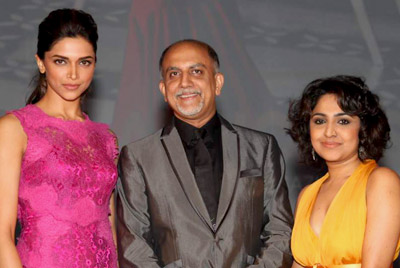
    Deepika Padukone with Alex Kuruvilla (MD Conde Nast India) & Manju Sara Rajan, Editor of Architectural Digest India

    By A Correspondent


    Publishing group Conde Nast India launched their fourth magazine title, the Indian edition of AD Architectural Digest, following the success of premium luxury magazines Vogue, GQ and Conde Nast Traveller. Architectural Digest in India will position itself as the most trusted authority on design, architecture and living.


    AD India is the ninth edition of the magazine, after the United States, Italy, Germany, France, Mexico, Russia, Spain and China. It is targeted towards the affluent Indian population in the age group of 25 to 50 years who aspire for fashionable living spaces. The magazine aims to capture the attention of new home owners and renovators, architects and designers as well as design enthusiasts.


    Speaking on the launch of Architectural Digest in India, Alex Kuruvilla, Managing Director of Conde Nast India said: “Having established leadership in the luxury lifestyle magazine space with Vogue, GQ and Conde Nast Traveller, we are happy to extend our portfolio and bring Architectural Digest in India, recognized as the world’s design bible – the most trusted authority on design, architecture and living to Indian homes.”


    The bi-monthly magazine will be priced at Rs150. AD’s editorial content is broadly divided into four key parts, including AD Discover with a focus on news, trends and lifestyle; AD Perspective bringing to light the people who matter; AD Spaces featuring the most beautiful homes and the AD Inside section sharing advice and tips on the must-have products. Key target markets for the magazine include metros like Mumbai, New Delhi and Bangalore.


    Manju Sara Rajan, editor of Architectural Digest India shared: “The editorial content of this bi-monthly magazine will contain photo spreads of the best homes in the world, feature stories on the latest trends and people in design plus advice on practical solutions for home improvement. AD will become an essential resource for refined home-owners planning luxurious spaces.”


    “By showcasing the best of contemporary Indian design and key international trends, AD will help readers visualise, plan, adapt and innovate homes to reflect the personalities of the people who live in them,” she added.


    The launch event of AD was held in Delhi on March 9 at the Aman in association with India Design Forum (IDF) and supported by Absolut elyx and Maserati.


    Architectural Digest, an interior design magazine published by Conde Nast was founded in 1920. The magazine is aimed at an affluent and style-conscious readership. AD is positioned as the most trusted authority on design, architecture and living. The Indian edition of AD Architectural Digest will present the very best of international and Indian architecture and design.


    Conde Nast, a division of Advance Publications, sets the benchmark for magazine publishing excellence. Conde Nast currently operates in 24 countries, publishing 126 magazines, and with 98 innovative websites from Conde Nast Digital.  Recent print launches include GQ inBrazil, Wired in the UK and Italy, Vogue in Turkey, and Conde Nast Traveller in India . Conde Nast India is a 100 per cent owned subsidiary of Conde Nast International.


  • MPG India appoints Ruma Sengupta as Director of Strategy

    By A Correspondent


    MPG India, the flagship brand of Havas Media, has announced the appointment of Ruma Sengupta as Director of Strategy.

    Based out of Mumbai, Ms Sengupta will work closely with MPG’s four key offices in Mumbai, Delhi, Bangalore and Chennai, to take charge of the agency’s strategic offering and product development in keeping with the vision of Leading New Thinking. She will also take custodianship of Havas Media’s proprietary tools and processes.


    Ms Sengupta will report to Anita Nayyar, CEO of Havas Media South Asia and also work closely with the regional strategy team based out Singapore.

    Ms Sengupta joins the agency with 15 years of experience and expertise across marketing, branding, sales, strategy, MR and analytics. She was most recently the Director of Business Insight for Synovate, where she was responsible for key international clients across FMCG categories. Prior to this, she has worked as Business Head for IMRB International. Her diverse experience also includes working in senior marketing roles at Adlabs Films Limited owned by Reliance ADAG and United Spirits Limited at UB Group.


    Ms Sengupta’s longest stint has been with Ranbaxy Global Consumer Healthcare where she launched OTC & DTC business and managed it successfully through marketing and sales-distribution.

    Commenting on the appointment, Ms Nayyar said: “Havas Media is well-known for the high quality of its strategic product and tools and Ruma has the right credentials and attitude to take control of our strategic offering. Her flair is evident from her extraordinary background having worked with top research agencies like Synovate and IMRB. Her previous experience in spearheading marketing and innovation capabilities with brands is a plus.”


    MPG anchors Havas Media, the world’s fastest growing global media network and recipient of the network Service Award at the 2010 Valencia Festival of Media. MPG provides media planning & buying, strategic consulting, branded entertainment and interactive marketing services for a range of clients in every region of the world. With offices in 109 countries, MPG consists of over 3,500 media professionals working across a broad variety of disciplines and categories.


    Havas Media, the global media network of Havas, is one of the world’s fastest growing media groups having grown from 10 markets in 1999 to 122 markets in 2012. Havas Media services its clients through a portfolio of specialist global networks and agencies. The group is organised to maximise local market dynamics whilst leveraging the extensive global insight and strategic support under its Meaningful Brands framework and analysis.


    The companies within Havas Media include: MPG (Havas Media’s global media communications network), Arena Media (Havas Media’s tailor-made communications network), Havas Digital (Havas Media’s global interactive network) and Havas Sports & Entertainment (Havas Media’s global sports and entertainment communication network).


  • Debrief: IndusInd Bank: Dull and annoying

    By Anil Thakraney


    A rather exasperating campaign from IndusInd Bank. I know this is feature-based advertising, but that’s no excuse, really.


    The commercial I watched features Bollywood veteran actress Neetu Singh and young actor called Jimmy Shergill, who plays her son. Promoting ‘Cash-On-Mobile’, it has Singh shopping for a surprise gift for her son. In a rather haughty manner, she dismisses all the shop assistants, constantly claiming that ‘I know everything’. At the cashier’s desk the bravado vanishes when she realizes she’s broke. She calls her son for help, who in turn transfers money to mommy instantly, via IndusInd Bank, of course.


    There are multiple problems with this ad. To begin with, the actress’s continuous drone grates the ears; this is not humour, it’s irritation for the viewer. If you find Singh continuously shouting ‘I know everything’ to be funny, you need help.


    [youtube width=”400″ height=”200″]http://www.youtube.com/watch?v=B7GBhH4XO1g[/youtube]

    Two, the ad is totally literal and predictable, therefore it has zero entertainment value. Waste of expensive movie actors. And finally, Ms Neetu Singh is a rarity in advertising. So to cast a man who’s not her son in real life jars a bit. A better idea would have been to not use Shergill, they could have cunningly used a voice-over that sounds like Mr Ranbir Kapoor. That would have injected a little charm.


    Alas, was not to be.


    Rating: (On a scale of 1 to 5): 1. Complete wash out.

  • Elephant gives an identity to Daimler’s BharatBenz

    By A Correspondent


    Elephant Strategy + Design has come out with its brand identity for Daimler’s India-specific range of trucks. The association with Daimler is two years old for Elephant, as Ashwini Deshpande, Director for Elephant Strategy + Design explained: “Daimler asked us for expression of interest nearly two years ago. The involvement asked was for development of identity for their India specific range of trucks. We were selected after they were satisfied on stringent global parameters as this was a unique case where the brand and products were to be developed outside Germany.”


    She continued, “It was a daunting task to partner with Daimler teams from India & Germany. Daimler owns legendary brands like Mercedes Benz. There was a huge learning in the process of development as the scale & reach of this brand as briefed to us was for making history, for changing the trucking landscape of India.”


    The name BharatBenz was chosen as it showcased Daimler’s commitment to the Indian market very effectively. “However, to continue the legacy and yet create a framework for contemporary Indian ethos was a challenge,” added Deshpande.


    She also shares that between Pune and Delhi, Elephant has added over 25 new clients in 2011. They include Axis Bank, BCCI (CLT20), Delhi Duty Free, Ericsson, Essar Steel, General Mills, Glenmark Pharmaceuticals, Heinz, Karrox, Mars International, Piramal Realty, Promethean Power, Reckitt Benckiser and Wagh Bakri Tea. Over a hundred projects of varying sizes and impact were executed between Delhi and Pune. Complan re-launch, Experience Strategy and visual language for Axis Bank, strategy, identity and communication for Delhi Duty Free, Visual language for Champions League T20 and innovative cookware ranges designed for Nirlep are some of the highlights. One of their most recent brand assignments was for Britannia NutriChoice Multigrain Thins where the agency designed the shape of the biscuit, the brand and the packaging.


    “We have created a character called Adem for Mead, the global giants who probably sell the most number of notebooks in the world. Excitement has come in all shapes and sizes. From notebooks to cricket stadium!” concludes Deshpande.


    Going ahead, the agency aims to see action from Service Design. There is also a plan to continue to grow the ongoing practices of product innovation and branding. There will be broader focus on Asia as the Singapore team of Elephant is ready to bring in richer insights.


  • Will Marathi content be a shot in the arm for FM in Mumbai?

    By Robin Thomas


    What’s common between radio stations in Kolkata, Bangalore, Chennai, Hyderabad, Ahmedabad, Kolhapur, and Kochi? They give almost equal prominence to local music along with the Hindi or Bollywood songs. This is in direct contrast to the Mumbai market where FM stations mainly play Bollywood songs which are quite popular with the Mumbai listeners.


    According to RAM’s (Radio Audience Measurement), Radio Establishment Survey 2011 findings, although the mother tongue of 51 per cent of FM device owners in the city is Marathi, an overwhelming 80 per cent of them prefer Hindi music and RJ talks on radio. Nevertheless, the survey also revealed that as compared to 2007, the preference for music and RJ Talk in Marathi has witnessed an increase in 2011.


    It’s not that the all the FM stations in Mumbai have ignored the Marathi speaking audience. Big FM, Radio Mirchi and Radio City play Marathi songs, but only on Sundays and they are the only radio stations to do so.


    Big FM, for instance, has been airing Masala Chaha every Sundays between 7am to 9am since 2009, much before Raj Thackeray’s diktat to the radio stations to play Marathi music. But even then, a Big FM spokesperson was of the view that although there is a market for Marathi music, Mumbai being a cosmopolitan city, most Mumbaikars prefer listening to Bollywood music. “There is surely a market for Marathi music, given the high population of Marathi speaking public. However, Mumbai is a cosmopolitan city with a wide audience base, and a mass channel has to play the music that appeals the most… which is Hindi, a lot of it being Bollywood. Phase III will unleash the true potential of radio and will allow for more differentiation in content, along with newer genres and radio stations that will cater to a more specific audience base.”


    Radio Mirchi airs ‘Mumbai Dhol’ every Sunday, between 12 noon to 3pm, hosted by RJ Rohit. ‘Mumbai Dhol’ covers the culture of the city, the happenings and plays back to back Marathi music, contemporary and the classics.


    Indira Rangarajan, VP, Programming, West & Central, Radio Mirchi stated: “The response to our Marathi show – ‘Mumbai Dhol’ has been very good. Following the resurgence of Marathi films and music, we had decided to experiment with a slot specifically for Marathi songs and it has worked well. I believe there is plenty of scope for Marathi music in Mumbai and over the years this popularity will increase further.”


    RadioCitytoo plays Marathi retro songs every Sunday evening between 5pm to 6pm during ‘Sandhikali Aasha’, a radio programme hosted by RJ Vishaka.


    After looking at the Marathi content being offered by these three stations, one wonders if there scope for more Marathi content on Mumbai radio stations? Or will the Marathi music lovers have to wait a little longer for a radio station that caters to their tastes?


    Unlike the private radio stations, the government-owned FM stations, AIR FM2 Gold and AIR FM1 Rainbow, play a mix of Hindi and Marathi songs every day. The private radio stations would do well to take a lesson from these government-owned radio stations.


    Naval Toshniwal, CEO, Tomato FM, a Kolhapur-based FM radio station, was also of the view that although the potential for Marathi music is huge, Mumbai being a cosmopolitan city will play more Hindi or Bollywood songs. “Yes, there is a huge scope for Marathi music in Mumbai. However, no private FM station would want to play only Marathi music, it will have to play Bollywood or Hindi songs too because of the cosmopolitan listenership. Looking at the current FM scenario where every station sounds the same, I believe that a radio station which plays a little more Marathi music will create some amount of differentiation in the market.”


    FM stations in the city play Marathi hit songs during prime-time, especially on occasions like Maharashtra Day or Gudi Padwa. For instance, Big FM Mumbai will be playing Marathi songs during the breakfast show from March 19 to March 23, celebrating the occasion of Gudi Padwa.


    According to Janardhan Pandey, Associate VP, Mudra Max: “Although the market may not be big, the potential for Marathi listenership is huge in Mumbai. The issue, however, is that there has not been any serious attempt by FM stations to woo the Marathi listeners. Awareness about Marathi programmes aired on radio stations seem to be non-existent, the Marathi programmes or music are played during mostly non-prime time. However unless a FM station does not aggressively promote its Marathi programmes, and plays Marathi songs more frequently, it will neither add new listeners nor will it attract new advertisers. There are a lot of retail advertisers in the city catering to the Marathi audience.” Ajay Rao, Vice President, Dentsu stated: “There is a huge scope for Marathi listenership in Mumbai as Marathi generates high level of passion.”


    The good news is that increase in the frequency of Marathi music on radio stations could mean attracting new listeners to radio, and perhaps even new advertisers. Moreover, multiple frequencies may bring some good news to the Marathi music lovers as it will bring new genres of radio stations.


  • Nilesh Naik is Senior CD, Percept/H, Bengaluru

    By A Correspondent


    Nilesh Naik has been appointed as Senior Creative Director, Percept/H – Bengaluru, effective February 2012. Prior to joining Percept/H, he was working with Dentsu Marcom, Mumbai as Creative Director.


    In his new role as Senior Creative Director at Percept/H, Mr Naik will be spearheading the creative team in Bengaluru and will be focusing on developing and strategizing innovative campaigns for the clients.


    Commented on the new appointment, Prabhakar Mundkur, Chief Executive Officer, Percept/H, said, “Our Bangalore office is growing from strength to strength. Getting Nilesh on the team is part of our effort to strengthen the creative product at Percept/H.”


    Elaborated Mr Naik: “Percept/H is the right fit in terms of brands, the people, and their vision for the place. It’s a great opportunity to create work that’s refreshingly different yet works wonders for the brand.”


    With experience of 13 years in the advertising industry, Mr Naik has worked with leading agencies such as Everest, Euro RSCG, Ambience and Bates. He has had the opportunity to work for different verticals namely FMCG, Finance, Real Estate, Publications, Telecom and Insurance, and his creative work has won him several accolades at both local and international award shows.


  • Hiring expected to pick up in the coming quarter

    By A Correspondent


    Indian employers are treading on a cautious yet optimistic trail and maintaining staff levels across major industries. Employers have definitely become selective and are conscious about the need for ‘right’ hiring at this juncture. The good news is that this period of uncertainty is better than 2008, since there are no large layoffs or hefty cost cuts and people are not losing jobs.


    The inaugural issue of the TimesJobs RecruiteX Quarterly Report throws light on this trend providing expert opinions and data-backed insights into the demand for skills and talent and the supply of human resources & capital.


    The report is segregated into three sections: top ten industries, locations and experience ranges. For the industrial section, the report provides the views of market experts alongside the research analysis thereby providing a balanced and comprehensive view of the recruitment market. Similarly, for locations and experience levels, the findings are confirmed with the interviews of senior executives from major HR consultancies and companies.


    Industrial Hiring Patterns-


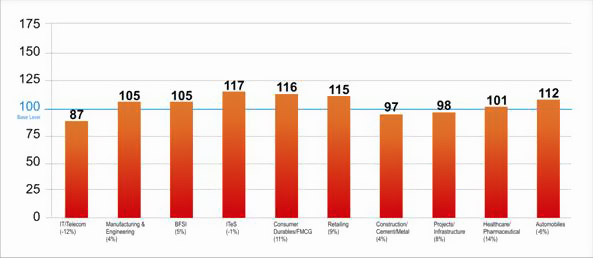
    The TimesJobs’ RecruiteX reports that all major industries clocked stable hiring patterns during the October-December 2011 quarter. According to the quarterly analysis of the RecruiteX, only three industries, BPO/ITeS, Consumer Durable/FMCG and Retail, out of the top ten industries, reported double-digit growth over the base level recorded in December 2010. Demand in support functions such as HR and Accounting & Finance has overshadowed core functions across top ten industries.


    This in-depth journal of statistics, information and analyses on employers (demand) and jobseekers (supply) and will serve as a reliable reference guide to present and future developments in recruitment.


    Geographic Hiring Patterns –


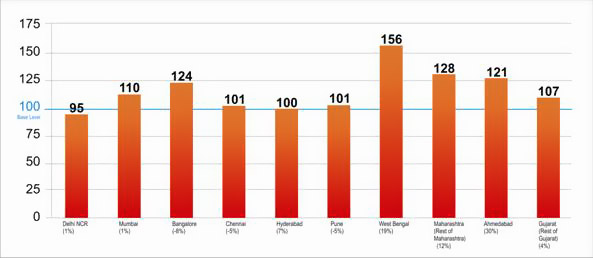
    As per TimesJobs’ RecruiteX, both, Delhi NCR and Mumbai have performed poorly on the demand index. Market experts opine that the hiring activity was negative in metros due to the poor macro-environment and negligible business investments.


    Among the other geographies that the TimesJobs RecruiteX covers, Pune witnessed decent growth in demand during the October-December 2011 quarter. Bangalore reported an increase in hiring activity and was the top performer during the same period.


    Work Ex Related Hiring Patterns –


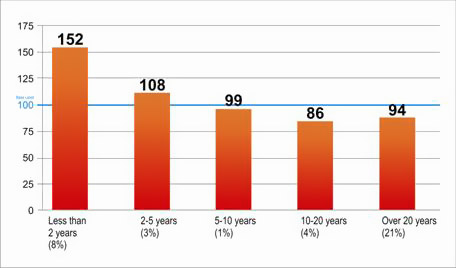
    Hiring activity for fresher/junior level and executive level positions witnessed a substantial fillip while recruitments in the middle-management level were sluggish. In comparison, recruitment for top management positions was healthier.


    Demand for candidates with less than 2 years of experience was robust across industries and locations. The Demand Index for this segment registered an 18-point growth in December 2011 compared to July 2011.


    This TimesJobs RecruiteX Report reinforces the portal’s efforts in becoming a strong medium to pull Indian employment market closer to the line of reality and presents a balanced outlook on the positions & perspectives of employers and job-seekers in Indian employment scenario.


    Other Key Findings:


    • Hiring expected to start picking up during the transition period of January to March 2012
    • Consumer Durables/ FMCG, Automobile, Energy and Infrastructure sector could be major employment drivers in the coming months
    • Demand in support functions such as HR and Accounting & Finance has overshadowed core functions across top ten industries
    • Engineering is the only major profession to maintain consistent growth pattern during the quarter in allied industries, locations and experience levels
    • Amongst top locations, only Bangalore and West Bengal have been able to maintain healthy supply of talent
    • Demand for senior experienced professionals will grow in Education, Healthcare/ Pharmaceutical domain


    RecruiteX Methodology


    To minimise the scope of inaccuracy, the TimesJobs RecruiteX analysis is based on demand and supply data integrated with numbers collected by our offline teams and then segregated according to top industry verticals, experience ranges and locations. Demand for talent is computed by factoring activities of recruiters on TimesJobs.com. Supply of talent is calculated by the activities of the jobseekers on the portal. The base value of RecruiteX has been kept as 100 for the month of December 2010. All RecruiteX values for subsequent months represent the trend of RecruiteX viz-a-viz December 2010.


  • Mirchi Kaan Awards to celebrate best in radio advertising

    By A Correspondent


    Introduced in 2004, the Mirchi Kaan Awards acknowledges and honours the contribution of individuals and organizations that have led the way in creating clutter breaking radio advertising. The awards have been instituted to encourage continued creative focus on radio advertising and are now synonymous with excellence in creativity in radio.


    While every year, the journey to the awards ceremony is a fun-filled, vibrant process keeping in mind the personality of Radio Mirchi, this year the focus is centred solely on the quality of work. Which is why, this year’s edition will see world renowned radio guru, Tony Hertz, conducting a workshop on the art and craft of radio advertising. Mr Hertz’s passion for radio has seen his career, which spans over 40 years and across six continents, as creative director at multiple agencies and the boss of two radio specialist outfits.


    With his experience, he has served twice on the Cannes Lions Radio Jury, on the 2011 D&AD Radio panel and as president of the Clio Awards Radio Jury. Apart from 22 Clios, multiple Gold and Silver ILR Awards, London International Awards and The New York Festivals Awards, Tony is also the only person to have won both D&AD Black and Yellow Radio Pencils.


    The country’s most prestigious radio awards, Mirchi Kaan will work towards raising professionalism and talent among writers. And their new mantra is to listen, learn and shine.


    The last date to send entries to Kaan Awards is March 18.


    Entertainment Network India Limited (ENIL),India’s leading private FM radio broadcaster, popularly known as Radio Mirchi, operates across 32 cities in the country. Launched in 2001, Radio Mirchi has the highest listenership across the country and a track record of developing innovative content, thus expanding and retaining its audiences and advertisers through the years. Radio Mirchi has delighted listeners and the industry with its exciting properties like the Purani Jeans Film Festival and the Mirchi Music Awards.


    Radio Mirchi’s continuous innovations across different platforms like Visual Radio or Mirchi Mobile have been instrumental in gaining leadership in the private FM Radio industry. Radio Mirchi makes its international foray with the launch of the brand in the UAE. From February 1, Radio Mirchi will be heard inDubai,Abu Dhabiand Al Ain and will the first Indian radio brand to go international.


  • The Anchor: 6 reasons why brands can’t ignore digital

    By Vineet Gupta


    #1 Digital is no more youth-centric or an urban phenomenon. It cuts across various age groups and touches a cross-section of society. For a brand it becomes imperative to be present in a medium that cut across geographies and age groups.


    #2 Digital is not an advertising medium but a medium of engagement. If earlier, it was brands that were sending out information to the consumers, now it’s a reversal of that game. Consumers seek information and are proactively engaging with brands on the digital platform, thus giving brands immense opportunity to engage with their consumers in a much more meaningful way.


    #3 Today, it is about mobility and being connected on the move. The consumer is engaging on a real-time basis with brands while being on the move. Access is via multiple screens and it doesn’t really matter where and how the consumer is connecting – but it’s important that he or she wants to be connected at all times with the brand.


    #4 The early adopters of the digital medium were brands that were looking for lead generation. Now many brands have gone beyond that and built an entire eco-system around the digital platform, including building communities or developing e-commerce platforms. This is the way forward for brands.


    #5 The future belongs to brands that have understood this medium and are using it not just for a brand building exercise. One has to realize that digital plays an important role in the purchase decision. Therefore there is a need to understand that it is much more than a marketing medium and all aspects like information, consumer feedback, sales and distribution should be built on this medium.


    #6 Lastly, digital is an important medium in the purchase funnel. Whether it is seeking information, desire to purchase or the action of purchasing, all can be done on this medium. Brands have to look at digital beyond just advertising.


    Vineet Gupta is the Managing Partner of 22feet.


  • [MJR] Grrrrr! Why do people speak so much on News TV?

    By Ranjona Banerji


    The best news programme in India has to be The Week That Wasn’t on CNN-IBN. Since it steadfastly refuses to save India and the world and shamelessly makes fun of everyone, it fails miserably on the high-pitched hysteria count. But it wins on all the others. And it makes you wish that the programme had more than a weekly format because if you spend three evenings running watching our other worthies, it is enough to make you scale to the top of a tall building without a safety harness.


    After his marathon election extravaganza, I have found Arnab Goswami and his channel a dead bore. Also, they spend too much time discussing the minutiae of the Indian cricket board’s digestive processes. Plus, when they do, Boria Mazumdar comes on air and this disrupts my digestive processes. So I tried to give a fair hearing to NDTV, Headlines Today and CNN-IBN (am currently in Tata Sky land which does not carry Newsx).


    Rajdeep Sardesai on Monday night went on and on about the UPA government collapsing, a third front forming and mid-term elections approaching. None of his guests – Devesh Thakur of the JD (U), Pinaki Mishra of the BJD and Abhishek Manu Singhvi of the Congress agreed with him. Sardesai laboured the point and the rest pooh-poohed him. I fail to see the point of such a programme. Then Sardesai announced that Chandan Mitra was arriving on the show so I quickly switched to NDTV. And to my horror, there was Chandan Mitra on NDTV. This was too much to handle and I tried to look for a tall building (with no safety harness) but there aren’t too many in Dehra Dun where I am now.


    On NDTV just before the horror of the spectacle of Chandan Mitra, Sonia Varma had Arvind Kejriwal on the show. He said that the results of the Uttar Pradesh government, where the Samajwadi Party effectively trounced the BSP, reflected the anger of the people against the Congress Party. Varma, if she had false teeth, would have swallowed them. Serves her right for inviting a member of Team Anna to start broadcasting their bizarre logic all over again.


    Headlines Today was on a trip which I couldn’t understand, a mixture of cricket and the government falling, but none of them cohesively.


    On NDTV Profit, Srinivasan Jain attempted to interview Aditya Ghosh, president of Indigo airlines, about why they were more profitable than the others and what about Kingfisher. However Jain spoke so much that Ghosh’s views got lost in a series of “having said thats”.


    Still on NDTV, Prannoy Roy had a panel discussion with several industrial worthies at a Mumbai college. Rahul Bajaj spoke so much that no one else had a chance, so that was that.


    The good news was that someone actually found the world-famous Bollywood Super Star Nupur Mehta who is now going to sue The Sunday Times (phoren) for calling her a “honey trap” used by bookies to lure cricketers into cheating. But no one told me whether it was just because her picture was used or because she really was the honey trap. Anyway, I had never heard of her before and any minute now my ignorance will be exposed because she is the star of Ra One, The Robot, Dirty Picture and more. No?


    Finally, I took refuge in Rajya Sabha TV which was so serious and sober that I felt that I had entered a parallel universe which completely disoriented me, so I went back to watching tennis.


  • Vipin Nair joins Head of Communications at Wipro

    By A Correspondent


    Vipin Nair has joined as the Head-Communications at Wipro. He will be handling the communication mandate for Wipro Technologies and the Corporate.


    Mr Nair brings with him diverse experience in the media and a rich experience of close to two decades. He has worked with print publications as well as international news wires. He has worked as the Executive Editor of Ticker Plant. Prior to that he has been with NewsWire 18 and CRISIL Marketwire. He has also worked with print publications including The Economic Times and Financial Express among others.