Author: mxmadmin

  • Brands focus on toon channels as viewership changes

    By Ameya Chumbhale


    If you thought Cartoon Network, Pogo, Disney, and Hungama TV were kids’ channels, look who’s watching them – nearly a fifth of those watching these channels are between 25 and 44 years. And nearly four out of ten viewers of these channels are more than 14 years.


    Most children, on the other hand, either prefer or are forced to watch what adults are watching on general entertainment channels – soppy serials or reality shows. According to TV viewership data shared by TAM Media Research, only 15 per cent of all children viewing TV, watch kids’ channels. The rest – 85 per cent — watch general entertainment channels (GEC).


    Needless to say, this has become a big opportunity for advertisers, especially those who try and reach out to parents through their children. “Parents are increasingly looking at children as representatives of the new world and latest technology. Consequently, children between 10-14 have a considerable say while buying a car or a gadget,” said Santosh Desai, chief executive officer at Futurebrands.


    In fact, for Turner International India, which runs Cartoon Network and Pogo, nearly 35-40 per cent of their advertisers last year came from what would seem like “non-traditional categories such as auto, consumer electronics, finance and telecom,” said Monica Tata, general manager for entertainment networks at Turner in India.


    Chairman and chief creative officer at ad agency BBDO India Josy Paul, while explaining the rationale behind these channels attracting non-traditonal categories of ads, says that brands don’t want to miss out on any opportunity of talking to the mother who is the anchor of the house. Traditionally, one would expect kids’ channels to air ads by ice creams, chocolates, F&B, and toy companies.


    Insurance major Aviva India is a case in point. Aviva spent 5 per cent of its advertising budget on kids genre in 2011 and had run the ‘Aviva Young Scholar Hunt’ contest between July and October 2011 on Pogo. The impact was telling. “Of all the insurance plans sold by Aviva, the share of child plans went up from 2-3 per cent in 2010 to 11-12 per cent in 2011,” said Gaurav Rajput, director of marketing at Aviva India.


    Sony tablet computers and Hewlett-Packard printers too are advertising across all kids channels these days. In fact HP, which launched its printer campaign across kids channels two weeks ago, is something they have done after several years.


    “My target group for the campaign is parents of school-going children, so the kids channels were a natural fit,” said Ayesha Durante, country manager for marketing HP India. For Anuradha Aggrawal, senior VP for consumer insights at Vodafone India, whose team spends a lot of time researching the dual viewership (kids and adults), says it helps in choosing their icons — the pug and the ZooZoos, which connect with children, actually help to build an early brand association with these young consumers.


    Mr Desai cautions that this could be a long-term strategy which only sectors like telecom can afford as they have “cash to burn”. He further added that in a one-TV system, everybody has his/her time slot to watch TV. Therefore, if a child is watching a kids channel, the parent has no option but to watch it.


    For the genre, this means big business. The Disney channel has more than doubled its ad revenues last year while Hungama TV’s revenues rose by 35 per cent, said Vijay Subramaniam, business head at Disney Kids Network India which runs the Disney channel, Disney XD and Hungama TV in India. Disney enjoying highest share of viewership at 22 per cent among kids aged between 4-14, according to TAM.


    Subramaniam says that the return on investment is not proportional to the viewership as kids genre corners just over 1.6 per cent of total revenue of the television industry against the over 6 per cent share of viewership.


    According to the 2011 FICCI-KPMG report, the TV industry is projected to grow to 33,700 crore by 2015 from the current 14,400 crore (2010) at a CAGR of 17 per cent. And the kids genre gets the maximum in terms of viewership after GECs and movie channels, which lead currently.


    Source: The Economic Times

    Copyright © 2012, Bennett, Coleman & Co. Ltd. All Rights Reserved

     

  • Mail Today launches in London

    By A Correspondent


    The large population of Indian descent in and around London have reason to cheer. Mail Today, a product of the joint venture of London’s Daily Mail and the India Today group, has announced its entry to London. The paper had launched in New Delhi four-and-a-half-years ago and Chandigarh more recently.


    “Targeting the large south Asian population in London, Mail Today wants to connect with the diaspora by bringing the best of Indian news packaged in a modern avatar,” Aroon Purie, Editor-in-Chief of the paper, wrote in the e-edition of the newspaper.


    British citizens of Indian descent as well as the growing number of Indian nationals studying or working in England have reason to cheer given the India Today group’s pre-eminence and of course Daily Mail’s local leadership.


  • 5 things to keep in mind while starting an online venture

    By Rohit Sharma


    #1 “Be Frugal” should be your mantra

    It is very important to be extremely frugal. Cash is King and start-ups should keep their fixed costs as low as possible. Try multitasking. It is important to conserve cash and be completely stingy before you raise the required capital for the business. Ideally, you should have capital for next 18 months either ready or in the pipeline.


    #2 Team, a critical success factor

    It is all about the team – their motivation levels, dedication and perseverance to make it happen. It is important that the co-founders have a common vision in the game. One of the biggest challenges is to hire the right start-up team (excluding the founders/co-founders). The team needs to be extremely good in terms of skill-sets; one also can’t afford to hire very expensive people. As the promoter of the business, you should clearly articulate your vision so that the start team comes on board completely motivated and with a strong belief in you and the business.


    #3 Business Metrics: Get them right

    It is very important to get the key business metrics of your business right from day one. Have complete clarity in terms of key growth drivers, revenue drivers and cost drivers and continuously monitor track more efficiency in the business. Business plans should not be made for the VCs, but for yourself and for the growth of the business. If you have done that successfully, VCs will anyways buy in.


    #4 Don’t give up too soon

    It is important for the entrepreneur, especially in the digital space to be extremely nimble and flexible. Mainly because the environment is very dynamic, business models are continuously changing, new technologies/innovation keep on coming, so one should be prepared to quickly adapt to newer business models if required. You might not be doing exactly the same thing eventually that you started with. There is nothing wrong with that as long as you have created a sustainable growth model in your business.


    #5 There is no experience like good customer experience

    It is very important to focus on a great customer experience. It is all about the right product that the customer loves and it could be the biggest differentiator for the business. One needs to spend disproportionate time to deliver an outstanding customer experience across all the value-chain components of your business. A great product or customer experience can be your biggest marketing tool.


    Rohit Sharma is the Founder, Wopshop.com.


  • Nokia is Green Brand of the Year, JWT & Web Chutney Green Agencies at Olive Crown awards

    By A Correspondent


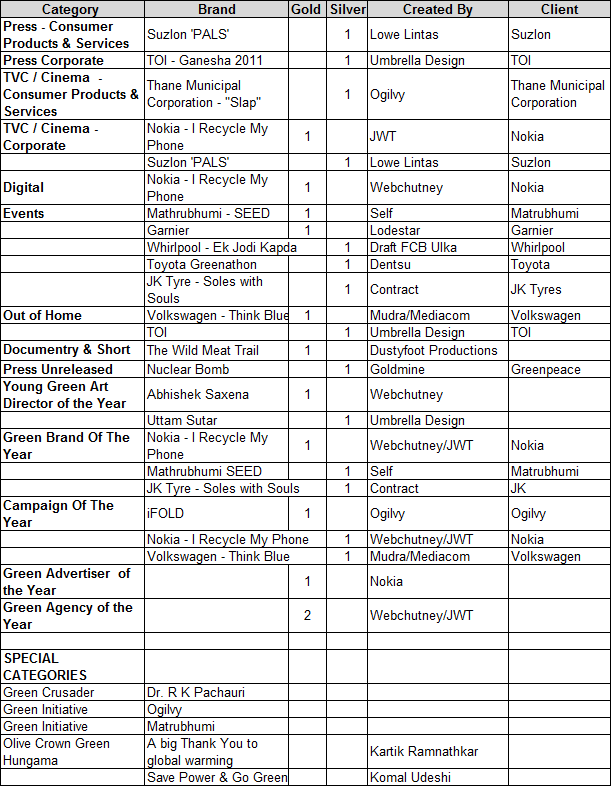
    The India Chapter of the International Advertising Association (IAA) presented the Olive Crown awards for excellence in Green advertising on March 3 at a glittering function held at the Taj Lands End in Mumbai.


    The Olive Crown Awards are the first and only awards in the country that celebrate excellence in communicating sustainability.


    The event, witnessed a heady mix of creativity, entertainment, a touch of seriousness, a dash of Bollywood and some of the biggest names in the advertising, marketing and media industry walking the “green carpet”.


    Singer Sona Mahapatra entertained guests with BollyJazz – Bollywood songs presented with a touch of Jazz. Funny man Vikram Sathye with his rib-tickling performance ensured that the guest had a great time The Guests of Honour at the function were Ms Nita Ambani, Chairperson Reliance Foundation and Member of ParliamentMs Priya Dutt.


    A special Green Crusader was presented to Dr. Rajendra Pachauri who won the Nobel Prize as Chairman IPCC.


    Olive Crowns were presented to winners in 14 categories and were judged by a panel of judges that included some of the most respected creative names in the business. Music Channel 9XM was the title partner for the event.


    IAA Olive Crown Awards – 3rd March 2012

  • IRS 2011 Q4: Dainik Jagran maintains leadership; Vanita is most read magazine

    The numbers from the latest round of the Indian Readership Survey (IRS) are out as the Media Research Users Council (MRUC) and Hansa Research Group (HRG) announced the findings of the fourth quarter of 2011.


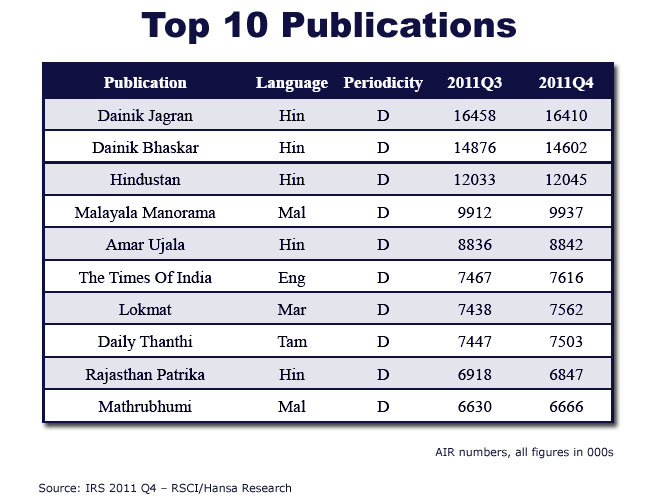
    No surprises here… According the AIR (Average Issue Readership) figures, Dainik Jagran continues to lead as the most read publication across the country. While Times of India is the only English daily to make it to the top 10 most read publications, Lokmat is the only Marathi daily in the top 10 most read publications. The rankings of the top six publications have not changed, however; the Marathi daily Lokmat has further strengthened its readership position, emerging as the seventh most read publication according to the AIR whereas the Tamil Daily Thanthi is now ranked eighth in its AIR.


    The rankings of the top 10 dailies are the same as the top 10 publications.


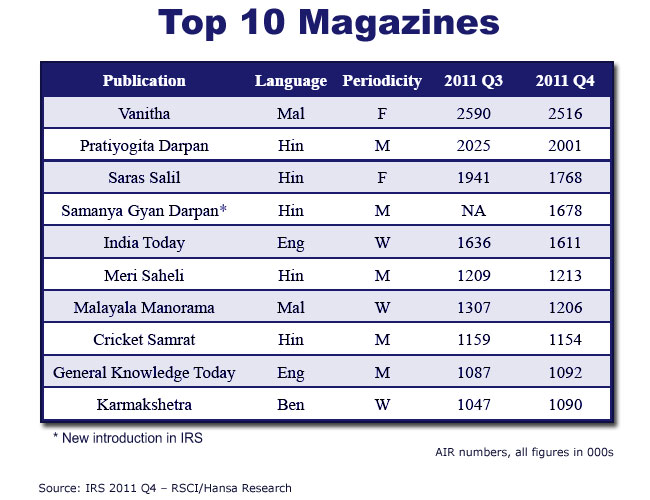
    The top 10 magazines of the country are mainly dominated by Hindi languages followed by English and Malayalam language magazines. Malayalam fortnightly magazine Vanitha continues to be the most read magazine across the country followed by Pratiyogita Darpan and Saras Salil.


    IRS Q42011 has a new entrant with Samanya Gyan Darpan; the Hindi monthly magazine is already ranked fourth most read magazine of the Country.


    Note AIR  or Average Issue Readership is defined as the readers of an average issue of a publication i.e. the estimated number of those who have read or looked at any issue of the publication within a specified time interval, which is equal to the periodicity of the publication (excluding the day of the interview).


  • IRS 2011 Q4: Media consumption grows but Radio and Cinema continue to decline

    By A Correspondent


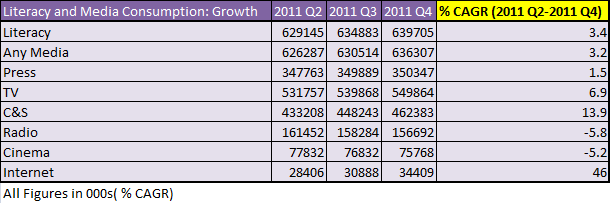
    IRS Q4 2011 findings have revealed that the literacy rate and media consumption in India has witnessed growth when compared to IRS Q3 2011. The other media categories to have grown are Press, Television, C&S (Cable and Satellite) and the Internet. While Radio and Cinema consumption have witnessed a decline, the Internet has emerged as the fastest growing medium in the country.


    Press has seen a marginal increase of 1.5 per cent in the CAGR (Compound Annual Growth Rate) whereas TV grew only 6.9 per cent of the CAGR. After the Internet, C&S is the second largest medium to have grown in double digits i.e. a CAGR of 13.9 per cent. Radio and Cinema on the other hand declined -5.8 per cent -5.2 per cent respectively.


  • IRS 2011Q4: Not much change in rankings but dailies witness significant growth

    By A Correspondent


    Top 10 Hindi Dailies:

    IRS Q4, 2010 v/s IRS Q4, 2011

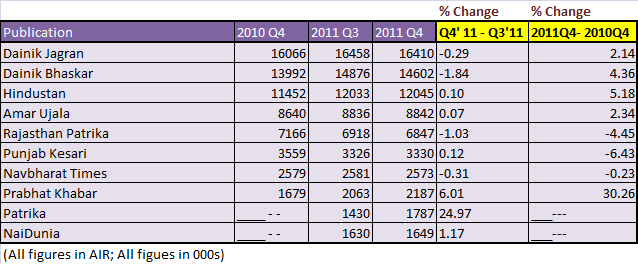
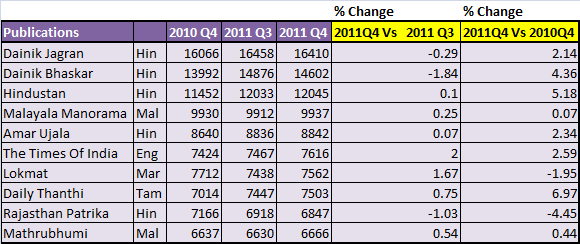
    There is not much of a difference in the rankings of the Top 10 Hindi Dailies. Dainik Jagran, Dainik Bhaskar,Hindustan, Amar Ujala and Rajasthan Patrika continue as the Top 5 Hindi Dailies. When compared to IRS 2010 Q4, IRS 2011 Q4 reveals the Top 4 Hindi Dailies, namely Dainik Jagran, Dainik Bhaskar,Hindustanand Amar Ujala have further strengthened their readership.


    A look at percentage change from Q4, 2010 to Q4, 2011 finds that Dainik Jagran has witnessed a growth of 2.14 per cent, Dainik Bhaskar grew by 4.36 per cent,Hindustanby 5.18 per cent while Amar Ujala grew by 2.34 per cent. The only Hindi daily to have witnessed double digit growth is Prabhat Khabar with a whopping 30.26 per cent growth in Q4, 2011 as against Q4, 2010. A total of five Hindi dailies have witnessed growth Quarter on Quarter.


    Q3, 2011 Vs Q4, 2011

    But the results for IRS Q4, 2011 Vs Q3, 2011 have a slightly different story to tell. The top two most read Hindi dailies – Dainik Jagran and Dainik Bhaskar – have witnessed a decline in Average Issue Readership (AIR), the decline is however marginal. Besides Dainik Jagran and Dainik Bhaskar, the Hindi dailies to have recorded growth in Q4, 2011 v/s Q3, 2011 are Hindustan, Amar Ujala, Punjab Kesari and Prabhat Khabar.


    Top 10 English Dailies:

    IRS Q4, 2010 Vs IRS Q4, 2011:

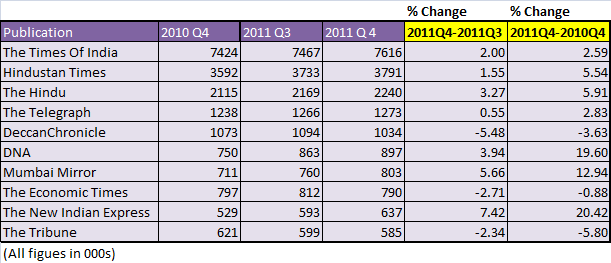
    The English dailies have performed exceedingly well in Q4, 2011. Seven out of the Top 10 English dailies have registered growth in their AIR. While DNA, Mumbai Mirror and The New Indian Express have registered growth in double digits, the top four English Dailies: The Times of India, Hindustan Times, The Hindu and The Telegraph have also witnessed growth quarter on quarter.


    IRS Q4, 2011 Vs Q3, 2011:

    The results for Q4, 2011 in comparison to the previous quarter also highlight the growth for most of the top Ten English dailies.


    Top 10 Language Dailies:

    IRS Q4, 2010 Vs IRS Q4, 2011:

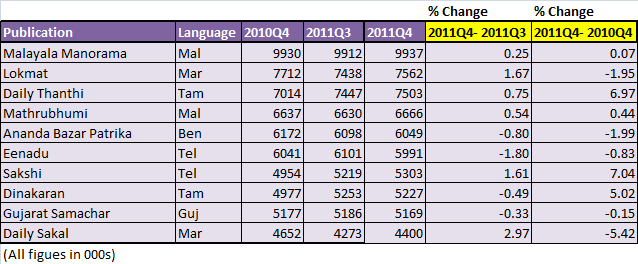
    The Q4, 2011 results as compared to the Q4, 2010 results have shown mixed reactions for Language dailies as only five publications witnessed growth since Q4, 2010 to Q4, 2011. Malayala Manorama continues to be the number one publication among the Language Dailies. According to IRS Q4, 2011 v/s Q4, 2010 findings, the Malayalam daily grew 0.07 per cent.


    Ranked second is Marathi daily, Lokmat which saw a decline of 1.95 per cent. The other Language dailies to have registered growth in their AIR are Daily Thanthi, Mathrubhumi, Sakshi and Dinakaran.


    Unlike the top two dailies, Daily Thanthi, ranked as third Language daily, grew by 6.97 per cent in IRS Q4, 2011 when compared to IRS Q4, 2010.


    It has been observed that the Malayalam dailies – Malayala Manorama and Mathrubhumi and the Tamil dailies – Daily Thanthi and Dinakaran have recorded growth in their AIR. Malayalam, Marathi, Tamil, Telugu, Gujarati and Bengali are some of the popular language dailies to have found a place in the Top 10 Language dailies.


    IRS Q4, 2011 v/s Q3, 2011:

    The top four Language dailies: Malayala Manorama, Lokmat, Daily Thanthi and Mathrubhumi have registered growth in their AIR numbers in IRS Q4, 2011 v/s IRS Q3, 2011. Besides the top four language dailies, Sakshi, the Telugu daily and Daily Sakal, the Marathi daily have also witnessed growth in their readership numbers.


    AIR or Average Issue Readership is defined as the readers of an average issue of a publication i.e. the estimated number of those who have read or looked at any issue of the publication within a specified time interval, which is equal to the periodicity of the publication (excluding the day of the interview). This is the preferred currency of media agencies across the country though often publications quote Total Readership (TR) when their AIR numbers are not impressive. MxMIndia only uses AIR in its IRS reportage.

  • IRS Q4 2011: Dailies flourish Year-on-Year


    The fourth quarter results of 2011 for the Indian Readership Survey were published on Monday and a quick look at comparing the numbers of IRS Q4 2011 versus Q4 2010 data, eight of the Top 10 publications – Dainik Jagran, Dainik Bhaskar, Hindustan, Malayala Manorama, Amar Ujala, The Times of India, Daily Thanthi and Mathrubhumi ­- have grown in their AIR (Average Issue Readership) Year-on-Year (YoY). Tamil daily Daily Thanthi and Marathi Daily Lokmat and Hindi Daily and the second most popular newspaper, Dainik Bhaskar  have registered the highest growths in AIR.


    When we compare Q3 2011 V/s Q4 2011, Dainik Jagran, Dainik Bhaskar and Rajasthan Patrika witnessed a slight decline in their readership. Dainik Jagran, Dainik Bhaskar, Hindustan, Malayala Manorama and Amar Ujala have retained their spots as the top five publications.


    After looking at the numbers, MxMIndia spoke to some of the publications for their views on the IRS Q4 2011 Topline numbers. Mr Rahul Kansal, Chief Marketing Officer, Times of India Group said: “Overall, I am quite happy with results, we have done pretty well in most of the markets including Delhi, Mumbai and Chennai, where we have seen very good growth.”


    However, Mr Rajiv Verma, CEO of HT Media Ltd, is disappointed with the IRS numbers but said in a statement, he will continue with investments in various markets. “While Hindustan Times has for long been No 1 in Delhi and No 2 in Mumbai, and Hindustan and Mint have consolidated their positions in their respective markets, as a group we are disappointed that these IRS numbers don’t reflect the full picture of our growth, and the reality of our investments and our efforts in the various markets across the country. However, we will continue to invest in various markets, to meet the needs of our readers and our advertisers, and will hope that the readership growth will be fully captured going forward.”


    Mr Sanjeev Kotnala, Vice President, Dainik Bhaskar Group said: “The IRS figures justify our focus on the urban, non-metro cities. Dainik Bhaskar is the only Gujarati newspaper to have a readership of more than 10 lakh in cities like Jaipur and Ahmedabad. If you see the figures for only the urban, non-metro cities, then you will realise that Dainik Bhaskar dominates the list. As far as the overall figures are concerned, we feel that it is a minor fluctuation, nothing major as far as our own perspective is concerned.”


    Speaking on trends from IRS Q4 findings, Mr Gautam Dalal, Vice President, Marketing, DNA said: “We observe that within Mumbai there is an increase in the overlap of English dailies readership – for every two readers there are three dailies being read. Mumbai, therefore, is seeing more penetration of English dailies and the trend of reading multiple newspapers is on the rise. Having such a high overlap percentage is a positive sign.”


    “In Mumbai we have had the highest number of growth for DNA, and these numbers are a testimony to our stand of having a high level of copy supported by the cutting edge editorial and by a focused market programme,” he added.


  • IRS 2011Q4: Same old magazine story

    By Robin Thomas


    While consuming the data for magazines, it may be remembered that many magazine publishers have been critical of the IRS numbers as worthy  indicators of their readership. The Association of Indian Magazines has readied an Engagement Study in order to educate advertsiers and agencies. Having noted that, let’s look at the IRS 2011Q4 topline figures for magazines.


    Top 10 Hindi Magazines

    IRS2010 Q4 Vs IRS2011 Q4:

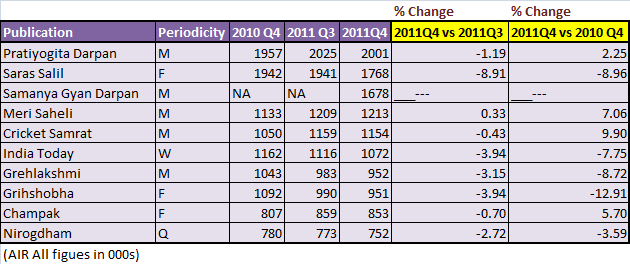
    AIR figures for Q4 2010 vs Q4 2011 may bring mixed feeling for the Magazines, as only four of the Top 10 Hindi magazines have grown in AIR (Average Issue Readership). Hindi monthly magazine, Pratiyogita Darpan is the most read Hindi magazine and is one of the Top Ten Hindi magazines to have witnessed growth in its readership figures. The other three Hindi magazines to have also grown in their AIR numbers are Meri Saheli and Cricket Samrat, both of which are Hindi monthly magazines, and Champak, Hindi Fortnightly has also witnessed growth.


    Interestingly, Samanya Gyan Darpan, another Hindi monthly magazine is a new entrant in the IRS and has already emerged as the third most read Hindi magazine with a readership of 16,78,000 AIR in Q4 2011.


    IRS 2011 Q4 Vs IRS 2011 Q3:

    The Q3 Vs Q4 2011 AIR numbers could certainly be disappointing to most Magazine publishers as only one in the Top 10 Hindi magazines has registered a growth in readership. Hindi monthly magazine Meri Saheli is the only Hindi magazine to have witnessed a growth, the growth however is a marginal 0.33 per cent. The most read Hindi magazine, Pratiyogita Darpan declined 1.19 per cent. Its nearest rival Saras Salil also declined 8.91 per cent.


    It may be noted that the most popular Hindi magazines are mainly monthly magazines followed fortnightly magazine. There is only one weekly magazine in the Top 10 Hindi Magazine category.


    Top 10 English Magazines:

    IRS2010 Q4 Vs IRS2011 Q4:

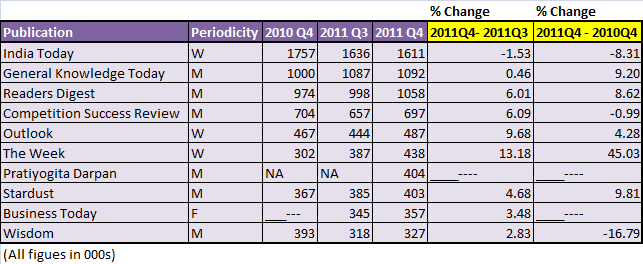
    The English magazines may bring some cheer to the industry as an overwhelming seven out of ten English magazines have registered growth in AIR. The Week has received the highest growth in its AIR from IRS 2010 Q4 to IRS 2011 Q4 data i.e. it grew from 302000 in Q4 2010 to 438000 in Q4 2011, that is a 45.03 per cent growth in AIR.


    India Today is the most read English magazine however the Weekly witnessed a decline of -8.31 per cent in AIR. The other English magazines to have increased in readership are General Knowledge Today, Reader’s Digest, Outlook, The Week and Stardust. Interestingly, the most popular English magazines are mainly monthly magazines followed by the weeklies.


    IRS 2011 Q4 Vs IRS 2011 Q3:

    The Q4 vs Q3 2011 results seem to be even more encouraging for the magazine industry, especially those in the English magazines as nine out of ten English magazines have witnessed growth in AIR. The only English magazine to have received a decline in readership is India Today, the number one English language magazine. The Week has again witnessed a double digit growth wherein its AIR grew from 3,87,000 in Q3 2011 to 4,38,000 in Q4 2011, a growth of 13.18 per cent. English monthly magazine, Pratiyogita Darpan is a new entrant and has already emerged as the seventh most popular English magazine of the country with an AIR of 404000 in Q4 2011.


    Top 10 Language Magazines:

    IRS2010 Q4 Vs IRS2011 Q4:

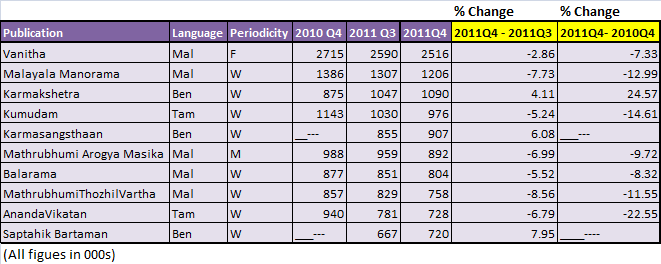
    The Top 10 Language Magazines reveals a gloomy result as nine out of the Top 10 Language magazines have witnessed a decline in readership. The only magazine to have grown in its AIR is the Bengali weekly, Karmakshetra. The weekly received an AIR of 10,90,000 in IRS 2011 Q4 as against 8,75,000 in IRS 2010 Q4, a growth of 24.57 per cent. Vanitha and Malayala Manorama are also among the Top 10 Language magazines to have declined in readership.


    IRS 2011 Q4 Vs IRS 2011 Q3:

    The scene is no different when compared to Q3 2011. However Bengali weeklies are the only magazines to have recorded growth in AIR. While the Bengali weekly Karmakshetra continues to grow even against Q3 2010 numbers, the other two Bengali language magazines to have witnessed significant growth are Karmasangsthaan and Saptahik Bartaman.  It may be noted that unlike the English dailies or even the Hindi dailies, most of the language magazine readership i.e. those in the Top 10 categories are coming from weekly magazines.


  • Havas Media wins Air France global account

    By A Correspondent


    Havas Media retained the global Air France account following a competitive pitch with VivaKi (Publicis Groupe) that commenced in the second half of 2011. MPG, the largest media network under Havas Media, will support the win. MPG will manage the Air France account out of the French hub.


    As the global agency of record, MPG and Havas Digital will continue to handle both the online and offline media responsibilities for the airline in all 54 Air France markets. In addition, Havas regained digital markets throughout Asia that had previously been managed by VivaKi, including China, Hong Kong, India, Malaysia, Vietnam, Singapore and Philippines.


    “On behalf of the whole team, I would like to thank Air France for renewing their confidence in Havas for the fourth time, thereby continuing the relationship that has been in place since 1992,” said Pascal Dasseux, COO Havas Media France.


    Havas Media – a real-time Global media agency leader – seeks to bring to Air France real-time solutions and constant reactivity thanks to a widely interlinked network; all Havas Media agencies will collaborate more closely and efficiently using their proprietary Flightdeck tool as well as the management and optimisation of paid, owned and earned media.


    MPG anchors the world’s fastest growing global media network, Havas Media. MPG provides media planning & buying, strategic consulting, branded entertainment and interactive marketing services for a range of clients in every region of the world. With offices in over 100 countries, MPG consists of over 5,000 media professionals working across a broad variety of disciplines and categories. MPG was named Mediapost’s Media Agency of the Year 2009-2011.


    Havas Media, the global media network of Havas, is one of the world’s fastest growing media groups having grown from 10 markets in 1999 to 122 markets in 2012. The companies within Havas Media include: MPG (Havas Media’s global media communications network), Arena Media (Havas Media’s tailor-made communications network), Havas Digital (Havas Media’s global interactive network) and Havas Sports & Entertainment (Havas Media’s global sports and entertainment communication network).


  • Chaitanya Prabhu joins Jump Games as Business Head

    By A Correspondent


    Chaitanya Prabhu has joined Jump Games (subsidiary of Reliance Entertainment Digital) as of March 1, as Business Head - India. Mr Prabhu has an experience of over 13 years, out of which seven have been in pure digital arena.


    His last stint was with Nokia, wherein he was responsible for setting up the Ovi Music Unlimited Service inIndia. After the success of the Ovi Music Unlimited inIndia, he was moved within Nokia to build the developer ecosystem for the Nokia store business. He worked with developers’ ecosystem to build monetization models for publishers/ developers and created some marquee apps for Nokia with Windows devices.


    Under his guidance and leadership, app download from Ovi store shot up from one  million a week to 2 million per day.


    Ask him one thing that made him leave the music lineage and join hard core gaming and the prompt reply: “Looking at how content owners play a key part in the success of the mobile ecosystems, I was very excited when I got an opportunity to head theIndiabusiness at Jump Games. I did foresee a big opportunity for Jump Games to be an integral part of the content and developer ecosystems and work with them to create exciting monetization models around gaming”


    Before Nokia, Mr Prabhu has worked with several renowned companies like Universal Music and Reliance Retail. He has completed his Masters in Business Administration from NMIMS, Mumbai.


  • Debrief: Where’s the Fevi magic?

    By Anil Thakraney


    The makers of Fevicol have launched a new variant called Fevicol Speedx, and as the brand name suggests, the promise is speed of bonding. And I must say Fevicol has disappointed me this time, I have always been a huge fan of their ads. This one just doesn’t have the usual Fevicol spark.


    In the commercial, a man orders a bed to be custom-made, and the conversation with the furniture supplier happens over the telephone. The buyer has many specifications, but as soon as he finishes the call, the bed arrives. A lot faster than a mass produced pizza. Yes, the furniturewallah makes and delivers stuff at lightning speed, courtesy Fevicol Speedx, of course.


    [youtube width=”400″ height=”200″]http://www.youtube.com/watch?v=wuNS-QSJuPk[/youtube]

    Now if you examine the TVC in isolation, there’s nothing really wrong with it. It’s catchy and it’s single minded. Usually, one would give such an ad decent points. But this ad is from the house of Fevicol, and these guys have set a very high benchmark for themselves. (Think of the ‘unbreakable egg’ and the ‘packed bus’ commercials from the past.) And when you view the new ad in that context, it’s a let-down. Sure, the exaggeration route has been used again, but this time the idea is much too literal and predictable. After the first exposure, the TVC has as much charm as a regular pizza ad. The commercial doesn’t pack in the X-factor we usually associate with Fevicol adverts.


    Not happening, I say. Looks like the ad agency literally lived up to the brand name, and speeded to the client’s office with the first storyboard.


    Rating: (On a scale of 1 to 5): 2.5. And that’s a very poor score for a Fevicol advert.