Author: mxmadmin

  • ASCI launches Endorser Due Diligence service

    By Our Staff


    The Advertising Standards Council of India (ASCI) has launched an Endorser Due Diligence service to help endorsers avoid making misleading claims in advertisements. Service will provide guidance from highly-qualified specialists from over 20 disciplines.


    ASCI has established a panel of experts, from over 20 disciplines, ranging from advertising regulation and legal, ayurveda, microbiology, electronics, market research, nutrition, dentistry, product formulations, financial services, and so on. The panel will assess the representations, statements, and claims in the advertisement from a consumer and technical perspective, examine the evidence in support of the claim where necessary, and thereby help the endorser conduct their due diligence. The advertisements can be sent to ASCI at any stage, including pre-production. This ensures that the endorser can do their independent due diligence before the advertisement is produced.


    Said Subhash Kamath, Chairman, ASCI: “Endorsers, particularly celebrities have a huge fan following and they enjoy the trust of millions of consumers. There is therefore a direct moral and now, legal responsibility that they bear to ensure that they do not make representations in ads that could be considered misleading. ASCI has always required celebrities to be mindful of what they endorse in advertisements, and now the law too, requires them to do due diligence in this regard.”


    Adds a communique: “Similar to the Advertising Advice service offered by ASCI, Endorser Due Diligence will be confidential and non-binding and will be issued in the name of the endorser.”


    Added Manisha Kapoor, Secretary-General ASCI: “Endorsers may not always be experts when it comes to the products they push and the claims they make. The law makes endorsers liable for the advertisements they appear in, hence Endorser Due Diligence becomes a critical need. ASCI’s service that is speedy, confidential, and based on the assessment of a multi-disciplinary panel can help endorsers do their due diligence in a timely and comprehensive manner, ensuring that consumers are not misled and that the endorser too, fulfills their legal obligations.


  • Blond-haired blue-eyed brands!


    By Avik Chattopadhyay

     

    Avik ChattopadhyayAs we read this, over 300 brands from across the world have taken a stand against Russia since it invaded Ukraine. Some real big names like Apple, General Motors, Volkswagen, Levi’s and MasterCard have decided to halt/ suspend operations and shipments. Consultancy firms like BCG, McKinsey and Deloitte have taken a call. Even some Chinese brands like Bank of China and Tik Tok have joined the list. All non-Russian energy companies have moved away either like BP and Shell divesting their shareholding in Rosneft or ExxonMobil walking away from the Sakhalin 1 project.


    While tracking the updated status on the internet, I came across an interesting Twitter feed that I cannot help but share here.


    While such economic ‘sanctions’ are very much expected, it is interesting to note that equally big brands like Coca-Cola, Unilever, Bridgestone, Pirelli, Pepsi, Philip Morris, Nestle, McDonald’s, Mondelez, Kellogg, Citi, Marriott, and Caterpillar still continue to do business in Russia.


    But the situation is very fluid. In fact, as I write I have an update that Coca-Cola and McDonald’s have also decided to suspend operations.


    Yale School of Management is keeping a real-time track of the status. Over 300 Companies Have Withdrawn from Russia – But Some Remain | Yale School of Management


    So, what makes some take one stand while others take another, or do not take the same one? Does this mean that McKinsey does not support Russia while Mondelez does? Or does BP denounce war while Bridgestone does not?


    While the ones who have taken a call against Russia are obviously being lauded for calling out an “imperialist” like Putin, are the ones who consciously have not, being subjected to criticism and pressure to fall in line? Will they experience serious fallouts on brand image and reputation in the long run?


    During my internet studies on the rise of Vladimir Putin and his oligarchs over the last two decades, I came across a term called “The Moscow Rules”. Bing! I remembered reading about this in ‘Tinker, Tailor, Soldier, Spy’.


    The Moscow Rules is a collection of 10 one-liners supposedly used by the Soviet secret service. They are also displayed at the International Spy Museum in the US. Post-Cold War, the rules remain as per the grapevine, now being used by the oligarchs to spread their presence across the world. They go as follows…


    1. Assume nothing.

    2. Never go against your gut.

    3. Everyone is potentially under opposition control.

    4. Do not look back; you are never completely alone.

    5. Go with the flow, blend in.

    6. Vary your pattern and stay within your cover.

    7. Lull them into a sense of complacency.

    8. Do not harass the opposition.

    9. Pick the time and place for action.

    10. Keep your options open.


    The stark simplicity hits you right away. There is no fancy business school jargon. Just plain common sense. Reminds me of Confucian precepts. Or Murphy’s Laws.


    Each is very much applicable to the world of brands. Each is fundamental to brand strategy and nourishment. Each feels more honest and powerful over the previous one. And the obvious paradoxes are simply brilliant! Just read 7, 8 and 9 together and you will get the drift. The sequence is intuitive, clinical, and utterly brutal. It’s like Machiavelli, Sun Tzu and Kautilya rolled into a Karpov move on the chessboard. Cold, calculated and thoroughly revised and rehearsed. Yet, #10 tells you that it could all go wrong, and you need to go back to #1.


    In the context of the Rules, I asked myself a few questions about the strategic decisions taken by brands in the context of the invasion of Ukraine.


    Pulled the plug or switched off power?

    Have the brands who have shown empathy with Ukraine pulled the plug altogether or merely switched off the power supply for the time being? The list by Yale uses terms like suspended and halted. These are all temporary measures and not finite ones. Once the invasion is brought to an end, whatever the outcome, they will be back for sure. Russia may be seen as a villain today but tomorrow it will all boil down to Putin, even if he wins this round. After all, a huge market of 145 million cannot be left alone to the Chinese and locals, can it? This is just like al Chinese brands, except for Tik Tok, were back in business in India just weeks after Galwan. The pressures of the marketplace and the shareholders are just too strong to pull the plug.


    Out of fear or fervour?

    With no disrespect to any brand that has suspended / halted operations in Russia, the action was taken more out of fear of political reprisal at home and other key markets rather than a foundational abhorrence of all war and military aggression. If it were so, similar stands could have been taken in cases of Iraq, Syria, Yemen, Palestine, or Tibet. It is all a matter of convenience. Most brands believe in #10 when it comes to morals. They take the high ground as the situation suits them.


    Hypothesis or hypocrisy?

    There are brands and then there are… brands. While a lot of posturing goes around about being led by and aligned with greater purpose[s], at the end of the day it just boils down to market share and share value. Most brands will not bat an eyelid to see their weaker competition die. Most would not hold themselves back from steamrolling a market. Most would love to enjoy ‘command and control’ in the markets they operate in, at the cost of unsafe working conditions, unethical influencing tactics, use of child labour and paying off officials and systems for staying a step ahead.  And they would not mind preaching to the ‘lesser’ ones, typically local / domestic. While constantly conspiring on how to gobble them up or bleed them to capitulation.


    These brands have blond hair and blue eyes.

    No harm can befall them.


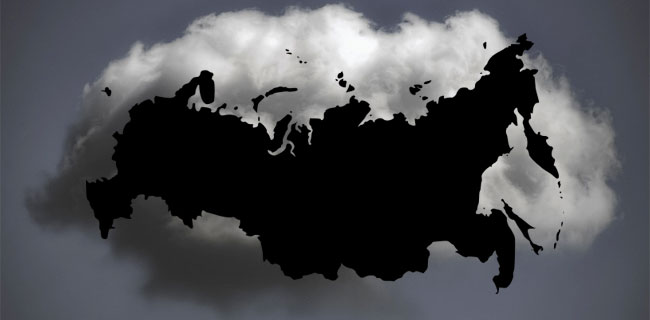
    I end my tirade with a cartoon by the Russian cartoonist Aleksey Merinov that speaks about the harsh reality and futility of war. Either with tanks or tweets!

  • Mahindra Group elevates Pramuch Goel as VP & Head – Group Communications

    By Our Staff


    Mahindra Group, has announced the elevation of Pramuch Goel as VP & Head – Group Communications with immediate effect. He takes over from Varsha Chainani who has moved on.


    Goel moves from his previous role of Strategic Communications Head for Auto and Farm Sectors. In his new role, he will report to Asha Kharga, Chief Customer and Brand Officer, Mahindra Group.


    Speaking about the announcement, Asha Kharga, Chief Customer and Brand Officer and Member of the Group Executive Board, Mahindra Group, said: “Pramuch is an accomplished brand and communications leader who has been part of the Mahindra Group for several years, working and contributing to various businesses. At Mahindra, it has always been our endeavour to nurture and promote talent and I am very pleased to see him grow and further his career with us. I wish him the best in his new role. I would also like to take this opportunity to thank Varsha Chainani for her contribution to the Mahindra Group and wish her the best for her future endeavours.”


  • Das ka Dum by Dr Bhaskar Das | BARC news ratings will revive next week. Should one really care given that despite no numbers, it was business as usual?

    Bhaskar Das

    We are sure there will be claims and counter-claims once the BARC numbers are out for news channels next week. Let’s read what Dr Bhaskar Das says in Das ka Dum dated March 11. Read on…


    If you wish to access the archives, please go to the Das Ka Dum tab on the website’s top navigation bar.


    Q.BARC news ratings will revive next week. Should one really care given that despite no numbers, it was business as usual?


    A. Data-driven ecosystems are a hygiene reality for any business for enriching the quality of decision-making. BARC ratings are important for this reason only, apart from other adjacent directionalities. So active practitioners in the relevant A&M industry would be interested in BARC data release. The data improves the quality of decision-making,  directly or indirectly, for all concerned.


  • Ranjona Banerji: Moral Paralysis?!

    Ranjona BanerjiBy Ranjona Banerji


    “To argue that the BJP’s huge victory is the result of its grounded policies and not communalism is not analysis. It is paralysis. Moral paralysis.”


    This tweet from writer, commentator and satirist Urvish Kothari aptly sums up the media response to the BJP’s victory in four of the five states that went to the polls this year.


    The manner in which the BJP won in UP, Uttarakhand, Goa and Manipur – with large margins bar Goa and larger margins than many exit polls — has led to massive excitement in Indian TV’s talking heads and experts. If earlier one could make the excuse that the excitement was over the excitement of election result coverage itself – CNN’s ill-fated experiment with holograms for instance – now it is more than evident that TV people are unable to separate their party choices from their coverage. (Actually, who doubted it? This is just one more confirmation.)


    That NDTV, that most beloved of “fair” TV channels by India’s “liberals” actually gives you an update of what’s happening on the BJP-sympathetic social media site Koo, even as its anchors and “analysts” were full of the same glee as the other more openly BJP channels, provides a stark example of how far TV media falls into the BJP’s lap. Short of dancing on the tables with joy, TV has indeed covered itself in BJP glory as expected. What one would not expect is more in-depth sober analysis, of voting patterns and margins and also, especially of AAP’s massive landslide in Punjab, but for that you have to look to newspapers and not PR-driven “news”.


    (Incidentally, only the naïve or frankly stupid will now come up with the money and threat excuses as an explanation for media cowardice: neither of those are new or unknown to a media operating in a hostile environment.)


    The actual analysis – as Kothari – points out – of this BJP victory in four states would be bleak for India’s future in a real world. We all know – TV people included – the miserable state of India’s social fabric and economy, not to forget India’s inability to create a credible, respected global voice for herself. Narendra Modi’s publicity machine however has as much success in the media as it appears to have over some voters.


    The Telegraph, Kolkata does not hold back: “For all the demonstrable faults and failures of the Narendra Modi regime, the broad national narrative refuse to reveal any clues of weariness or desire for change. If Thursday’s outcome were meant to preview of 2024, the die is indelibly cast: India is turning a deep saffron that imitates the hues of and haranguing of a Hindu rashtra, the Congress continues to pale perilously. Its footprint has never been more anaemic.”


    The inability of much of the media to distinguish between supporting this or that party and supporting democracy brings us back to the brink. The BJP will undoubtedly push through the contentious farm laws again; and AAP is not likely to create any hurdles there. Promises of implementing a Uniform Civil Code and the possible return of CAA-NRC-NPR raise their ugly heads again with all the attendant roiling.


    We already know there will be no help from the media – all those channels and newspapers which support the massive malicious RSS-BJP lie that “Hindus are in danger” will be overjoyed by Parliamentary support to anything that puts religious minorities “in their place”.


    Judging from the coverage of yesterday’s results, we can safely assume that the bulk of the Indian media will not put up any struggle for democracy in the foreseeable future. That includes the 2024 general election.


    Moral paralysis: what better phrase to describe us?


    Ranjona Banerji is a senior journalist and commentator. She writes on MxMIndia on Tuesdays and Fridays. Her views here are personal.


  • Reckitt consolidates with Dentsu X, assigns digital mandate as well

    By Our Staf


    Reckitt India has consolidated the entire media mandate including strategy and planning across offline and digital with Dentsu X. Dentsu X has been handing the offline media mandate for Reckitt India since 2020. The additional mandate of strategy and digital has been awarded to the agency following a comprehensive competitive pitch process, notes a communique from Dentsu X.


    Speaking on the win, Divya Karani, South Asia Media CEO, Dentsu commented: “This win certainly reflects our client’s confidence in Dentsu’s ability to make a meaningful difference to their businesses.”


    Added Roopam Garg, Chief Executive Officer, Dentsu X: “Reckitt has been an absolute delight to work with. This long-term partnership underlines Reckitt’s confidence in our expertise and we look forward to working with the brand on driving consumer centricity and innovations. With a distinct viewpoint on the evolving communication landscape, Dentsu X believes in providing experiences that go beyond conventional media exposures. This consolidation certainly empowers us to drive the desired seamless consumer experience.”


    Said Gaurav Jain, Senior VP, South Asia, Reckitt: “We’re excited to expand our relationship with Dentsu X. They understand our brand, our vision and our way of working. We are confident that Dentsu X will continue to assist us in engaging with our audience while also contributing to our commercial objectives.”

  • Das ka Dum with Dr Bhaskar Das | A report last week spoke about two media baron brothers warring and heading for a split. Perhaps it’s old news, but would you say these appear to be tough times for the behemoth?

    Bhaskar DasHmmm. We’ll reserve comment on the question. Let’s read what Dr Bhaskar Das says in Das ka Dum dated March 10. Read on…


    If you wish to access the archives, please go to the Das Ka Dum tab on the website’s top navigation bar.


    Q. A report last week spoke about two brothers who run a leading media company warring and heading for a split of the company. Now one may say that it’s regurgitation of old news, would you say these appear to be tough times for the behemoth?


    A. Every business or every business house evolves with time. It is a good practice to reconfigure its  business units to adjust to either external market forces or for optimising focus on connected business units. It is better than suffering from active inertia and not taking any step. It might appear to outsiders that the trigger is tough times, but I feel it’s not necessarily so. In fact, tough times  don’t last, but tough companies/ people last. All decisions must be taken keeping in mind the interest of business, and not what is perceived by outsiders, who may not have any visibility of the operating imperatives.


  • Dentsu Impact & Ozone launch campaign for digital voting

    By Our Staff


    Dentsu Impact, in association with Ozone Electronics and Digital Solutions has launched the ‘Ab Chalegi Finger Key’ campaign. The campaign metaphorically demonstrates the connection between Ozone’s digital lock and electronic voting wherein one can open a lock using one finger and simultaneously vote for a better future.


    Conceptualised and executed by Dentsu Impact, the 360-degree campaign includes print, radio, digital & OOH. Further, the brand has also launched an IP (Intellectual Property) in association with the prominent news channels – NDTV and ABP. The multi-episode program on the news channels nudges the voters to make the right choice for themselves and the society at large. It also includes an exclusive anthem to help attract mass appeal and celebrity endorsements along with on-ground interviews with audiences and debates. With this campaign, the brand has interestingly used the Indian elections as a platform and transformed it into one of the hottest debating arenas.


    Added Abhishek Aggarwal, President, Ozone Overseas: “At Ozone, our prime focus is to provide solutions that are high-tech, safe and hassle-free for the consumer. Through this campaign, we aim to sensitize people that by exercising the power of their finger they can choose the right government for better security and progress just like with a swipe of their fingers they can secure their valuables.”


    Said Ujjwal Anand, Executive Vice President, Dentsu Impact: “Elections give that one chance to the voters to exercise their rights for a safe, secure and brighter future. By using the power of the voting finger, they can make changes that really matter. ‘Is baar kiski chalegi’, ‘is baar kaun ayega’, ‘satta kisko milegi’ are all turn of phrases that we get to hear particularly around the election frenzy. We decided to give a spin to these phrases and hinge our campaign articulation around the verbiage. And so ‘Ab Chalegi Finger Key’!”


  • Lowe Lintas creates maiden brand film for ZebPay

    By Our Staff


    With the launch of a multi-film campaign conceived by Lowe Lintas Bangalore, ZebPay aims to build further awareness and establish a differentiated positioning for the brand as ‘Crypto Mein Pro’.


    Said Raj Karkara, Chief Operating Officer, ZebPay: “Crypto is relatively nascent and while many players tend to oversimplify this complex category in their communications, we believe India deserves better. As pioneers of crypto in India since 2014, our goal is to educate, support and enable investors as they navigate this rapidly evolving ecosystem. This is reflected in our latest campaign and brand position ‘Crypto Mein Pro’, where instead of glamorising the category by using celebrity endorsements along with callouts such as ‘simple hain’ or ‘start with only Rs. 100’, we chose to take a more mature stand. By showcasing our deep industry expertise built through years of experience, we seek to communicate the importance of choosing the right partner that is as serious about investing in crypto as our users are.”


    Commenting on the creative thought behind the campaign, Sagar Kapoor, Chief Creative Officer, Lowe Lintas added: “The world of crypto is very new and very interesting. One thing that stood out was how into crypto Zebpay was and we felt that there was an idea here itself. The launch campaign of ‘Crypto Mein Pro’ highlights how passionate and knowledgeable Zebpay is when it comes to crypto with a humorous take.”


  • Unpredictable Politics, Predictable Media


    By Shailesh Kapoor


    Shailesh KapoorElection months (there are many of them in India) are money-spinners for the news business. Besides political advertising, which has been on the rise because of BJP’s aggressive marketing plans over the last decade, elections also generate advertiser interest, because of their ability to generate higher viewership and engagement.


     

    But there’s a hint of predictability seeping into India’s elections coverage of late. The ‘issues’ and the controversies raised during the campaign period don’t offer anything new. It’s the same old rhetoric around caste, religion and personal attacks on opposing leaders. On the counting day, if there’s a cliff-hanger state that goes down to the wire, like Madhya Pradesh and Gujarat a few years ago, you get extended on-air interest from the viewer. Otherwise, it can be all over by 10am, as was the case yesterday for UP and Punjab, among others.


    The younger viewer, in the 18-30 years age group, does not find much of this interesting. Consumption of elections coverage is driven by a segment of audience that’s both politically-informed and politically-engaged. These are men above the age of 35 years. And this cohort is only getting older with time, because younger people are not making a transition from being merely politically-informed to also being politically-engaged.


    This is ironic, given that India in the midst of a highly-charged political environment over the last decade, with a leader (Narendra Modi) who enjoys a certain cult following. That’s, perhaps, where the issue lies. Our politics may have become too single-person centric over this decade for it to have shades and layers that interest the youth at large. There are regional leaders, like Mamata Banerjee or Arvind Kejriwal, who bring some freshness. But that’s only an odd state every two-three years. The vacuum in the rest of the polity is making the discourse predictable at large.


    If we examine this from the media perspective, our news channels have not been able to cash in on the politically-charged vibe. By now, an equivalent of Presidential debates in the US should have been a reality in India. If not at a national level, then at least at a state level. But news channels are satisfied with a debates format Arnab Goswami started about 15 years ago. Many popular anchors and journalists will spend their entire career doing shows in just this one format.


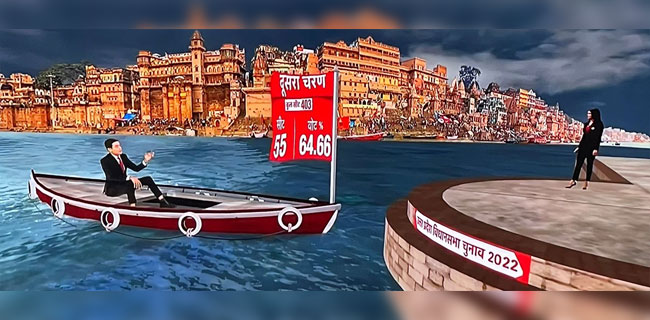
    Instead of playing a role in creating political engagement, news channels have focused on frills, like animation and graphics. They are trying to make elections entertaining. While that offsets general election fatigue that the core political audience cohort may face, it does nothing to the youth, who have better forms of entertainment at their disposal.


    The larger question a news channel should be asking is: Am I losing a generation of audience altogether? If yes, where will my viewership come from in the next five-ten years? This question may not be news specific. Even movie channels will face this concern once streaming becomes a little more mainstream that it currently is. It’s a larger linear TV concern: the medium is getting ‘older’, and there will come a tipping point, perhaps a decade from now, when it may no longer be the first ‘family-viewing’ option, because a majority of family members are disengaged with the medium.


    But that’s some time away, and there are a few elections lined up over the next 2-3 years, leading upto the big one in 2024. Can our news channels innovate beyond the predictable tropes while covering them?


  • Good Glamm appoints Chandrama Deshmukh as Head of Content

    By Our Staff


    Good Glamm Group, the content-to-commerce beauty and personal care brand, has appointed Chandrama Deshmukh as its new Head of Content. Deshmukh will lead the Good Glamm Group’s content strategy and development across businesses.


    Said Priyanka Gill, Co-Founder, Good Glamm Group said: “Content at Good Glamm Group has played an integral role since its inception. As a DTC Beauty and Personal unicorn with content-to-commerce as our moat, content is a major contributor in aiding our commerce and scaling our brands. I am happy to welcome Chandrama to the team and I am confident that her experience and understanding of content will further elevate the content experience across our portfolio of brands.”


    Chandrama Deshmukh
    Chandrama Deshmukh

    Added Deshmukh: “I am incredibly excited to be a part of The Good Glamm Group, an ever expanding and innovative content to commerce conglomerate. The amazing work that the team has done in building an inspiring experience for millions of users and creators across the world was very compelling. It gives me an opportunity to explore, understand and execute new ways to make content the centre of the business. I am looking forward to contributing to the organisations ever evolving journey.”


  • GoEgoNetwork appoints SRV Media as its AoR

    By Our Staff


    Electric Vehicle Charging Network, GoEgoNetwork, has appointed Pune-based SRV Media Pvt. Ltd. as its digital marketing agency. As a part of the mandate, the digital marketing and PR agency, will handle social media marketing and other performance marketing activities for the brand.


    Said Sayantan Chakraborti, CEO & Founder of GoEgoNetwork: “We are delighted to get SRV Media on board as our digital marketing agency. We believe SRV Media’s in-depth understanding of the market will help us communicate and engage with our customers more effectively. We look forward to their original and innovative initiatives.”


    Added Dr Vikram Kumar, Co-Founder & Managing Director of SRV Media Pvt. Ltd: “We are excited to partner with goEgoNetwork as their communication consultant. goEgoNetwork has displayed immense expertise and proficiency in building EV charging stations, powered by its own software management system. As an agency, we look forward to aiding and scaling goEgoNetwork’s efforts and initiatives into creating valuable experiences for its existing and future customers.”