Author: mxmadmin

  • Channel [V] says goodbye to Bollywood music

    By A Correspondent


    Star India’s Channel [V] is ready for a change from July 1 when it will discontinue all music slots in its programming. With this transition, the channel is set to consolidate its position in the youth entertainment genre.


    This move is being made to strengthen its stance as a holistic youth entertainment channel. The drastic change in the content strategy took almost three years. Speaking on the move, Prem Kamath, Executive VP & GM, said: “This shift in programming strategy is rooted in our continuous effort to remain a unique entertainment destination for the youth. We recognize the affinity the youth have developed for our shows and we can only oblige them with greater hours of these preferred shows.”


    In an effort to increase weekly hours of original content, Channel [V] will convert its teen crime show, Gumrah – End of Innocence into a daily. And, it also plans to launch new fictional shows like ‘The Buddy Project’ which will occupy the 6pm slot from Monday to Friday.


    However, the channel promises not to distance itself from music. “As for music, it can never go out of the youth DNA. We will continue our on-ground and on-air properties that are based on music. We will simply stop airing Bollywood music slots.”


    Launched in 1994 and reaching out to over 25 million viewers, the channel’s current mantra – Bloody Cool – manifests itself not only through its shows, but also through the broadcast persona and out of TV alliances created to engage with the youth.


  • Mindshare & Google launch ‘Mobile Garage’

    By A Correspondent


    Mindshare and Google have announced the launch of ‘Mobile Garage’, a unique venture designed to use Google’s best in class mobile expertise to supercharge the use of mobile by Mindshare’s global client base.


    Mobile Garage will see the setting up of mobilehubs around the globe – initially New York, London and Singapore – where Mindshare clients will gain access via dedicated teams to mobile strategists and product experts. The hubs will consist of a mix of Mindshare and Google employees and will work across all aspects of the mobile eco-system, from search optimisation and app development, to strategy, planning and creative optimization.

    Nick Emery, CEO Mindshare Worldwide said: ‘We designed Mindshare to be open source and to work with the best partners for the benefit of our clients. It’s about trial, experimentation and speed to re-design our business. Working with Google on mobile will give our clients a competitive advantage in a key battleground both now and for the future.”


    Mobile Garage will give Mindshare clients a unique advantage in the race to harness the growing global trend of mobile device usage. Mobile search traffic has increased 400 per cent over the past 2 years, and its potential goes even further. The GSMA, the industry body for mobile operators, and research company Machina, predict there will be 24 billion connected devices by 2020 creating an industry worth $4.5 trillion and covering innovations such as connected cars, building automation and traffic management. In addition the venture will also give Mindshare clients competitive advantage in emerging markets, with KPCB’s Mary Meeker recently showing that mobile internet usage had surpassed desktop internet usage in India.

    Matt Brittin, VP, Sales and Operations, Northern and Central Europe at Google said: “We have adopted a ‘mobile first’ philosophy at Google to keep pace with the rapid acceleration in consumer mobile usage. We are delighted to team up with Mindshare on a similar strategy for their clients. Mindshare have already shown strong momentum in the mobile marketing space, and have a great opportunity to lead their clients to win on mobile in the future.”


    Mobile Garage will complement Mindshare’s existing relationship with WPP’s mobile agencies Joule and H-Art.


  • Gaana.com launches music streaming app on Win 8 tab

    By A Correspondent


    Gaana.com is the first full-fledged music streaming application for India’s store of Windows 8 Release Preview. It is also the first music serving application for Surface in India. With a vast repertoire of popular Bollywood, Hindi, regional and international music, it is currently available in 38 markets worldwide.


    The Gaana.com application in the Surface store has the slick Windows 8 metro-style tiled interface with intuitive interactions and fluid navigation. The application offers users a smooth browsing with the latest and most popular albums, artists, genres and songs. Users can easily browse through the entire database of music, and choose from curated music charts or filter music based on language preferences. Gaana.com also offers music suggestions, based on the album that a user is listening to, further enhancing the overall experience.


    Gaana.com is one of the most popular music websites with over 10 million songs to choose from. It has a user base of more than 3 million unique visitors. Satyan Gajwani, CEO of Times Internet Ltd said: “We want gaana.com to be as accessible to users as possible. The Windows 8 Surface tablet is an exciting innovation, and a fantastic new way for users to experience music on demand. The Gaana app is now available in the Surface store for users globally to listen, compile, and share the music they love.”


  • Never make a film to win at Cannes, because then you’ll never do: Abhinay Deo

    By Meghna Sharma


    The final day at Cannes Lion 2012 turned out excellent for Taproot’s campaign for Mumbai Mirror – I am Mumbai. The advertisement was shortlisted in Film and Film Craft categories and went on to bag India ‘s first ever Gold in the Film Craft category.


    The campaign was entered in the Film Craft category by Mumbai-based Ramesh Deo Productions. The film was directed by Abhinay Deo whose work has been shortlisted at Cannes Lion before too. MxMIndia spoke to the winning director to know what it takes to make an award-winning campaign.


    It is India’s first ever win in the category, were you expecting a Gold?

    Honestly speaking I wasn’t. It’s my job to make a good film and keep entering them at such prestigious award functions. The rest depends purely on the quality of the work!


    What goes into directing an award-winning film?

    There is no thumb rule for it. All I can say is that one has to be honest to the craft. Never make a film to win an award be it cannes or any other, because then you surely won’t. (Laughs)


    The cast had never faced the camera before, so was it difficult to film it?

    When you have a cast which has never faced the camera before, it can either be extremely difficult or easy. It all depends on how you break the ice with them because they are bound to have apprehensions and fears about the whole thing. Sometimes such a cast can do wonders and have a film which even a seasoned actor couldn’t have been able to do better. I was sure that I wasn’t going to film the campaign with trained actors or celebrities.


    What was the thought process behind shooting the ad in black & white?

    Over the years, the city has lost its character. Today, everything is muddled-up; so, to show consistency, we decided to shoot it in black & white. Also, it was a polarised concept and I believe colour would have softened it. It was meant to be a hard-hitting one and B&W helped us achieve that.


    How important is an idea to direct for a concept like ‘I am Mumbai’?

    Both are important for a concept to work. The idea won’t work without good direction and vice-versa.  Without each other, it will just flop.


    How involved was Taproot in the ad?

    It was Aggi’s idea all along. Only after the idea was conceptualised, did I take over. And while shooting, it was my baby alone. It is great that Aggi and I know, and are able to understand, each other well, which helped both of us. We were able to execute each other’s ideas and thoughts well.


    Some of the reports that are coming out on Cannes Lions attribute the agency for the award. Do you think in advertising, perception-wise, it’s the agency which gets all the credit and not the film company and director?

    The campaign won the award for Film Craft category, so I think the award should be attributed to the craft.


    As a director, do you have any preferred agencies you work with?

    I have worked with most of them and have loved the experience. And I would continue to work with all of them. There are no preferences when it comes to work!


    Meanwhile, how’s the work on ’24’ going? When do we see the first season? Since TV is said to take so much of one’s time, does it allow you time for ad films?

    The series is in the scripting phase and, hopefully, will soon move to the execution stage. And when the shooting begins, I will give it all the time needed. In the past too, when I was making my two feature films, I didn’t make any advertisements. So, if needed I won’t be taking up advertisements till the series is over. Dedication and honesty towards work are important for me.


    Photograph of Abhinay Deo: Fotocorp


  • Audi Q3 ‘Start Young Music Movement’ showcases young talent

    By A Correspondent


    The Audi Q3 ‘Start Young Music Movement’ launched by Creativeland Asia has been successful in providing Audi fans with a platform to showcase their creativity and has encouraged them to start young towards achieving their dreams.
    Created by Creativeland, the microsite www.audi-q3.in enables Audi fans to create their own music video in 4 simple steps and submit it to win exciting prizes.


    On the online editing timeline, participants can simply pick pictures from their Facebook page and mix them up with the clips already created by Audi, or they could even record their own footage. The video can be then edited to the ‘This Is Our Time’ soundtrack created specifically for this. The videos then can be shared with friends and people around the world. Twenty videos with the maximum number of likes will be shown to the jury selected by Audi for this purpose.


    The music video ‘This is our time’ has been created by Creativeland Asia exclusively for the Audi Q3 ‘Start Young Music Movement’.


    [youtube width=”400″ height=”225″]http://www.youtube.com/watch?v=8-SmBSFPq8k[/youtube]Credits:

    Creative agency: Creativeland Asia
    Record Label: Creativeland Records
    Production Company: Pixel Tonic Films
    Director: Deb Medhekar
    Music: Mikey McCleary
    Vocals: Nikhil D’Souza


  • Zee to go paranormal with ‘Fear Files’

    By A Correspondent


    [youtube width=”400″ height=”225″]http://www.youtube.com/watch?v=rXrE1Apj9bE[/youtube]

    The Zee Network hopes to repeat the popularity of its once popular Zee Horror Show with a new programme called ‘Fear Files’. The show will focus on events that are experienced by those who have lived to tell their story.


    “Horror has been a part of our lives for years now. Almost all of us have heard stories of paranormal activities – some of us believe in them and some don’t. But there is no denying the fact that it hasn’t touched our lives. So, through this show we want to tell real life stories of people who have experienced the unexplainable,” said Sukesh Motwani, fiction programming head, Zee TV.


    Sukesh Motwani

    He added: “But this time around we have kept the gory details out. One can call it “intelligent” horror.” Fear Files was shot at haunted locations in a drama-documentary style. Thorough research was done for each story and at the end of each show, a paranormal expert will share the rationale view on all unnatural phenomena. The 26-episode show will go on air from June 30.


    Talking about the weekend late night (10:30 pm) slot, Akash Chawla, Senior Vice President and head -marketing, national channels, Zee TV said that he is keeping his fingers crossed: “Data suggests that the weekend 10:30pm slot has been doing well. And since the show will be aired right after DID Little Masters, we hope to cash in on the slot. Also, the genre cuts across age-groups and gender and as many find it intriguing; we hope our TG (25-44 age-group) won’t be disappointed in the show.”


    Akash Chawla

    The channel is going all out to market the show. “Apart from promoting the show on our channels, there are going to be a lot of innovative print ads as well. Also, this time, we plan to spend around 12 per cent of our marketing budget on the digital platform,” said Mr Chawla.


    “Marketing such shows is definitely a challenge,” he added. Innovative ways have thus been lined-up to promote ‘Fear Files’ as the channel felt that people have grown up and want to see something ‘reasonable’.


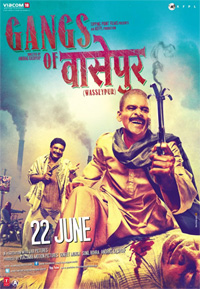
  • Mostly 3.5 *s for Anurag Kashyap’s Gangs of Wasseypur

    Gangs of Wasseypur


    Directed by: Anurag Kashyap

    Produced by: Anurag Kashyap, Sunil Bohra

    Written by: Zeishan Quadri, Akhilesh, Sachin Ladia, Anurag Kashyap

    Starring: Jaideep Ahlawat, Manoj Bajpai, Richa Chadda, Nawazuddin Siddiqui, Jameel Khan, Syed Zeeshan Quadri, Aditya Kumar, Reemma Sen


    Anurag Kashyap has annexed the role of rebel against Bollywood and by making dark, violent films, has got himself a following in the indie and festival circuit. But after the excessive Gangs of Wasseypur (Part 2 is coming up), one can only hope he has exorcised the ghost of The Godfather, and can now truly become a chronicler of the times; he has the style, he has the cinematic sensibility, he has to grow beyond a laddish fascination for violence and men who indulge in crude power games.


    Critics feel duty bound to praise his films, because he dares to go against the rules of Bollywood and thrives; he has edged out Ram Gopal Varma from his prince of darkness pedestal. He also drums up a serious amount of hype. But is there more to him than machismo?


    The film got mostly 3.5 star ratings, as if critics were shying to give it that extra half star and bring it to the excellent category- so despite the praise, it’s technically just a little above good in the ratings.


    Raja Sen of rediff.com found it boring, gave it 2.5 and wrote: “It must here be remembered that mob bosses, at least the ones Hindi cinema have accustomed us to over the years, have hardly been an efficient lot. They growl orders, surround themselves by those applauding their every maniacal move, and, intoxicated by their own bluster, proceed to boast about their convoluted plot to the protagonist, resulting in their climactic downfall. It is this look-what-I-did windbaggery that constantly weighs down Wasseypur, a highly competent and occasionally enjoyable product, and keeps it from soaring like it should have.”


    Anupama Chopra gave it 3 and commented: “Kashyap’s material is strong, but there’s just too much of it. There is so much plot squeezed into the two-hour-forty-five-minute running time that your head swims. We hardly ever stay with a character long enough to get emotionally invested, and a voice-over clumsily interrupts the story to connect the dots. At one point, I was so confused that I longed for a master key booklet to the film that outlined the various factions, relationships and rivalries. The narrative also moves constantly between the personal and professional (murder, revenge and thuggery being the main professions). So the film moves from the enmity track to Sardar’s mistress and at one point even segues into Sardar’s son’s Bollywood-inspired romance-over-Ray-Bans fantasy. It’s indulgent and much too long.”


    The 3.5 club included Rajeev Masand of IBN: “Filmed crisply, without any gimmicks by Rajeev Ravi, Gangs is both steeped in cinematic tradition, yet modern in its treatment. You’re especially seduced by the way Kashyap blends the songs into his narrative, often using them against the film’s most visceral, violent scenes. A big thumbs-up for composer Sneha Khanwalkar who goes all guns blazing to deliver a marvellous mixed-bag of a soundtrack that contains such irresistible gems as I am a hunter and Keh ke loonga. Bolstered by its riveting performances and its thrilling plot dynamics, this is a gripping film that seizes your full attention.”


    Karan Anshuman of Mumbai Mirror (3.5) wrote: “Gangs of Wasseypur is the kind of film you will have to watch in a theatre. You absolutely need to be sitting in the dark with no volume control to enjoy what Kashyap throws at you without a care of turning down the noise of gunshots and explosions, without exposing your expressions of guilty pleasures to others as a crude seduction scene plays out. The digressions – though merited – are one too many and this greatly affects length. Its lack of coherence may not work for everybody. Its runtime didn’t even work for me. That’s the only flaw here: it’s just too long.”


    Vinayak Chakravorty, Today (3.5), raved: “Anurag’s new film, first of a two-part saga, repositions The Godfather lore with a hardy Bihari twist. You spot tribute nods to Tarantino, Scorsese and Sergio Leone all along, as the film leaves you dizzy with its wanton celebration of the gory and the immoral. But Anurag isn’t aping the western masters. He wholly turns every inspiration into an original cinematic statement as the reels roll. In that sense, GOW comes across as a crossover film in the truest spirit of the term – juxtaposing global influences onto a desi gangland canvas, and setting off masala basics within a believable premise.”


    Madhureeta Mukherjee of the Times of India (3.5) gushed: “This one’s a gang bang. Sorry, make that a gang bang-bang; because that’s how this story explodes – with bullets, blasts and bust-ups. Throw in gallons of blood, body-counts and ‘boom-boom’, true Bihari ishtyle. It doesn’t need coal to fuel this revenge drama. It fires on Anurag Kashyap’s penchant for the dark, dubious, deadly and daring.”


    Blessy Chettiar of DNA (3.5) commented: “There are times the self-indulgent ghost of That Girl in Yellow Boots wanders around Wasseypur, with seemingly pointless gore and montages eating into precious screen time. Many a time the camera wanders aimlessly, on severed heads and pretty faces. The changing history of Dhanbad at its centre, over a dozen important characters, a web of plots and subplots moving deftly to a to-be-continued finale, can leave you exhausted and confused.”


    Saibal Chatterjee of NDTV (3.5) wrote: “The saga tosses and turns convulsively from one shootout to another as a bunch of amoral human bloodhounds sniff around for their next kill in a volatile, lawless landscape. The unbridled violence and fetid language – the expletives fly as thick and fast as the bullets – are, however, only one facet of this cinematically layered shot at a time-honoured and popular genre. The spirit of no-holds-barred derring-do embedded in the narrative sinews of Gangs of Wasseypur is so pronounced that there is little in the film that goes along expected lines. Gangs of Wasseypur is part Sergio Leone, part Sam Peckinpah on the one hand. On the other, it embraces elements from Quentin Tarantino and Johnnie To. But the manner in which Kashyap stamps his own home-grown style and sensibility on the manic melange makes it an exhilaratingly edgy movie experience.”


    Shubhra Gupta of Indian Express gave it a surprising 4 stars: “‘Gangs Of Wasseypur’ is a sprawling, exuberant, ferociously ambitious piece of film making, which hits most of its marks. It reunites Anurag Kashyap with exactly the kind of style he is most comfortable with: hyper masculine, hyper real, going for the jugular. It’s not so much about gangs, as about men who are pushed into ‘gangstergiri’ as a thing to live by; as you go along, you see that Wasseypur is not just a place, but a state of mind, which roars and strikes after each deceptively quiet patch. I liked most of ‘Gangs’, Part One, enormously.”


  • Ranjona Banerji: Crazy, like a fool; what about Daddy Cool?

    Ranjona Banerji

    By Ranjona Banerji


    If you are an aging tennis star in India, one element vital for your success is a Daddy. Without a Daddy, you can win on the tennis courts. But as we all know, that is not where wars are won, that is where minor skirmishes are fought. The big fight is in the media. You need a Daddy to defend you, speak for you, put forward your point of view – do all the things you are incapable of or couldn’t be bothered to do yourself.


    Which is why in the fight between Leander Paes and Mahesh Bhupathi, it is the Daddies who have taken centre court. Why is Bhupathi behaving like such an ass? Out pops Daddy Bhupathi to explain. What is Leander actually going to do? Only Daddy Paes can attempt to answer that.


    There are plenty of theories put forward about how men and their fathers operate and many experts use the Oedipus tragedy (son kills father to marry mother) to explain the tension between sons and daddies. But not for the old men of Indian tennis, all this psychobabble poppycock. Compete with their Daddies? Whatever for, when their Daddies are their biggest allies, wiping their botties, filling up their juice bottles, putting on their bibs and interpreting their baby babble for the public.


    In women’s tennis, daddies are usually more famous for teaching their daughters some hubble-bubble tennis based on their own crackpot theories and then stealing all their money. Heaven forbid that the Daddies of India’s most famous male tennis players could ever be accused of such reprehensible behaviour. Instead, here they are, speaking up for their adult sons who threaten, bully and sulk their way to the Olympic Games – or not.


    What a fine example of India’s famous familial feeling we have here – and dare we say it, India’s long traditions of patriarchy. Birds you know are quite cruel to their babies and push them out of their nests so they can learn to fly. But these tennis Daddies are not wicked birdies – they love their sons and will do whatever the sons want.


    I know many daddies who would give such sons two put-puts on their large almost 40-year-old botties and make them fight their own battles. Er, maybe if we had such grown-up, speak-for-themselves tennis stars and less protective Daddies, we might not find ourselves in this Olympic mess?


  • Anil Thakraney: Yes, We Cannes!

    By Anil Thakraney


    I have been to Cannes just once, and this was in the year 2000. To represent the ad mag I was editing at the time. I have many interesting memories of that trip, but the one that stands out is this: While I did run into quite a few eager desi ad men and women, India did not win a single award. In fact, the scenario was so bad, global ad gurus and the fest organizers would treat Indian journos with the same degree of respect as those from Eastern Europe. Okay, perhaps slightly better. And this made even a simple thing like obtaining interviews with the ad biggies a Herculean task.


    I am happy to discover that in the interim period a lot has changed. While India may still not be setting Cannes on fire, our creative directors do return with a decent number of trophies. This was inconceivable in the year 2000. I am particularly pleased that the Mumbai Mirror TV commercial scored a Gold. Not only because I have worked for that newspaper in the past, but also because I recall giving the ad very high marks in the review I did for mxmindia. This is a clear indication that the ad frat must take my ad reviews very seriously… the Cannes jury gets influenced by them, hehe.


    So then how did India turn the corner in the last decade? I would say there are three reasons: In the last few years, thanks to the economic boom and the efforts of some filmmakers (most specifically, Sir Danny Boyle), the India story has become interesting for the goras. They want to know more about us, we excite them now. This also means that the jury members now pay more attention to the Indian approach to advertising, they try hard to get our culture. Plus having more desi judges out there helps. All this then results in a better strike rate.


    Second, the quality of our ‘creamy layer’ work has gone up in the last ten years. And I use the phrase creamy layer because 90 per cent of the mass advertising continues to be bollocks, and this is the case with the rest of the world too. But we have significantly improved on our good work. I also think some of our creative directors and ad filmmakers are paying a lot more attention to execution, a very important reason behind our increasing medals tally.


    But most importantly, the clients have evolved in the last decade. Many of them want to push the envelope, they want to innovate; they don’t mind taking risks. This has naturally helped matters a lot. This was not the case in the past. Back in the bad old days, one was paid to do safe work, and risk takers used to be punished.


    Maybe I will visit Cannes next year, it’s the right time. Think I will be given as much bhav as the American and the Brit journos. 🙂


    * * *


    PS: Interesting blogpost on the biggest advertising lies. Lies that get bandied around so often, they become truths. Here’s exploding some popular myths.

    Link: http://adcontrarian.blogspot.co.uk/2012/06/advertisings-5-biggest-lies.html


  • The Anchor: Lloyd Mathias on the 6 things every marketer learns on the job

    By Lloyd Mathias


    1. No matter how good your campaign is, it won’t work till you have your team fully aligned with it. So, as much as you spend time on zeroing on the consumer insight, researching the proposition, fine tuning the communication – it is important to “sell” the campaign to your internal constituents.  Hence the need for internal communication – point-of-sale material for trade, detailers for the sales force.  It is also critical to align campaign breaks with availability of field materials and widespread distribution.  The best campaigns don’t succeed without product in the shelves.


    2. The past is no guarantee to the future. Most marketers believe if it’s worked well in the past, it will work again. The fact is consumer tastes change over time. Even more importantly, the market dynamics change. Also, most consumers need fresh stimulation.


    3. Treat your agency as an integral part of your marketing team.  It is amazing how many marketers have near adversarial relationships with their agencies (creative, media, digital PR).  Your agency is the co-custodian of your brand – the more they know about your business and the issues facing it – the richer will be their input. Treat them as co-owners. Give them the freedom to do the occasional over the tip creative.  Long term they won’t let you down.


    4. Marketers tire of their campaigns much faster than consumer do. Remember most consumers see a whole lot less of your brand than you do.  Refresh if you need to, don’t revamp.


    5. Meet real consumers as often as you can. An hour with consumers is worth many hours of pouring over research data. Consumers today – more than ever – have a strong point of view and want to be heard. Some of the finest ideas come from immersing with your consumers. And remember – don’t confuse your sales force or trade partners with REAL consumers. No, not even analyzing the brands’ Facebook page responses or looking up the Twitter handle can beat real consumer face time!


    6. Always keep the larger business objective in mind. Remember the primary role of marketing is to drive sales & bring in revenues. Everything else comes next. So try not to be overly protective about the marketing budget – especially if the business needs cuts.  In the long run if business wins – marketing wins.


    Lloyd Mathias is Director, GreenBean Ventures. He was President & CMO, Tata Teleservices until late last year and was Sales & Marketing Director of Motorola India prior to that.


  • Local retailers partner global brands to launch own labels

    By Sarah Jacob


    Ramesh Tainwala believes that “women kindergarten teachers tend to be more confident mothers.” As analogies go, this one may border on the stretched but what the chairman of Planet Retail is attempting to convey is that retailers like him can pick up learnings by partnering with marquee brands, and then use them to boldly build labels of their own.


    Planet Retail, which has brought brands like Debenhams, Acceorize, Nautica and Next into the country, has begun flying solo with handbags brand Lavie. It’s not the only domestic retailer following a learn-and-launch strategy.


    DLF Retail, which has tied up with brands such as Claire’s and DKNY, launched in-house home decor chain Pure Home + Living a year ago. It is now set to flag off another format called Pure Kitchen Studio by November. Or take Lalit Kishore, master franchisee of sports footwear brand Lotto in India, who has launched his own brand of footwear called Globalite. And then there’s Devyani International, a franchisee for Pizza Hut, KFC and Costa Coffee in India, which has introduced South Indian fast-food chain Vaango independently.


    “It is easy to open outlets on your own. But international partnerships help in understanding the economics, food preferences and processes for standardised delivery,” said Virag Joshi, president & CEO, Devyani International.


    Alliances can provide the domestic partners with a slew of insights across the entire retailing process. Rohit Aggarwal, promoter of Lite Bite Foods, which started as a franchise for Subway, gives an example. “One takes for granted that the freezer or chiller is cold, but (working with an) international brand teaches you that the temperature needs to be checked every 30 minutes.” Lite Bite is now a Rs100 crore operation running not just Subway outlets but home-grown chains like Punjab Grill and Street Foods of India.


    International partnerships also help build a sophisticated team with focused skill sets. “Skills that the management feels can be leveraged without an additional cost to build their own brand in parallel with the primary brands,” said Gaurav Marya, president of Franchise India Holdings, which helps brands partner franchisees in India.


    There are plenty of synergies that can be availed of from sharing support functions and the supply chain. Economies of scale come into the picture on the advertising front, distribution, hiring and office space, too.


    Devyani International, for instance, has a common production unit or commissary in Gurgaon for brands across its portfolio. And Mr Kishore’s Globalite rides on the wholesale supply chain that is used to retail Lotto across multi-brand stores.


    Companies say that in the initial stages having international brands in the kitty helps with prospective trade partners. “A foreign partner carries a lot of weight,” said Mr Aggarwal.


    Kanchan Lall, associate VP at management consulting firm Tecnova, likens this trend to the development of private labels by retailers. “Once you grasp the understanding of a business, you look for avenues with higher margins and decision-making flexibility,” she said.


    The domestic brand builders rule out potential conflicts of interest, pointing out that the local labels typically operate in a different market segment. “Globalite would not matter to Lotto as the two cater to different price segments,” Mr Kishore explained. While Lotto retails at Rs2, 300 a pair on an average, Globalite is priced around Rs1,500 a pair.


    The seven-store handbags chain Lavie gains by being bundled with international brands in Planet Retail’s portfolio. “At the same time, Lavie also helps refine the strategy for the premium and super-premium brands in the portfolio and supports them with assurance of higher footfalls when negotiating with a mall,” said Mr Tainwala.


    Source: The Economic Times

    Copyright © 2012, Bennett, Coleman & Co. Ltd. All Rights Reserved