Author: mxmadmin

  • IRS 2012Q1: Hindi readership sways its way towards +ve growth

    By A Correspondent


    As a large population of this country continue to swear by the usage of the national language – Hindi, it is no surprise that newspapers and magazines in this language have seen moderate growth in IRS 2012Q1. In the Top 10 Hindi dailies, Dainik Jagran dominates with AIR of 16,412 versus 16,410 that it reported last quarter. At second place is Dainik Bhaskar that recorded an AIR of 14,553 as against 14,602 in 2011Q4.Hindustancomes next with an AIR of 12,157; Amar Ujala at fourth with 8693 and Rajasthan Patrika at fifth with an AIR of 6807. Punjab Kesari has posted positive growth with an AIR of 3,386 compared to 3,330 in the last quarter. Navbharat Times is next with an AIR of 2588. Prabhat Khabar is the best placed with an AIR of 2,437 compared to 2,187 reported last quarter – an 11 per cent growth. Patrika is next at 1,946 (growth of 9 per cent) and Nai Duniya at 1,688.
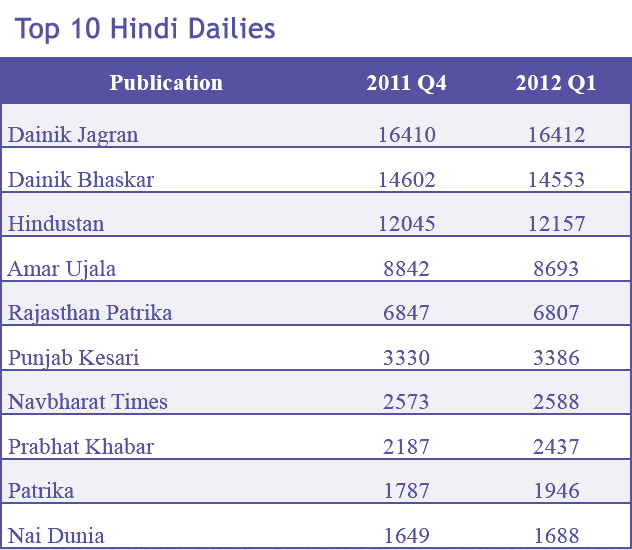
     

    (AIR numbers; all figures in ‘000)


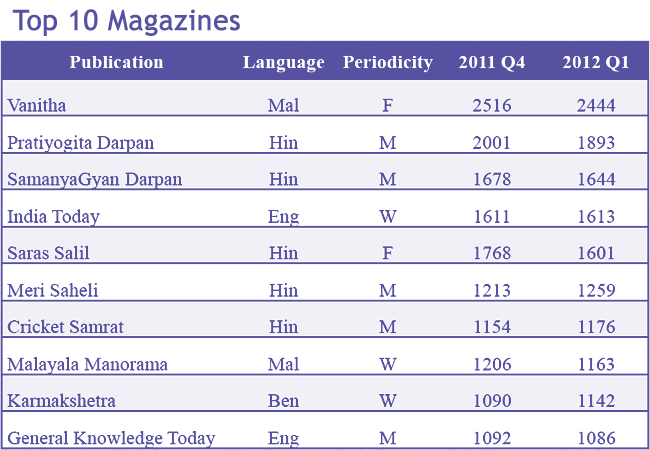
    Among the magazines, there has been a moderate effect that has been witnessed in the Hindi readership. Pratiyogita Darpan has seen a drop of 5.4 per cent with an AIR of 1,893 compared to an AIR of 2,001 in last quarter. SamanyaGyan Darpan has posted an AIR of 1,644 versus 1,678 recorded last quarter. At three is Saras Salil that has seen a big drop with an AIR of 1,601 versus 1,768 recorded last quarter – a drop of 9.5 per cent. Meri Saheli is steady at fourth with an AIR of 1,259 and Cricket Samrat is next with 1,176. India Today is next with 1,051 while Grahlakshmi follows with an AIR of 958. Completing the list is Grihshobha with an AIR of 860, Champak at ninth place with an AIR of 811 and Nirogdham with an AIR of 747.
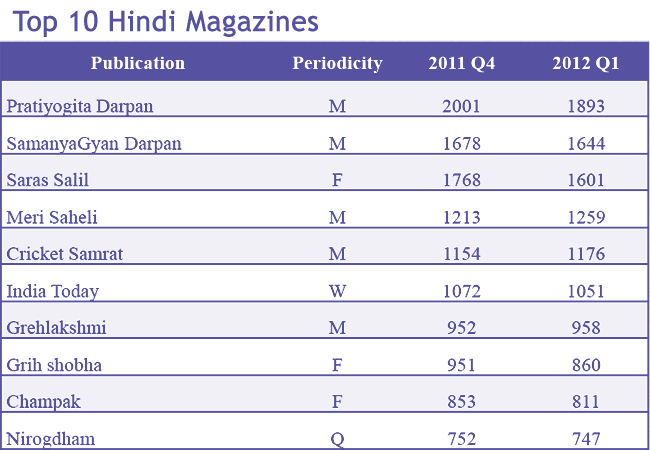
     

    (AIR numbers; all figures in ‘000)


    Dinesh Rathore, Vice President, MediaVest Worldwide said: “The population of people who speak Hindi and English is seeing a rise and that explains the overall rise in readership of these language editions. Also, a lot of players are moving out of their markets and launching in other states leading to newer set of readers. Players like Dainik Jagran, Dainik Bhaskar, Rajasthan Patrika are launching in many new states. So this explains the rise in the readership of their papers.”


    Adding inputs, Anamika Mehta of Lodestar UM said: “By launching in newer markets you are creating specialists products to cater to those markets and therefore, language readership will see a rise to an extent. Also, as explosion of business happens in small towns and markets the regional media will follow suit and grow too. That is what we have seen in television too. For SMEs and business houses, print will continue to be an important medium for them.”
     

  • Stagnancy stages a comeback in IRS 2012Q1


    By A Correspondent


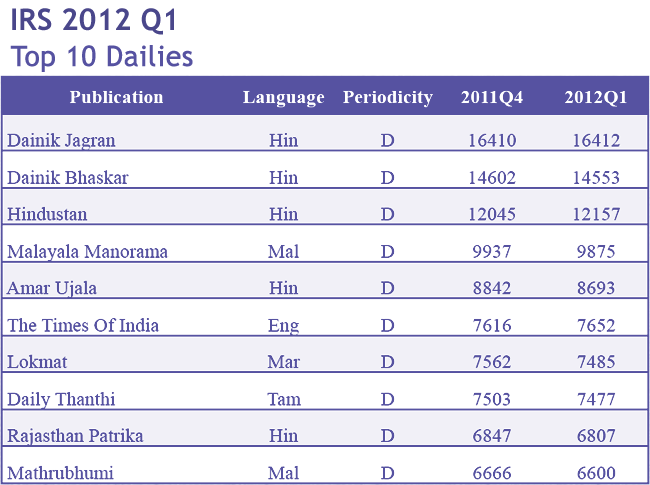
    The IRS 2012 Q1 readership results released by MRUC and Hansa has nothing new to tell but the obvious tale of the apparent rise in numbers of a few publications and the decline in readership of a majority of players. Going by the Average Issue Readership norm, in the Top 10 dailies there has been no change in the pecking order of the top performers but the readership of 7 out of 10 dailies has seen a marginal decline. Of the ten publications, five are Hindi in origin, two are in Malayalam, and one each in Tamil, English and Marathi.


    Emerging a frontrunner once again, Dainik Jagran manages to hold its forte showing slight readership growth with 16,412 in 2012Q1 as against 16,410 that it reported in 2011Q4. At No 2, Dainik Bhaskar has reported numbers totalling 14,553 a decline by 0.33 per cent from 2011Q4 figure of 14,602.Hindustansits comfortably at the third spot having reported a 1 per cent growth of 12,157 as against 12,045 reported in 2011Q4. Malayala Manorama is at the fourth spot with an AIR of 9,875 as against 9,937 in 2011Q4 – a drop of 0.6 per cent. Amar Ujala is next reporting an AIR of 8693 against an AIR of 8842 in 2011Q4 – a drop of 1.7 per cent. The Times of India English edition continues to see growth and comes in sixth with AIR of 7,652 as against 7,616 registered last quarter. Marathi daily Lokmat sees a marginal decline to end 2012Q1 at 7,485 compared to 2011Q4 AIR of 7,562. Tamil daily Daily Thanthi is next with AIR numbers of 7,477 as against 7,503 recorded in 2011Q4. Rajasthan Patrika with 6,807 and Mathrubhumi with 6,600 end the tally occupying the ninth and tenth spot respectively.


    Reacting to the overall trend, Dinesh Rathore, Vice President, MediaVest Worldwide said, “The study hasn’t thrown any new surprises. What is known is that the readership time spent on print is coming down these days, which is even lesser in case of magazines. Newspapers as a habit are not going to die soon but the time spent is surely on a decline. Also, if people were subscribing to more newspapers earlier, they are subscribing to one less now because of the options available on digital.”


    Highlighting her stance on the numbers, Anamika Mehta of Lodestar UM said: “What I infer is that the drop is very marginal. Print will continue to hold its ground in India. With literacy rates going up and the launch of several new products print will continue to drive growth in India . Also, what is seen is that there is a growth of consumption that is happening on the web and moreover, India is a very young country. Almost 60 per cent plus of the population are younger than 35 years. With these audiences the consumption is more on the web than on the physical newspaper. Also, we are seeing a lot of launches by players in the regional markets. So it’s not as bad as it seems.”


    Voicing a similar opinion as given by Mr Rathore, Priti Murthy, National Director – Insights, Maxus said, “I am not surprised by the overall trend that has been thrown up. Why do we read newspapers and magazines, for the sheer content that it provides and content is available faster in other mediums today – definitely digital and to a large extent even TV. I see this trend continuing in the next 3-4 years after which it will reach a saturation point. Also, how much ever tactical initiatives publications engage in to increase circulation, it clearly shows that readership is not going to increase. The time spent in reading newspapers and magazines will continue to see a decline. Also the new generation that is growing up may not grow up on a newspaper alone. They rely on mobile and other AV modes to receive their communication.”


    (AIR numbers; all figures in ‘000)


    The downfall story continues with magazines as well with leader Vanitha (Malayalam) reporting an AIR of 2,444 as against 2,516 in 2011Q4 – a decline by 3 per cent. Pratiyogita Darpan too sees a decline of 5.4 per cent having registered an AIR of 1,893 in 2012Q1 as against an AIR of 2001 in 2011Q4. SamanyaGyan Darpan sees a marginal decline with an AIR of 1,644 as against 1,678 reported last quarter. India Today is the topmost English magazine in this list and figures at the fourth spot with 1,613 as against an AIR of 1,611 reported last quarter. Saras Salil is next on the line-up and has reported a big drop of 9.5 per cent registering an AIR of 1601 as against an AIR of 1,768 reported in 2011Q4. Meri Saheli and Cricket Samrat have posted growth with an AIR of 1,259 and 1,176 respectively. Malayalam Manorama at 1,163 has seen a decline of 3.5 per cent while Bengali magazine Karmakshetra has seen a growth in its AIR at 1,142 as against 1,090 in 2011Q4. General Knowledge Today completes the list with an AIR of 1086.


    Throwing light on the trend spotted in magazines, Anamika Mehta said: “In the case of magazines, what we are seeing is that the time spent on magazines is going down but there are a lot of new and niche products being launched. A lot of international players too are coming into this market. So that should give it some scope for growth. But right now I think magazines are in a more worrying state than dailies in India but having said that I do not see the death of the medium coming here anytime soon.”


    (AIR numbers; all figures in ‘000)


  • IRS 2012Q1: English readership throws up usual pattern

    By A Correspondent


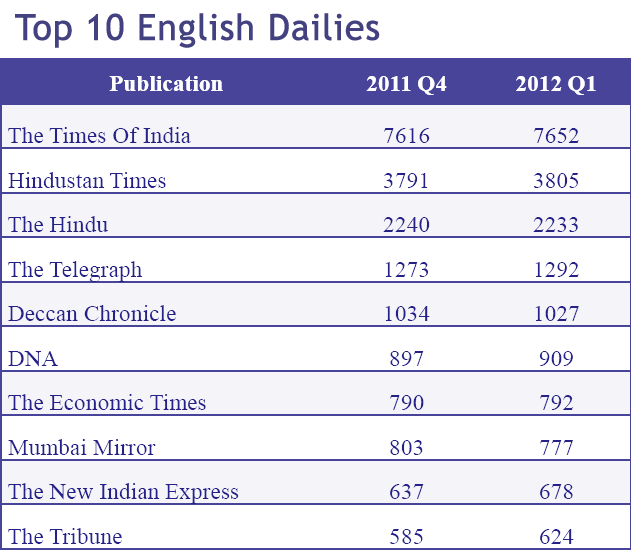
    A favourite with the urban zones and also with the advertisers, English dailies and magazines have shown an average readership trend in 2012Q1. Leading the list yet again for the dailies is Times of India that has recorded an AIR of 7,652 as against 7,616. Hindustan Times is next with an AIR of 3,805. The Hindu has seen a gradual decline with an AIR of 2,233 and occupies the third spot. The Telegraph comes fourth with an AIR of 1,292 while Deccan Chronicle is fifth with an AIR 1,027. DNA has shown a slight growth recording an AIR of 909 as against 897 it recorded in 2011Q4. The Economic Times follows with an AIR of 792 followed by Mumbai Mirror at 777. The New Indian Express is ninth with an AIR of 678 while The Tribune rounds off the list with an AIR of 624.


    (AIR numbers; all figures in ‘000)


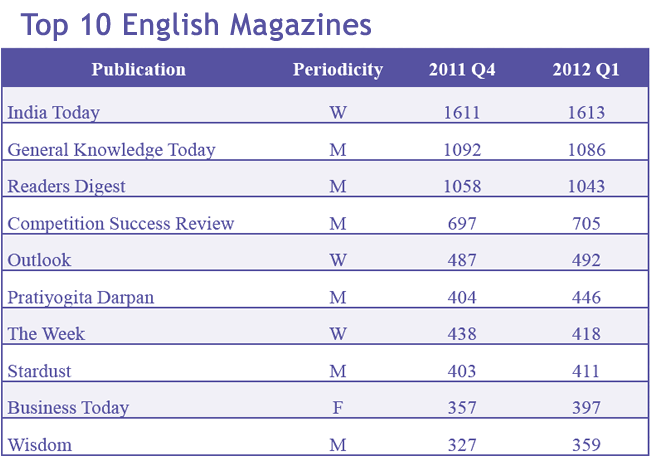
    The trend for magazines is somewhat similar to that delivered by dailies. India Today, retaining its top spot, has shown a small hike with an AIR of 1,613. General Knowledge Today is second on the list with an AIR of 1,086. The going is downhill for Readers Digest that posted an AIR of 1,043. Competition Success Review is next on the list having posted an AIR of 705. Outlook follows next showing growth with an AIR of 492. Pratiyogita Darpan is next with an AIR of 446. The Week follows with an AIR of 418 while Stardust is next with an AIR of 411. Business Today is ninth on the list with an AIR of 397 while Wisdom ends the list with an AIR of 359.


    (AIR numbers; all figures in ‘000)


  • Digitization in 4 metros put off to November 1

    By A Correspondent


    Given the varied and protracted deliberations with stakeholders, the Government of India has announced that the sunset date will be October 31, 2012 for the four metros with a complete switchover from November 1 in Chennai, Kolkata, Mumbai and New Delhi.


    Here goes a prepared statement issued:

    The Cable Television Networks (Regulation) Amendment Act, 2011 has made it mandatory for switchover of the existing analogue Cable TV networks to Digital Addressable System (DAS) by December 2014, in a phased manner. In respect of four metros of Delhi, Mumbai, Kolkata and Chennai, the digital switchover is mandated to be completed by 30th June 2012.


    The Task Force, comprising of all stakeholders, constituted by the Ministry in April, 2011, has been monitoring the progress made by various stakeholders towards digitisation. The task force has also undertaken field visits and interacted with local stakeholders. Discussions have been regularly held with Broadcasters, Multi System Operators (MSOs), Local Cable Operators (LCOs), while the Ministry of Information & Broadcasting has been in regular contact with the concerned State Governments on this issue.


    Regulations on Tariff & Interconnection were issued by TRAI only on 30th April 2012 instead of being issued in January, 2012, as expected.  The Quality of Service Regulations and the Consumer Complaint Redressal Regulations were issued on 14th May, 2012 by TRAI. As per these Regulations, every Broadcaster and MSO was required to publish its Reference Interconnect Offers (RIOs) within 30 days of issue of the Regulation.  Another 30 days are required for negotiations between Broadcasters and MSOs.  Thereafter, the MSOs and LCOs arrive at agreements which enable the consumers to have a clear indication of the terms and conditions for installing Set Top Boxes and the prices of channels on an a-la-carte as well as on a bouquet basis.


    The second order of TRAI of 14th May, 2012, has mandated that every MSO or its linked Cable Operator has to put in place a Consumer Complaint Redressal System consisting of a complaint centre with toll free consumer care number, web based complaint monitoring system as well as appoint or designate one or more nodal officers and publish consumer’s charter for DAS.


    Both these orders of TRAI have not yet been substantially implemented.  As a result of this, the installation of Set Top Boxes has not picked up necessary pace for the completion of the process of digitalisation by 30th June, 2012.


    The assessment of these ground realities, compels the Ministry of Information & Broadcasting to set a new deadline.  It is, however, imperative that the modified target deadline is set with strict benchmarks to ensure that no complacency sets-in in the system and the new target date is achieved collectively by all the stakeholders.


    Therefore, keeping in view public interest and after intensive and extensive consultations, as well as written commitments from all the stakeholders, for fully implementing the regulations of TRAI, the Ministry of Information & Broadcasting has decided to modify the 30th June deadline for a complete switch over to 31st October 2012 for all four Metro Cities i.e Delhi, Mumbai, Chennai and Kolkata.


    All the TRAI regulations for DAS will come into effect from 01st November, 2012.


    The Ministry of Information & Broadcasting will closely monitor the process of digitalisation over the next four months.  The Ministry of Information & Broadcasting will issue warning letters to those going slow on their written commitments.  Needless to add that both, the Ministry of Information & Broadcasting and TRAI, will take action under the provisions of the Cable Act, wherever and whenever necessary.


  • Debrief: Cadbury Gems: Not really a gem

    By Anil Thakraney


    After ‘upgrading’ their chocolate brands to adults, Cadbury is trying out the same trick with the totally kiddie Cadbury Gems. And I must say this is a very brave move. While one can understand and accept the fact that adults do indulge in chocolates, uncles and aunties gorging on Gems is pushing things a bit.


    The strategy is that Cadbury Gems brings out the inner bachcha in you. And that the brand makes you behave in a childish manner in adult situations. ‘Raho Umarless’ is the creative interpretation. I watched two commercials. In one, an oldish aunty sitting on a park bench notices a Cadbury Gem. She can’t resist it and sets off a volcanic eruption of candies. In another ad, a man spots an artifact inside a museum. It’s created out of Cadbury Gems. He plucks one candy out, and this action dislodges the entire structure and the creation is destroyed.


    There’s a basic problem with this creative treatment: It’s kiddish. Cadbury has failed to replicate the magic they create with their chocolates. For the latter, one is shown adult situations in which adults behave like adults. This creates empathy, and the brand wins. In the case of Cadbury Gems, adults behaving like silly kids will draw zero empathy from adults, there is no emotional connect. At best, the kids, who are the core consumers of Cadbury Gems, will love these commercials, and laugh their little heads off watching adults make fools of themselves.


    In other words, all that Cadbury has done is to reach out to the bachchas once again, this time showing adults in slapstick situations. And because of this, despite the ads being entertaining, they will score no points with the adult market. In any case, I think it’s a bad idea trying to promote a hardcore kiddie candy to adults. It’s not going to work.


    [youtube width=”325″ height=”225″]http://www.youtube.com/watch?v=Ink9lAkrcxY[/youtube] [youtube width=”325″ height=”225″]http://www.youtube.com/watch?v=jjV91ZRqu-o[/youtube]


    Rating: (On a scale of 1 to 5): 2. Dicey strategy. Flawed creative.


  • 1 Gold, 2 Silvers,1 Bronze on Day 3


    By A Correspondent


    “Of course, it feels awesome to win a Gold for something which we had put in a lot of hard work.” That’s Rahul Mathew, Executive Creative Director, McCann Worldgroup India, Mumbai. Mr Mathew and co-exec CD Akshay Kapnadak worked on the Outdoor Lions-winning campaign for Western Union Money Transfer. “It also reinforces the client’s trust on us and our work,” he said. McCann had produced a three-part campaign for Western Union


    McCann bagged India’s first Gold in Outdoor Lions for Western Union Money Transfer


    Indian entries won four metals on Day 3 of the Cannes Lions 2012. While McCann bagged India’s first Gold for Western Union Money Transfer in the Outdoor Lions, there were two silvers and one bronze in Media Lions. The sole shortlist from India in Creative Effectiveness did not win any metal and in the Mobile Category, there was no Indian shortlist.


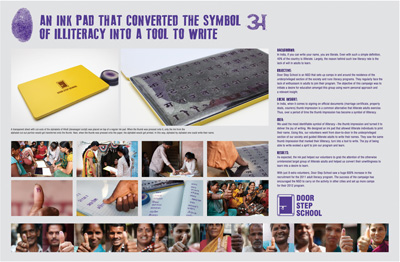
    Leo Burnett snatched a Silver for Doorstep School in the Best Localised Campaign category
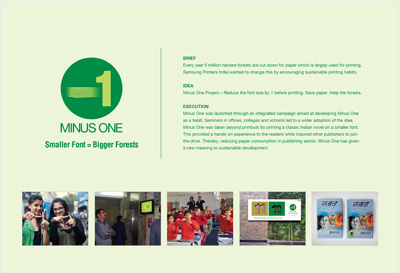
    Cheil won Silver for Samsung Printers in the Best Use of Integrated Media category
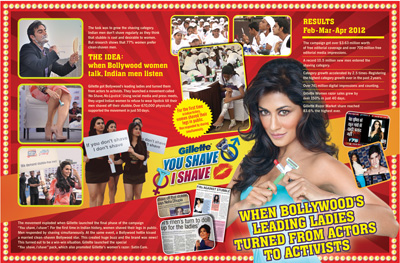
    BBDO won a Bronze Lion for its work on Gillette

    The Silver for Leo Burnett came in for Doorstep School for use of media in the Best Localised Campaign category.  Lead credits for the ad: K V Sridhar, National Creative Director, Nitesh Tiwari, Executive Creative Director, Vikram Pandey, Creative Director and Amit Thakur, Art Director.


    The other Silver for Cheil was for Samsung Printers for Best Use of Integrated Media. Lead credits for this: Varun Arora, Executive Creative Director,  Shiva Kumar and Dinkar Porwal, Creative Directors and Kamlesh Jangid and Shubhasis Bhatacharjee, Art Directors.


    Speaking on the win, Alok Agrawal, COO at Cheil Worldwide India, said, “The Minus One project for Samsung Printer has been winning awards and accolades at various international and Indian festival. So in a way, we knew that the work was a strong contender to be a winner. This is a fine example of a simple yet a powerful idea. One has seen various environment related communication but this is something which each one can practice by just reducing one point size when taking a printout thus reducing the usage of paper. Also the way the entire idea was approached and communicated was unique and caught up on the viral thus helping in winning the Media Lions.”


    The Bronze Lion has been won by BBDO for Gillette. The agency’s campaign titled ‘You Shave, I Shave’ . Lead Credits: Josy Paul, Chairman/Chief Creative Officer, Rajdeepak Das, Executive Creative Director, Sandeep Sawant/Josy Paul/Rajdeepak Das. Creative Director, Josy Paul/Yohan Daver/Riti Hamlai/Prakhar Deogirikar/Rajdeepak Das/Sandeep Sawan, Copywriters,  Rajdeepak Das/Sandeep Sawant/Ravi Shanker/Sagar Jadhav/Yohan Daver/Prakhar Deogi, Art Directors.


  • Ormax offers tool to measure effectiveness of big media tie-ups

    By A Correspondent


    Media research & consulting firm Ormax Media announced the launch of its proprietary model for brand association measurement – Mpact. Mpact is a scientific tool that measures the strength of association of a brand with a big-ticket, high-impact media property.


    Mpact can be used by brands and media agencies to test effectiveness of their brand’s association with high-impact properties across media, e.g. Sporting event associations, reality shows sponsorships, AFPs, print and television innovations and roadblocks, product placements, co-branded campaigns, and so on.


    In the Mpact model, consumer data is used to calculate the Mpact Score, a single-number measure of the effectiveness of the association for the brand.


    Speaking on the launch, Shailesh Kapoor, CEO – Ormax Media: “When an advertiser pays a premium to associate with an impact property such as IPL, KBC or Bigg Boss; takes a false cover on Times Of India; plans a roadblock on a top channel; or associates with a big film such as Ra.One or Bodyguard – returns that go beyond just the day-after recall of the association are expected. Mpact is a simple but powerful method of measuring how effective the association has been for the brand, beyond just a recall score which is extremely transient in nature. In effect, the Mpact Score is a surrogate ROI measure of the association.”


    Mpact has been developed and tested across more than 50 media associations by leading brands in various categories, including ‘Airtel presents Satyamev Jayate.’

  • Kenichiro Hibi is MD, Sony India

    By A Correspondent


    SonyIndiahas announced the appointment of Kenichiro Hibi as its new Managing Director with effect from July 1. Mr. Hibi will be responsible for spearheading the overall growth and profitability of the company within the region, by driving robust business strategy, providing thought leadership and guiding excellence in market performance across all categories.


    Mr. Hibi brings with him over 23 years of diversified experience in Sony, with a host of senior level positions to his credit. His last role was as Managing Director, Sony CIS, where he played a crucial role in making this region emerge as one of the most potential contributors in Sony’s global growth map. While managing the CIS region for over six years, he was successful in developing a sound business strategy, which adjusted to market turbulence while maintaining focus on customer orientation.


    Mr. Hibi will be replacing Mr. Masaru Tamagawa, the current Managing Director, Sony India, who will move on to the position of President, Sony Europe, with effect from July 1.


    Announcing the new appointment, Mr. Haruyasu Nagata, SVP in charge of Global Sales and Marketing, Sony Corporation, said: “I am delighted to appoint Mr. Kenichiro Hibi as the new Managing Director for SonyIndia. He has already successfully contributed to Sony’s growth in the rapidly evolvingRussiamarket, and we are confident that his experience and expertise will take our Indian operations to the next level. Mr. Tamagawa made an exceptional contribution in making SonyIndiaa top ranking sales company contributing significantly to Sony’s global sales, and I am confident that Mr. Hibi will build on this momentum by augmenting our overall market share and the customer experience we deliver in this rapidly growing market.”


    Expressing his delight on the appointment, Mr. Kenichiro Hibi said: “Indiais one of the key markets for Sony globally, with an immense growth potential across categories. I am excited to continue Sony’s journey to success in one of the most dynamic markets in the world.”


    Mr. Masaru Tamagawa has been Managing Director, SonyIndiasince 2007 and has overseen the emergence of SonyIndiaas a major organisation and growth market, holding the top share of the electronics market inIndia. He previously ledSonyGulf, based inDubai.

  • 9XM celebrates World Music Day with 9XM Wall of Music

    By A Correspondent


    9XM is celebrating the World Music Day on June 21 with a unique on-ground innovation. The channel is creatingIndia’s very first digital music wall called the ‘9XM Wall of Music’ offering free downloads of the latest Bollywood songs. The 9XM Wall of Music will be installed at the Chatrapati Shivaji Terminus in Mumbai and DAME Shivaji Stadium inDelhi.


    Based on the augmented reality technology, the 9XM Wall of Music will enable multiple songs downloads from the latest Bollywood movies. People can download songs by scanning the Bollywood movie posters placed on this wall, with their smart phone devices. People who do not own a smart phone can also download songs from the 9XM Wall of Music by sending a SMS to 54646 to get the song link on their phones for further download.


    Speaking on this initiative, Amar Tidke, Sr. VP & Content Head, 9X Media Group said: “June 21 is celebrated as the World Music Day across the world. This designated day of free music will be celebrated by 9XM by providing unlimited free downloads of the latest Bollywood hit songs. We are confident that this unique offering will make the World Music Day extremely memorable for Bollywood music fans.”


    The World Music Day originated inFranceand is celebrated annually on June 21. It is a day when the world celebrates the magical gift of music. Anyone can make music on World Music Day, in some cases in any location, provided one rule is followed: The music must be free.


    The 9XM Wall of Music will be promoted with a 360 degree plan across on air, print and digital platforms.

  • Life OK and SAB: The see-saw continues…

    By Meghna Sharma


    In India there is no dearth of television channels. The competition is only growing and the race to lead in the TRP race is heating up. In the past few weeks, the two channels which seen an increase in their TRPs are Life OK and SAB TV which have been fighting for the fifth spot in the TRPs race.



     

    Life OK, the newest entrance in the GEC genre from the Star India stable, was launched in December last year. The network renamed and re-launched their youth-oriented channel Star One with new tagline ‘cherishing what you have’.


    On the contrary, SAB TV has been around for over a decade now but has gone through various transformations. In March 2005, SAB TV was acquired by Sony Entertainment Television and was transformed into a youth-centric channel. In June 2008, the channel announced that it would return to its roots by being repositioned as a comedy-centric channel.


    So what does the race for TRPs mean for the two channels and do they pose a threat to other GECs? MxMIndia spoke to a few media planners to see what is the future of the GECs and what shape will this ‘war’ take.


    According to the latest TAM data, in week 24, SAB TV has toppled Life OK and regained No 5 position. Whereas, last week (week 23), Life OK was the fifth most watched GEC.


    Sundeep Nagpal

    Sundeep Nagpal, founder director, Stratagem Media feels that these are momentary fluctuations and cannot be contributed to anything per se. “These channels have a small base; therefore, even a single factor can affect the ratings of the show – positively or negatively – depending on how it did on a particular week. Hence, I don’t think we should be alarmed by such fluctuations. And they won’t be able to impact the top 4 slots.”


    The two channels have positioned themselves differently, too. SAB TV is a comedy-centric channel which portrays itself has a family channel, whereas Life OK has shows full of melodrama like other GECs.


    Janardhan Pandey, associate vice-president, DDB Mudra Max feels that the two cannot impact each other drastically. “SAB has its own set of audience which won’t get influenced by other GECs and vice-versa. They will continue to do well in their own categories; the fluctuation between the two is possible but they don’t have the same hold as other GECs do. They still have a long way to go.”


    Jai Lala

    On the other hand, Priti Murthy, national director – Insights, Maxus, feels that though these channels might be still small fish, they cannot be ignored entirely. “Like these two channels, even number two and three slots have been fluctuating for a while now. So, slot five and six can create an impact too. One cannot rule out the possibility of them gaining to higher positions in the future if they come up with new and better content.”


    On the channels growth, Mindshare’s principal partner, Jai Lala feels that the two channels have grown since Imagine TV, a Turner International India Pvt Ltd entity, was shut down earlier this year. “The shutdown of Imagine TV has benefited these two who are now turning out to be competitors. However, they still have a small base compared to others and unless and until they cross the 200+ threshold, I don’t think that they can or will affect the channels like Star or Zee or Sony which have been ruling the top slots in the TRP race for a long period of time.”


    Uday Mohan

    “While these channels are doing well they have a long way to go in terms of reaching the numbers of the mainline GECs. They still don’t have the kind of appointment viewing that the mainline GECs generate….they might eat into the shares of other frequency channels but will not threaten GECs, at least not immediately,” added Uday Mohan, executive director – North, MPG.


    Most experts believe that there is nothing to be alarmed about the two channels see-sawing. What they do feel is that both the incumbent SAB and challenger Life OK will have to work harder if they want to reach the top slots.


  • Colors jumps to No 2, thanks to JDJ

    By A Correspondent


    Reality shows are the flavour of the season; and the latest entry to the bandwagon is Colors’ Jhalak Dikhla Ja.  The celebrity dance show in its fifth season premiered on July 16 on Colors and thanks to the show, the channel saw its highest growth this week. Colors has jumped to No. 2 again.

     

    According to the latest data for week 24, Star Plus is on number 1 position with 268 GRPs this week (last week 269). Zee TV has slipped to No. 3 with 212 GRPs (last week 203). Sony Entertainment Television went below the 200 mark, at No. 4, the channel has recorded 187 GRPs (last week 201).


    DID Little Masters on Zee has been doing well for the channel, but saw a drop in TVR ratings (2.8)  as Jhalak Dikhla Ja  got a 3.13 TVR. Both are dance shows, but whereas one deals with children, the other has celebrities like Madhuri Dixit and Karan Johar to its credit.


    So what worked for the show as well as the channel? Dinesh Rathore, vice president, India- West, MediaVest Worldwide, feels that though celebrities do arouse curiosity and makes them switch to a particular channel, there is no dearth of celebrities on television today as most reality shows feature them. “I think the show has done well on its opening weekend because of the initial curiosity. It would be difficult to say if it will continue to do so for the channel. We’ll just have to wait and watch.”


    Monaz Todywalla, general manager, Madison Media, said: “From the content point of view, the show is well packaged and promoted. Hence, it was bound to get such ratings on the opening weekend. However, the channel cannot rest on the shows shoulders alone. If it wants to remain on the slot or even reach the numero uno position, it will have to do a lot more, especially content wise.”


    Meanwhile, Zee TV’s DID Li’L Masters which earned a launch rating of 5.8 is adding a Bollywood flavour to its show on the coming Sunday with a tribute to the iconic dancing stars of Indian cinema.


    Surely what we have seen is a mere ‘jhalak’ of the two warring dance shows.


  • Ranjona Banerji: What the Whacky-dooky?!

    Ranjona Banerji

    By Ranjona Banerji


    I understand that advertising is vital to the well-being of a newspaper but just who invented these idiotic “half-jackets” which either split the front page of a newspaper or cover it with some meaningful and wholesome message about a bank or a soft drink?


    What I mean is, does one blame an advertising agency or the ad sales department of a newspaper?


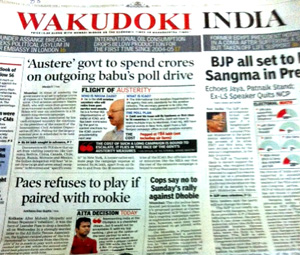
    My problem however is not to do with the advertising message itself – although I was hard-pressed to understand today’s Wakudoki message on The Times of India masthead. Why this car company had to say Wakudoki to us, I don’t know. What Wakudoki is I don’t know. In some places Wakudoki was one word and in other places Wako-doki was hyphenated. Actually this made me happy in a schadenfruede kind of way – copy checkers in ad agencies are of the same calibre as sub-editors in newspapers.


    My primary objection is that they don’t allow you to fold the newspaper properly. This is particularly annoying as you reach the last pages of the paper as the half-jacket page with not enough hold flies off or falls off or slips out. This makes me want to shout something far more robust and potent that “Wakudoki” or even “Waku-doki”. Hyphen or not, the words I’m thinking of do not start with a ‘w’.


    Halfway through reading about Leander Paes’s current tantrum to compete with Mahesh Bhupathi’s original tantrum, I suddenly find the names have changed to Drogba and Rooney. These names are as mysterious to me as “Wakudoki” (and “Waku-doki”) and as I wonder if my coffee has some magic mushrooms in it, I realise that the last page of the newspaper has slipped off.


    I realise that The Times of India is not the only guilty newspaper here. Everyone does it. It’s just that I was whacked in the face today by this vastly annoying invention. It even beats the detergent bubbles and spouting soft drinks I had to deal with as a young sub-editor.


    In my view, I would rather the newspaper just sold its front page, self-respect and identity in one go rather than in half-measures. That way you can just turn the page, know that it will fold obediently and carry on with the latest Purno, Pranab, Nitish, Narendra fight.


    Instead of wanting to start the day by whacking whoever comes close because the newspaper begins with some cheapie corporate who only wants to pay for half a sheet of paper.