 By Shailesh Kapoor
Earlier this week, one of Hindi cinema’s most iconic films, Hum Aapke Hain Koun..! (HAHK), completed 25 years. In times when anniversaries of eminently forgettable films are celebrated on social media with great fanfare, this one deserves a genuine shout out.
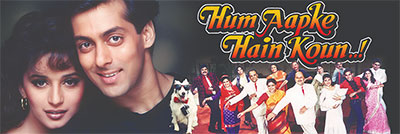 Rajshri’s 1994 film was a remake of their very own Nadiya Ke Paar (1982), which in turn was an interpretation of Keshav Prasad Mishra’s Hindi novel Kohbar Ki Shart, though the novel has a wider story than the two films. Remaking Nadiya Ke Paar in the 90s would need some courage. The idea of the original film is grounded in Indian culture and family values, which were not in vogue in the cinema of the early 90s, though Sooraj Barjatya, the director of HAHK, himself had brought Indian values to the fore in his debut film Maine Pyar Kiya (1989).
But more than that, the humble rural setting of Nadiya Ke Paar was too un-cinematic for the 90s, when overseas business was a crucial component of box office, and even the Indian audience was looking for escape and aspiration through their cinema. How Barjatya visualised the adaptation is a story that’s still not been told much, perhaps because the original film is not very well known (though interestingly, it rates higher on IMDb than HAHK). But what he managed can only be called the work of a true genius.
Much of HAHK’s imagery is about its 14 songs and the wedding functions. I remember The Times Of India review at the time of the film’s release being headlined something like ‘A bag of frills’. The film, of course, is a lot more than that. At the heart of it, it has one of the most well-etched, though somewhat simplistic, love story. But more than anything else, it’s a textbook chapter on the perfect modern Indian joint family, a mythical idea that many would want to be a part of, but is too good to be true, and largely out of reach.
When one speaks about classics, one typically has 5-6 big scenes that stand out. That’s not the case with HAHK. It’s a seamless 220-minutes (in its original form before some songs were edited) line-up of sequences that are individually compelling, but not shouting for attention outside the context of the film. In the end, the whole is much bigger than the sum of the parts here, and it’s a fairly wholesome one too.
Boxofficeindia.com projects the inflation-adjusted domestic nett revenue of HAHK at Rs. 711 Cr. That would make it bigger than everything Hindi cinema has churned out, including the dubbed Hindi version of Bahubali 2. But HAHK’s memories are not about the numbers. They are about the impact it had in the mid-90s. It was a time when theatres were shutting down and theatre-going was going out of vogue. The film, which the makers audaciously released in only 35 screens in its first week, “found” its audience, not over a week or a month, but over more than a year.
I remember how only two theatres in Delhi (Sapna and Satyam, if memory serves me right) ran the film in the initial 2-3 weeks. In days of no Internet, getting a ticket did not come easy. It meant making a trip a few days earlier to stand in the advance booking queue. I did it more than a few times, as there was enough in the film to demand a second viewing, and then one more, and then some more.
By the time it was Diwali, the film had found audiences in the most unlikely sections of the society. Families that had never visited a theatre were going in big groups of 15-20, all decked up for an experience of their life.
The film then had a long and immensely successful television run, which is still going strong. Many believe the film has not aged as well as DDLJ, which came a year later. But for me, HAHK doesn’t need to go through the ageing test. It’s rooted in 1994, and that’s from where it should be seen.
May its legacy live on!