Entourage Films has announce another collaboration with Zomato for the launch of the Zomato Dining Carnival.
Said Sharat Katariya who directed the film: “The film beautifully reflects the joy and spontaneity that the Zomato Dining Carnival is all about, bringing the essence of the campaign to life. Ahsaas and Adarsh were the perfect fit to bring that quirk to life, their individual performances brought an extra layer of charm to the campaign. They fully embraced the playful nature we intended to capture and delivered it with exceptional flair.”
Added Harshil Dhawan – Creative Head of Zomato, who has conceived the campaign: “When dining deals are so irresistible, every moment feels like a cue to make a plan! With the Zomato Dining Carnival in full swing, featuring over 8,000 restaurants and up to 50% off, we’ve turned spontaneous cravings into spontaneous plans. Our films hilariously capture how an epic dining deal can make you drop everything and head out for a feast, no matter where you are or what you are doing.”
A very interesting article popped into my inbox this morning. It spoke about the role of product managers in consumer-facing tech companies. The article was triggered because Zomato had placed a live order count which a consumer can see after s/he places an order. You can see it here.
It seems that the feature was dissed on social media, mostly by the Product Manager types. Most were questioning the use of this feature. Did it help the consumer? How does it add value? Why is Zomato wasting time on features which do not help the user? You get the drift.
The author of the piece moaned the fact that product managers are becoming too bureaucratic. Everything that is build into a product today, has to be justified with metrics or some quantitative outcome. Everything has to be about productivity and efficiency. Unlike, say, Google which in the 2000s encouraged its employees to spend 20% of their time working on things, besides their projects which may benefit Google. Or the Google Doodles which are an intrinsic feature of the brand today.
The author said that product managers forget that some things can be done for fun. Or to give the product a cool quotient. That’s what the Zomato live order count was doing.
Fun? Cool? Let the consumer have an emotional connect?
Sounds familiar?
I may be a bit old-fashioned but isn’t that what a brand does regularly.
The problem is that new age products are just products. Not brands.
That’s why they are being run by product managers. Not brand managers.
That’s why the obsession with product feature which creates a better value for the product. Never mind if it will be copied soon.
You don’t believe me.
Ok, then. Here is a small test.
You prefer Ola or Uber?
Do you use only Zomato or Swiggy too.
Can you actually differentiate between Blinkit and Zepto?
I bet you use all these products that I mentioned above.
You have all these apps installed on your phones.
And you use all depending upon an offer or a cheaper option or just because someone gives you a better loyalty programme.
And I am not even getting into Vivo or Oppo!!!
So, the question is why are we building better products and not great brands?
Why are the new age products not building brands?
The easy answer is that the obsession with data and quantitative metrics, while being a welcome change from the days when marketers would struggle to gauge the efficacy of an advertising campaign due to lack of data, has made us jump to the other end of the spectrum. If anything cannot be explained by data then it’s of no use.
A product differentiates with its features. All the new age products and the products which have thrived due to the proliferation of data focus on this aspect.
But a brand differentiates in many other ways. It could differentiate with its pricing or distribution strategy. Air Deccan or Indigo and sachets do it well.
It could differentiate with its advertising and emotional appeal. Remember Amazon with Aur Dikhao campaign or Flipkart with kids acting as adults? Remember the Vodafone Zoozoo campaigns? Or Abhishek Bachchan with what an idea sirjee for Idea.
Or brand can differentiate with its service. In appliances, Philips has done an amazing job by harnessing local electricians to start service centres available in every nook and corner of the country.
And brands also differentiate on the basis of their personality. Coke is fun but more in a family way. It’s a bit more mature. A bit more real. Pepsi on the other hand is fun which is rebel. Fun which appeals to the non-conformist. Fun which is flamboyant and maybe even in your face.
That’s why the shift happened from product management to brand management. That’s why a Hindustan Unilever could have more than four brands of soaps. three brands of detergents, four brands of tea, three brands of skin care……… The difference was what each brand stood for and whom it targeted. And that helped HUL gain leadership in each of the product categories.
By having brand managers and not product managers.
These brand managers would build differentiating brands.
But the new age products, and I cannot bring myself to calling them a brand, are too focused on building better products.
Let me tell you for brand managers also the big challenge was to innovate their product regularly. In categories like soaps and detergents. And they would. But because they would focus on brand and not just a product, they would look beyond the packaging, or the fragrance or an enticing offer. Sometimes it would be just memorable advertising.
Fun anyone? Cool anyone?
Or sometimes it would be combination of packaging and pricing.
Godrej No1 launched Buy-3-Get-1 free, not as a promotion but as the only option available. It was a win-win for everyone. The retailer would gladly tear the combined pack and give individual soaps to consumer. Remember, he had one soap free so on that he would get full MRP as his margin. Or he could sell the one piece below MRP. So, even the consumer was happy.
Brand building is also strategic. Jio launched not with the conventional pricing strategy of talk time plus sms plus some data but with data-led pricing. Calls and smses were free. The strategic thinking was that data was the real deal, not talk time. So, the whole product was built around data. And the product was turned into a brand with data lead pricing. And with the brand being free for first nine months, data users were happy to buy a new sim. The total nine-month free offer coupled with the earlier cheap plans created a perception that as a brand, Jio was cheaper. Today, when Jio is not really the cheapest, the brand perception of being inexpensive persists. And sponsoring IPL year after year helped gain massive exposure
Phew! See the well-thought-out strategy that covered almost all aspects of marketing.
To me, building products and not brands is also the sign of times.
Brands take a longer time to build. Products can come and go. Already Zomato is saying that its revenues from Blinkit will overtake Zomato this year. So, why build a brand when new products can be arrived at. Why worry about brand extensions or line extensions when one can just name a new product and call it a brand.
Avoiding brand building is being lazy. Quick results. Not necessarily in terms of profits. But in terms of valuations, Gross Merchandising Value or even IPOs. Targetting a focused customer is not the deal but targetting VCs is.
So, will the new age products change?
They better. Because the first new age product Google, built a brand and is still going strong. But Yahoo search and many such others built products which just disappeared.
Will Zomato, Uber and Blinkit survive by the time your children grow up? That is the million-dollar question.
In a bid to create excitement around the upcoming Cricket World Cup, Zomato, the food ordering and delivery platform, has unveiled yet an ad film as part of its ongoing ‘Match Ho Toh Zomato’ campaign.
Directed by Bollywood director duo Raj Nidimoru and Krishna DK, the film opens with Ranveer Singh and Samantha Ruth Prabhu reflecting on the importance of India winning the Cricket World Cup. Notes a communique: “The essence behind the film is that one might miss out on ‘n’ number of things in life, but for now the only thing that matters is India winning the World Cup. It captures India’s love for food and cricket as a group of friends, including Ranveer Singh and Samantha Ruth Prabhu, gather around, eyes glued to the screens, engrossed in the cricket season with boxes of food ordered from Zomato. The camaraderie and shared excitement build up to a conclusion with everyone cheering, ‘Indiaaa-India’.”
In a tribute to the rich tapestry of India’s harvest festivals, Zomato, India’s food ordering and delivery platform, has unveiled a series of ad films celebrating Pongal, Sankranti, Makar Sankranti/ Uttarayana, and Lohri.
Notes a communique: “Zomato’s ad films capture the spirit of these harvest festivals, emphasising the significance of tradition, familial bonds, and the evolving cultural landscape. The campaign beautifully encapsulates the warmth and bond shared between the generations and highlights the relationship between a grandmother and her teenage granddaughter who comes home to celebrate Pongal with her family.”
Zomato has unveiled its World Cup campaign starring brand ambassador, Ranveer Singh and cricketer Chris Gayle.
Zomato has launched an AI-generated film featuring actor Ranveer Singh and Chris Gayle, calling out restaurant partners’ names and their popular dishes, during this world cup season.
Said Sahibjeet Singh Sawhney, Marketing Head, Zomato: “Our World Cup campaign is born out of our love and respect for Team India. And who better than Ranveer Singh to capture the infectious excitement, energy and passion of cricket fans across the country. There is a natural synergy between Ranveer and Zomato, which we have captured in our campaign as well. The Cricket World Cup is an exciting time for Zomato and while India breaks records on the field, we too are ready to serve the country. As the ad film says, it is time for India-India over Zomato-Zomato.”
Most of us have an issue with opportunistic Cause Marketing and pseudo-Purpose-led brand campaigns. And many of us share Prathap Suthan’s sarcasm when he writes about the advertising industry’s hypersensitivity to hopeless global causes in the month of June – primarily for awards, easily identifiable with the timing, efforts, scale and design. However, some of us still hang on to the hope that there are a few brands which keep it simple, while working on an identified cause consistently and diligently. They are in it for an extended period , where they explore it from different angles. Tata Tea- ‘Jaago Re‘ and Ariel- ‘Share the load’ are two examples of cause/purpose-led marketing campaigns with an excellent brand fit. Additionally, they have longevity that has been explored by the brand.
What makes JAAGO RE work.
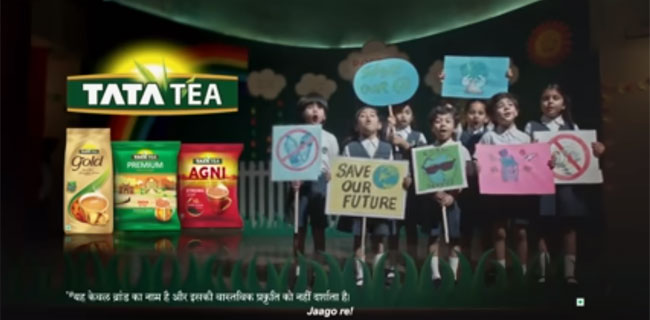
Good cause marketing must have an almost direct brand/service relationship. In the case of Tea- strongly associated as an early morning beverage – Jaago Re- Wake Up is such a simple and strong statement- an excellent brand fit. The audience can completely relate to it- even though Jaago Re, in this case, is more than the Physical act of waking up.
Tata Tea has worked on Jaago Re for over 15 years and has taken it to new heights with fresh communication. There is a huge investment of time and effort after crafting the idea.
It addresses issues relevant to the public. Things they want to act upon but don’t seem to have the initiative or solution. Issues like Corruption, Woman Empowerment, Gender inequality, Voting, Bribery and now climate change- or protecting the climate for the next generation.
The brand approach is to simplify these complex issues and provide a trigger – a thought to the audience. In a way, ask the audience to wake up and take the initiative. Take those identified small initiatives at the individual level that have the power to collectively impact the system. Because every such issue needs an individual-level action which would collectively converge into ground-level movement, the change would happen.
The ‘Jaago Re’ campaign has been fully focussed. There is always a scenario build-up (reminder of the situation) and a call for action. The suggested initiatives (solutions) are relatable, and the solutions seem to be practical and practicable. There is always an element that shouts there is no need to wait for things to happen.
Tata Tea Pushes New Climate Change Initiatives.
‘Alarm Bajne Se Pehle Jaago Re’ pushed for proactive behaviour. ‘Power of 49′ reminded women of their voting power and how they could make a difference in the general election. The weakest link in the campaign was Soch Badlo‘, which seemed more preachy but asked the audience to see things from a different perspective. ‘Khilana Bandh Pilana Shuru’ suggested fighting corruption with a strong direct call for action.
These campaigns had a solid link to Tata tea, and the Umbrella Brand ‘TATA’, with its image and trust, further strengthened the idea. The campaigns were not mere visual fantasies but had strong digital and ground-level support. Thus, the campaign remained impactful and relevant for the masses.
Tata Tea Jaago Re Climate Change Imitative.
The latest Tata Tea ‘Jaago Re Climate Change’ campaign brilliantly uses well-known nursery rhymes at a school function. The nursery rhymes are tweaked for the message. It strikes a chord with the audience. They all remember these rhymes and recognise the change. The message that the next generation will have to pay the price of the current generation’s actions and inaction is starkly delivered with impact and simplicity.
One can safely presume that the Tata. Tea campaigns will not be able to create a mass movement or make many people act. However, you can not ignore the efforts and relentless pursuit of simplistic solutions. In this case, the communications and the creative device of Nursery Rhymes work to create impactful awareness.
The Jaago Re site, in addition to asking people to pledge action (Pledges now reaching 50K!), shares ways people can be part of the solution. These are simple solutions like saving energy at home, planting trees, sustainable green commuting, reducing waste, using eco-friendly products and recycling.
Tata Tea addressed the climate change issue earlier, asking the current generation to act. In that case, the instigator was a child. However, the Nursery rhyme is far more impactful.
No doubt, Jaago Re is an impactful, relevant and successful campaign. The only grudge that one has is the annual re-evaluation and shifting of the targeted issue. But, then, it is what the brand needs to do.
KEEPING IT SIMPLE – TIGER ANTHEM BY TOI
Another cause marketing! Hopefully a sustained effort.
The Tiger Anthem ‘Meet my Mom‘ by The Times of India has crossed 100 Mn views in a fortnight across platforms and going strong. It is part of the ‘Saving Our Stripes’ campaign on the 50th year of Project Tiger, supported across print and digital mediums. TOI- the media giant had used every possible way and media under its banner to highlight and build interest in the subject before the Anthem was released. These included contests, User-generated content, interviews, articles, podcast and exciting use of cartoons.
TOI has hit an emotional chord with the audience by using the powerful bond of a mother and her child. As it is future-looking, the anthem has very peepy and simple lyrics that should interest the young audience- expected to take the initiative further. It not only shows that the animals must co-exist, but it also shows the young mind that the relationship between a mother and her child is independent of the species. The cub is as innocent and unaware of the dangers, and the true threat to them is us, the humans.
Complicate At Your Own Risk.
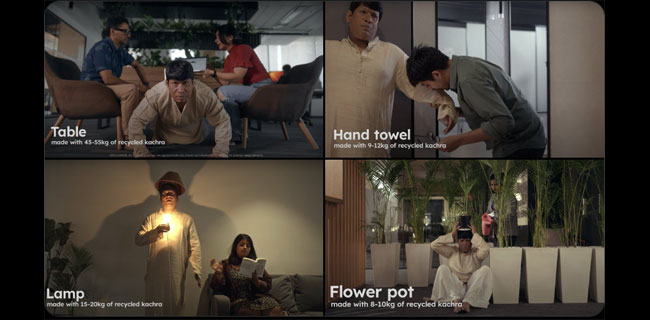
Zomato’s recent Kachra TVC is a case in point, where the brand picked up a cause and blotched it up due to insensitivities. There is a lot the brands must consider in today’s world while approaching a cause with a social divide. Here is an excellent article, ‘Brands Navigating The Social class divide- lessons in Sensitivity from past campaigns’ by Hamsini Shivakumar and Prabhjot Singh Gambir. There is always a possibility to filter the communication through SMEAR INDEX, checking for possible backlash. However, know that the intent does not count, and irrespective of your best efforts, some part of the audience will always be objections to the creative. Then, the brand should be able to take a stand.
Net-Net
Keeping it simple works in most communication. And for cause led/purpose-led marketing, one needs to be clear about the objective and the association and be willing to invest time and effort sustainably. There is no point in fooling the audience- ‘Yeh Public Hai Saab Kuch Jaanti Hai, Saab Kuch Samjhati Hai’ (the public knows and understands everything). And when so many brands have been trying to leverage half-baked June ideas, the public knows how to differentiate and tell. Cause marketing needs time and repeated strikes. It requires a ‘Sau Sunnarki Not Eek Lohar Ki’ ( needs multiple strikes, nudges like a goldsmith and not a hard hit like a blacksmith).
So, there is nothing wrong with cause/purpose marketing if you can do justice to it.
Photo source: Tweet by Neeraj Ghaywan (@ghaywan) at https://twitter.com/ghaywan/status/1666667224273403908?s=20
By Hamsini Shivakumar & Prabhjot Singh Gambhir
Hamsini ShivakumarPrabhjot Singh Gambhir
Zomato’s recent campaign aimed to raise awareness about recycling waste on World Environment Day. However, the use of the character ‘Kachra’ from the movie Lagaan inadvertently reinforced stereotypes and perpetuates the devaluation of people from a specific class. Although the brand intended to employ wordplay in the video, the end-result appears culturally out of sync. The humour in the video appears to be mocking the already marginalised rather than challenging those in positions of power. The video received a lot of backlash on social media, which eventually led to Zomato deleting the video itself from all platforms.
When faced with these social class divides, brands and their creative agencies are confronted with a unique challenge. Traditionally, marketing has approached class divisions as issues of affordability and accessibility for consumers. The solution typically involves offering products and services at various price points to cater to different segments of the market.
Think of shampoo sachets, and phone recharges priced at Rs 10. Market segmentation based on affordability addresses the problem of access, ensuring that every consumer can afford and desire products within their price range, whether at the lower end or luxury segment of the market.
However, addressing the social class divide as a brand in brand communication presents a distinct challenge, as it raises questions about portrayal and representation. It forces brands to examine their vantage point and ideological stance. If a brand aims to project itself as embracing progressive values, how should it navigate the complex issue of social class and class divides?
This is particularly relevant when it comes to the portrayal of domestic help and their treatment in advertising, especially for brands selling household cleaning products and related items. How should they depict domestic help? Should they merely reflect reality as it is, or should they encourage consumers to adopt more progressive behaviours?
To effectively navigate the intersection of brand communication and the social class divide, brands can draw valuable lessons from previous campaigns that approached similar subjects with sensitivity. Let’s take a look at some examples of how some brands have approached this issue in the past:
Ghadi Detergent:
In Indian popular culture, domestic help is often portrayed as solely responsible for the cleanliness and maintenance of households, perpetuating the notion that it is their sole duty while family members contribute little. Such stereotypes create a power imbalance between domestic help and the families they serve, with the latter holding all decision-making authority.
Ghadi Detergent’s campaign, #SaareMaelDhoDaalo, deviates from this stereotype. Instead, it encourages individuals to recognise the importance of every task, no matter how small, and to treat domestic help with respect. The campaign depicts a young boy with a callous attitude towards the work performed by the house help. To rectify his behaviour, his mother decides to teach him a lesson by having him clean the house under the false pretence that the house help is on leave. In the end, he learns to appreciate the domestic help’s contribution and even pays him extra to celebrate the festivities.
Women’s Day 2019 #YourSecondHome : An initiative by PregaNews
Similarly, PregaNews launched its Women’s Day 2019 campaign, #YourSecondHome, which highlights the importance of domestic helpers and their contributions to households.
The content begins with a woman scolding her domestic help and asking her not to perform her usual tasks. It appears that the domestic help’s job is at risk. However, as the narrative unfolds, we discover that the woman is actually reducing the workload of the domestic help due to her pregnancy and invites another domestic worker to assist. The campaign challenges initial perceptions by portraying the employer as caring and considerate, much like a family member would be.
The messaging of the campaign promotes progressive ideals, advocating for empathy towards domestic workers and providing them with benefits such as maternity leave or reduced workload during pregnancy, similar to practices in the organised sector. The brand, PregaNews, seamlessly integrates into the narrative of the ad.
Cadbury Dairy Milk – Driver
The work features a boss driving his driver to his child’s school so that he could attend the parent-teacher meeting. While the content is only 45 seconds long, it is quite impactful. We immediately get to understand the dynamics between the employee and the employer and how this is a routine activity. We understand how his boss is being kind and patient towards him and goes out of his way to help him.
The video shows how a small gesture of kindness towards one’s driver/staff can make a significant difference in their life. The brand integration of Cadbury Dairy Milk is also quite seamless, as it plays on the factor of the boss ‘being sweet’ and sweetness is associated with the chocolate in question.
Oswal Refined Soyabean oil
Oswal Refined Soyabean oil’s campaign portrays a positive image of domestic helpers by showcasing the relationship between the wife and her employee. While the husband is upset that the domestic help always leaves early to attend to her children, the wife, on the other hand, is accommodating as she knows that she works well and efficiently. One day, when the wife is out of the city, the maid bakes a cake for the husband and stays late at night just to celebrate his birthday so that he does not feel isolated on his special day.
The video emphasises that domestic help is not just the staff of the house, but a part of the family, and employers should be accommodating to their requirements.
However, while the ad’s story has a nice recall value, the brand takes a backseat here. The brand integration of Oswal is not quite as seamless because the story is not built around refined soybean oil. Even a slight mention of it in the narrative would’ve helped the brand integration.
Facebook | More Together – Pooja Didi
Facebook’s campaign, More Together – Pooja Didi, is a heart-warming portrayal of support staff. The content initiative can almost be categorised as a mini-short film, as it is about seven minutes long. It highlights the problem of unemployment during the pandemic and how the protagonist – Pooja, starts hiring people in large numbers to provide them with gainful employment solely out of her altruistic intentions.
However, when she cannot pay the salaries and bills to the people she does business with, she is in a state of crisis. That is when the hired staff of her sweet shop utilises the power of social media to narrate the story of Pooja’s altruistic actions, which end up attracting customers to the shop, thus enabling her to pay all her bills.
Conclusion
All the brands seem to take the high power distance between employers and domestic help for granted as a given in Indian society and thus mirror existing realities. They don’t show the possibility of a different future for domestic help (except the Cadbury ad to some extent) in which they can be empowered and assertive of their rights vis-a-vis their employers.
The convergence of brand communication and the social class divide poses both challenges and opportunities for brands. By being mindful of the implications of their messaging, brands can strive to create advertisements that promote empathy, understanding, and equality. Actively working to dismantle stereotypes and biases, brands can contribute to positive social change.
HamsiniShivakumar is a long-time culture-watcher, semiotician, brand consultant and co-founder of Leapfrog Strategy as well as Semiofest, the global unconference for applied semiotics.Prabhjot Singh Gambhir has done his Masters in Film Studies and is passionate about stand-up comedy. He has now turned his observant eye to cultural discourse and its intersection with brands.The views expressed here are their own.
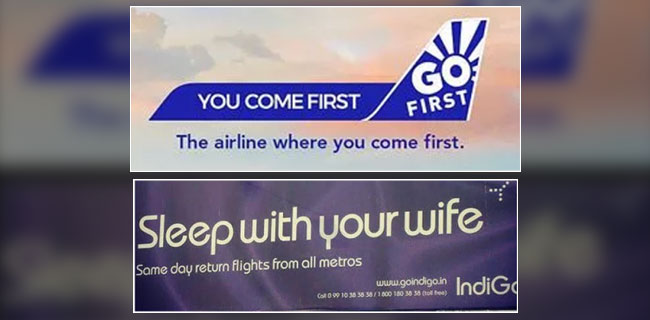
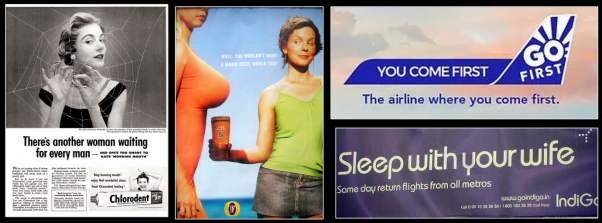
Blame Eularie Saldanha in Campaign India for triggering this article. It questioned if the brands would come on board platforms dedicated to porn? In the current era of targeted marketing, reaching larger audiences, breaking taboos and being woke overall, how ironic is it for mediums with such potential to be avoided by brands for advertising? I am not getting there, but many brands have been using creative clearly and cleverly full of double meaning. Creativity is used in the quest for attention-grabbing, shocking, and otherwise culturally misfit communication.
Pornographic sites may be one of the largest visited sites, but mostly, the audience wants to remain anonymous. The article also suggests that brands avoid pornographic mediums as they believe it would/can contravene the law. However, brands are open to cleverly including titillating objectifying messages to defend them as non-objectionable and straightforward.
Yes, yes, they, in that case, are not breaking any law. However, it is still not safe and can lead to controversies and negative brand impact. On the other side, it can help build up an immediate reaction, a totally anticipated buzz and controllable earned media.
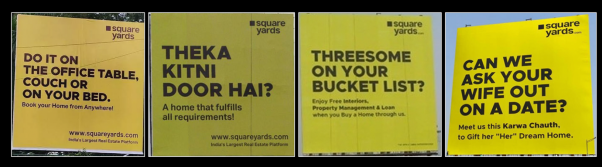
Recently the real estate platform plastered the city with hoardings where the double-meaning was the strategy for attention-seeking. And most people may today see nothing wrong with this advertising, and at least they have not broken any law. The brand, in such cases, has taken a strategic open-eyed conscious decision to use the medium in the way they have- including the predominant yellow background. However, they have cleverly missed simple thoughts along with some provocative communication. Today in 2022, the campaign is seen as Traffic Halting humour! And is also called out for Vulgarity. So clearly, some love it, and some hate it.
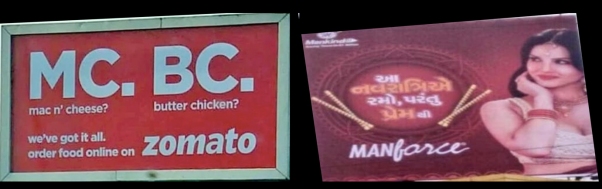
Zomato, in 2017, did the debated and discredited MC BC campaign. Here the descriptors were the protection. Did it make Zomato a less favoured app? The answer would be a straight NO. Were they right in doing the campaign? Don’t know- but they were within their rights to do so. It was not something that was against prevailing ASCI guidelines. Was it a case of Dirt lies in the eyes of the thinker– the audience who read the campaign differently?
Sometimes it is all about relevance and the timing of the campaign. As we evolve and more openness creeps into society, the subject matter of such campaigns may not be called out for their content, hopefully losing the shock value. The operating world is Hopefully.
Double meaning campaigns may be as old as the advertising itself. Sometimes they seem witty and humorous, and often crossing the edge, they are deemed hugely offensive. It is always a tight rope walk for the brand.
In India, we had campaigns like – LUX innerwear- Andar Ki Baath ai, Amul Macho- Toying hai, Teda hai par mera hai, Aquawhite- Roz Raat ko kartey ho, ZATAK and many more. Earlier, this was primarily restricted to Condoms, Perfumes, Deodrants and innerwear.
In the Campaign India article, Ashish Khazanchi, managing partner, Enormous Brand, speaks on porn sites as advertising media. It is also true for the double meaning campaigns. He says: “One would have to do it in a manner that is really clever and makes the audiences like the brand for its smartness. The potential for cringe remains huge, so the communication better is genuinely witty.”
Defining clearly smart and genuinely witty will always be subjective and open to debate. Every brand has to find its own coordinates for what will be permissible, legally unchallenged and ethically- culturally correct. While doing so, they should check it on the SMEAR index and be ready with an honourable escape. Zomato did it with their campaign– so did brand ManKind Pharma during Navratri– even when there was complete data-based strategic support.
The question still remains: who decides these edges and social acceptance. And is it right to throttle creativity by people hungry for media attention? The double meaning is also one of the ways of being witty and creative!
I waded into a discussion today about staging IPL with the virus raging all round us. I may sound too simplistic but with all the doom and gloom news which we all are exposed to, much of it at a personal level too, the IPL is a much required distraction and a break. Just like the football leagues have been in Europe during the second wave. And besides the matches one also gets to watch many new old fashioned ads. So, I decided to base my re-view today on the ads which have in some way entertained us. Not just made us smile but also involved and wanting to actually re-view it. (Now you understand why I have been writing review with a hyphen!).
The first such ads that come to my mind is the Phone pe series of ads. They are short, sharp and highlighting the many generic benefits of UPI payment. Sure, the benefits are generic but these ads are appropriating the benefits for Phone Pe with delightful vivid demonstrations, without the need for any audio. And the one ad which did use some dialogue was done very smartly with the play on the word scan. My personal favourite though was the one with the two Bengali women angling for that one last Sandesh. For once, my choice was backed by my Gen Z sample.
Finolex pipes. Not really a consumer product but I think they have done an entertaining job with Sehwag in the series of ads. And a very bold twist to the narrative has been added with the thought of “Jo cheez chalti rahti hain woh kahan yaad rahti hai.” What an interesting twist to long-lasting. Though what my Gen Z sample loved was the product shot at the end. Pipes and fittings in the form of a throne on which Sehwag is sitting for the sign off. A real nice touch, indeed for a boring simplistic looking product.
I did speak about the MPL ad in one of my reviews earlier. I think they have done a good job of taking Hindi proverbs regarding brain and then using these to explain how one can use the MPL ad without too much of brain power, read thinking. Another reason I found these entertaining was because they take a diametrically opposite stance to Dream 11, specially the Dhoni ads which urges people not to use brains for excuses, lying etc but to use it to make the Dream 11 fantasy teams.
Incidentally, I do have a question for MPL. What about the comprehension of these ads in south Indian languages? Do they have similar language idioms? Dear readers, any suggestions?
The Groww ads were intriguing. The whole concept of giving up something close, like your child or a product one developed for nothing is thought provoking. But the link with the product was a bit weak. But hey, this re-view is about entertaining ads. Not necessarily effective. But you know why my Gen Z sample loved it. The line. Invest kar. Kuhud grow kar. Not karo. The irreverence of the line was entertaining for her.
The Gulabjamun wale uncle ads of Swiggy were also entertaining. The guy has become a brand symbol or mnemonic for Swiggy and his losing his own identity is a nice twist.
Sadly, I found not many other entertaining ads. No, I do not find Cred entertaining. Except for Dravid, which was more of a surprise and shock than entertain, the rest have no entertainment or even relevance factor for me. And that Zumba ad was a joke, right?
But there is hope. We haven’t yet hit the halfway point also and I just get a feeling that some entertaining ads are on the way. Keep reading this column for some more.
Leading potato chip brand Lay’s has launched a campaign to express gratitude towards the unsung heroes of India who have brought joy to millions even in these challenging times. Titled #HEARTWORK, the brand got partners across industry like Flipkart, Zomato, Dunzo, Swiggy and Whisper to join it in paying tribute.
Expressing his thoughts, Dilen Gandhi, Senior Director and Category Head – Foods, PepsiCo India said: “At the beginning of this month, we launched a campaign – #Heartwork to thank farmers, truck drivers, retailers, and many more unsung heroes who have brought joy to millions. Maintaining the chain of gratitude, we reached out to leading companies and brands such as Flipkart, Tide, Vistara, Kia and Cadbury and many more, with a customised virtual pack to express our gratitude for their #Heartwork. At the time when consumers couldn’t step out, the unsung heroes played an essential role in providing products & services every day across the country. Their tireless hard work is indeed Heartwork. We hope this will inspire many more brands join this journey and appreciate these unseen heroes.”
Depicting instances of cravings from everyday life, Zomato’s latest TVC ‘Mat kar Ichha control, Zomato khol’ urges users to take advantage of its app and fulfill the food cravings that they needn’t shut out.
Said Sandeep Anand, Chief Marketing Officer, Food Delivery, Zomato: “Most customers feel an internal tussle when they crave to order outside food. This tussle is mostly around social conditioning where they feel that giving into their craving depicts a lack of self-control. Through this TVC, we attempt to encourage users to live larger than life and give into their cravings, guilt-free.”
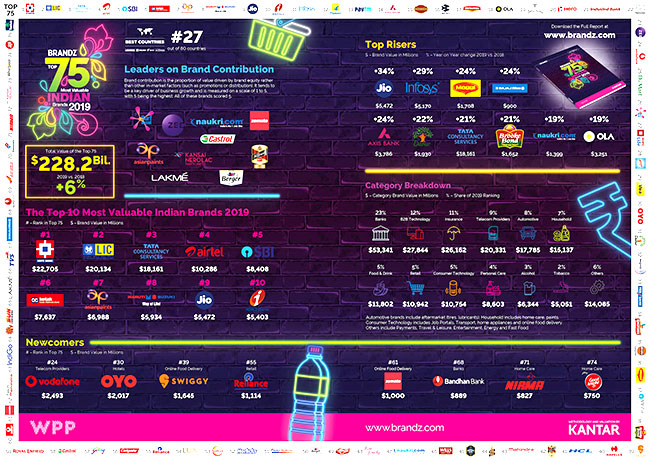
The BrandZ study, which is the only brand valuation ranking to combine companies’ financial data with consumer insight and opinion, shows that trust is key to develop the stability required for long-term success; highly trusted brands in the Top 75 are worth 129% more than less trusted ones.
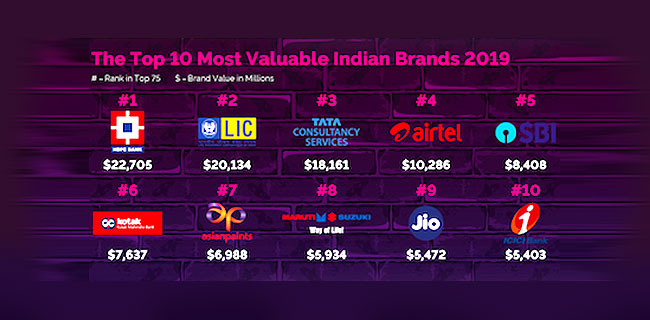
BrandZ Top 10 Most Valuable Indian Brands 2019
Rank 2019
Brand
Category
Brand Value 2019 ($M USD)
Brand Value Change
1
HDFC Bank
Banks
22,705
+5%
2
LIC
Insurance
20,134
+2%
3
Tata Consultancy Services
Technology
18,161
+21%
4
Airtel
Telecom providers
10,286
-10%
5
State Bank of India
Banks
8,408
+7%
6
Kotak Mahindra Bank
Banks
7,637
+15%
7
Asian Paints
Paints
6,988
+14%
8
Maruti Suzuki
Automobiles
5,934
-14%
9
Jio
Telecom providers
5,472
+34%
10
ICICI Bank
Banks
5,403
+11%
Notable brands include ecommerce site Flipkart (No. 12), which increased its brand value 14% to $4.7 billion, while unicorn brands hotel booking site Oyo ($2.0 billion), online food ordering service Swiggy ($1.6 billion) and online restaurant marketplace Zomato ($1.0 billion) are newcomers to the ranking at No. 30, No. 39 and No. 61 respectively.
The fastest riser in the 2019 ranking is telecom provider, Jio, which climbed one place to No. 9 with a 34% increase in brand value to $5.5 billion. Its disruptive business model has made internet access available to many Indians who were previously unable to afford it, thereby opening up access to digital platforms and services. Vodafone ($2.5 billion) meanwhile was the top-ranked newcomer at No. 24.
Both digital and offline brands such as D-Mart (No. 25, $2.4 billion) have found success as a result of the rise of ‘middle India’; the growing number of people in the country’s second, third and fourth-tier cities and towns that are changing India’s traditional urban-rural divide. These previously poorly-served segments increasingly have access to a variety of online services, with Swiggy and Zomato building much of their growth on this shift.
Said David Roth, CEO of The Store WPP EMEA and Asia and Chairman of BrandZ: “As India flexes its muscles on the world stage, it faces increased macroeconomic headwinds which have combined with a rise in global trade tensions to create a challenging environment. Successful Indian brands are adapting to these challenges and recognising that longevity requires them to do more than just disrupt the status quo; long-term brand building requires new strategies that major on stability.”
Added Preeti Reddy, CEO South Asia, Insights Division, Kantar: “Consumer trust is a common thread among successful brands. However, it is concerning that only a few have succeeded in growing trust over the last five years. Those who done so, have done it through open and honest conversations with their customers. Brands would do well to consciously work at building consumer trust – it is the shield that gives a brand the resilience to face headwinds in uncertain times.”
Said Vishikh Talwar, Chief Client Officer, Kantar Insights Division: “The rise of ‘middle India’ combined with rapid growth of the mobile internet is providing unprecedented opportunities for brands. But, with an almost overwhelming choice of products and services to buy, consumers are increasingly discerning; the Indian psyche requires that brands cater for local needs with offerings that genuinely improve daily life. Today that’s as much about providing comfort and reliability as it is about generating new experiences.”
Key trends highlighted in the BrandZ Indian Top 75 study include:
:: Mobile internet access:Smartphone user numbers in India increased by 18% in 2018 (the fastest rate of growth in the world), mainly due to a combination of Jio’s own low tariffs and the renewed competition causing other telecom providers to reduce their rates.
:: Buying power:Retail is the second fastest growing category, with online and offline both growing strongly. New entrant Reliance Retail (No. 55, $1.1 billion) opened nearly 500 new stores and used Jio’s service to connect retail shops with grocery deliveries, while D-Mart ($2.4 billion) focused predominantly on offline, rising two places to No. 25.
:: The Amazon effect: Amazon and Flipkart compete with many Indian brands across several sectors, with Amazon also opening its largest campus yet in India. This has increased competition and driven brands to step up their operations to ensure they are meeting customers’ needs.
:: A confident country: The success of unicorn brands such as Swiggy, Zomato and Oyo is fostering a new-found confidence in India. This is augmented with the increasingly global outlook of these new brands as they actively seek to expand their operations outside India.

 A very interesting article popped into my inbox this morning. It spoke about the role of product managers in consumer-facing tech companies. The article was triggered because Zomato had placed a live order count which a consumer can see after s/he places an order. You can see it here.