By Ritu Midha
Though there have been, and are other social networking sites, none match Facebook – whose growth has been phenomenal – in terms of usage and the buzz around it. Brands, keen to be where their target audience is, seek it out and in spite of issues like low internet penetration, power cuts and low literacy levels, social media and more specifically Facebook is seeing exponential growth in India.
A study by Experian India released in September 2011 indicates that Facebook, YouTube and Orkut are the top three social networking websites in the country.
As per the study, search engines continue to be number one in terms of visit share in the month of August 2011 with 17.25 percent visit share, while social networking and forums are at number two with 13.99 percent.
The study also indicates that social networking sites are amongst the top three sources of traffic for these industry categories: Automotive, Community, Computers & Internet, Education, Entertainment, Food & Beverages, Health & Medical, Lifestyle, Music, News & Media, Shopping & Classifieds, Sports and Travel.
When it comes to specific social media sites Facebook is at number one with a 52.47 percent visits share, while YouTube is a distant second with 20.34 percent share (July 2011). And when one looks at percentage change this August vis-a-vis August 2010, Facebook has seen a whopping 88.46 percent growth from 27.85 percent to 52.49 percent.
And as per a global Cisco study, within certain countries, including India, updating Facebook was ranked as the highest priority, even more than hanging out with friends. Of all the countries surveyed in the study India ranked highest in the frequency of Facebook interaction, with 92 percent of students and 98 percent of employees checking it daily.
Facebook, thus, has arrived in India, and if the growth rate is any indication it is not a storm in the frying pan. However, one wonders if Indian brands have really begun to value the impact of social media, or is being on social media just a feel-good factor for them? Says Mr Ashok Lalla, President – Digital, Euro RSCG, “There certainly is a lot of enthusiasm among Indian brands to get onto the social media bandwagon. Unfortunately, most get on thinking that a fan page, or an app or a Twitter handle is all that it takes to crack the social media code. However, we are also seeing some brands take a more mature view of social media, and these also better integrate social marketing with the rest of the marketing and communications mix.â€
Mr Alok Kejriwal, CEO and Co-Founder, Games2win, too agrees that brands are at different stages of evolution as far as social media goes. He remarked, “Some of them use social media well, some of them are learning and some of them are completely ignorant. The brands who get it are those who have young CEOs and managers rather than the ‘Silver Foxes’ who run the companies that run the brands who live on the dark side of the moon. Think Vodafone vs Air India.â€
Talking specifically of Facebook, where most of the consumer action is at the moment, while a few brands are working on specific Facebook strategies, others just want to fit it in. Mr Lalla said, “I’m not sure if brands have reworked their overall communication strategies, but they certainly have recast and extended them to include social media. Facebook clearly is the first and most popular part of most social media plans. That’s not surprising, since it’s got the largest number of social media-active people in India.â€
Interestingly, one notices that brands look at gaining as many ‘likes’ as possible – a ‘like’ on a page can get a fan Rs 1,000 off on a luxury cosmetics brand – while a few others believe that the ultimate is to make the customers win a contest, and give away an expensive handset. These mostly work as tactics for the moment. As soon as the contests and discounts are over – so is the people’s interest in that specific page.
What, then, would be an ideal Facebook strategy for a brand? Kejriwal explains, “Listening and not marketing. Brands and their decision-makers need to listen to the whispers on social media – their ears should be on the railway tracks picking up tremors and the train before it arrives in their face. Facebook is a reactive and conversational media for brands rather than a pro-active and defensive media.â€
It effectively means that ‘likes’ are not a good enough benchmark for a brand page on Facebook. Mr Kejriwal declared, “No way! Likes are silly. It’s like saying that the number of units sold of a sachet is the sign of the success of a brand! Less Is More on Facebook for a brand. The quality of conversation – not the quantity – is important.â€
“The real impact comes when brands look at ‘Life beyond the Like’. And focus on identifying and nurturing the ‘fans’ that have real brand love, and the potential to turn into brand advocates,†added Mr Lalla.
Social media, and more specifically Facebook, opens doors for two-way communication between the brand and its audiences – and it is that conversation that brings the biggest value to a brand. Mr Lalla elucidates, “Today a brand is no longer about what marketers tell consumers it is, but it is what consumers tell other consumers it is. In this context, it makes immense sense for a brand to be receptive and responsive to its audience. That’s where a two-way communication (conversation) helps.â€
It is largely youth brands looking at a presence of Facebook – an effect of the perception that it is largely young and happening who spend time of Facebook. However as per Mr Lalla, the fastest growing demographic on Facebook worldwide is the over-50s. So, used right, social marketing via Facebook can make a difference for more than just youth brands. Brands, perhaps, are waiting, to witness a few big success stories before taking Facebook more seriously. In times to come it will become even more intrinsic to marketing, and brands will gradually learn to appreciate the influence it can create on their audiences.
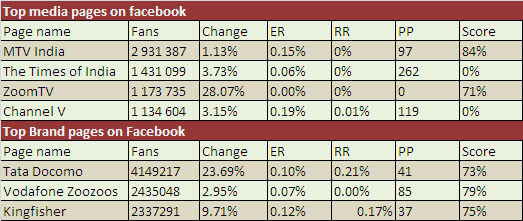
| ER = Engagement Rate, average number of total interactions to the pages posts divided by the number of fans in the last 30 days |
| RR = Response Rate, the pages response rate to the user questions posted on the wall in the last 30 days |
| PP = Page Posts, the number of the posts by the page in the last 30 days |
| Score = The score of the Facebook page, a Socialbakers only metric that we create out of 30 different parameters |
Source:
http://www.socialbakers.com/facebook-pages/brands/india/
http://www.socialbakers.com/facebook-pages/media/india/

 By Anil Thakraney