Tag: World Disability Day

  • World Disability Day: Is it time to question the country’s readiness on disability-friendly policies?


    By Shruti Pushkarna


    Shruti PushkarnaTwo years ago, on December 3, I wrote my first column with the intent of initiating a dialogue on ‘disability’. Why did I feel the need to do so? Primarily because disability or the needs of the disabled population have never been part of our mainstream agenda. Raising awareness, I thought, would be the first logical step towards reducing the ignorance levels.


    Second, the conversations on disability in the media focused on romanticised tales of role models, generating sympathy from the audience or worse, making them feel thankful for their able-bodied existence vis-à-vis someone who was paying off his or her karmic debt.


    I don’t know if my attempts at reinforcing the need to normalise disability, shifting the focus on abilities, and accepting the differences, has altered any mindsets. But if I have been able to make you pause and think even for a moment, I feel accomplished.


    And on the eve of International Day of Persons with Disabilities (IDPD), I renew my vow to keep at it. Keep advocating for an ‘inclusive’ world for all. Not only because it’s the right thing to do, and everyone deserves a chance to live independently with dignity. But also, because including 15 per cent of the global population will change the majority’s perspective towards life and situations.


    If you are wondering ‘how so’, believe you me, that’s been my biggest personal lesson. Disability is a condition that a person is either born with or acquires later in life. It’s a condition that results in limiting the person in some ways. The limitations, however, are a result of barriers in the physical (and virtual) environment as well as behavioural blockades.


    Learning to respect the differences stems from concentrating on the potential of people without fixating on what doesn’t ‘seem’ possible to us. For this to happen, ‘accessibility’ has to become a priority. Once persons with disabilities start participating and interacting with the mainstream, the walls in our heads will slowly start coming down.


    Let me break this down a bit. I worked as a television news producer some years ago. If I were to take up that job again, I can easily see a blind person scripting or voicing the show. I can also picture a speech impaired production assistant accompanying the crew on shoots, maintaining logs, holding up cue cards etc. A person with locomotor disability can very well be the go-to guy (or gal) for topical research.


    This is just one possible scenario emanating from my ‘limited’ understanding. Imagine the possibilities.


    If we can work on removing the obstacles and introducing solutions that enable persons with disabilities not only to enter or exit a space, but perform all the functions that are essential to that scenario, this column will become redundant.


    Why? Because first-hand interactions and experiences are the most effective ways to ‘sensitize’.


    Before you write me off as pedantic, here are some examples which reiterate the gaps in inclusion and speak of our (read society/government/corporates/policy-makers/media) indifference towards the disabled community.


    1. It’s 2021. And the Rights of Persons with Disabilities Act 2016 recognizes 21 types of disabilities. But our accessibility definition starts and ends with a wheelchair. So much so, that we force blind, deaf or speech impaired people into a wheelchair despite their ability to use their legs!

    2. Even wheelchair access is not implemented fully on the ground. Many places don’t have wheelchairs. If you bring one of your own, good luck pushing it through the narrow doors of rooms, toilets, shops, restaurants etc. And then there’s the ramps. You are sure to exercise your forearms pushing the wheelchair up and down the inconsistent and steep inclines.

    3. Where are the statistics on the disabled population? Forget gender, children, state or disability specific data, the latest count we have is from Census 2011 which is far from accurate. If we don’t know how many need access to services and spaces and in which geographies, what is the likelihood of catering to their needs?

    4. The United Nations theme for IDPD 2021 is “Leadership and participation of persons with disabilities toward an inclusive, accessible and sustainable post-Covid-19 world.” After the pandemic, a majority of our social and professional activities have moved online. But digital platforms including websites and mobile applications are not fully accessible to persons with disabilities. December 31stis the deadline for filing income tax returns and the government’s official portal is ridden with virtual barriers. Digital wallets, the new norm of post-demonetisation and socially distanced world, remain inaccessible.

    5.The UN Sustainable Development Goal 11 is to make cities inclusive, safe, resilient and sustainable. Yet we are building parks, cinema halls, shopping plazas and holiday resorts discarding the principles of universal design.


    Although some media reports and surveys might suggest that we don’t score too badly on the global index, is India really a disabled-friendly country? Can the media step away from tokenism on December 3 and really ask some tough questions on whether our country adheres to the ‘Leave No One Behind’ philosophy?


    Shruti Pushkarna is a former journalist who now works as a programmes and media specialist for the inclusion of persons with disabilities. Shruti writes for MxMIndia every other Thursday. Her views here are personal. She can be reached via Twitter at @shrutipushkarna


  • Shruti Pushkarna | World Disability Day: What will it take to change the status quo?

    Shruti PushkarnaBy Shruti Pushkarna


    As I write this piece, I’m experiencing a mixed set of emotions. I’m thrilled because I have managed to nearly complete a year of this column on ‘Media and Disability’. At the same time I’m sort of disillusioned, thinking if this fortnightly exercise has made any real difference for persons with disabilities. I’m saddened because the media or the society doesn’t much care about vulnerable groups and their respective challenges. But more than anything I’m angry.


    Change is not easy to come. I’m aware. But I’m angry at how little has changed in the past several years in this age of information boom and 24X7 news. Also despite the new empowering laws and policies that gave us hope of better times to come.


    As a society we haven’t even gone beyond thinking of disability as a karmic fallout. Seriously, what is wrong with us? Typecasting aside, we look at persons with disabilities as lesser mortals who deserve to be where they are. Religious leaders, spiritual gurus, even parents of disabled children and the masses believe and propagate so. The media only goes a tiny step further embellishing them with either a heroic or pitiful portrayal.


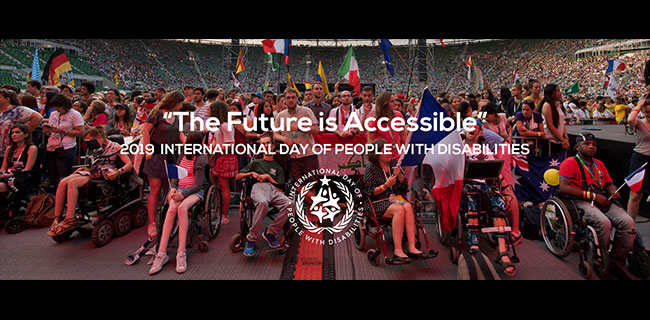
    Across the globe, December 3 is observed as the International Day of Persons with Disabilities. This year, the focus is on spreading awareness about not only the obviously visible disabilities but also the less apparent ones, with the hope to build a more inclusive world. There is a special emphasis on creating a sustainable and accessible post-Covid environment for everyone.


    Here in India, it feels like a distant dream. Last year this day, I wrote on ‘What Media Must Do’ vis-à-vis not leaving the disabled out of the mainstream discourse’. Maybe I should recycle the same commentary, as it seems to have fallen on deaf ears. Through the year, I have raised several pertinent issues pertaining to different types of disabilities, the difficulties faced by them in spaces of work, education, entertainment and the apathy that seeps through the cultural fabric of our country.


    The frustration that all of us faced after being locked down for a few months due to the spread of Covid-19 comes nowhere close to what disabled people go through every single day, living on the periphery, discarded by the mainstream, excluded by their community, denied the opportunity to exercise their abilities.


    Let’s face it. It’s a thoroughly unequal, unjust and imbalanced state of affairs. Strange parallel coexistence of those who binge-watch ‘Fabulous Lives of Bollywood Wives’ and people who are refused mere 35kg of ration despite the Delhi High Court orders for the disabled to be included under the National Food Security Act.


    Not only are people unaware of each other’s alternate realities, our media coverage is even more lopsided. For a very long time, I believed that the media had the responsibility and obligation of operating in public interest. As a former journalist, I swore by it. But today everything is about ratings, demographics, market share and monies.


    It’s all about the content that sells. And the content that sells hardly costs anything to produce. So why invest money in investigating and reporting real issues and accounts when the objective is to run a profit division? Instead of giving a voice to the weak and ignored sections of the population, the media is feeding our guilty pleasures and morbid fascinations.


    Covid-19 has changed a great deal in terms of how we work, educate our children, or engage with friends and family. Apart from all the perils, we have discovered new ways of functioning. From a disability perspective, the gap that existed especially in education and employment has somewhat been bridged. Due to innovations in technology, disabled people are empowered to study and work alongside able-bodied peers in the comfort of their homes. The virtual mode of operation has removed the physical barriers, opening doors for inclusion.


    Most Disability Advocates believe we have made more progress in the last 10 months than in the past decade. While this is a promising opportunity created by the pandemic, the ableist world has to take note and build accessible products and infrastructure.


    It again comes down to awareness and the will to include. We are crippled by our individual attitudinal disability, which dissuades us from acknowledging the needs of another. The truth is we like to be ignorant. We prefer being so because it’s easy. As long as it doesn’t affect us, it’s not worth talking about. Our content consumption habits and social media patterns reflect the narcissistic bubbles we exist in.


    The country needs to be pulled out of eternal slumber. We need to get angry at the status quo, at the injustice, at the skewed coverage of issues. I’m reminded of the famous speech from the1976 movie Network where Howard Beale (Peter Finch) says: “I’m mad as hell and I’m not going to take this any more. I want you to get up right now. Sit up. Go to your windows. Open them and stick your head out and yell.”


    The question is whether the country will join in. Can the media lead the citizens in a rallying cry for change?


    Shruti Pushkarna heads operations of the New Delhi-based Score Foundation where she works as Director-Programmes & Communications. She is a former journalist (part of the founding team of MxMIndia) who has moved full-time to the social sector. Shruti writes for MxMIndia every other Thursday. Her views here are personal. She can be reached via Twitter at @shrutipushkarna


  • Das ka Dum with Dr Bhaskar Das: Do you think the Indian media doesn’t project disability appropriately? Would it help if all media organisations hire Persons with Disabilities so that they get upclose with their concerns?

    It’s World Disability Day and we thought it was appropriate to ask a question around that as part of Das Ka Dum with Dr Bhaskar Das. Read on…
     

    If you wish to access the archives, please go to the Das Ka Dum tab on the website’s top navigation bar.


    Q. This isn’t one of those questions we ask you as part of this series… it’s not provocative. Today (December 3) is World Disability Day. The unfortunate fact is that disability can afflict anyone – even those born able. Do you think the Indian media doesn’t project disability appropriately? Or do you think it’s not the media’s role to go out of the way to track issues that the disabled face. Would you say it will help if all media organisations hire Persons with Disabilities so that they get up-close with their concerns?


    A. First disability isn’t socially and empathetically the right word. I feel differentially abled is more respectful for them. They don’t need sympathy. They need encouragement. And for that I agree to what you suggested. But that is not enough. As a country we are not sensitive enough to acknowledge and handle the challenge of the differentially abled community. The support system is also lacking. There are some organisations who have been doing seminal work in this space but that is hardly enough.


    Yes, the media in general does not play an activist role in this case to facilitate/ force a transformation. Hence individuals quite often  play a more active role than media organisations or corporates. Every organisation, media or non-media, has to play a more active and conscientious role in this area than at present.

  • World Disability Day Special | Shanta Saikia: Look me in the eye, I am not going to be easily dismissed

    By Shanta Saikia


    “All vitals are stable” – the four words that gave me strength and much needed assurance in the most trying time of my life. The words were uttered by the neurosurgeon at the GTB Hospital in Delhi, where I was rushed after being crushed under a DTC bus on a chilly day on March 12, 2007.


    Over the years, the pain has faded, what remains in my memory is the tremendous support I received from all quarters – my family, friends, neighbours, bosses, colleagues, strangers who walked into Gangaram Hospital to donate blood for me, and above all, the untiring efforts of the doctors and nurses.


    Back home after spending two months confined to a 3.5 ft x 6.5 ft hospital bed, that’s when the reality hit me – I am a disabled person (my certificate says 80% permanent disability), minus my right leg. A momentary lack of attention by a bus driver cost me my mobility forever.


    Looking back today, I can be matter-of-fact about it, but at that time all I knew was to take one day at a time. Undergo painful physical therapy sessions daily. But the most painful part was watching the helplessness in my mother’s eyes as she bore witness to her beloved daughter struggling with very basic things – learning to sit on the bed without support (lying on bed for two months had resulted in back muscle atrophy), learning to use the toilet again, learning to stand on my one remaining leg again. Walking again.


    Well, getting on to a wheelchair was a big success at that time; and after several bumps into the furniture and chipping the cement off the corners of my flat, I became a skilful navigator of the wheelchair and I would be out of home practically every weekend. The world outside the secured and comfortable confines of my home posed several challenges – most notably accessibility. Unfortunately, accessibility still remains a problem today in a world full of stairs, ill-constructed ramps and roads that are anything but smooth as Hema Malini’s cheeks!


    Using a prosthetic leg made accessibility much easier for me, still India remains inaccessible to a large percentage of its population who are termed – Divyang. That really is the dampner, not the spirit or lack of will or effort on the part of the person with disability. I could graduate to a prosthetic leg, but a large section of the population makes do with improvisation and sheer will power. Cost of a good quality prosthetic device costs as much as a hatchback, if not more. How many can afford it?


    One bright spark in all this for me has been digital media. I was working for exchange4media.com at the time of my accident. My boss Dr Anurag Batra went out of his way to support me and helped me with my hospital bills. Digital media allowed me to work from home. I continue to work from home even today. The industry really needs to relook at the work pattern – allowing employees to work remotely could be a new reality and allow several talented people a more flexible workplace and be more committed, with the pain of daily commuting taken out of the equation. Sure there are challenges, but nothing that is insurmountable.


    I had decided right at the outset that I wouldn’t confine myself at home following my accident. Whenever I got out, I am met with stares, some people hesitatingly ask me, ‘Kya hua tha?’ Some offer to help me. But what annoys me most is the patronising attitude of a lot of people. Still, you learn to accept them as part of life now. Do we have an option? Yet, I go out every chance I get; guess I want to force people to acknowledge that people with disability are not to be a hidden population, because we make you guys uncomfortable, because you don’t know what to make of us. Look me in the eye, I am not going to be easily dismissed. I am currently fighting to save my paternal property in Assam from a neighbour who wants to usurp part of the property. They thought I am a single, disabled woman, so they can get away with it. They ain’t know nothing yet!


    Learning to walk again

    I believe I’ve waited long enough

    Where do I begin?…

    Set me free, again

    To keep alive, a moment at a time

    That’s still inside, a whisper to a riot

    The sacrifice, the knowing to survive


    – Foo Fighters


    Shanta Saikia is an army kid and proud of it. Thanks to her father’s various postings, she got to see the real India – up, close and personal. Her love for travelling has not been curtailed due to her limited mobility. A journalist for 25 years, she started her career with the now-discontinued A&M magazine, and as she says, “it was love at first sight for advertising for her.” Shanta Saikia is working since 2016 as Editor, Adgully, a leading advertising and marketing sector publication.


  • Disability: What Must Our Media Do


    By Shruti Pushkarna


    Shruti PushkarnaBefore I started writing this piece, I casually googled  ‘media and disability’. Interestingly, most results were pertaining to the role of the media, portrayal of disability, some academic papers on the subject and so on. Well, that’s typically what comes to mind when you throw these two words together at anyone.


    Having crossed over to the disability sector from journalism, I have witnessed several debates (both in official and informal settings) where disability experts, people with acquired disability, scholars and mediapersons battle with each other, presenting their views on the subject.


    Again, most debates are focused on ‘representation’. I find the premise of all such discussions fallacious. Our debates, writings, films, stories, all are from an ‘external’ standpoint. It’s always from ‘how I understand it’, or ‘how I perceive it’ or ‘what I have gathered from my research’. And that’s why any coverage or any engagement with disability in the media is at the surface level. Still.


    This is part of the reason why stories and accounts are either heroic or pitiful. What I see lacking is the ‘normalisation’ of the idea. We like to compartmentalise issues and people into boxes that are easier to handle. Look at them a certain way rather than making them a part of the overall landscape of things.


    In the process, someone else decides what is the issue, how does it impact a life and how it should be tackled. The understanding of it, once or twice removed.


    As a communications specialist, I recognise the influencing power of the media and the fraternity. Common notions of disability arise from our media exposure. The images and words that come to mind are ‘wheel chair’, ‘crippled’, ‘handicap’, ‘dependent’, ‘incapacitated’, ‘vegetable’ etc. Clearly, these are neither complete nor correct.


    Let’s try to break this down. ‘Disability’ is basically a condition that ‘limits’ a person. This condition could be mental or physical, it could be permanent or temporary. It could be a condition present from birth or acquired later in life. But it’s a ‘condition’. A person with disability is a person with certain limitations, but still a ‘person’. That’s what we often miss out on. We tend to focus on the disability so much that we seldom learn anything about the person. The person may be educated or a school dropout, interested in adventure sports or music, may be a foodie, or a movie buff.


    How often do you see a person with disability invited to a public forum to present views on anything other than disability issues? What about the regular issues that affect citizens of this country, like infrastructure, climate change, taxes, education, unemployment or inflation?  Do these not equally affect this section of society? Or are we assuming that disabled people don’t access any services, like you and I do.


    According to Census 2011, 2.2 per cent of India’s (then) 121 crore population is disabled. And these are government statistics, way less than the actual numbers. There is a legislation called the Rights of Persons with Disabilities Act (RPWD) 2016 that lists out 21 types of disabilities. The RPWD Act mandates equal access to all facilities and services to persons with disabilities. The Act is progressive in its view of shifting the focus from ‘reservations and entitlements’ to ‘empowerment and inclusion’.


    A policy can be enforced and implemented. But for it to become a ‘practice’, mindsets have to be altered. That’s what media can help with.


    Attitudes can often be more disabling rather than the actual barriers in access. I have worn spectacles since Class 2 or 3, I don’t even remember. My inability to see without glasses is also a ‘disability’. But spectacles can cover up for my impairment. Kids in my school use to single me out and poke fun at my thick glasses but with time, it changed. Slowly, with more people dependent on correctional lenses, it became ‘normal’ (it’s a full-blown market today!).


    It’s what we see and how much of it we see. If today in schools and workplaces, we start encountering persons with vision impairment, speech impairment, or any other disability, that will gradually become the new normal.


    Certain sectors like IT, hospitality and education have started employing persons with disabilities. Their limitations are easily addressed with small changes in the physical or digital environment. This has helped businesses understand the needs of the larger disabled population better. The media should also consider hiring them, so the ‘normalisation’ of disability can happen from within.


    This will change how people respond to ‘disability’. The element of shock or awe will slowly be replaced by a more pragmatic approach.


    Today, when I go to a movie theatre, I’m happy to see seats reserved for people in wheelchairs. But the access to the cinema still remains an issue. On several occasions, I have seen wheelchair-bound people being physically lifted by four staff members to get  them to a seat just so they can access mainstream entertainment.


    If it were easily ‘accessible’, more people in wheelchairs would be seen at the movies. Last year, I attended a special screening of the film ‘Sanju’ at PVR Cinemas in Delhi, for blind and visually impaired people. Wondering how blind people can see a movie? Well, they do. Often accompanied by sighted people who can help them follow the missing links in the absence of dialogues. Technology has reduced that dependence too. An app called XL Cinema, free to download on an Android phone, can enable a blind person to follow ‘audio description’ of the movie alongside the actual screening.


    There is the issue of access and then the issue of dignity. The industry needs to address both. And that will happen when we deal with them as ‘people’ and not as a mere ‘section with special needs’.


    According to Census 2011, there are around 104 million people aged 60 years or above. This group of people may also fall into the bracket of ‘people with special needs’. Similarly, with a sizeable percentage of disabilities caused by road accidents, India’s overall disabled population is constantly on the rise. We cannot ignore or outcast them.


    Often our imagination is curtailed because of their lack of participation in mainstream activities and spaces. Their absence leads to a confined view, further forcing them to live on the peripheries.


    This year, the theme of the International Day of Persons with Disabilities is to promote their participation in the development agenda. The UN-defined Agenda 2030 for Sustainable Development pledges on ‘leaving no one behind’. The media needs to look at ‘disability’ as a cross-cutting issue and promote inclusion in every sphere.


    Shruti Pushkarna is a former journalist (part of the founding team of MxMIndia). who has now moved full-time to the social sector. She heads operations of the New Delhi-based Score Foundation where she works as Director. Her views here are personal. She can be reached via Twitter at @shrutipushkarna