With apologies to none at all
 By Vikas Mehta
Things moved fast last week. On Thursday, February 1, Union finance minister, Nirmala Sitharaman, announced in her interim budget speech that the centre is proposing a plan to encourage use of vaccine for preventing cervical cancer amongst girls 9-14 years of age. Cervical cancer is the second-most common cancer in India and almost a fourth of global cervical cancer deaths happen in India. No details of the government scheme were forthcoming but the initiative was lauded and welcomed.
The very next day, news came in through her media team that controversial and newsmaker model Poonam Pandey had died at the age of 32 of cervical cancer. For me, it sounded too much of a coincidence but social media was trending with the news and there was much shock reaction too.
Then a day later, Ms Pandey appeared to say that the news of her death due to cervical cancer was part of a campaign to raise awareness of Cervical cancer.
And yesterday was World Cancer Day.
All hell broke loose after Ms Pandey’s disclosure. My social media was full of angry friends and acquaintances. Influencer marketing had hit a new low, said someone. Another mentioned Ms Pandey’s past and said that she is not new to controversies. Her act may be for a noble cause but given her past it could cast a shadow on her intent, opinioned another. Someone mentioned that this marketing stunt had crossed all limits. The editor of this portal lamented the death of journalistic good practices as breaking news was more important than checking it out first.
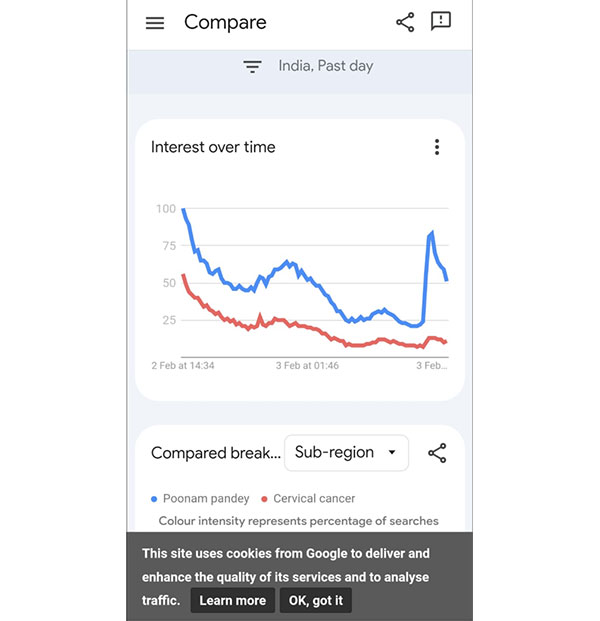
A digital guru tweeted (or should I say Xed) a google analytical graph that demonstrated that search for Ms Pandey had gone up substantially whereas cervical cancer search was languishing.
In the meantime, I had posted about this marketing deed on some groups which are solely populated by GenZ and the reaction I got was exactly opposite.
How clever, said one. Don’t know who she exactly is but she seems to be famous and has used her fame well, chipped in another. Fake news is bad but nothing wrong in using fake news for good was another response I received.
Sensing a generational gap (me, my friends and acquaintances are all over 50) and also a distinct shift in values and ethics, I challenged GenZ with similar comments as listed above by my generation.
What I am narrating below are not my views but as generated by GenZ.
- She didn’t die and willingly gave her name to a cause. What’s wrong in that?
- We see worse fake news which is actually fake. This was not actually fake.
- I did not know about cervical cancer and when my mother shared this news with me (of a celebrity dying so young), I found much more about it.
- She did not kill anyone. She did not hurt anyone. She did not cause a loss or a scam. So how does it matter?
- She may have gained lot of publicity for herself but it has brought cervical cancer in the news too.
- Ethics and morality evolve with times. I am told a few decades ago it was not right for a boy and a girl to meet alone. Today it is accepted.
- My parents want me to get high marks in exams. They don’t bother how. If I cheat and get it, it does not matter. The end result matters. Here too the end result is good.
- What matters is grabbing attention. Nowadays news portals give sensational headlines which are only half true or in some cases not true at all. Or brands send message that my card is waiting despatch when I haven’t even applied for a card. If they can do so to catch attention then what’s wrong in this stunt?
- Journalists anyways are all sold out and have no spine. So why expect them to chase the truth or research well before publishing a news (hear hear Mr. Editor!).
- She seems to be old, but she thinks like us. Maybe I will follow her.
- She should not have done this as it is inauspicious to fake death was a stray comment. But it was latched on to by 2-3 others and attacked. How can one be so old fashioned and traditional was the refrain. Do not believe in such superstitious things. Don’t you wear black?
- I never knew that a form of cancer can be prevented with a vaccine. At least now I am aware.
This last point resonated with me. I have a daughter who is now approaching her twenties and neither me nor my wife had ever heard about the dangers of cervical cancer or its vaccination. As I write this, my wife is talking to our doctor to see if she can be vaccinated.
Now let me add my two bits to this generational gap issue.
I do confess that initially I too was dismayed at this whole issue. In fact, because it was Ms Pandey and the news was released by her team and not family had seemed quite odd. But I could never suspect that someone will fake one’s own death unless it was for some subterfuge. So, my morality, traditional thinking and values were shaken.
But when I heard some of the arguments, I realised that there are worse things happening to be upset by this. And it definitely was for something good. Even though data shows that the cause was a distant second to the influencer at least it had been stirred up. A small technicality too. I don’t think Ms Pandey is an influencer. At best she is a celebrity.
This episode not just highlighted the generation gap but also reinforced a marketing dictum. Your users may be many but identify your target and talk to them. Don’t forget that this initiative was not Ms Pandey’s. It was initiated by the HPV vaccine and they should be lauded for targeting teenagers to get their attention to the dangers of cervical cancer.
It also tells me how sharply segmented we are by demographics. News portals and social media like Facebook which are more frequented by the older generation have been quick to criticise Ms Pandey. Issues more relevant to this older generation like ethics, morality, tradition, good old days etc matter more and that dictates their writings and rants. It becomes a closed circle where nothing else matters or exists.
The GenZ is not too troubled by these attributes. They are more open, not affected by past and more result focused. Some of my generation call GenZ instant gratification generation, but I think that’s unfair. They live in the present because they have no history to dwell upon. And with the rapid technology evolution, history becomes historical rapidly.
Let’s not forget that brands have in the past also used half news or fake news to create sensation and frenzy. As a friend reminded me, Taj Mahal tea ran a PR campaign in the 2000s announcing that Ustad Zakir Hussain, who was the brand endorser, had decided to stop playing tabla. There was lot of frenzy and health speculation until it was revealed that it was a challenge, wherein the Ustad had announced ‘find me a better tea and I will stop playing tabla’.
Wasn’t this also spreading fake news? Distorted news? So how was that acceptable? For, last I heard that became a case study on how to do good PR. How come Ms Poonam’s case was going to an extreme and falling to a new low? Or her past will shadow the noble deed? Or was it just because Poonam Pandey was used and not a “more respected celebrity”.
Come to think of it, this campaign (that’s what I will call it from now, not a stunt) was about shock value but maybe it will also fall into the awe category.

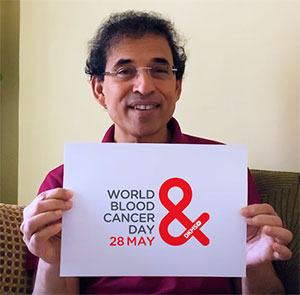 To mark World Blood Cancer Day observed on May 28, DKMS BMST Foundation India, a non-profit organization dedicated to the fight against blood cancer and other blood disorders, launched their digital campaign #WeAreAllWeNeed that calls for Indians to come forward and register as potential blood stem cell donors.