Tag: Wimbledon

  • Between a rock and a hard place!


    By Avik Chattopadhyay

     

    Avik ChattopadhyaySunday, July 11, was quite a tumultuous day in London. While in Wimbledon, Novak Djokovic fought his way to his sixth title on grass, just 8.8 miles away, Wembley was preparing for the Euro 2020 finals between England and Italy.


    Wimbledon was prim and proper, with people enjoying the game seated comfortably at centre court or relaxing on the lawns outside watching on large screens. Everything was very ‘English’ in its casual elegance and sportsmanship was displayed by one and all.


    Wembley was the epicentre of a gathering storm, with people drunk on the streets damaging public property, smashing car and shop windows, uprooting potted plants and dancing on police barriers. Everything was very ‘English’ in its feared hooliganism and total lack of social propriety towards one and all.


    What happened outside the stadium after the English lost in the penalty shootout has been shared across the world, with most English media embarrassed to cover and capture it in its brutal entirety.


    A popular social media message doing the rounds is, “Wimbledon is what England wants the world to see it. Wembley is what England actually is.”


    Screen captured from bbc.com


    So, what really is “England” as a brand?
    Is it actually Wimbledon with Wembley as an aberration?
    Or is it actually Wembley with Wimbledon as an elitist diversion?
    Or is it both in equal measure?
    Or is it a larger macrocosm with these sporting events as little parts?


    A more fundamental question that emerges is – is it England or London as a brand? Do Londoners believe they are distinct from the rest of England just like New Yorkers or Parisians do? Do they consider themselves just different or ‘better’?


    “Places as brands are some of the most complex to both understand and work on”, Wally Olins, one of the world’s last brand gurus, had told me in 2010 when he was working on the London brand as part of the oncoming 2012 Olympic Games.


    “Most place branding exercises end up being tourism campaigns,” he continued, “projecting an incomplete picture to the world at large and, more importantly, its citizens.”


    So, while the world was debating the racist hooliganism of London, there were these electric buses traversing the city carrying pithy messages in typical English humour. If one were to judge London by just a single event of either a Wimbledon, a Wembley or a London Bus, one would be very far from the total picture that depicts the city in her entire form and mind.


    Place brands are the closest to individual human brands in their complexity, mood swings, and multitude of manifestations. Their constituents make them so. Corporate and product brands are far simpler in contrast as there is greater ‘control’ on how the constituents behave.


    It is nearly impossible for place brands to be opaque to the world outside, be it a tourist, an investor, or an immigrant. Each stakeholder is well aware of all aspects of the place before experiencing it, investing in it or even wanting to be a part of it. It is not that the place willingly shares all its manifestations, but the actions of its constituents ensure this level of transparency. London would love to have wished away what happened before and after the football game, but a place does not have control over each of its constituents. And one can end up being a total embarrassment even if miniscule as today’s open world captures, amplifies and critiques it even before you can finish singing your national anthem!


    Just see what one virus from a bat did to brand China! All the hard work over the last three decades in building its ‘power and prosperity’ image came tumbling down because some constituents handled the situation so badly that it will take another three decades to restore any semblance of credibility and bonhomie with the larger world. In retrospect, it could not have been worse timed ahead of the 100th anniversary celebrations of the CPC!


    At the same time, place brands are also subject to stereotyping by the rest of the world. There are riots currently happening in South Africa but then discussion and outrage in social media circles is far lesser even though more than seventy people have already died. That is because a larger part of the world actually expects such happenings in that place. This is the other aspect of place branding that it cannot turn away from.


    Places and their citizens are stereotyped on historical records and their interpretations. A large part of this stereotyping is a post-colonial outcome with most ex-colonies taking considerable time to come out of the images cast upon them by their occupiers. The general narrative created is the deterioration of an ex-colony in quality of life, law and order and culture once it gains independence. Close to 70% of the world has spent the last half century in destroying these narratives primarily through action and credible demonstration rather than mere advertising.


    Hence whether Kerala is truly “god’s own country” will not be determined by only the tourist boats on the backwaters but also on people enjoying “beef fry and parotta” irrespective of faith and ensuring every child gets high-quality education.


    That makes place branding a slightly easier task!
     

  • Mahesh Bhupathi wins a Brand Slam with Andrew Murray

    By Ravi Teja Sharma


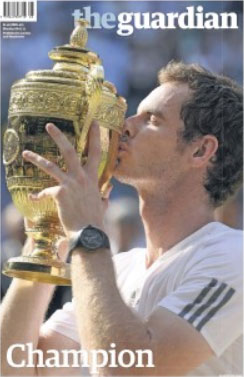
    An unlikely winner from this year’s Wimbledon is Indian tennis pro Mahesh Bhupathi whose company Globosport had signed up to manage the commercial interests of the new champion Andrew Murray a few months ago.

     

    Mr Bhupathi was in the box at the Centre Court for the finals on Sunday and was seen hugging Mr Murray’s mother after the Scot beat world number one Novak Djokovic in straight sets to become the first Briton to win Wimbledon in 77 years.


    Mr Murray’s win is a shot in the arm for Globosport, which is mandated to develop the tennis star’s off-court interest globally, with a specific focus on Asia and the Middle East, following a tie-up with London-based XIX Entertainment.


    Run by British entrepreneur, artist manager and the creator of the Idol franchise Simon Fuller, XIX has been managing Murray’s commercial activities since 2007.


    A person close to Mr Bhupathi said the world number six doubles player and the Globosport team led by his sister Kavita Bhupathi are working on a few contracts for Mr Murray. “A few discussions have happened with brands in recent months and some negotiations are at an advanced stage. There could be some announcements soon,” said the person, who did not wish to be named.


    The person did not confirm if any of the deals being signed are with brands in India. Mr Bhupathi, who is in London, declined to comment. Celebrity managers say Mr Murray’s win is a golden opportunity for Mr Bhupathi, particularly to grow his business abroad.


    “This is a great opportunity for Mahesh. I hope he has a business plan in place and he strikes when the iron is hot,” says Bunty Sajdeh, the chief executive officer of Cornerstone Sport & Entertainment, referring to Mr Murray’s win this Sunday.


    The head of another Mumbai-based sports marketing firm says Mr Murray’s win will help create a positive profile for Globosport in international markets and in India. “But it will all depend on whether he is able to get contracts for Murray.”


    India, where cricketers dominate the market for sports endorsements, will be a difficult market to crack for Mr Murray. “If he gets business for Murray, I am sure there will be more tennis players, especially in Asia, lining up to do business with Globosport,” he says.


    But since the mandate is a global one, and Asia and the Middle East are untapped territory as far as Mr Murray is concerned, the task is certainly cut out for Mr Bhupathi. After losing his first four Grand Slam finals, Mr Murray last year won the Olympic gold medal in London as well as the US Open in New York.


    There have been talks of Mr Bhupathi retiring after 2013 to focus on business. He is among a clutch of Indian tennis players including the Amritraj brothers and Leander Paes who have dabbled in business with a fair bit of success. His company has helped multiple brands connect with sports and Bollywood stars such as MS Dhoni, Saina Nehwal, Sania Mirza and Aamir Khan.


    Earlier this year, Mr Bhupathi had unveiled a plan for an International Premier Tennis League in the lines of Indian Premier League twenty20 cricket tournament and the World Team Tennis that was run in the US in the 70s. The league will have teams in eight cities and will be played during the offseason starting 2014.


    While some feel this plan is terribly ambitious on Mr Bhupathi’s part, the league is said to have commitments from star players like Djokovic, Rafael Nadal, Serena Williams, Maria Sharapova and Victoria Azarenka. Andy Murray too is on board now.


    There have also been talks of Messrs Murray and Djokovic getting equity stake in the tennis tournament, which already has investors like ATP board members and former players Justin Gimelstob and Boris Becker.


    Source:The Economic Times

    Copyright © 2013, Bennett, Coleman & Co. Ltd. All Rights Reserved

    Licensed to republish


  • Starcom’s SMG Convonix tracks Wimbledon online chatter

    By A Correspondent


    SMG Convonix, a division of Starcom MediaVest Group (SMG), has implemented a social dashboard to measure global online buzz and chatter around Wimbledon 2013, the annual tennis tournament currently on in England.


    The dashboard (http://www.convonix.com/wimbledon), powered by Iristrack, SMG Convonix’ proprietary social listening and online brand monitoring platform, measures buzz around matches, identifies trending players, monitors fan support and more.  Thus far, the dashboard has logged more than 1.5 million Wimbledon related online conversations from around the world.


    “Tennis is a truly global sport, and we at Convonix are watching the world watch Wimbledon,” said Vishal Sampat, CEO, SMG Convonix. “Our unique social dashboard gives us the ability to deliver real time insights on social chatter as it happens all around the world.”


    Wimbledon 2013 is scheduled to draw to a close on Sunday, July 7.


  • Ranjona Banerji: Tablets & tabloids – shape of news to come

    By Ranjona Banerji


    Having spent too long in a newsroom bossing about, I’d almost forgotten the cliquish little world that reporters live in, especially same-beat reporters. But one day of covering the Wimbledon tournament for Mid-Day and I feel that I am ready to write a thesis on the tribal customs of travelling tennis journalists.


    I had the same feeling years ago when I covered – just one, mind you – a film shooting for fun once. (Thanks actually to the founder editor of this website). All the habitual film journos hung around together and demanded entertainment from the PR guys who had organised the trip. They paid no attention to the shooting or the stars. Because it was a novel experience for me, I hung around the set – interminably boring – and interviewed one of the two main stars. The other never emerged from her room.


    In the same way, the Wimbledon press centre remained full of people watching TV and filing while I the wide-eyed rookie ran around the place. Great fun. However, more seriously, it seems that in spite of the fact that there were some women about, the media is the preserve of what NGOs call “male, pale and stale”. That is, sports journalists tend to be old white men! I tried to take aphotograph of the press enclosure on Centre Court to prove my point but apparently journalists in the press enclosure are not allowed to take photographs. Go figure.


    **


    There seems to be a lot of anger against the television media in India for its coverage of the Uttarakhand floods. It is impossible to know what went wrong from so far away but I can conjecture that as usual Indian TV went into “blame mode” rather than reporting mode and this meant that the issue became a school-playground level debate between opposing yellers and screamers. How this is of any help to anyone is a pointless question however since TV editors evidently cannot think beyond “discussion journalism”.


    But one story was intriguing and that was The Times of India report that Gujarat chief minister Narendra Modi travelled to Uttarakhand and rescued 15,000 Gujaratis. It was not made clear in the story how exactly the Gujarat state administration left behind the other people or how in extreme weather conditions they identified who was who. A petition on change.org (http://www.change.org/en-GB/petitions/chairperson-press-council-of-india-inquire-into-serious-violation-of-media-ethics-by-times-of-india?utm_campaign=share_button_action_box) has asked some questions about violation of ethics. The implication in the petition is that the story was a PR exercise for the Gujarat chief minister to show how efficient he is. But the underlying feeling is a bit of holocaust-type politics where you save only one kind of person (depending on ethnicity) and abandon the rest. Which is pretty bad PR if you think about it…


    **


    Meanwhile, here in the UK, once again you notice how news dissemination is no longer what it was. Newspaper subscription on tablet devices is winning the battle against paper. And on the tube, tabloid newspapers are common, free or otherwise. Some lessons which India will have to pick up on sooner or later. Sooner for the media industry’s own good but who knows.


    Ranjona Banerji is a senior journalist and commentator based in Mumbai. She is also Contributing Editor, MxMIndia. She can be reached via Twitter at @ranjona. The views here are her own


  • The Anchor: 6 things to watch out for in the 2012 London Games

    By Ranjona Banerji


    I hope everyone interested in having a good laugh has been watching Twenty Twelve on BBC Entertainment, a comedy series which follows “the deliverance committee” involved in making sure the 2012 London Games run smoothly. Everything from bureaucracy to PR to political correctness to politics to jargon to celebrity are satirised brilliantly and it all seems so real.


    However, it is also possible that you interested in the Games themselves. In which case, here’s what to watch out for.


    1. The Opening ceremony on Friday, that is 1am (Saturday morning technically) for India on ESPN, Star Sports. Directed by Danny Boyle, (yes, he of the Jai Ho and slums are fun fame) it is expected to be a massive extravaganza. He has to compete with the glorious, breathtaking performance put up by the Chinese in Beijing in 2008. I don’t actually quite remember it actually, but it was spectacular. Lots of firework dragons. Or was that the first Lord of the Rings movie? Whatever.


    2. The Indian medal chase. This is supposed to be our best chance “ever” (please substitute your own version of an American teenager’s twang here) of winning lots of medals. Boxing, tennis (oh, wait, in India sometimes there’re both the same thing), hockey, badminton, wrestling, shooting… In fact, anything except running and jumping which, of course, are what the Olympics started with in ancient Greece. No one expects us to run and jump, least of all, us.


    3. Badminton starts on Saturday (go Saina Nehwal!), which is why badminton players may not be at the Danny Boyle show. Actually, so does boxing, athletics, handball, judo, tennis, volleyball, weightlifting and just about everything else. Football has already started. So maybe no one will be at that opening ceremony, so it’ll be all sparse and minimalist and New Age.


    4. London, the best city in the world. Apart of course from New York, Paris, Shanghai, Hong Kong, Dubai, Delhi, well of course, of course, that’s a joke! If you can’t be there, you can watch it, especially that giant red squirly whirly steel thingie made by that famous Indian artist chappie Anish Kapoor (Indian! We are the greatest!). So wish you were at the West End, Covent Garden, Piccadilly,Oxford Street,Kensington Gardens, Buckingham Palace, Tate Modern, instead of wherever you are.


    5. Wimbledon! This one is for me. The Championships are over, but tennis is going back to the green (or re-greened) grass. Twice in one year is remarkable and unique. (I wrote Wimbledon! But I meant Roger Federer! Of course.)


    6. There’s a special Olympic sport that has been included just for India. It’s called: Where’s That Kalmadi? You can seek him here, seek him there as the former head honcho of sporty stuff and hmm, other stuff, Suresh Kalmadi, weaves and dodges his way around the Games, avoiding the media, the athletes, the police…


  • Ranjona Banerji: Media forgets more than it remembers

    Ranjona Banerji

    By Ranjona Banerji


    Most Indian newspapers stayed up late to bring readers the results of the Euro semi-final between Germany and Italy. The Times of India also managed to check up the Wimbledon scores and had a front page snippet on Rafael Nadal’s shocker of a second round exit. This is unusual because TOI usually does much less for tennis than other newspapers.


    (But CNN tennis reporter, I have a question for you: Is Rafael Nadal’s second round exit bigger than Pete Sampras’s fourth round exit in 2001, since you said that Nadal’s upset was the biggest in tennis history and no one could remember another? Nadal has two Wimbledon titles, Sampras at the time had seven Wimbledon titles – a record he holds with William Renshaw – and would never win another. The man Sampras lost to: Roger Federer. It was only 11 years ago, a little history is not a bad thing for a sports reporter. Or even, a good memory!)


    * * *


    The Houston Chronicle has fired a reporter for working as an exotic dancer (sometimes known as stripper) as a second job. The woman was exposed by a rival publication. Snitching on your competitors is a trend in Western journalism which is yet to reach India and one wonders whether that is not a good thing. The Guardian’s exposes of phone-hacking and other dubious practices by rival newspapers, especially those owned by Rupert Murdoch, perhaps fall in the realm of both public service and dogged investigative journalism. (The Hindu comes the closest in India, as it occasionally pulls up lesser media houses for journalistic and marketing transgressions.) But “investigating” fellow journalists of media houses and their personal lives to inform readers? Am not sure what category of journalism this falls into.


    * * *


    A minor storm in Indian journalism has been over the death of a photographer who worked with Tehelka, was sent into the hinterland to do a story on Naxals, got malaria there and died. The newspaper is at fault for apparently not factoring malaria into the threat element of this assignment.


    Newspapers in India are notorious for not being bothered about the dangers of newsgathering – mainly because most newspapers have dispensed with most kinds of dangerous reporting. (I could I suppose say the same thing about TV, in that they hardly started.) Gone are the days when even gossip columnists – like Devyani Chaubal being slapped by Dharmendra – faced physical dangers while working. I am being facetious I know but bullet-proof vests are hardly part of a reporter’s must-haves in India. There should be no room for callousness. But I am still unconvinced what Tehelka could have done about a mosquito. If they did not help the photographer or his family later, then there is cause for criticism.


    Still, it would not hurt media houses to take a closer look at employee welfare (this does not mean a box of mithai at Diwali) and on-the-job dangers.


    * * *

    Interesting that the anniversary of the Emergency came and went with little media attention. Are we moving on or did we just, like, forget?


    * * *


    The case of Abu Jundal or Jindal or Zaby or whatever his name is – the Lashkar handler of the 26/11 attacks sent to India by Saudi Arabia – is exciting but it is still in its early stages. Rather than focus their hysterics only on Pakistan, the Indian television media might like to look at it as a story first and probe all angles rather than jump into jingoistic propaganda.


    * * *


    The Indian media – particularly TV – got itself into a bit of a bind over Pakistan’s flip-flop over the release of Sarabjit Singh. Sarabjit is a celebrity prisoner whose family has ceaselessly campaigned for his release. Pakistan announced Sarabjit’s name and then changed it the next day to Surjeet Singh. Now the dilemma: should the media show happiness for Surjeet, rage against the machine for Sarabjit, damn Pakistan or blame Pakistan? Is one Indian equal to another or are famous Indians more equal? It is not known how hard Surjeet Singh’s family worked the media to get him released, so perhaps there’s an answer. Also Surjeet Singh walked across the Wagah border and claimed he was a RAW agent, a tag Sarabjit and his family have consistently denied!


    * * *


    Congratulations to Mid-Day on its 33rd anniversary and a whopping anniversary issue of 200 pages which I haven’t had the time to read yet. Might take me all week!.


  • Ranjona Banerji: Irritating ads that irritate

    Ranjona Banerji

    By Ranjona Banerji


    Am stepping on a few toes here and other people’s territory but then wothehell. As much news as you watch on TV (or as much TV that you watch, be honest) you’re forced to watch as much advertising as content.


    And sometimes it’s fun (like Hari Sadu and naukri.com) or even the poor chappie who thinks he’s eating chicken, but it turns out to be a doggie. Or Fastrack’s funny series on the risqué side with Genelia D’Souza and Virat Kohli. Or even the Flipkart ads where children play adults.


    But what does one make of Priyanka Chopra squirming about on the ground to a song that does not match the bizarre dance she does as she tells us she hates the “chip chip”. All that happens for Garnier is that most people throw up and switch channels.


    Through the telecast of Wimbledon on Star Sports you get to hear that “amazing Thailand always amazes”. Well, duh, couldn’t they think of another word? Or has someone done Thailand tourism in?


    The Kelloggs ads with that vastly annoying mother who does something as simple as throw a few almonds on a bowl of cereal and pretends she’s invented sliced bread is anodyne as such ads normally are.


    But the winners of the most irritating ads have to be Reliance Foundation and Coca-Cola. Insensitivity seems to rule the Coca-Cola ad in which a group of not very well off (how do I say this politely?) children play cricket in some dusty desert scrub land as a voice over tells us poetically how they have no cricket bat, ball, stumps, the pavilion has no roof and so on and ends some poignant note about how this is not play but the call of the earth or something. Then Sachin Tendulkar with his strange new hairstyle drinks a Coke and says play on. The children and Tendulkar never meet and you get the feeling that the children cannot afford to drink Coca-Cola, certainly not one each.


    And there’s the Reliance Foundation. I’m not getting to the connection with the programme Satyamev Jayate. For one, the ad looks like a copy of the Vedanta ad, which claimed to be saving the lives of various village children with schools and food and making their dreams come true. The ad ran into as many problems as Vedanta does with its mining projects and the company’s attempt to redeem itself with this real or exaggerated NGO social work effort did not work.


    If indeed Nita Ambani is moving into social work, an ad that copies an already discredited ad is surely not the best vehicle. Also, the figures put up for the number of children fed or schooled or clothed is embarrassingly small for a company the size of Reliance. Even worse, Nita Ambani’s look is so carefully crafted that it looks just that. Also makes her ears look unnaturally large.


    Hidden persuasion is fine. But these are attempts at such blatant manipulation that they are not just exploitative, they may not even work.


    For those interested in advertising and how it works, try and catch The Gruen Transfer on the Australia Network or Youtube. Hosted by Australian comic Will Anderson, it is funny, incisive, intelligent and hard-hitting. And did I say funny?


    All right, I’ll watch the news from tomorrow.


  • Ranjona Banerji: TV does right by Baby Mahi!

    Ranjona Banerji

    By Ranjona Banerji


    Let’s cut TV news a little flak. What! Did I really just say that? The story of “baby Mahi” who fell into an abandoned borewell on her birthday last week but could not be rescued for almost five days is a made-for-TV story. Most newspapers would have reduced the story to a brief, if they carried it at all. Human life or in this unfortunate case death means very little in Indian newspapers unless it concerns high net worth individuals or happens in large numbers. Here also the concern is relative: for a Mumbai newspaper a bus that falls into a ravine and kills 50 of a marriage party in Bihar means less than an accident on the Mumbai-Pune expressway which kills 15. Geography and proximity carry more weight than the idea of death itself.


    TV news, however, challenges these assumptions made by the print media. While some may find TV’s attention to baby Mahi excessive or indeed point out that people fall into wells all the time, they are missing the point. Newspapers belong to the old, fatalistic India, where you took everything in your stride because life taught you that horrible things happen to everyone and especially to poor people. TV belongs to New India and as we learn every night, India always wants to know.


    And some questions, we must admit, need to be answered. There is no reason why people should regularly die because they accidentally fall into wells. There is no reason why we should not insist that safety protocols be put in place to prevent such accidents. There is no reason why local officials are not pulled up for being callous.


    Even if the hyperbole and hysteria generated by TV reporters and anchors can be vastly annoying, it does not mean that the reason they are having fits is not genuine. It took every bit of fortitude I could muster at midnight to listen to Arnab Goswami’s impassioned outburst against apathy and indifference (Wimbledon means I cannot get to TV news before midnight, yes I have no life and thank god I don’t watch football!) but behind all the bluster – there was a point.


    The trick for TV now is not to let this baby Mahi case turn into a real-life version of Peepli Live. They have to continue with the campaign they have begun so that they do not become as cynical as print journalists. It may be a tall order, but they started it.


    * * *


    I greatly admire Pakistanis who appear on Indian TV news discussions about terrorism. It takes great courage to withstand all that solid evidence against them and continue selling their government’s line. And they seem to be quite happy to do it. I do not get to watch Pak TV any more so I do not know if Indians appear on panel discussions to get pilloried. Does anyone know?


    * * *


    Football has taken over our newspapers. It is now emerging as cricket’s biggest competitor. We all know that Indian football does not generate any interest at all (somewhat like Indian hockey) but every FIFA tournament brings the lives of others to a standstill.


    The test I suppose is when cricket (with India playing) and football tournaments happen at the same time. Who do you think will win? Or will we then know whether sports pages are just lazy or have some top class brains involved in the planning?


    * * *


    The Times of India in its little debate section on the edit page has gone for and against on the use of the term “Bollywood”. It’s an old argument and an amusing one. We all know that the term is derogatory and was coined in the 1970s with that in mind. We also know that as long as the Hindi film industry continues to make song and dance potboilers, the term will continue to stick. No one calls Shyam Benegal or his oeuvre “Bollywood” so we all know the difference. TOI could have suggested options like “Goregaon”, since that’s where so many films are made and that’s how Hollywood got its name. Any takers?