Tag: Will Sansom

  • The Agency of the Future is an Algorithm: Razorfish-Contagious seminar @CannesLions2015

    By Dyanne Coelho


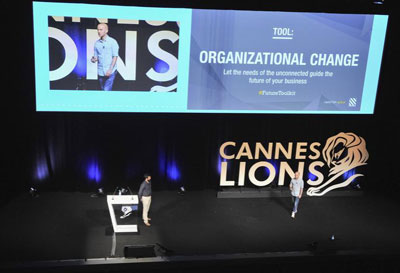
    There’s absolutely no point sticking to the rules anymore. The last decade has changed the way marketing works in our industry and the growth of the digital space has created more opportunities, more expectations and more solutions. But how prepared are we for what comes next? While we talk of the ever increasing pace of change, it’s clear that what matters is not so much what we know about the future, but how we adapt to it. A well-worded introduction, set the pace for the seminar entitled ‘Toolkit for Transformation’with Ray Velez, Chief Technology Officer, Razorfish Global and Will Sansom, Director, Content and Strategy, Contagious Communications.


    “Is it just us or have we reached a point where the industry has hit pause,” Sansom asked. “We carry devices in our pocket now that have more processing power than the super computers that put man on the moon. Statistics suggest, that young people switch media platforms over 25 times an hour,” he said.

    “Technology breeds technology, and innovation breeds innovation. Knowing about the future isn’t enough; you also need to plan on how to adapt to it,” Velez added.


    We think in the future, brand loyalty will become extinct, Sansom revealed. According to him, we’ve never been better enabled andequipped to switch between brands no matter the category. Research shows that there is about $6.2 trillion in revenue to be made from people switching loyalty from one brand to another. This is now being called the switching economy. This is proof that brand loyalty is becoming extinct, they discussed.


    We have more choice now. A lot of the new generation start-ups that are now huge global multibillion dollar companies are all about giving us more choice, Sansom explained. “We have more information at our disposal, comparison sites, reviews, social media, and from a trusted network we can tap into it any time we need it.”


    A major study that Razorfish conducted into cross-channel experiences and loyalty across four key markets – US, UK, Brazil and China, found that word of mouth and online reviews were the greatest influencers of purchase decisions. This led to the next point of ‘Considered Consumption’. This includes decisions consumers make based on how much they know about the brand, like their ethical practices, their carbon footprint etc. For example, the company Sir Richards is a new contraceptive company. For every condom that they sell in the Europe or US, they donate one condom to developing markets specifically those where sexually transmitted diseases are a vital problem. There are a lot of companies like this now, because consumerslike to spend money with good brands, but also like to spend money on brands that do good, they suggested.


    “In our opinion, one of the biggest contributors to brand loyaltyis the fact that we celebrate the self. And we live in an age where we’re equipped and encouraged particularly through social media to promote who we are as individuals. But brands are not treating us as individuals. For far too long brands are relying on flawed segmentation processes that market to demographics, but they don’t market to me,” Velez pointed out.


    Crucially customers increasingly want a relationship with a brand that feels more personal. Razorfish asked in a study how important is it that brands provide a product or service that feels like it was made just for you? Close to two-thirds of the respondents wanted just this. “It’s a challenge, but we believe the solution is in data. Data is how we listen to our customers. If we’re not using data, we’re in essence ignoring our customers. In the end data gives us that roadmap on how to reach customers on a one-to-one basis,” Velez added.


    The speakers divulged a few tools that are essential when dealing with the problem of a fading consumer loyalty. For one, design around them, not around your short-term sales targets. People are migrating towards brands that treat them like individuals, they said. Secondly as far as creativity is concerned, disrupt your business, not just your advertising and for organisational change, make a commitment to being in beta. In the future the unconnected world will need connecting, Sansom pointed out.


    A McKinsey study showed that even by 2017, close to 4.2 billion people will still be unconnected, or will remain offline; that’s roughly half the world’s population. Velez revealed. “For consumers, educate and enable before advertising,” he said.


    For creativity, think beyond browsers, for organisational change, let the needs of the unconnected guide the future of your business, Sansom suggests.


    “Great brands will liberate us from our screens. The connected today face a fatigue from being too connected to screens,” Velez explains. We ought to design for the human interface, not for the screen. The internet is not the screen, Sansom added.


    The agency of the future will be an algorithm, the speakers discussed. We’d be kidding ourselves if we thought that industries aren’t about efficiency, about making things better, faster, cheaper. Are we ever going to get to a point where an algorithm could create a whole piece of advertising from start to finish, by itself?


    “Imagine dealing with a creative director who is an algorithm. He literally knows all the answers,” Sansom said. But does that mean that we will be out of jobs? Not at all, he says, but what we do is going to change, and it will free us up of mundane tasks, it will be better.
     

  • AdAsia: India gets Contagious

    By Our Correspondents


    Neeraj Nayar, President, Contagious India on launching Contagious in India
    [youtube width=”300″ height=”200″]http://www.youtube.com/watch?v=dsIx5Aahgck[/youtube]
    Neeraj Nayar on the revenue model for Contagious India
    [youtube width=”300″ height=”200″]http://www.youtube.com/watch?v=B9UkmQn_sAU[/youtube]
    Neeraj Nayar, President, Contagious India says he’s confident of the product he has to offer
    [youtube width=”300″ height=”200″]http://www.youtube.com/watch?v=MRmTbSlUYPY[/youtube]

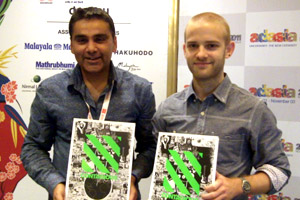
    Contagious Communications, a complete intelligence resource, was officially launched in India on Day 2 of AdAsia 2011 in New Delhi. Neeraj Nayar, President of Contagious India, will oversee the India operations along with Will Sansom, Writer and Consultant for Contagious. As part of the launch, Contagious will bring in its much acclaimed Contagious magazine – seen as the Bible among many in the industry – and will also include in the portfolio an online feed, trend briefings and Consultancy and Special Reports.


    Talking about the launch of Contagious in India, Mr Nayar said, “There is some great ideas coming out from India and I think its important to be here and closer to the market.” The magazine which is available only for subscription will cost around 1000 pounds for a year (the magazine comes out quarterly). The pricing does not deter its promoters as Sansom pointed that it’s a niche product and very high in its content quality. There are also different packages for those who are interested in getting the maximum out of Contagious.


    Contagious was launched in 2004 to explore the relationship between brands and consumers, to predict the impact of new technologies and to make sense of the fragmenting media landscape. The magazine comes with a DVD showcasing over 100 pieces of creative work per issue.

  • AdAsia | Day 2 – Exec Summary: Food for thought, and plenty

    By Tuhina Anand

    Conversation, exchange of ideas, networking and business as usual was the order of the day at AdAsia. Day 2 of Congress at AdAsia 2011 started with a session by Frederika Meijer, Representative UNPF, India and Country Director UNFPA, Bhutan. The session was on `The Female Equation: Communicating with conscience. The session was an attempt to bring to attention, provoke debate, and challenge the minds present to think of providing creative solutions to one of the critical issue on ‘The girl child’.

    The next session on Marketing 3.0-New Rules of Engagement was an interesting session where Joseph Tripodi, Executive Vice President and Chief Marketing and Commercial Officer, The Coca Cola Company discussed how marketing is dead and engagement is in. He talked about balancing the notion of Brand Love and Brand Value. As consumer engagement is rapidly changing he pointed that the challenge is to navigate in this new universe. He talked about the `Liquid and Linked’ philosophy that the company embarked on last year. It’s this philosophy which has helped in creating the FIFA World Cup campaign celebration campaign. Tripodi introduced the newly launched campaign on Arctic Home that Coca Cola has taken to give homes to polar bears. Then he gave a peek into what the company has planned for London Olympics 2012 which again is truly a Liquid and Linked philosophy. It’s basically about unlocking the social side of Olympic and dubbed it as `integrated and ambitious’ plan. Prasoon Joshi, Chairman and CEO, McCann Worldgroup India and ECD McCann Erickson was the session anchor who threw some tricky questions to Tripodi who answered them all with ease.

    There is business uncertainty, market uncertainty and media uncertainty and that’s what the next session delved on. Kelly Clark, Worldwide CEO, Maxus, Mainardo De Nardis, CEO, OMD Worldwide discussed Media Fragmentation: How to navigate through traffic? The session was moderated by Bob O’Leary, MD, Head of Global Marketing, Consumer, Citi. The panel discussed the explosion of media in the market along with changing human behaviour and the need to find a way through this. Mainardo about the changing Asian market where the role has reversed and other countries are borrowing from best practices from Asia while the scenario was completely different few years ago.

    It was a change to see finally young blood take to stage with the next session on `Ideas that are Contagious’ by Will Sansom, Writer and Consultant, Contagious Communications. HE showed works that were truly innovative uncovering new opportunities and collaborative cultures. An interesting example was that of luxury brand Burberry which used Tweetwalk to engage consumers while managing to retain the exclusivity that only front row gets during its fashion show. Through the use of social media it engaged people to follow the brand online by putting a shot of model just before the walk thus getting its fans to follow the brand online and not disturbing the dynamics offline.

    There was also a session by TED/INK-The New Age of Advertising. Lakshmi Pratury, Host, The INK and Ronda Carnegie, Head of Global Partnerships, TED talked about the movement that provokes people to think and challenge the consumer consciousness.

    Times have change and with that has changed strategies of communication from brand to consumers. For much of its history, the art of advertising revolved around the creation of the ad: an expertly crafted message conveyed through traditional media and consumed by end audiences. But the audiences today have changed, they way the consume media today has changed. The session ‘Acts. Not ads’ deconstructed how, in today’s multidimensional media landscape, advertising messages are evolving into true social movements and acts that can affect and drive positive change. The panelists gave several examples to drive home their point of how acts are much more efficacious as compared to merely advertising. Today, the consumer wants to be a part of an ad and engage with the brand, making it an act.

    There are several brands in the market and with the cacophony emanating from brand declarations, trying to out-shine other brands, results in only a ‘trust-famine’ in the mind of the consumer. Trust becomes very important and that is what the session in adasia discussed ‘Building brands in a trust deficit world’. For the panelists, the essence of building trust was to talk and engage customer and be ethical and responsible as a brand. Consumers like to associate themselves with responsible brands. The latent psychological element of how people buy things at the first place is also important. It is essential for brands to have consistency in the messaging over time and across all touch point to create trust. The key is to keep the old and add the new… In the urge of doing new one should not discard the old value systems for the new. Moreover, for brands to be trustworthy, they have to be modest, even when they are doing very well because one never knows where the next problem is coming from.