Feminine-care brand Whisper, from the house of Procter & Gamble, is raising awareness about– the early onset of menstruation among young girls — as part of the fifth edition of its #KeepGirlsInSchool (KGIS) movement.
Said Rajdeepak Das, Chief Creative Officer, Publicis Groupe – South Asia and Chairman Leo Burnett – South Asia: “Our ongoing research about the changing conversations around menstruation identified a glaring anomaly – girls today are getting their periods much earlier than before. However, they are being educated about periods at a much later stage or oftentimes not at all. Whisper and Leo Burnett have been on a journey to keep girls in school for a long time and we wanted to bridge this gap. Our latest work talks to the 8-year-olds in a language they can understand, with a heartwarming song that teaches them that getting periods means they are healthy. The goal is to not just teach the little girls but also use the song as a tool to equip her ecosystem- parents and educators, enabling them to teach periods in an empowering manner.”
Added Girish Kalyanaraman, Vice President & Category Leader – India Feminine Care at Procter & Gamble: “There is a seismic shift happening in period biology. This heightens the need to educate girls early on and to prepare them to embrace this biological process. Through this initiative, we strive to educate them about how periods are healthy and how they can take care of themselves on their period days. Every year, Whisper goes to more than 60,000 schools to create period education programmes and we are now also going to younger standards. Consumers too can do their bit buying a Whisper Ultra pack which will help us educate and donate pads to one girl to keep her in school.”
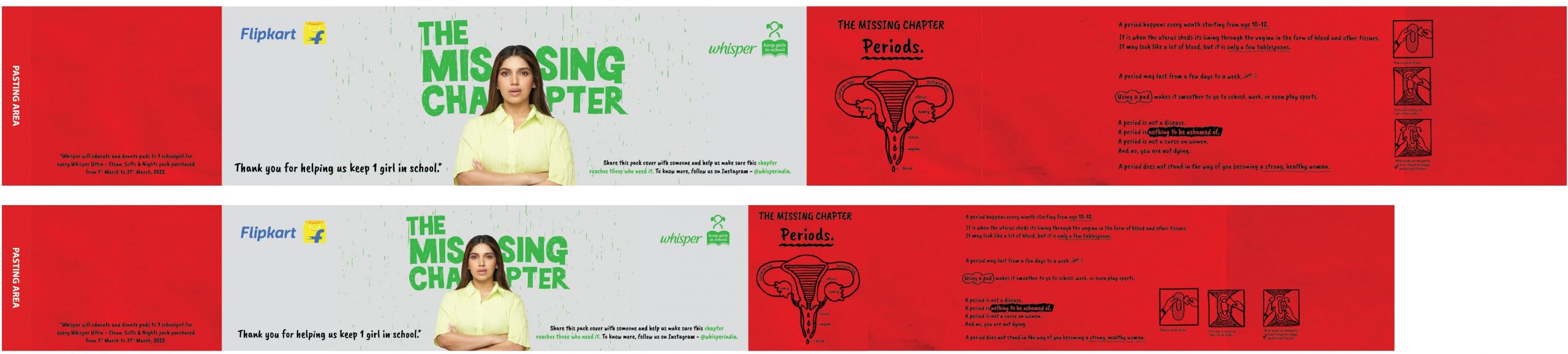
Feminine-care brand Whisper, from the house of Procter & Gamble, has unveiled a new film titled ‘The Missing Chapter’ as part of the fourth edition of its #KeepGirlsInSchool (KGIS) movement. This time, the new film aims to educate mothers on the biology of periods so that they, in turn, can educate their daughters on periods including menstrual hygiene and using sanitary pads during their monthly cycles. The film is conceptualized by Leo Burnett.
Said Girish Kalyanaraman – Vice President and Category Leader, Feminine Care, Procter & Gamble India: “For a natural process like periods, it is very important that parents educate their young daughters correctly. In most parts of India, we’ve seen that mothers themselves are unaware about the biology of periods and the ways to manage it. As a result, menstrual hygiene is compromised. This leads to girls staying at home during their period days every month and they slowly start falling behind eventually dropping out of school altogether. Our film ‘The Missing chapter’ aims to address this and spread awareness among mothers so that the next generation of women is empowered and educated to manage their periods and keep girls in school.”
Added Rajdeepak Das, CEO & Chief Creative Officer, Leo Burnett – South Asia: “A mother is the first teacher of a child, the one who imparts life’s most important lessons. Thus she could be a powerful ally in our journey with Whisper to Keep Girls in School. But in India, mothers themselves lack the education to teach their daughters about periods. Our focus this year is to educate mothers, create a chain of positive information, and break the cycle of ignorance.”
There was an unusually cool breeze at the lawns of Taj Landsend hotel in suburban Mumbai, the venue of choice for the Effie Awards each year. Conducted by The Advertising Club the Effie Awards are key for networked agencies as the performance in India adds up to the global performance, and when it comes to critical pitches, it’s Effectiveness (hence Effie) as against Creativity (the Creative Abby) that matters most.
EFFIE India 2022 Client of the year
So in the 2022 edition, it was favourites Ogilvy that took away the top honour of the Agency of the Year. Mondelez India was Client of the Year, while coveted Grand EFFIE was won by Leo Burnett India for Whisper India’s campaign ‘Whisper: Changing the education system to keep girls in school.’
Grand EFFIE India 2022
Surpassing all its previous editions, Effie 2022 received 986 entries, the highest ever in 22 years, and saw participation from 53 agencies.
Speaking at the awards night, Partha Sinha, President, The Advertising Club, said: “It is extremely heartening to witness Effie become the most coveted trophy within the marketing and advertising fraternity. Like every year, this year too, Effe has witnessed significant patronage from industry veterans and category leaders. I’d like to congratulate all the winners for crafting impactful campaigns that are now sheer examples of innovation and effectiveness.”
Elaborating on the awards, Mitrajit Bhattacharya, Chairperson, Effie India, said: “It gives me great joy to host the Effie Awards once again as a physical event, celebrating the best work of the year with the people who create them. A big thank you to 493 judges who judged a record-breaking 986 entries over three rounds of online judging. I also thank each participating agency and client for their support. And a huge shout out to our sponsors, The Ad Club managing committee, the Effie committee, Effie New York, and The Ad Club secretariat to make this event a huge success.”
Adding on the enhancements in the award process this year, Pradeep Dwivedi, Co-Chairperson, Effie India, added, “We have built a sustainable trajectory as a leading Effie organising body, having successfully implemented the new Acclaim Platform for the jury process this year, in tandem with our worldwide peers and Effie Global team. The adoption and change management of the same by our industry members has been truly amazing!”
A special award for creator marketing was awarded to Mondelez, Wavemaker and Ogilvy.
It was the official International Women’s Day yesterday. The 8th of March. Another day and another round of conclaves, purpose-led brand associations, events, and hype. Another day when inspirational anecdotes featuring women achievers were circulated and celebrated. Women exploitation, empowerment, POSH, Glass Ceiling breakers were the focus of discussions. And then, life returned to abnormal. Because what one desires should be normal and what exists, what one is trying to change the abnormal. I am not sure if I got that right. May be it is the other way round.
Advertising is always ahead of the curve, reflecting aspiration and desire. Brands try to mirror evolution of women and changed status on and around women’s day. A life full of unconstrained new social flexibility and age-old constraints.
The purpose-led intent of the brand and its advertising fails to nudge a behaviour change or change the life of women. But, this focused women’s day advertising and brand associations bringing attention and focus to inequalities, non-inclusive, exploitation, unjust norms, and expectations must not stop. They are the reality check and a good reminder.
Socially we have come a long way, and we collectively accept the new emerging scenario and challenges. However, when we look deep, we remain the same in more ways.
NOTHING CHANGED.
Trust me, other than for the minuscule population, women’s day is like that dinner in a marriage or the political rally full of promises. In a short time, every evidence of the celebration is removed, and the promises are forgotten.
Everyone tries to exploit the opportunity. In Mumbai, a sizeable residential society and the Municipal corporation representative celebrated Women’s Day last week. The corporator is also a woman. Speeches happened; examples of achievements were shared. And at the end, women were given a branded Tawa and pan as a gift. PR opportunity over. It tells how much nothing has changed.
On TV, debates and conclave on women’s interests happened. Newspapers devoted pages, and FM will bring stories to life. Digital will have its moment marketing, and that’s it. Most probably, at most debates, it will be a male-dominated panel. Or perhaps not.
Even today, sharing household jobs and load still sounds like ‘Share Her Load’, and we know we have not moved further.
WE HAVE BEEN OVER-AMBITIOUS.
I think somewhere, we have missed a trick. We are trying to move too fast. We want tectonic impact without grassroot changes and acceptance of role, responsibility, and contribution resulting from gender inequality. And we have moved to discuss women’s role in Climate control. We have missed the basic need to nudge behavioural change in terms of Gender respect, gender equality and inclusiveness.
NO SHIFT.
In 2021, MTV said: ‘There is more to a girl’s Life than Shaadi ‘. Facebook featured a woman football coach to make a statement. Ijazat Hai by OkCupid reminded you that women still need permission for everything she does! Most try to establish that running and maintaining a home is not her and not only her responsibility.
In 2022, the 121st Women’s Day celebration is no different.
We are still in the same area and area. The brands are trying to establish and talk of a similar thing. Designing a world without a glass ceiling and barriers. We still work with contrived expectations. Prega News harps how women can carry both worlds. The world she is expected to- her home and the world of her job responsibilities.
Wow skincare demonstrates the power with #SheMakesUs. Kalyan jewellers push for I am more than enough and tries trending #BreakTheBias. Hera uses International women’s day as a cover to launch and even includes a hashtag #NoMoreCompromise in the creative; such initiatives undermine the efforts of other well-intending brands.
Greenlam Industries, in a very contrived way, try encouraging gender equality. Still, it is not her right.. #CanDare, #Impossible, and such Hashtags appear and disappear like the celeste bodies.
MISSING CHAPTER.
A special mention to Whisper for ‘Keep Girls in School’. This initiative will go a long way and will have a considerable impact. We need more dedication from brands- ‘Missing Chapter’ is a move in the right direction. And yes, I wait to see the wall paintings that the brand wants to use to raise awareness about mensuration.
WE HAVE BEEN STUPID.
We have always kept high expectations from purpose-led advertising. Yes, the right communication is known to trigger behaviour change and nudge society toward the right direction, but they are rare and few. A significant societal change requires working at an individual level.
THERE IS HOPE.
It will be wrong to say that all efforts are wasted, and no change has happened. The new generation is far smarter, more cued for their acceptance and rights. I do think the tsunami of change is just ahead, and the process will only get accelerated. Till then, let’s raise a toast to the new generation of aware women and wish that things do change.
YOU CAN MAKE A DIFFERENCE.
Forget the buzz associated with International Women’s Day, and forget its existence. Go, celebrate the women in your life. Whosoever is important in your life. Your grandmother, mother, sister, wife, daughter, daughter-in-law, friends and relatives.
Start afresh. Start small.
Listen to their ambitions, desires, barriers, and complaints. And make some positive contribution to their life. Start treating them as equal. Allow them to express be inclusive in education, social interaction and freedom and flexibility. Give them the freedom to be listened to and act.
Whisper sanitary pads launched its new film titled ‘The Missing Chapter’ as part of its #KeepGirlsInSchool movement.
Talking about the movement, Akhil Meshram, Senior Director, Category Leader, Whisper, Indian Subcontinent at Procter & Gamble, said: “At Whisper, we have been committed towards increasing awareness around menstrual hygiene management and period education for the past 25 years. The ‘Keep Girls in School’ (KGIS) movement, launched two years ago, has taken this commitment forward to also address how young girls and their families don’t need to look at periods as taboo. This year, by scaling up KGIS 3.0, we seek to ensure that 100% of all adolescent girls in the country are educated on menstrual hygiene so that no girl is forced to drop out of school due to her period.”
Continuing to share her support for the movement, Bhumi Pednekar commented, “It has been a pleasure to work closely with Whisper®’s #KeepgirlsInSchool movement to drive awareness about the importance of menstrual hygiene education for young girls across India. The pandemic has prevented many young girls from gaining awareness and accessing menstrual education resources, which could have helped them understand what their bodies are going through. I am glad that in its third year, #KeepgirlsinSchool is addressing this imbalance in their educational experience, and I hope together we can help young girls across the nation understand their bodies and their menstrual health braising awareness about the Missing Chapter.”
Speaking about the campaign Rajdeepak Das, CEO & Chief Strategy Officer – South Asia, Leo Burnett, said, “This year Project Missing Chapter addresses an important aspect of why 1 in 5 girls drop out of school – no menstrual education. A simple chapter on menstrual hygiene can make a huge impact for these girls. Our film narrates how three girls, armed with a symbolic red paper are spreading information and awareness on menstrual hygiene. Whisper® is the perfect example of a HumanKind brand, and we are very proud to be working with them on this mission.”
Leading potato chip brand Lay’s has launched a campaign to express gratitude towards the unsung heroes of India who have brought joy to millions even in these challenging times. Titled #HEARTWORK, the brand got partners across industry like Flipkart, Zomato, Dunzo, Swiggy and Whisper to join it in paying tribute.
Expressing his thoughts, Dilen Gandhi, Senior Director and Category Head – Foods, PepsiCo India said: “At the beginning of this month, we launched a campaign – #Heartwork to thank farmers, truck drivers, retailers, and many more unsung heroes who have brought joy to millions. Maintaining the chain of gratitude, we reached out to leading companies and brands such as Flipkart, Tide, Vistara, Kia and Cadbury and many more, with a customised virtual pack to express our gratitude for their #Heartwork. At the time when consumers couldn’t step out, the unsung heroes played an essential role in providing products & services every day across the country. Their tireless hard work is indeed Heartwork. We hope this will inspire many more brands join this journey and appreciate these unseen heroes.”
Procter & Gamble brand Whisper has released its latest campaign to #KeepGirlsInSchool and prevent them from dropping out when they get their periods. As part of this campaign, Whisper launched its new film that aims to create awareness on how even today, girls across India drop out of school on hitting puberty. The film brings to light the startling fact that 1 in 5 girls are dropping out of school each year and we don’t even notice. To bridge this gap, Whisper reinforces its pledge to double the impact of their existing menstrual hygiene education program by reaching five crore girls by 2022.
The film, conceptualised by Leo Burnett, sheds light on how girls go missing from school during periods and nobody notices. Said Chetna Soni, Category Leader – Feminine Care, P&G Indian sub-continent: “Whisper has become synonymous with challenging societal barriers to menstrual hygiene in the country through its path-breaking campaigns and #KeepGirlsInSchool is the latest edition in the brand’s illustrious history. We pioneered breaking period taboos by using our voice in advertising and media through trail-blazing award-winning campaign #TouchThePickle and following it up with revolutionary campaigns like #SitImproper and #WhispersBreakSilence.”
Added Rajdeepak Das, Managing Director – India & Chief Creative Officer Leo Burnett South Asia “It is shocking to know that even today in India, 1 in 5 girls drop out of school because of period hygiene. We have been partnering with Whisper to not only tell this moving story, but with the #KeepGirlsinSchool initiative we want to jolt people with the reality of these numbers and encourage everyone to join us in our movement to towards achieving 100% menstrual hygiene in the country.”
In the wake of India’s success at the 2016 Olympics, the phrase ‘Like A Girl’ is going through a positive transition and has ensured heartening conversations such as – “They fought #LikeAGirl†or “They played #LikeAGirlâ€, but we still seem to have a long way to go before each and every girl can do things “Like A Girl†and be proud of it.
A survey, conducted recently by Nielsen in association with Whisper, revealed that one in two girls in India agree that the phrase ‘Like A Girl’ is still used as an insult. “You run like a girlâ€, “you throw like a girlâ€, “you fight like a girlâ€, “you play like a girl†are common insults heard or said that can have a significant effect on girls’ self-confidence, especially during puberty.
According to the study, girls in India were found to be facing a considerable drop in self confidence, especially after having reached puberty, due to the various societal norms and restrictions that they are expected to conform to. At such a stage, phrases such as ‘Like A Girl’ being used in a mean and hurtful manner add to the feeling of being pressurized.
The ‘Like A Girl’ movement was launched by Always, the global brand name for Whisper, outside India, in the USA and select global markets in 2014. It has been supported by organisations such as UN Women, as well as celebrities such as Masie Williams from the Game of Thrones and accomplished athletes like British cyclist Laura Trott (winner of two gold medals in Rio 2016) as well as popular USA Soccer star Alex Morgan among others.
Whisper’s curiously-titled but hard-hitting campaign was awarded the Grand Prix in the newly-created Glass Lion category at Cannes Lions this year. The awards went to creative agency BBDO India. Spokespersons from the brand’s parent company, Procter & Gamble, responded to questions from Dyanne Coelho on why the movement, which aims to eradicate the taboos and age-old myths around menstruation, received an overwhelming response both at the international festival as well as back in India.
How did the idea behind Whisper’s ‘Touch the Pickle’ campaign come about?
Whisper’s brand purpose is to advocate for, and empower, women, to reach their fullest potential. The Touch the Pickle movement was conceived when we realised that a majority of Indian women feel restricted from achieving their dreams because of irrational taboos around menstruation. We believe women should not feel restricted on their period days, and an overwhelming number of women across the country responded to our campaign with their own stories of breaking taboos. A survey by market research firm Ipsos on understanding these taboos revealed that among urban women, 59 per cent still don’t touch pickle, and more than half prefer not to venture out of their homes, during their periods. In light of these findings, Whisper embarked upon the journey to launch a nationwide movement — across not just TV but also PR and digital. ‘Touch the Pickle’ was one of the most irrational taboos and was an apt metaphor for all the other irrational taboos that hold women back.
Many argue that these so-called taboos have been passed down over years because they are healthy practices women should adhere to, during menstruation. And that it is only now that these practices are being labelled taboos. How would you respond to that?
There are two kinds of taboos that Indian women follow. Irrational taboos, like not washing their hair, not touching the pickle, sleeping in areas away from the house, have no relevance to menstruation today and are age-old myths imposed by families that considered periods as impure. The other set, like not wearing whites, not leaving the house and not exercising, started at a time when good sanitary protection did not exist and women had to use cloth, rags or even sand or ash during periods. Today, when there is superior technology in terms of sanitary pads, women shouldn’t worry about following such unreasonable practices. About 99 per cent of gynaecologists believe sanitary napkins are the best form of protection during menstruation as per a national study by the Feminine and Infant Hygiene Association and Ipsos. In the 21st century, when there is a solution, there is no need for women to restrict themselves.
Was the impact to the campaign different in Tier II and III cities from the metros?
An eyeopener for us during the research conducted by Ipsos is that even in urban towns, most of these taboos are still observed. For example, 65 per cent of women from urban India perceive periods as an obstacle in achieving their full potential and some 54 per cent are not allowed to water plants at this time. Our focus has been to drive awareness of the irrelevance of these taboos and encourage consumers to help change the social behaviour and gender inequality that restricts them. We’ve done this in different ways via TV, PR and digital, but we’ve also focused on educating young women and their communities on menstrual hygiene. We’ve also pledged to educate 15 million girls by 2017 on menstrual hygiene, and saw this impact in the sudden surge of conversations, discussions and debates women across India were having around menstruation, where many of them were questioning the myths that were holding them back.
The campaign received positive publicity elsewhere in the world, more than in India. What do you think the reason for that is?
Touch the Pickle was an integrated movement not restricted only to television. Women Achievers like Aditi Gupta (founder of Menstrupedia), Ishita Malviya (India’s first female surfer), Nungshi and Tashi (the first twins to scale Mt Everest), anthropologist Suneela Garg and film personalities like Parineeti Chopra, Kalki Koechlin and Shradha Kapoor, all came together to support this movement to eradicate taboos. The winds of change are blowing through India and the world, and insights regarding taboos around menstruation resonated with global audiences because taboos related to periods are not an Indian phenomenon only.
There are some who believe that while this campaign had a positive impact on many in India, it also paints a socially-regressive view of our society, when that is not the case.
Although 65 per cent of Indian urban women observed these taboos, 82 per cent wanted to break free of them. Interestingly observing irrational taboos is not just an Indian thing. Across the world, women hide their sanitary pads. You will find it heartening to know that in the last year, a surge of Indian women have expressed how normal menstruation is, and how important it is to eradicate these taboos — whether it is the Jamia Millia university [campaign], the Rupi Kaur Instagram incident or even the Menstrupedia comic (which we partnered with) which educates women on menstruation. This means Indian women are empowered and unstoppable in leading this movement.
Has the campaign resulted in a growth in sales for Whisper? If so, by how much?
Touch the Pickle was an integrated movement across touchpoints, including PR, TV and digital, where the central idea was the consumers’ need to be empowered and lead this change. Consumers rewarded us by choosing Whisper, and we have seen our business grow in the last year.
After the overwhelming response it got, are you thinking of running the campaign again?
We are thankful to Cannes Lions International Festival of Creativity and Lean In for instituting this much-deserved award category, the Glass Lion, and awarding us a Grand Prix. We have our partner agencies BBDO, Madison PR, Mediacom, Quasar and Encompass to thank. This is an important movement and we’ll continue to stand for empowering women.
While period communication has its own language (typically problem – solution), we were trying to show how the period experience differs for Whisper users who live confident and active lives. Therefore it seemed appropriate to find charming everyday moments and juxtaposing them… sometimes with humour (comparing window-shopping to shortlisting prospective grooms)… and sometimes with the “can do” spirit of today’s youth. We also wanted to leverage a brand ambassador who had risen to success with hard work and perseverance, and so chose Saina the badminton superstar who, like a crore of Indian girls, also counts on Whisper on the days that count.
5. Media vehicles chosen:
Television
6. Key issues kept in mind while executing the ad:
Keep it real, relatable and humble. Make it reflect the inner voice of the Whisper girl.
7. Does the treatment do justice to the brief?:
We used the narrative format of vignettes to connect with the girl across the country… North/South/East and West. As well as stayed true to the language we hear the Indian girl speak.
8. What is the differentiating factor about the ad:
The brand has a long-standing heritage in this country… A heritage of understanding and connecting with the Indian girl for the last 23 years. As well as a heritage of superior protection, which in its current avatar translated as 1 second absorbency.
9. Market and client feedback:
The client was very happy with the campaign, which qualified strongly, resulting in compelling in-market results and one of the highest historical value share reads on the brand.


 It was the official International Women’s Day yesterday. The 8th of March. Another day and another round of conclaves, purpose-led brand associations, events, and hype. Another day when inspirational anecdotes featuring women achievers were circulated and celebrated. Women exploitation, empowerment, POSH, Glass Ceiling breakers were the focus of discussions. And then, life returned to abnormal. Because what one desires should be normal and what exists, what one is trying to change the abnormal. I am not sure if I got that right. May be it is the other way round.
 Whisper sanitary pads launched its new film titled ‘The Missing Chapter’ as part of its #KeepGirlsInSchool movement.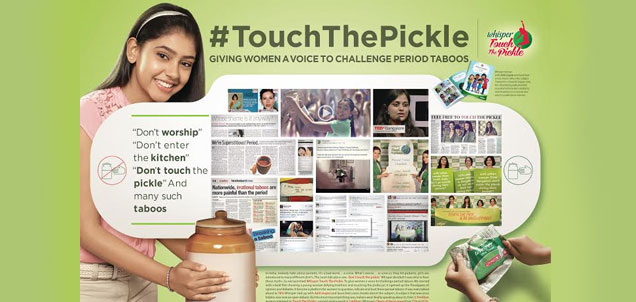
 KV Sridhar, NCD, Leo Burnett