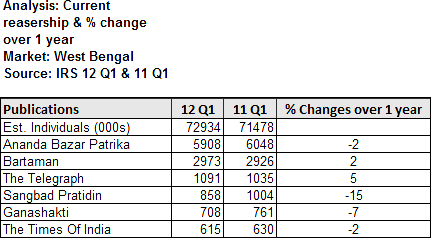
Tag: West Bengal

  • Jaldi 5 with Raj Datta: TOI has a strong youth connect but ABP is undisputed leader

    It was launched with much fanfare in Kolkata yesterday. But will Ei Samay from The Times of India stable be able to create enough impact in the Ananda Bazar Patrika-dominated Bengal market? We spoke to Raj Datta, Senior GM, MPG-Kolkata for his first impressions on the new daily.


    Raj Datta

    On the qualitative front a lot of the editorial team has moved from ABP to TOI, almost to prove a point as DNA had done to TOI, giving ABP a run for its money. So they know the market, its people and the competition, a heady combination. Editorial content being good, the case would be to develop their weekend content and other sections.

    On the quantitative front, Ei Samay is offering very competitive introductory pricing. For a  six-month subscription, the package is Rs 175, as also special and bumper pricing helping to increase circulation potential and get  hold of those initial eyeballs. Re-subscription would remain to be seen, but undoubtedly they will garner a captive audience for the first six months, really quite a bit of time for a reader to get habituated to style and format.


    02 Will a Bengali newspaper from The Times of India stable will be able to dent the market?

    Historically and in numbers, ABP has been the undisputed leader in Kolkata with a sticky brand loyalty associated with them. TOI has had marketing muscle, been innovative and agile with a strong youth connect and flexibility to changing technologies and trends.

    Whether Ei Samay will dent the market or not remains to be seen but certainly they will dent the method of operation of the ABP group making them more aggressive, reactive and proactive. Already there has been a review in its pricing, something they have not with other entrants and Ei Bela launched to target a younger segment in a compact newspaper format akin to a Mid-Day.


    03 How was the response  for the launch issues= of Ei Samay?

    The first issue was out at an inaugural 72 pages, a first-timer for a newspaper anytime, anywhere. The editorial content was very good and it had some great innovations, like there was a French window on the front page which opened half way on both sides. It certainly hit you in one shot as it aimed to do. The response would have to be a wait and watch but certainly it’s something ABP will respond proactively to.


    04 About Ei Samay, Times group editorial director Jaideep Bose wrote, “It will be Ei Samay’s endeavour to champion its readers’ causes in every possible way — be it to enhance their quality of life, or help rejuvenate Bengal, or create opportunities for the young, or simply provide a platform for ideas and solutions.” Do you think the product epitomises this thinking?

    The recent IRS confirmed that ABP’s youth profile is poor, something which Ei Bela is positioned to counter-act to balance the absolute number rule with the problematic youth area panacea.

    Traditionally, TOI has had a strong youth connect with experience in marketing initiatives and the ‘power of ideas’ involving a younger audience. It knows how to bring in the celebrity and style, talk of where the next party, poetry reading or art show is happening; or come up with editorial sections by student or experts. It knows how to create events and awards to take center stage.


    05 How are advertisers responding? 

    Ei Samay’s pricing is extremely competitive and the packaging very attractive with add-on rates at just Rs.150-Rs.200 making it a value-for-money part of the advertising offering. It is essentially targeting Kolkota city over the rest of Bengal. Ei Bela by ABP is also targeted to the city and is offering competitive advertising rates as are the ABP group publications but TOI is being extremely aggressive on this front.

    The corporate business should be easy for TOI to garner with most of the companies having offices in other cities too, but the real fight is in the retail business, which is huge… like saris, jewellery, etc. And there are other Kolkota publications like Bartaman and Sambad Pratidin too.


    As told to Ananya Saha


  • Bengal (paper) tigers set to roar


    By Ananya Saha


    Once the domain of Ananda Bazaar Patrika,West Bengal is now readying itself for an emerging newspaper war. The Times of India has trumpeted its entry into the traditional market with the announcement of its Bengali broadsheet Eyi Shomoy, and is putting its marketing muscle behind the promotion of the product. The Bengali broadsheet from BCCL will have to fight for numbers with Bartaman, Pratidin, Ganashakti and of course Ananda Bazaar Patrika.


    This is also for the first time that ABP’s dominance is facing a huge challenge. Whether as a gameplan or a coincidence, ABP has announced its evening tabloid Eyi Bela at the same time. The industry veterans are calling it mother of print battles: BCCL’s strong marketing and distribution against ABP’s loyalists. ABP currently dominates the print market with many of its publications aimed at each segment: Ananda Bazaar Patrika (Bengali daily), The Telegraph (English daily), Desh (Bengali magazine), Anandamela (Bengali children’s magazine), Anandalok (Bengali cinema magazine), Sananda (Bengali women’s magazine) and Sportsworld (English sports magazine).


    While some may argue that ABP is entrenched in this polarised Bengali market, others say that TOI will be able to make a definite dent in the market. Call it retaliation or just a good act, but ABP is said to be lowering rates, and increasing the pages of the newspaper. This is something that the Bengali newspaper has not ever done to counter any of the other newspapers’ entry. Meanwhile, it remains to be seen if TOI’s youthfulness will reflect on its Bengali broadsheet as it takes ABP on home turf.


    So far, the Bengali print market has been without any incident, and nobody has been able to impact it. A media veteran said that TOI will not have it easy. Why? “The Kolkata market is biased and opinionated. With its regional paper, TOI will not be able to address the local Bengali readers… It may do well in a Delhi or Mumbai where people do not have the time to read opinions.”


    ABP, moreover, has emerged as a clear (and consistent) leader in the market. It is true that when the English daily Times of India entered, ABP’s Telegraph did feel the jolt. Currently, in the market of 15-16 lakh readers, APB’s readership is close to 12-13 lakh, according to an analyst who has been observing the market keenly. But media specialists are sure that the TOI Bengali edition will pick up well when it launches, and managing two lakh copies initially will not be difficult for Eyi Shomoy. However, a media veteran noted that even with its marketing muscle, TOI’s Eyi Shomoy may find it tough to get the numbers until it  addresses the Bengali janata the way ABP’s Bengali daily does or is capable of.


    Currently, 70-80 percent of newspaper revenues are lapped up by ABP of the Rs 250 crore (rupee/advertisement) Bengali print market. The share of revenue by ABP is much more than readership, noted the media analyst. The idea of ABP’s launch of Bengali tabloid Eyi Bela is probably to target the lower-end advertisers in various districts and smaller cities. This may well become the golden opportunity of revenue for the paper, since it could attract a bulk of advertisers who are not able to advertise in high-priced media vehicles.


    Also, Eyi Bela is aiming to attract the growing youth population of the city. Industry analysts are divided given that the commuting culture in the city is different from Mumbai’s. “The evening segment dynamism is missing in this market,” noted an analyst.


    However, Sundeep Nagpal, Director, Stratagem Media, differs. He said, “I am actually surprised that no one launched an evening tabloid earlier in this market. Wherever there is a commuting culture, the tabloid can succeed. However, in this case, it is going to be the case of high distribution since an eveninger’s content cannot guarantee readership.”


    Even as the politically aligned market is going to see new entrant, the dynamics within the market is also undergoing a change: the rise of double-income couples, the need of smaller retailers to reach out to the aspirational class, evolving youth and rising city phenomenon. The evening tabloid may cater well to this segment.


    Media veteran Sajal Mukherjee shared his observation, “The West Bengal market is one of the oldest traditional markets inIndia. One might argue that the Bengali community is loyal to ABP but it is also true that readers want value for money. And loyalties shift depending on the value they get. In the Karnataka market, Prajavani had a stronghold where Vijay Karnataka challenged it and succeeded. Similarly, Divya Bhaskar was able to make a clear dent in the Gujarat market, which was led by Gujarat Samachar and Sandesh.”


    “If there is good marketing support in the new market, combined with good benefits to the readers, the loyalty will obviously be dislodged. TOI has had enough experience in the local markets, and it will be a good war to watch in Bengal,” Mr Mukherjee noted.


    What may also act in favour of TOI is that they will be able to offer a 360-degree national bouquet on good rate to advertisers. Mr Mukherjee opined that Eyi Shomoy has huge scope to gain the second spot in the market. TOI is already making itself familiar to the local audience by sponsoring ground events. This might work in the favour of the new broadsheet since people will be ready to subscribe to it. TOI is clearly aiming at growth for the future, and is not looking at short-term benefits. The industry veterans note that after Eyi Shomoy hits the 3-4-lakh mark, it might get troublesome for ABP.


    But ABP will not let go of its domain so easily. Will it result in a new strategy? Can Eyi Bela actually make a new market in Bengal? And will Eyi Shomoy’s challenge to ABP be tackled more forcefully? Advertisers and analysts might differ, but it is readers who are bound to get the sweetest deal.


  • TV journos, please develop some sense

    By Ranjona Banerji


    If you have ever felt that you wanted to get bored to the point of death, as a sort of scientific experiment, you would do worse than to try and make sense of daytime TV news. Having just listened to a 5 minute conversation between an anchor and reporter about the latest on the controversy about the army chief’s age, all I could fathom was that the Supreme Court has dismissed a petition. Meanwhile, the anchor and reporter repeated the same thing about five times, over and over again. Plenty of ‘of courses’ and ‘in facts’, in fact, of course, studded this conversation.


    * * *


    West Bengal’s hospitals have always had plenty of horror stories in and around them but now that TV has tasted blood there, one can see that there is unlikely to be an escape from the scanner right now. Mamata Banerjee had better watch out.


    * * *


    Mid-Day was first off the block to tell us about extraordinary behaviour of the captain of the capsized ship, Costa Concordia, as he apparently ran away from his ship – later he said he tripped and fell into a lifeboat. The transcript of the conversation between the Italian Coastguard and the captain was an eye-opener. The captain has been accused of trying some kind of stunt which led to the cruise liner running aground. Indian TV and newspapers have as usual only concentrated on the Indians affected by this accident which makes looking for the complete picture a tedious task. Is there no life – or death – outside our geographical borders?


    * * *


    Suresh Kalmadi gets bail and as usual, our TV channels behave as if he has been acquitted of corruption charges. There are few simple things for journalists to remember here: you are innocent until proven guilty in India, bail is a permissible legal option and I throw this in for good measure: it is okay to criticise the armed forces.
    This hysterical self-righteousness demonstrated by most of our TV reporters is not just annoying, it is potentially dangerous.


    * * *


    It might also help if our TV reporters and anchors develop a sense of humour instead of trying to save India’s sensitivities from the BBC programme Top Gear. Surely, we can work on the principle that we are a mature society and can take a few jokes? Or, perhaps Indian news channels should have special telecasts for Indians living abroad who get quite upset quite easily? Then those of us left behind in India can live our lives in peace.


    * * *


    Meanwhile, we still don’t know if writer Salman Rushdie is coming to the Jaipur Lit Fest or not. So much for investigative journalism or a well-constructed publicity stunt?


    * * *


    Veteran and respected journalist Harish Khare has quit as media adviser to the Prime Minister, says The Times of India because he is upset at the appointment of TV journalist Pankaj Pachauri as communications adviser. Is this something to watch out for?


    * * *


    The death of TOI’s film critic Nikhat Kazmi on Friday morning was a sad way to start the day.


  • Channels need to develop editing skills

    By Ranjona Banerji


    The fire at the AMRI hospital in Kolkata was one of those tragedies which challenge our skills as journalists. And how did we come out of it? Perhaps some of the visuals on television of mourning relatives were too much to handle as was the fear of having to look at victims of the fire but on the whole, not a bad job.


    TV channels went from covering the news to opinions but perhaps reporters still have to learn that editorialising should be left to those in the studio. Many commended Monideepa Banerjee of NDTV for her clear, concise reporting – experience probably helps (all right, it definitely does).


    Also, TV channels might do well to develop some editing skills. A clearly awe-struck reporter on Times Now was full of admiration for west Bengal chief minister’s efforts to help the situation from the ground when common sense would have told him that she would only have been hindering efforts. It took Saturday’s newspapers to point that out.


    The stories of how the fire spread and the deaths of helpless patients are horrifying in themselves. TV was quick to pick up on culpability and newspapers have gone further by looking at the lacunae in fire safety protocols across the country. (Needless to say they are more honoured in the breach.)


    The Kolkata (or in the case of The Telegraph, Calcutta) newspapers obviously have more details about the incident and were somewhat more scathing. It would be interesting to know just why the patients were locked in by the guards. Also, how much further we will follow this story – how soon, for instance, will all the board members currently arrested be out on bail and get away scot-free?


    **


    The Lokpal draft was released by the Parliamentary committee on Friday but the Kolkata fire seemed to have topped all other news stories – perhaps appropriately. Team Anna as usual started spitting fire and venom and Prashant Bhushan, called for some kind of a revolution against our democratic system – or so it seemed to me.


    No one else appears to have picked it up.


    Personally, I would be interested to know if the India Against Corruption movement also targets non-government corruption. The AMRI fire was evidently a case of private sector fraud. Any takers?


    **


    The Calcutta Club debate aired on Times Now was interesting – the subject was whether the means justify the ends, with reference to the Jan Lokpal movement and Team Anna. Of the six speakers – Salman Kurshid, Sitaram Yechury, Ravi Shankar Prasad, Sudhir K Singh, Arvind Kejriwal and Kiran Bedi – only Kejriwal and Bedi had severe problems understanding the protocol of a formal debate. They seemed to believe this was a normal TV haranguing match. Moderator Arnab Goswami had to work hard to ensure discipline and was tougher than he is on his TV extravaganzas. The politicians were civilised and Sudhir K Singh made the most sense.

  • Shika Mukerjee: Mamata dream sequence ends

    By Shikha Mukerjee

    Like a grand infatuation that is pursuing its natural course towards an inevitable end, the heady, halcyon days of the media’s romance with Mamata Banerjee as the harbinger of “change” or “parivartan” are coming to an end. Sunday, October 30: the mainstream print media is showing distinct signs of doubt about Didi’s capacity to deliver on her promises; her announcement that for the next one month all her attention would be focused on “industry,” her “Diwali-gift” of projects to the people of West Bengal produced sceptical headlines.

    Of the two dozen or so daily newspapers in Kolkata, the story of the Diwali gift or Industrial Revolution was the lead in many, the second or even third lead in some and appeared below the fold in a few rare exceptions. It is not a categorical imperative that Mamata’s initiatives on industrialisation must be the universal lead in every newspaper or even television. The Telegraph said, ‘A Diwali ‘gift’ but not so perfect’. The Times of India said, ‘Industry bonanza hits Singur hurdle’. The Ananda Bazar Patrika said, ‘Mamata takes the field to gain Industry’s confidence.’ Ekdin said, ‘Assurances of Industrial revolution in West Bengal to restore its golden past’. Pratidin said, ‘Now the Industrial Revolution.’ Bartamaan said, ‘Migration in search of jobs to end: Mamata.’

    On television, especially the top five 24X7 Bangla news channels, more widely watched and consequently of greater significance in terms of reflecting popular sentiment, the story was listed a long way after news on crib deaths and the newest Maoist demands. National news channels insistently reported on the growing number of crib deaths and the failure of the political leadership, namely Mamata, to respond to the situation as an emergency.

    A month or two earlier, no market savvy newspaper or television channel would have given a negative spin to any story featuring Mamata as the principal actor. By describing her Diwali gift as old projects repackaged as new, the newspapers are signalling that the romance is nearing its end. Some newspapers even listed which of the 10 projects that Mamata had announced as new initiatives had been sold to the public before. Some said that the list included so many public sector projects that the lack of interest of private investors was obvious. Some even quoted unnamed industrialists and public sector officials on why the list was a made up story of possibilities.

    One strong indication of the romance going stale was a story in The Telegraph on October 21, ‘Mamataisms at the Crossroads’, that analysed and checked off the status of her initiatives on her priority issues during the long, long campaign against the Communist Party of India Marxist’s misrule and arrived at the conclusion that she had made little headway though many starts, even if most were false ones.  The clash between the suave and pedigreed Trinamool Congress finance minister Amit Mitra and the former less socially elite, but no less academically qualified finance minister Asim Dasgupta was a delicious play off in which Dr Dasgupta has certainly scored a bull’s eye. As the story appeared, it was evident that The Telegraph, The Ananda Bazar, Ekdin, The Times of India were all clued in on who would win the fight.

    Assisted by the media, Dasgupta launched a methodical and technically sound demolition job on Mamata’s claims that a mere 6 per cent of the state’s money was available for development. The apparently academic point that Dasgupta made – on how the calculation was wrong – is in effect a lit fuse, politically. The positive play that Dasgupta received is the measure of the decline of Mamata’s magic in the media. The contrast is particularly striking because three months ago, when he made a similar point and was very critical that the new government had not presented a conventional budget, the media found ways of converting the criticism into the peeve of a loser. It dragged in seriously negative evaluations of his tenure as finance minister of the CPM government and quite openly jeered at him.

    It is intriguing that whereas Dasgupta’s earlier salvos did not get any support from the popular band of economists, this broadside had several economists, including one or two known CPM baiters and Trinamool Congress admirers confirming the accuracy of the ex-finance minister’s statement.

    In contrast, the very soft treatment that Mamata has received over crib deaths underscores her star quality.  The “failure” of the health system in tackling a crisis was played up in terms of the numbers of crib deaths at the BC Roy Memorial Hospital for Children. Media went out into the districts to find more instances of failure, in a show of initiative that indicates that the story has regained its own life instead of being a frame within which Mamata and her government are artfully displayed. But the media did not pick on her when she brushed aside questions at a press meet, declaring, “ask the health secretary” and “this is about industry”. Nor did it bay for her blood when she responded “What can I do.”

    The quagmire in which negotiations with the Maoists have been stuck, the declining credibility of the negotiators, the revision of strategy for dealing with the obviously reinvigorated ultra Left has not led to direct criticism of Mamata, but it has produced a shift in treatment. Even though the media has not underlined the abrupt change in Mamata’s stand, from declaring “There are no Maoists-Phaoists in West Bengal” to calling them “supari-killers” and “cowards,” it has turned watchful and cautious about the chief minister’s capacity to handle the problem, classifying it as one of the “Mamataisms.”

    Industry, finances, health, Maoists covers much of what Mamata promised as part of her Parivartan politics. By reserving judgment on the promises that she made – return of land to unwilling farmers of Singur, now mired in a legal battle, ending the Maoist problem, opening the doors to a flood of fresh investments, delivering better governance, extracting more money from the Centre – the media has played fair or even handled her with kid gloves. It has not clamoured for answers at the gradually but noticeably fewer press meets. She has not been cornered or pushed up against a wall.

    In fact the media has been unusually, almost unethically, gentle in its interactions with Mamata Banerjee. It has tolerated, even after she became chief minister, the ferocious regulation of access that she exercises with the media. It has accepted with good grace the fact that there are some newspersons who have 24X7 access to her and that the rest have to depend on these select few for camera footage and reporting. The band of faithful is privy to the best footage at every photo-opportunity; they are welcome in her office and get interviews. The rest have to make do with crumbs cast their way. The absence of protest is, as one journalist said, a measure of her “charisma.”

    Put differently, the news media cannot function without the crumbs because its audience or public remains loyal to the charismatic leader. No media publication or channel can afford to black out the things that Mamata does or says. No media channel can complain on air that it never gets a chance to interview the leader. No media channel can protest if a newsperson from another “house” sits in on an interview when it is finally granted. If after this prolonged discriminatory treatment the media has chosen to suck it up rather than raise a furore then it signals the popularity of Mamata Banerjee and the risk of annoying her. Therefore even when media persons privately complain bitterly about the “humiliation,” “discrimination” and “difficulty,” they have not as yet turned critical or even objectively analytical. The stories that the media does not report vastly outnumber the stories that it does; the discretion is exercised over what the public and positive image of Mamata can bear versus the stories that reveal the negative in terms of faults, whims, bad decisions.

    A year back, the CPM government would have been excoriated if it had spun the funds available for development story in the manner in which Mamata presented her desperate case at the National Development Council meeting in New Delhi. It would have trashed stories about promised bailouts by the Centre, especially Prime Minister Manmohan Singh to the West Bengal government for reasons of political sympathy. It would have gleefully pointed out that the Centre’s failure to deliver on promises was a pointer to the declining clout of the political leadership of West Bengal. In other words, Mamata is getting the best deal that the media has ever offered to any member of the political establishment anywhere; it has suspended disbelief and meekly accepted its assigned role in the Mamata era, as a faithful purveyor of designer messages.


    The writer is a senior journalist.



  • Puja with The Telegraph in Bengal

    By Akash Raha

    Durga Puja, by far the biggest festival in West Bengal, is the event of the year. Festivities touch dizzy heights in Kolkata where more than 2,000 pujas take place in neighbourhoods, not counting pujas in apartment complexes/RWAs, which touch about 500.

    West Bengal’s top English daily The Telegraph is all set to activate three big initiatives during this period so as to enable its readers to make the most of this festive season. It also partners with clients to set up meaningful interaction opportunities with relevant target audiences and help create a special bond through the festive route.

    Speaking about the initiatives Mr Dhruba Mukherjee, Associate Vice President, The Telegraph said, “Durga Puja is the most important festival of Bengal and being Bengal’s favourite English daily, we wanted to do something for the city. Our activities, even though fun, take up a social cause and exemplify our responsibility towards the city.”


    True Spirit Puja

    More than 300 neighbourhood pujas participate in this initiative, the objective of which is to make the Puja experience safe, happy and meaningful. Organizing committees are judged on the basis of their display of civic consciousness, social contribution and safety measures. After a preliminary judging round a panel of celebrities visit the shortlisted pujas to rate them. Based on the ratings the pujas are accorded stars from five stars to one star. Thereafter one puja is given the model puja status.

    Each star rated puja is given a fund to undertake a development project in their locality. This initiative is now in its ninth year and is co-partnered from the beginning by Calcutta Electric Supply Corporation (CESC) of the RP Sanjiv Goenka Group. It is also supported by Kolkata Police, Kolkata Municipal Corporation, West Bengal Fires Services and NGO – The Bengal.  It is extensively promoted editorially in the pages of The Telegraph.

    Hand in Hand

    Here, The Telegraph ties up with 100 SEC A apartment complexes/RWAs, each with a minimum of 100 flats. Overall about 20,000 flats participate in this initiative. During the five days of festivities The Telegraph helps the societies to organize various cultural programmes and fun activities for residents, and also arranges for prizes. Some of the activities organized are antakshari, sit and draw, dhunuchi dance, recipe contest and so on. The Telegraph through this also creates an engagement opportunity for various other interested clients to interact with the target audience through the Hand in Hand pavilion it sets up within societies. This activity is in its seventh year and is the centre of puja celebrations for apartment blocks in Kolkata. The entire proceeding is amplified in a big way using the pages of The Telegraph as well as TV, radio and web. This year the event is being presented by Lewis Berger and associate partners are Bajaj Almond Hair Oil and Reliance 3G.

    Festival of Joy

    This initiative, in its second year, is modelled on the ‘True Spirit Puja’ concept and is executed only for apartment societies/RWAs. The idea is to promote civic, social and safety consciousness among residents of these societies. This in turn ensures that their cause of celebration does not become a cause of concern to the environment around. In its second year this is rapidly gaining ground and has already seen participation from about 50 apartment societies/RWAs this year. A panel of celebrity judges visits the shortlisted apartments and accords ratings. Each rated apartment is given a funding for a development project in their locality. The whole activation is supported editorially in The Telegraph to amplify the just cause it intends to promote. This year the event is being presented by the Eureka Forbes group.