By Our Staff
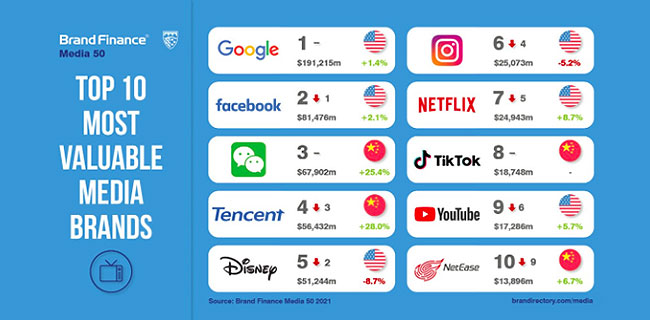
Search engines included in Brand Finance’s annual ranking of world’s most valuable media brands for first time, with Google claiming top spot – brand value nearly US$200 billion. TikTok breaks right into top 10 most valuable media brands after its first brand valuation. Social media and gaming brands among fastest-growing in ranking, with Chinese newcomers Bilibili and Huya improving most – at 106% and 74% respectively. TV networks and film studios suffer in wake of pandemic – CBS fastest-falling brand in ranking, losing half of brand value over last year. WeChat named strongest media brand with elite AAA+ rating, while Facebook struggles to overcome reputational issues.
View the full Brand Finance Media 50 2021 report here
For the first time, search engines are included in Brand Finance’s annual ranking of the world’s most valuable and strongest media brands, with Google claiming the top spot, following a 1% increase in brand value to US$191.2 billion.
Technology has become an integral part of all businesses, so Brand Finance has reclassified brands into the industries they are revolutionising. As a search engine, most of Google’s revenue is derived from advertising, leading to its inclusion as a media brand and the extension of the Brand Finance Media ranking to include 50 brands this year.
Google also owns the majority of internet advertisement infrastructure – controlling about 90% of search ads, managing the main ad exchange and server, running popular browser Chrome, and dominating smart devices with its Android operating system. Moreover, it manages widespread data centres, as well as a large portion of the cloud, which is where most of the ad dynamics occur. In addition to capitalising on ad spend, Google has since expanded into a variety of fields such as hardware, entering the smartphone industry by releasing the Pixel, its first handset.
The addition of search engine brands to the Brand Finance Media 50 2021 ranking follows expansions in previous years including streaming platforms, gaming brands, and social media as they continue to grow and carve out their own place in the media market, shifting the balance away from the networks, film studios, and publishers before them. Five further search engines feature in the extended ranking this year, with Yahoo! placing second highest after Google in 13th position with a brand value of US$9.4 billion.
Said Richard Haigh, Managing Director, Brand Finance: “Significantly better at innovating than its rivals, Google changed the marketplace of search engines, spearheading the digital media revolution in a way that distinguishes the brand above all others. No better indicator of this is the fact that the name Google has become a verb – ‘I’ll Google it’ is quite arguably one of the most widely used phrases of the 21st century.”
TikTok (known in China as Douyin) enters the Brand Finance Media 50 2021 ranking for the first time with a brand value of US$18.7 billion, launching into the top 10 most valuable media brands in 8th position.
Another Chinese video sharing platform Bilibili has gained more in brand value than any other brand in the Brand Finance Media 50 2021 ranking, with an impressive 106% increase to US$1.9 billion. Despite being known for its cache of video content, Bilibili draws a large portion of its sales from smartphone games, which accounted for 40% of its revenues in 2020 versus over 70% in 2018, indicating an attempt to diversify its revenue stream. In the first quarter of last year alone, Bilibili reached 172 million Monthly Active Users (MAUs), placing it in the same class as video services operated by Tencent (up 28% to US$56.4 billion).
Video game publisher Huya is the ranking’s second fastest-growing brand with an impressive 74% increase in brand value to US$1.6 billion. The brand celebrated an uptick in MAUs at the end of last year – reaching a total of 178.5 million people – as well as a boost to advertising revenues, primarily driven by its expanding and diversifying advertiser base.
Other gaming platforms that performed well this year include South Korean NCSoft (up 68% to US$2.2 billion) and Kakao (up 49% to US$1.8 billion), as well as Activision Blizzard (up 20% to US$6.3 billion) and Electronic Arts (up 14% to US$4.4 billion).
COVID-19 has exacerbated the widening gap between traditional media brands, with TV networks and film studios facing an uphill battle against online competitors. This is best exemplified by CBS being the fastest-falling brand in this year’s ranking, with a 49% decrease in brand value to US$5.9 billion, following a dramatic drop in advertising revenue and a disastrous merger with Viacom. However, CBS is not alone in its struggles, with NBC (down 44% to US$8.4 billion), 20th Television (down 25% to US$6.1 billion), and Universal (down 21% to US$11.6 billion) all seeing considerable declines in brand value as film and television production was halted.
Comparatively, Netflix enjoyed a spike in usage, causing its brand value to increase by 9% to US$24.9 billion. Netflix has been a pioneering force in changing consumers’ viewing habits, taking over traditional television by providing a more appealing, flexible option in line with the modern fast-paced lifestyle. With 37 million new users by the end of 2020, Netflix’s success has driven improved revenue forecasts and brand equity scores. Despite this, the streaming platform’s growth was not as substantial as in previous years due to challenges posed by competitors such as Disney (down 9% to US$51.2 billion) and HBO (down 3% to US$4.0 billion), which recently started offering streaming services in a bid to remain competitive.
Riding the airwaves of media revolution to offer more personalised, online consumer experiences, Spotify enjoyed an impressive 39% boost in brand value to US$5.6 billion. The music streaming platform has seen a significant increase in new users over the past year after expanding operations into 13 new markets. Spotify is now primed for further success as it continues to develop its capabilities, signing exclusive podcast contracts with Archie Comics and Joe Rogan, and acquiring Megaphone from Graham Holdings to improve its own podcast technology.
Added Richard Haigh, Managing Director, Brand Finance: “Podcasts are one of the primary motivators for listeners to upgrade to paid subscriptions on music streaming platforms, with the global podcast industry expected to grow by nearly 30% over the next five years. With these forecasts, and rivals already showing market intent, Spotify’s reign as the leading music streaming brand will be difficult to maintain.”
WeChat is the world’s strongest media brand with a Brand Strength Index (BSI) score of 95.4 out of 100. One of the world’s most popular social media apps, WeChat is also the strongest brand globally, according to the Brand Finance Global 500 2021 report, and one of only two brands in the media ranking to have been awarded the elite AAA+ brand strength rating, the other being Disney with a BSI score of 89.7 out of 100.
Alongside revenue forecasts, brand strength is a crucial driver of brand value, and as WeChat’s brand strength grew, its brand value also enjoyed a rapid boost, increasing by 25% to US$67.9 billion. One of China’s home-grown tech successes with very strong equity, WeChat enjoyed high scores in reputation and consideration among Chinese consumers – according to Brand Finance’s original market research – successfully implementing a broad and all-encompassing proposition that offers services from messaging and banking, to taxi services and online shopping, becoming essential to many users’ daily lives.
Said Richard Haigh, Managing Director, Brand Finance: “A beacon of innovation, WeChat has shown the value of constantly striving for technical development, particularly in the face of adversity. Though the company has done exceptionally well this year, lower levels of enthusiasm among younger adults in China may be a warning flag. It will be essential for WeChat to keep up its momentum to achieve similar successes in the year ahead.”
In stark contrast, social networking site Facebook trails behind WeChat by almost 20 BSI points, scoring 77.0 out of 100. With 2.8 billion active monthly users, Facebook remains the most popular social media platform in the world. Despite recording a marginal increase in brand value and placing second overall in this year’s ranking, Facebook has battled widespread scrutiny over privacy issues and suffered significant reputational damage in the wake of several political and social scandals, ultimately damaging its brand strength.
With an even lower BSI score of 72.5 out of 100, Twitter’s brand strength is similarly dented by issues with consumer trust and reputation. In the past year, the platform faced intense scrutiny over its handling of Donald Trump’s account, sparking raucous debate surrounding freedom of speech and accusations against the former US President for allegedly using the platform to incite violence and spread fake news.
 App enabler WeChat has unveiled a series of campaigns under the #StartHere handle. The idea was to communicate and position WeChat as the starting point of all conversations and interactions.