
Tag: websites

  • Why are young people abandoning news websites?


    By Nic Newman


    The crisis in journalism caused by the traditional news media’s struggles to cope with the digital revolution has been well documented over many years. But news organisations now face a much more fundamental change driven by generations who have grown up with and rely almost entirely on various digital media.

    Data published in this year’s Reuters Institute Digital News Report shows an acceleration in the structural shifts towards more digital, mobile and media environments. This is where news content is delivered via social media and now, increasingly video-led platforms such as TikTok, rather than via what to a new generation of media consumers look like the more formal and stuffy traditional of “legacy” media, including newspapers and television.

    Not only is consumption of traditional television news and print formats continuing to decline at a relentless rate, but online websites are also struggling to engage news users, despite the tumultuous times in which we live.

    One benchmark of this shift is a question we ask about key gateways that people use to access news. Using average data across all 46 countries surveyed in our annual report, we found that more people choose social media each year, mostly at the expense of direct access via a traditional news website or app. Access via search and other aggregators has also increased slightly over time.


    Use of news websites/apps versus social media to access news:
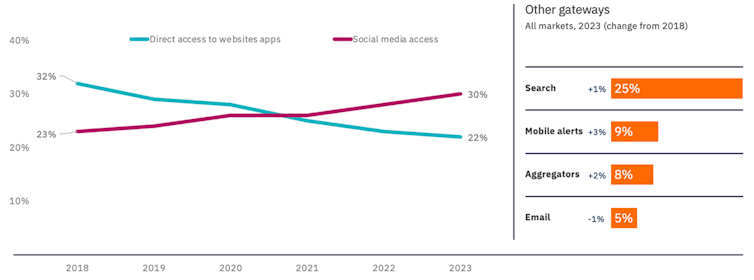
    Graph showing direct news website/app use decline and social news increasing.
    Which of these was the main way in which you came across news in the last week? Base: All who used a news gateway in the last week in each market-year ≈ 2000. Note: Number of markets grew from 36 in 2018 to 46 from 2021 onwards. Markets listed in online methodology.
    Reuters Institute for the Study of Journalism, Oxford University, Author provided


    These are averages, and it is important to point out that direct connection remains strong in some markets – mainly in northern Europe, where there is keen interest in news and relatively high trust. But elsewhere – especially in parts of Asia, Latin America, and Africa – social media or other aggregators are by far the most important gateways, leaving news brands much more dependent on third-party platforms for traffic.

    Generational differences are also a big part of the story. In almost every country we find that younger users are less likely to go directly to a news site or app and more likely to use social media or other intermediaries.

    The following chart for the UK shows that over-35s (blue line) have hardly changed their direct preferences over time, but that the 18–24 group (pink line) has become significantly less likely to use a news website or app.

    This is just one indication of how the generation that has grown up in the age of social and messaging apps is displaying very different behaviours as they come into adulthood.


    Percentage of people using a news website or app:
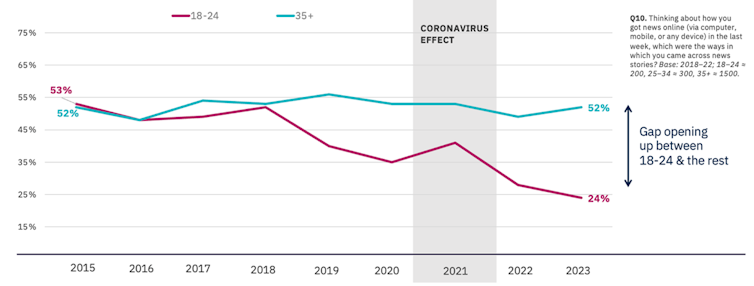
    Graph showing declining use of news websites and apps among 18-24 age group from 53% in 2015 to 24% in 2023 while 35+ group stayed around 52% (see previous two paragraphs).
    Thinking about how you got news online (via computer, mobile, or any device) in the last week, which were the ways in which you came across news stories? Base: 2018–22; 18–24 ≈ 200, 25–34 ≈ 300, 35+ ≈ 1500. Reuters Institute for the Study of Journalism, Oxford University, Author provided


    Dependence on social media may be growing, but it is not necessarily the same old networks. Across all age groups, Facebook is becoming much less important as a source of news – and by implication as a driver of traffic to news websites. Just 28% say they accessed news via Facebook in 2023 compared with 42% in 2016, based on data from 12 countries we have been tracking since 2014.

    This decline is partly driven by Facebook pulling back from news and partly by the way that video-based networks such as YouTube and TikTok are capturing much of the attention of younger users.

    Twitter usage is also reportedly declining following the chaotic set of changes introduced by Elon Musk, even if our survey shows relatively stable weekly reach overall.

    New platforms

    TikTok is the fastest growing social network in our survey, used by 44% of 18–24 year-olds for any purpose and by 20% for news (up five percentage points compared with last year). Our survey results also show that the Chinese-owned app is most heavily used in parts of Asia, Latin America and Africa.
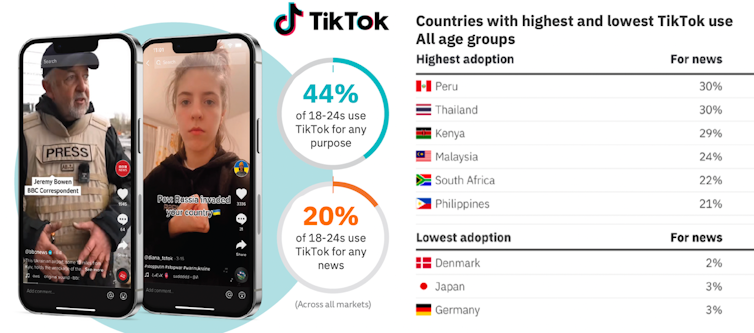
    Graph showing which platforms and websites people have used to access news.
    Which, if any, of the following have you used for news in the last week? Base: Total sample in each market ≈ 2000. Note: TikTok has been banned in India and does not operate in Hong Kong.
    Reuters Institute for the Study of Journalism, Oxford University, Author provided


    The report also provides evidence that users of TikTok, Instagram and Snapchat tend to pay more attention to celebrities and social media influencers than they do to journalists or media companies when it comes to news topics. This marks a sharp contrast with “legacy” – or more established – social networks such as Facebook and Twitter, where news organisations still attract most attention and lead conversations.

    Although news organisations have been experimenting with TikTok accounts, many are struggling to adapt to the more informal tone where creativity is the key to attracting an audience.

    These shifts are additionally challenging for publishers because they often require expensive bespoke content to be created and there are few ways to monetise short form videos, with limited linking opportunities back to websites or apps.


    Younger people less likely to read online

    These platform shifts are part of a wider move away from reading and towards watching or listening to news content online. While all age groups say they still prefer to read news online because of the speed and control if offers, younger groups are more likely to express preferences for watching or listening to news content, as the chart below shows. And this translates into greater consumption of short-form videos and podcasts by this group, according to our data.


    News consumption preferences by age and media:
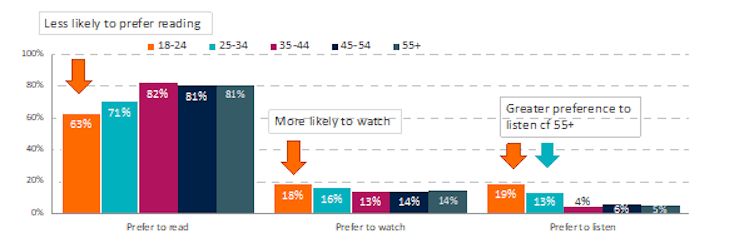
    Graph showing young people are less likely to read and more likely to watch or listen to news.
    In thinking about your online habits around news and current affairs, which of the following statements applies best to you? Please select one. Base UK= 1740 (excl. DKs)
    Reuters Institute for the Study of Journalism, Oxford University, Author provided


    Our research over more than a decade has captured the way that all age groups have adopted digital media, alongside more familiar formats such as TV and print. But now we are seeing the emergence of a generation of social natives that are not bound by traditional definitions of news.

    As our previous research has shown, younger groups expect news to be engaging, participatory and to be available on their terms – in the networks and platforms where they spend their time. Trust is not a given, it needs to be earned – as much by journalists as by any other creator of content.

    For all the difficulties this entails – around trust, attention and business models – this is the media environment that the public is increasingly choosing for themselves. It is one where journalists and news media will need to carve out their place if they want to maintain their relevance and connection with the wider public.The Conversation


    Nic Newman is Senior Research Associate, Reuters Institute for the Study of Journalism, University of Oxford. This article is republished from The Conversation under a Creative Commons license. Read the original article.


  • Loss of plurality is worrying: Paranjoy Guha Thakurta

    Paranjoy Guha Thakurta

    By Paranjoy Guha Thakurta


    This sort of an acquisition is part of a growing trend of ‘corporatization’ of the media where big business houses such as the Aditya Birla Group and the Reliance Industries group are investing into existing media groups. Through this process of consolidation, they are also bailing out these groups.


    The Raghav Behl-led Network 18 and Ramoji Rao-led Eenadu are now part of one big conglomerate because Reliance Industries Ltd (RIL) has bailed out both by pumping in a huge amount of money. On paper, it appears as if they are still separate corporate entities, which they are, as per the laws of the land. But the kind of associations they have struck gives an impression that they are now going to work like a conglomerate. Now this is exactly what has happened in the case of Mr Aroon Pourie who heads the India Today group which is also going to be one major conglomerate. So what we are seeing, in that sense, is the ‘cartelization’ of the media. There are cartels being formed, there are oligopolies being formed.


    The recession in the west has led to shrinking of advertising expenditures for the media in India and across the world especially after 2008, and this has had a direct impact on the fortunes of media organizations. So this process of consolidation has got expedited. What this means is that the media in India is going to become less plural, it’s going to be dominated by relatively fewer groups. What you are really seeing is, large corporate groups exercising greater dominance on the media. Now there are two implications.


    Also read:

    AV Birla group buys 27.5% in India Today group


    Birla may use personal money for buy, Mail Today may now launch editions in Mumbai, other metros


    Why media purists needn’t worry about Kumar Mangalam Birla’s 27.5 % in Living Media

    One is, of course, you are finding telecom companies (Mr Aditya Birla also happens to be the head of Idea and Mr Mukesh Ambani’s RIL is a major player in the broadband wireless access space), which are providing you communications, are also now playing an important role in companies that produce content. So the content providers and content distributors are coming together. This, in my opinion, is going to result in a loss of heterogeneity, resulting in a loss of plurality. In a sense, the oligopolies that are going to be formed will also impact the listeners of content, the viewers of content, or the readers of content. The content they get will be less heterogeneous.


    The other part of the story is that these companies are also big advertisers. Therefore, the clout of the advertiser will go up. As I said, the telecom service providers are now becoming important stakeholders in companies that are producing content. So the distributors of content are becoming stakeholders in the producers of content. Similarly what you also see at another level, the companies which are big advertisers are also now becoming the owners of the media. So in my opinion, these trends towards ‘cartelization’, or the formation of these giant corporate conglomerates is not going to lead to greater plurality as far as the consumers of content are concerned.


    The numbers of TV channels and newspapers and websites often give you a very deceptive kind of a picture and the capital is a classic example of that.Delhiis the only city in the world with 16 English language daily newspapers. This gives you a misleading picture, that readers of English dailies inDelhihave a huge choice. But the fact of the matter is that two newspapers, The Times of India and Hindustan Times would account for well over three-fourths of the total market of all English daily newspapers. And if you add to that Economic Times, then these three publications put together would account for more than 80 per cent of the total circulation of all English newspapers in India. So, in terms of numbers it looks good, but if you look at the structure of the market, you see few dominant players.


    In India, unlike in other countries of the world, like US, UK or Australia, there are no cross-media restrictions. In other countries, there are both vertical as well as horizontal restrictions. Vertical restrictions mean that the content producer and the content distributor are different companies/groups. In India, the same guys who are producing content are also distributing the content. You have the DMK controlling the distribution channel and also producing the television channel; you have Zee News producing news and also controlling Dish TV. There are clear conflicts of interest that arise if your distributor and the provider are the same. That’s only one part of the story.


    The other is what is called horizontal cross media restrictions. That means, the same company dominates all forms of the media, like print, radio, TV, in the same geographical area. In our country we don’t have any legal restrictions on cross media holdings. As far as the media is concerned, the group concept or the conglomerate concept does not operate in our country. So you have Bennett Coleman Ltd which brings out various print publications, and then you have Times Global Broadcasting which brings out the television content. These two companies happen to be controlled by the same set of people. But because the legal restrictions that exist in India apply to individual entities and not to conglomerates, effectively you have no cross-media restriction.


    Speaking of editorial content, editors will not publish or broadcast anything that would go against the interest of the corporate that controls; these would become subtle forms of censorship and control. For instance, Living Media which includes, Aaj Tak, India Today, Headlines Today and Mail Today, these publications or these broadcasters are unlikely to publish anything negative that could affect the business interests of the Aditya Birla Group. So that could be an eminent danger, that degrees of freedom that editors and content providers would enjoy, would get curtailed not just because of the pattern of ownership but also because the owners of major conglomerates are also major advertisers.


    Even if on paper, the editors have the autonomy and independence to publish what they like, there could be subtle forms of censorship wherein editors would feel constrained or would think twice before publishing any story that could in any way go against the interest of the promoters of the company that control these media conglomerates.


    I am optimistic about the future of media in India but I am also concerned about the fact there is loss of heterogeneity, loss of choices to the consumer.


    (As told to Shruti Pushkarna)


    Paranjoy Guha Thakurta is a senior journalist, editor and broadcaster based in New Delhi.


  • Dussehra, Durga Puja go online

    By A Correspondent

    With Dussehra and Durga Puja coming up, Getit has introduced new websites for the two festivals. These websites provide knowledge and connect people with the splendour of these festivals. The websites, http://mysoredussehra.getit.in/ and http://durgapuja.getit.in/, have information about the festival, the background, recipes, rituals etc, and the Durga Puja website also gives an insight into the top Puja Pandals. The site has integrated search, allowing users to find companies offering services related to the Puja festivities.

    The ‘Mysore Dussehra’ website showcases the grandness of this festival in most parts of Karnataka. Getit, through the special site, aims to provide a platform for users to find all information related to the festival, as well as conduct a search to find suppliers/products that one needs.

    Commenting on the launch, Mr Sidharth Gupta, CEO, GETIT Infoservices Pvt Ltd said, “Festivals are the best time to get closer to our customers by giving them the right solutions to help them celebrate with ease. Based on the success and acceptance of our Onam webite, we have launched these two sites for Dussehra and Durga Puja. The fact that we can provide search solutions integrated into these sites, significantly enhances their utility.”