Tag: WARC Data

  • WARC Global Advertising Trends: The Investment Gap

    By Our Staff


    A new WARC analysis of advertising spend forecasts for 100 markets worldwide and the results of a survey by GWI of more than 715,000 consumers, show that advertiser spend on TV and social media is highly inflated in relation to daily consumption. These findings are published today by WARC, the international marketing intelligence service, as part of its new WARC Data Premium suite, launched today.


    The analysis finds that as of the first quarter of 2021, social media now attracts more investment from advertisers than linear TV for the first time, however both media draw far more of advertising budgets than the average consumer spends with these channels each day.


    Social media, for example, is forecast to account for 39.1% of 2022 adspend among the eight media studied in the report – linear TV, online video, social media, print press, online press, podcasts, broadcast radio and online audio – but has a 21.4% share of daily media consumption, a discrepancy of 17.7 percentage points (pp) equivalent in value to $94.3bn.


    Social media has accounted for over two hours of daily media consumption since Q2 2016, per GWI monitoring, and WARC Data Premium’s latest forecasts expect daily social time to reach 2:30 during the second half of next year.


    Notably, all demographics measured in the report are set to spend twice as long with social media as they are with online press next year, despite ongoing trust issues – less than one-half of adults say advertising on social media is ‘somewhat’ or ‘very’ trustworthy, falling to 28% in China, 19% in the US and just 10% in the UK.


    Despite this, the largest gaps between social consumption and adspend can be found in China (where advertiser spend is 3.3x consumption), the UK (2.2x) and the US (2.0x). Conversely, in Australia (0.9x), India (0.4x) and Russia (0.5x), social’s share of daily media consumption is higher than its share of advertising budgets – a potential indicator of opportunity for brands.


    Linear TV adspend is 2x daily consumption, but online video investment is balanced Linear TV is forecast to account for a 31.5% share of advertising spend next year among the eight media studied, compared to a 16.1% share of daily media consumption. This would equate to an investment gap of $86.9bn worldwide next year.


    An overspend in relation to consumption does not translate directly into waste, and proportions vary by size of budget. Successful high-budget campaigns spending over $10m, for example, typically allocate 60% of their budgets to TV, while successful alcoholic drinks campaigns typically allocate 44%.


    While linear TV spend is inflated in relation to its consumption, online video is now close to parity after years of underinvestment. It is worth noting that the world’s largest online video platform – Netflix – is predominantly adfree, while platforms such as YouTube are prone to ad blocking on desktop and mobile devices.


    Still, advertisers are forecast to spend $71.9bn on online video this year, a 13.6% share of the eight studies media which compares to a 12.9% of media consumption, or one hour 37 minutes.


    Audio and online press heavily undervalued Data show that audio media appear highly undervalued – a trend that was recently highlighted by WARC in the US.


    Perhaps most notably, podcasts are found to be undervalued by $40bn, with the greatest opportunities for advertisers among audiences aged 16-24, middle earners, and those educated until the age of 16.


    One in three internet users now listens to a podcast each month, but a cost per thousand (CPM) of $23.55 is higher than even TV. Spotify has quickly gained ground on Apple to become the largest app for podcast streaming as of March this year.


    Online press also appears to be another heavy undervalued medium: advertisers would need to spend $58.0bn on online press ads globally next year to achieve parity with consumption levels. Instead, forecast spend is just $12.8bn.


    Business models in the publishing sector have been diversifying to counter the shortfall in advertising revenue; 76% of publishers are prioritising subscriptions this year.


    Said James McDonald, Managing Editor, WARC Data, and author of the report: “The study shines a light on divergences between media investment and consumption, two metrics which are rarely seen to be in lockstep with one another. In some cases, particularly for undervalued audio formats such as podcasts, this presents a good opportunity for canny practitioners to reach audiences with comparatively little competition.


    “For industry stalwarts like linear TV, the seemingly inflated investment gap actually speaks more to the enduring power of the medium – its vast reach combined with attentive audiences and the heightened impact of audiovisual creative. These traits allow it to command a premium in the media mix, one which is likely to sustain even as social media further grows its share of budgets.”


  • WARC Adspend Trendwatch


    By Our Staff


    Global advertising spend is on course for 12.6% growth this year to reach US$665bn, an upgrade from 6.7% initially projected, as the global ad market rebounds strongly from the Covid-19 downturn of last year, finds WARC, the international intelligence service. Further growth, of 8.2%, is forecast for 2022, by when the global advertising market will be worth more than US$700bn.


    New quarterly research from 100 markets by WARC finds that advertising spend in Q2 2021 rose 23.6% to a total of US$157.6bn – a new high for a second quarter period and the strongest rise in over a decade.


    Growth in the second quarter was driven mostly by online formats, which collectively saw spend rise by 31.2% versus the previous year. eCommerce (+59.5%) and search (+50.6%) were star performers, though offline media – most notably linear TV (+11.5%) – also fared well.


    The second quarter rise in global ad trade followed on from 12.5% growth in the first quarter; consequently, at US$311.5bn, global ad investment was 17.8% higher during the first six months of the year than during the same period in 2020.


    New research lays bare the scale of the 2020 ad recession. While total spend fell by 5.4% – approximately half the rate initially estimated – spend on offline media such as print, radio, TV and cinema fell by a fifth, or US$63bn, equating to the worst downturn for this sector in WARC’s 40 years of market monitoring.


    Spend online, however, rose by 9.4% ($29.2bn) last year, buoyed by rising eCommerce (+27.4%), social media (+18.3%) and online video (+15.9%) investment.


    Online media gained 10 percentage points in budget allocation last year in the automotive and financial categories, a rate of increase that was double the pre-pandemic average. All product sectors are allocating more of their ad budget to online formats than before the pandemic.


    Online formats are also leading growth in 2021, with WARC forecasting spend on eCommerce advertising to rise 35.2% this year, mostly to the benefit of Amazon. Brand spend on search – where Google is the largest player – is set to rise by over a quarter (26.2%) this year, while online video spend is expected to be up by 17.7% and social media by 13.1% this year. All of these formats are expected to record growth in 2022, too.


    Said James McDonald, Managing Editor, WARC Data, and author of the report: “New quarterly research, collated from 100 markets worldwide, shows for the first time the true extent of the digital shift in response to the coronavirus outbreak last year. Growth in online adspend has typically tracked some 20 percentage points ahead of offline media, but in the final quarter of 2020 this leapt to a remarkable 41 points – an absolute difference of $41bn.Investment in offline media fell by $63bn worldwide in 2020, marking the worst year in living memory for the majority of media owners. All media are forecast to record growth this year, with most sustaining this into 2022. Yet, as has been seen before, it is the online platforms that are set to benefit most from the ad market’s recovery.”


    Trends by media and format 2021/2022

    :: Linear TV: Spend is projected to grow 7.1% – or $11.1bn – to $168.1bn this year, equal to a quarter (25.3%) of the global ad market. Investment is expected to rise by a further 2.7% in 2022, though this means only 60% of 2020’s losses will be recovered by 2022.

    :: Out of home: Double-digit growth is expected in both 2021 (17.4%) and 2022 (11.2%) as the medium recovers from the lowest level of investment in over a decade. This year will see $34.9bn being spent and this is set to rise to $38.8bn next year, though this still leaves the market $2.6bn short from 2019’s level of investment.

    :: Cinema: Spend was heavily curtailed in 2020 and a strong recovery looks underway. Cinema is forecast to be the fastest growing medium in both 2021 (149.9%) and 2022 (26.9%), taking total investment to $3.4bn next year.

    :: Linear radio: Investment in radio ads is projected to increase by double-digits (10.4%) – or $2.5bn – this year. However, spend in 2022 will largely be flat (0.8%) to a total of $26.6bn.

    :: Newspapers: Advertising spend on print newspapers will rise by 4.8% this year, the first growth recorded in a decade. This puts the total at $29.6bn, before a mild decline of 1.0% is projected for 2022.

    :: Magazines: Investment is expected to rise by a modest 2.5% this year before falling into decline of 4.3% next year. This means magazine brands in 2022 will have recovered just 5% of 2020’s lost advertising revenue.

    :: Social media: Social formats, combined, were among the strongest performers in 2020, recording total growth of 18.3% to a total of $99.2bn. Social spend is set to rise by 13.1% in 2021 and a further 10.1% in 2022, by when the market will be worth $123.5bn – approaching a fifth (17.2%) of all advertising spend worldwide.

    :: Online video: Online video spend rose 15.9% to reach $54.9bn in 2020. Growth is forecast to accelerate to 17.7% this year, with a rise of 15.9% predicted in 2022.

    :: eCommerce: Brand spend on eCommerce platforms leapt 27.4% last year as shoppers migrated online in response to social distancing guidelines. Advertising growth in this sector is now expected to accelerate to over a third (35.2%) in 2021, pushing the market’s value to a total of US$85.2bn. Further growth, of 11.4%, is forecast next year.

    :: Paid search: The search market recorded its first decline on record during the second quarter of 2020, though a strong finish to the year meant investment was up by 5.4% during 2020 as a whole. Rapid growth, of 26.2%, is forecast for 2021; the search market grew by a record 50.6% during Q2 2021 alone. Growth will then ease back to 4.3% in 2022, by when the market will be worth $151.9bn, 21.1% of all adspend.


    Trends by region 2021/2022

    :: North America: Spend in the largest region (with a 38% share of all investment) is expected to rise by 12.8% this year to reach $254.9bn, driven by a 12.7% increase to $242.5bn in the US and a 14.5% rise to $12.3bn in Canada. North America will see spend rise 8.4% next year to reach a new high of $276.3bn.

    :: Asia Pacific: Regional advertising investment is projected to increase by 12.8% this year to top $200bn for the first time. This will be driven by the Chinese ad market, which is expected to grow by 16.3% to top $100bn for the first time. Japan (+8.9% to $44.4bn) and Australia (+11.6% to $12.2bn) are also set for full recoveries this year. India, however, will see strong growth (+16.1% to $8.2bn) but 2021 investment will not fully recover 2020’s losses.

    :: Europe: Spend in Europe is expected to rise by 12.1% this year to reach $154.6bn, with 6.5% growth projected for 2022. Spain (+16.6% to $7.6bn) and the UK (+15.5% to $33.3bn) will be the quickest growing major markets this year. Russia (+14.4% to $9.3bn), Italy (+11.9% to $9.9bn), France (+11.4% to $15.7bn) and Germany (+9.7% to $26.6bn) will also see strong growth, though Spain and Russia will not recover all of 2020’s losses this year.

    :: Latin America: Ad investment is projected to rise by double-digits in both 2021 (16.9%) and 2022 (11.1%) to reach $24.8bn next year. However, this is still down 7.8% from 2019 levels owing to a steep contraction in 2020, particularly in the region’s largest market – Brazilian adspend (in US dollar terms) fell by more than a third in 2020, with 22.3% growth projected for this year and a 12.4% rise expected in 2022 (to reach $13.2bn).

    :: Middle East: Following a one-quarter decline in spend last year, regional advertising growth will be 6.2% this year and will then accelerate to 15.1% in 2022. This puts total investment at $13.2bn next year, $1.2bn less than the pre-pandemic level in 2019.

    :: Africa: Spend is projected to rise by 9.7% this year to reach $6.2bn, with further growth of 7.3% expected for 2022.


    Trends by product category (Five largest in 2022)

    :: Telecoms & utilities: The quickest growing category pre-pandemic shows no sign of slowing as advertising spend is expected to grow almost twice as quick as the wider ad market in 2021 and 2022. Total investment will increase by 21.1% this year and then 11.2% next year to reach a projected $95bn, extending telecoms & utilities’ lead as the largest advertising category.

    :: Media & publishing: Advertising spend from media brands is expected to top $70bn worldwide this year for the first time, growing 18.3% (the third quickest rate) and easily surpassing the mild decline last year. Further growth of 6.9% is expected in 2022, with online media expected to take an almost three-quarters share of total investment, up from one-quarter in 2013.

    :: Business & industrial: Investment from business advertisers is forecast to rise by double-digits (10.6%) this year to equal $69.3bn. Growth of 7.7% is expected in 2022, the third quickest rate that year, which will take total adspend to $74.6bn and within touching distance of overtaking media & publishing as the second largest category.

    :: Retail: A cut to advertising budgets of $6.2bn last year will only just be recovered this year – investment is projected to rise by 11.1% to reach $66.2 in 2021, just 0.6% higher than pre-pandemic spend in 2019. WARC Data’s analysis of company reports also finds that while some retailers were modest in their ad cuts last year, like Amazon (-0.9%) and Best Buy (-2.5%), others were more severe – Walmart (-13.5%), Carrefour (-22.8%) and TJX (-34.5%) cut their adspend by double-digits in 2020.

    :: Financial services: Steep cuts to automotive advertising last year has pushed financial services into the top five largest categories. Total investment is projected to rise by 17.9% in 2021 and this will push spend above $50bn for the first time. Additional growth of 7.0% is expected next year, furthering its lead over sixth placed automotive.


    A sample report of WARC’s Global Ad Trends: Ad Investment 2021/22 is available for all here. WARC Data subscribers can read the report in full.


    Global Ad Trends, a bi-monthly report which draws on WARC’s dataset of advertising and media intelligence to take a holistic view on current industry developments, is part of WARC Data, a dedicated independent and objective one-stop online subscription service which rigorously harmonises, aggregates, verifies and evaluates data from over 100 reputable sources.


     

  • WARC’s global trend sheds focus on search advertising

    By A Correspondent


    WARC has found that investment in search advertising will rise 9.6 per cent this year, to $135.9bn – equal to 22.0 per cent of all advertising spend worldwide. But this growth rate is the softest since 2015 and is a marked slowdown from the 16.9 per cent rise in 2018. Search’s share of internet advertising has now flatlined at 45.8 per cent – the lowest in more than a decade.


    The squeeze on Google’s main source of revenue has forced it to confront Amazon head on in the smart speaker market, as it looks to facilitate voice search in future paths to purchase. But Amazon has a first-mover advantage in many markets, notably the US, UK and Japan. Control of voice search could be critical to either’s success in future; most marketers understand its potential in the coming years but few have plans to use voice search today.


    Mobile is driving growth in the search market

    Mobile search adspend is expected to rise 19.2per cent to $88.1bn this year – almost two-thirds (64.8per cent) of total search spend worldwide. The US alone accounts for 43.0per cent of this total (US$38.1bn in 2019), while a fifth (21.8per cent, or $19.3bn) is transacted in China. Japan ($6.1bn, a 6.9per cent share) and the UK ($5.3bn, 6.0per cent) follow.

    Google accounts for 95.4per cent of all mobile searches worldwide, higher than its share of desktop search traffic (88.6per cent). Google’s share of mobile search traffic in the US (94.4per cent) and UK (97.9per cent) is close to its global rate but in China its share is near zero, with Baidu the incumbent on 79.9per cent.

    Mobile’s share of search advertising investment is rising ahead of mobile’s share of search traffic, which has plateaued globally since 2017 as consumers spend more time in app (over 80per cent of mobile usage is in-app, according to comScore).

    Research by Mindshare shows that Instagram is used by 69per cent of consumers to discover products, ahead of Snap at 64per cent and Facebook at 61per cent. Google is used most to research, with 70per cent of consumers utilising the platform in this way (versus 51per cent for second-highest Pinterest). Crucially, however, Amazon is used most to buy; 78per cent of Amazon users report this, compared to 40per cent using Google for the same purpose.

    One in three (32per cent) online purchases in the UK begins on Amazon, rising to 52per cent for entertainment products, 50per cent for children’s products, 47per cent for household items and 40per cent for electronics. Comparatively, one in five (19per cent) online purchases begins with a search engine, such as Google.

    Amazon made $35bn from e-commerce in Q3 2019, up by a fifth from the previous year and putting it on course to reach close to $150bn in sales for 2019 as a whole. Over one in ten (11per cent) product page views come from sponsored ads, according to data from Jumpshot.


    Voice is becoming a new search battleground

    Voice is an area of growth for search advertising, aided by the rising popularity of smart speakers – an area where competition between Google and Amazon is fierce. More than one in ten internet users in the US and UK now own a smart speaker. Amazon enjoys a healthy lead over Google in a number of key markets, including the US, where three-quarters of smart speaker owners use Alexa. In the UK, that share is 77per cent.

    The ‘first-mover’ advantage is crucial here, however. Google was first to launch in Australia and enjoys a comfortable lead over Amazon (86per cent penetration versus Amazon’s 15per cent), and the same is true in Singapore (76per cent versus 24per cent). This may not bode well for Facebook, which is developing an AI assistant for its Portal devices and is playing catch up to win market share in this area.

    For all the potential, voice search remains a niche pursuit for advertisers today: only one in ten US practitioners plans to include it within their marketing strategy for 2020. A quarter (25.2per cent) believe it will be an ‘extremely’ important marketing channel within the next three to five years, but half (48.9per cent) have no plans to utilise the tech in the short-term.

    Said James McDonald, Managing Editor, WARC Data, and author of the research: “Search has boomed over the last decade as practitioners have put a greater emphasis on performance-related advertising to lift ROI – few marketing strategies exclude a search element today. WARC research shows that practitioners regard it as the easiest channel to measure accurately, and it is more cost effective in driving conversions when compared to online display formats such as video. But the industry is beginning to question whether this focus has been beneficial in the long run, with a number of large, consumer-facing businesses considering a pivot back to more conventional brand building formats. This could explain, in part, the slowdown in search investment this year, a cooling which will reignite Google’s drive to control the next frontier: voice-assisted search.”


  • Globally, most products are moving adspends online: WARC report


    By A Correspondent


    TV still attracts over two-thirds of advertising investment within the soft drinks sector, while a similar share is seen in the food category – both sectors are far less likely to have been disrupted by e-commerce, so the need for high levels of digital adspend to facilitate a path to purchase is reduced.

    But across all categories, ad investment is shifting heavily into internet formats. The pivot to online advertising is particularly stark within financial services and retail, with both sectors having heavily developed digital platforms to serve their customers in recent years.

    These are some of the findings by WARC, the global authority on advertising and media effectiveness, drawn from an analysis of its newly relaunched WARC Data product, which provides a new industry standard measure of net advertising investment data across 19 product categories in 23 markets, including the United States, United Kingdom and China.


    Said James McDonald, Managing Editor, WARC Data, and author of the research: “In a multichannel world, it has become harder than ever to track campaign performance, measure ROI, or to even trust third-party data. Additionally, the problem is compounded by an environment of ad blocking, fraud, and consumer distrust, and is hazed by walled gardens, programmatic stacks and opaque practice. This results in millions of ad dollars wasted each year. But it is essential that ad investment works harder in the media mix to obtain optimal reach and effectiveness. As such, our latest research into product category insights provides vital data to help brand owners, agencies and media strategists and planners inform their decision making.”

    In WARC’s latest ‘Global Advertising Trends – Benchmarking ad investment by product category’, the industry intelligence included in the report sheds light on how different sectors value advertising media, and how this has changed over time.

    Key findings for five of the 19 product categories available include: 

    Financial Services

    :: Total global adspend in 2018: $43.2bn (+13.0% year-on-year)

    :: Median revenue ROI for successful campaigns: 2.93

    :: Media spend: Internet $19.7bn (+24.4% year-on-year). TV $12.9bn (+4.0%).

    :: Radio $3.7bn (+5.1%). Other $7.0bn (+6.7%)

    :: Ad/sales ratios: Financial services (3.6%). Banks, credit, loans (6.7%). Insurance (0.8%). Investment (1.5%).


    Close to half of the $43.2bn financial services brands invested in advertising last year was directed towards internet formats. The data show a dramatic shift to digital over the last five years; internet’s share of sector spend has grown 22.0 percentage points (pp) since 2013, to 45.5% last year. This is just above internet’s share of global adspend (44.1%). As a share of sales revenue, the sector spends 3.6% on advertising, rising to 6.7% among banks.


    Food

    :: Total global adspend in 2018: $25.3bn (+1.4% year-on-year)

    :: Median revenue ROI for successful campaigns: 2.93

    :: Media spend: TV $16.5bn (+1.0% year-on-year). Internet $3.7bn (+7.9%). Print $2.8bn (-12.7%). Other $2.3bn (+15.3%)

    :: Ad/sales ratios: Food (2.6%). Confectionery (5.6%). Dairy (0.6%). Meat, fish, poultry (0.7%).


    Almost two-thirds of the $25.3bn in ad investment within the food category last year was spent on TV, nearly double TV’s global share of 33.3%. TV spend in the sector rose 1.0% year-on-year to $16.5bn in 2018 but has dipped by 3.7% each year since 2013 on a compound basis. Print also accounts for a greater share of food adspend than is the case globally, with newspapers’ (-2.6pp) and magazines’ (-2.1pp) share dipping mildly over the last five years.


    Retail

    :: Total global adspend in 2018: $62.3bn (+0.0% year-on-year)

    :: Median revenue ROI for successful campaigns: 4.40

    :: Media spend: Internet $21.5bn (+9.1% year-on-year). TV $20.3bn (-0.6%). Print $9.6bn (-15.5%). Other $10.9bn (+0.8%)

    :: Ad/sales ratios: Retail 2.3%. Clothing & fashion (2.9%). Restaurants (2.0%). Supermarkets (1.2%).


    Global advertising spend in the retail sector was flat in 2018 at $62.3bn. The $1.8bn in extra internet spend (up 9.1% from 2017) was offset by a decline in spend for all other media bar out of home (+12.7%) and cinema (+4.9%). Ad investment among the retail sector has tracked downwards in recent years, recording a compound annual growth rate of -1.8% since 2013. However, online advertising has become far more valuable to the sector during this time.


    Soft drinks

    :: Total global adspend in 2018: $15.1bn (+1.1% year-on-year)

    :: Median revenue ROI for successful campaigns: 2.84

    :: Media spend: TV $10.5bn (+1.1% year-on-year). Internet $1.9bn (+28.3%). OOH $1.3bn (-24.1%). Other $1.4bn (+1.3%)

    :: Ad/sales ratios: Soft drinks (5.9%). Bottled water (5.9%). Carbonated (5.9%).


    At 70.0%, TV’s share of soft drinks brands’ adspend is higher than all other categories studied for the report. The $10.5bn spent on TV ads in 2018 was up 1.1% from 2017

    and has grown at a compound rate of 2.0% each year since 2013 – bucking the global trend. However, investment in other media – chiefly internet – has eroded TV’s share of sector spend by 4.4pp over the five years to 2018. Internet formats still draw a relatively small amount of investment, at 12.8%; this is almost three times less than the global level and is likely a reflection of how little e-commerce has disrupted the sector.


    Toiletries & cosmetics

    :: Total global adspend in 2018: $25.7bn (-3.6% year-on-year)

    :: Median revenue ROI for successful campaigns: 2.06

    :: Media spend: TV $14.9bn (-3.9% year-on-year). Internet $5.6bn (+9.7%). Print $2.9bn (-12.0%). Other $2.3bn (-15.9%)

    :: Ad/sales ratios: Toiletries & costmetics (16.9%). Bath toiletries & soaps (12.3%). Fragrances (21.5%).


    At a top line level, ad investment within the toiletries & cosmetics sector has dipped 4.1% each year since 2013 on a compound basis, to a total of $25.7bn last year. This is largely due to how this spend has been allocated historically: in 2013, TV accounted for two-thirds of adspend while print drew a further fifth. Both of these media have recorded declining spend over the period, with internet (+10.7pp) and out of home (+4.7pp) gaining most in share but from a low base -depressing total investment growth in recent years. Print still accounts for 11.4% of sector spend, with magazines alone worth over $2bn, but this total has more than halved since 2013.


  • Cinema advertising making a strong headway globally, notes WARC report

    By A Correspondent


    The global cinema advertising market is expected to be worth $4.6bn this year, representing a 6.8 per cent rise from 2018. This is ahead of the all-media growth forecast by WARC, of 4.6 per cent for 2019 (to $624.9bn), and places cinema as the second-fastest growing ad medium this year, behind internet as a whole.


    While small, cinema’s 0.7 per cent share of global adspend is expected to hold steady in 2019, making it the only medium other than Internet not to lose share. Figures from WARC’s Adspend Database show that cinema’s share of global adspend has dipped only twice since 1980 (1994 and 2013) and growth in cinema ad investment has generally tracked ahead of other traditional media since 1981, and consistently so since 2014.


    In Europe, advertisers spend 1.6 times more on cinema per admission than in the US. The UK leads the way, with spend per admission rising from £0.18 in 1980 to £1.43 last year, when 177m admissions were recorded – the highest on record. This despite 46% of UK consumers stating that Netflix is their first choice for watching movies, according to GlobalWebIndex.


    The report notes that China is the largest cinema ad market globally, with RMB11.9bn (US$1.8bn) expected to be spent this year. This equates to a 47.3 per cent share of global cinema adspend when measured in Purchasing Power Parity terms. Further, China has accounted for three quarters (74.9 per cent) of global growth in Cinema adspend since 2015, on average, and is expected to contribute 87.4 per cent towards global cinema growth this year.


    In the US, the world’s second-largest cinema market with a projected value of $735m this year, the medium draws less than half a percent of media budgets on average. Seven product categories allocate more than this, most notably food, for which cinema accounts for 1.5 per cent of all media spend.


    Captive audiences viewing high-quality ads in an emotional atmosphere is a draw for advertisers. Research by Ebiquity has found that Cinema outperforms all other media at triggering an emotional response, guaranteeing a safe environment, and getting ads noticed. However, the medium scores lowest in increasing campaign ROI, maximising campaign reach, and generating short-term sales.


    Further, data from the Motion Picture Association of America (MPAA) show that the amount consumers spend on digital home entertainment, including on online subscriptions such as Netflix, surpassed the amount spent at the cinema globally for the first-time last year ($42.6bn versus $41.1bn). This landmark had already been reached in the US during 2015.


    Over the course of an average year, a Netflix subscription will cost a consumer US$113.16. This compares to the $45.55 a North American will spend at the cinema each year on average, with the equivalent figures for the UK and the EU at $25.13 and $11.04 respectively.


    In the US, a moviegoer visited the cinema five times on average in 2018, which roughly equates to 263m consumers going every two months. But with almost three-quarters (74 per cent) of Americans now using an online subscription – and 84 per cent using a pay TV channel – to watch a movie at least 2-3 times each month, viewership in the living room may have reached parity with the silver screen.


    Said James McDonald, Managing Editor, WARC Data, and author of the research: “The experiential nature of cinema places it in a different bracket to SVOD services, which instead occupy a similar space to traditional TV. This, coupled with the exclusivity of box office hits – particularly franchises – should ensure any downward pressure from SVOD services is minimal in the short-term.


    “Cinema offers advertisers access to younger, more affluent audiences who have an affinity with the medium. This enables ads to be screened in a brand safe environment where they will be noticed, often in a location that is close to a retail outlet and, by extension, a point of purchase.”


  • $66bn in ad sponsorship this year


    By A Correspondent


    Advertisers are expected to spend a combined $66bn on sponsorship this year, though fewer than one in five are confident that they can actually measure the business value return of the sponsorships they undertake.

    These and other key findings are included in the latest monthly Global Ad Trends report focusing on sponsorship compiled by WARC, the international authority on advertising and media effectiveness.

    Sponsorship growth is trending ahead of most paid media, and $66bn is expected to be invested this year – mostly on sports properties

    Brand spend on sponsorship – inclusive of rights but excluding activation – is expected to rise 4.9% to reach $65.8bn worldwide this year. Sponsorship is growing faster than all paid media channels excluding internet formats.

    North America makes up the greatest share of spend (36.8%, or $24.2bn), followed by Europe (26.7% or $17.6bn), Asia-Pacific (25.2% or $16.6bn), Latin America (7.0% or $4.6bn), and then the Middle East & Africa (4.3% or $2.8bn).

    Most of this money is going to sports properties. Among these are the FIFA World Cup in Russia, which is thought to have attracted $1.7bn worth of deals. At a time of fragmentation, sport offers large, engaged, multiscreen audiences: by volume of data, the 2018 FIFA World Cup was the most-streamed sporting event in history. TV is still king for live sporting events, with World Cup matches reaching 44% of the global population via television.

    Sponsorships are principally used to drive brand metrics and reach

    Generating brand awareness is the most important objective for sponsorship campaigns. This mirrors separate WARC research in this year’s WARC 100 that found 61% of successful campaigns counted brand awareness as a core objective. This suggests sponsorship plays the same role as mass-reach media, fitting into the ‘upper-funnel’ of a marketing plan (generating awareness and consideration).

    Sponsors rely on intermediate metrics; true ROI remains a challenge

    Only 19% of sponsorship professionals are confident that they can actually measure the business value return of the sponsorships they undertake. Further, only 37% of practitioners have a standardised process for measuring sponsorship.

    The top two named tools used for evaluation are digital and social media metrics. However, the Association of National Advertisers (ANA) states that social media metrics often provide a “distracting noise” due to their weak relationship to sales.

    Social Media and live events power sponsorship activation

    Social is considered the number one activation channel for sponsorships by 83% of marketers. However, the prevailing sentiment is that authentic engagement of sponsorship, through digital and social activation, remains a challenge.

    Possibly by way of remedy, the share of marketers activating sponsorships through experiential live events has risen to two-thirds (65%) over the last year.

    Summing up, James McDonald, Data Editor, WARC, says: “As brands continue to jostle for a finite amount of consumer attention, the changing way in which media is consumed has led to the fragmentation of audiences. Yet sports generate an engaged, mass audience which sponsors can reach, before amplifying their campaigns via social media and experiential events.

    “Sponsorships facilitate the upper part of the sales funnel – driving brand awareness and consideration – in much the same way as TV. This can present challenges, however, such as the knowledge gap between brand impact and sales impact.”

    Global media analysis: A round-up of sponsorship

    ·  4.9% forecast rise in sponsorship spend this year, outpacing the majority of paid media

    ·  19% of practitioners who say they can confidently measure the ROI of their sponsorship campaigns

    ·  39% of Russia World Cup sponsorship deals originating in Asia

    ·  44% reach of global population for both the FIFA World Cup and Olympic Games

    ·  73% of advertisers stating that brand awareness is the most important objective for sponsorship campaigns

    ·  83% of marketers who use social media to amplify sponsorship campaigns


    Other new key media intelligence on WARC Data

    ·  Advertisers to spend over $20bn on consumer data this year

    ·  Blockchain adoption is low, though over half of advertisers intend to use in future

    ·  Word-of-mouth most popular way to discover new video content

    ·  Over a third of UK adults have access to a connected TV


  • Newsbrands diversify to plug $28bn financial hole


    Newsbrands’ combined revenue has dipped globally by $27.8bn between 2012 and 2017, with rising income from print circulation and digital advertising not enough to offset a $40.1bn decline in print ad receipts over the period. Publishers are now looking to diversify business models to balance the deficit.


    These and other key findings are included the latest monthly Global Ad Trends report focusing on print and digital publishing compiled by WARC, the international authority on advertising and media effectiveness.


    Print still provides over 90% of newsbrands’ revenue and total income is down $28bn since 2012

    Print (print advertising and print circulation) still accounts for over 90% of newsbrands’ revenue worldwide, though the majority now comes from circulation. Print circulation revenue has grown by around 1.6% each year, rising from $80.4bn in 2012 to an estimated $86.8bn in 2017 (57.5% of the total). Once the main source of income, print advertising now contributes 33.2% towards the bottom line.

    Digital (digital advertising and digital circulation)’s share of newsbrands’ ad income is growing, but is not yet enough to offset print’s decline. Income from digital ads ($10.1bn in 2017, of which $4.7bn is transacted in the US) now provides a further 6.7% and digital subscriptions just 2.6%.


    Most publishers believe their business will diversify to offset the downturn

    A quarter of respondents to a recent WAN-IFRA survey believe that non-traditional revenue sources (i.e. those beyond circulation, subscriptions and advertising) currently account for less than 10% of total income. By 2022, most (21%) believe non-traditional income will contribute between 31% and 40%. Branded content teams (such as Guardian Labs, WSJ Custom Studios and T Brand Studio) are becoming in-house fixtures, and partnerships with content recommendation companies (such as Outbrain and Taboola) are commonplace.


    Facebook offers publishers scale, and risk

    The majority of publishers state that their main business objective when engaging with Facebook is to use the platform as a distributor of content. Targeting new audiences and building brand awareness are also key goals, highlighting the social network’s scale.

    On average, 26.7% of consumers are sharing news stories online, varying from 43.0% in Brazil to 8.0% in Japan last year. But 53% could not remember the name of the newsbrand when referred from social media. Aside from anonymity, publishers have little control over the user’s overall viewing experience, and monetisation of the audience is a significant issue.

    Facebook recently made changes to its news feed algorithm, which de-prioritise video content from third-party media outlets. The move threatens publishers’ “pivot to video”, a strategy which aims to generate more ad income from non-text formats.


    UK newsbrands join forces to offer brands context, safety and scale

    As of last week, advertisers and agencies are now able to buy digital inventory and access audiences across UK newsbrands The Times, The Daily Telegraph, The Sun and The Guardian from a single sales point. The publishers each have an equal stake in revenue generated from an audience roughly on a par with Facebook’s reach in the UK of 35.1m users, according to the latest PAMCo data, and could be a potential indication of the future model for other publishers.

    Summing up, James McDonald, Data Editor, WARC, says: “The data underline the scale of the challenge facing publishers – despite robust consumer interest in their products. The response appears to be to club together to build scale, to emphasise the importance of context and brand safety, and to diversify revenue streams, particularly into native and branded content.”


    Global media analysis: A round-up of print and digital publishing

    ·  1.6% average growth rate in print circulation revenue

    ·  26.7% readers who share news stories on social media

    ·  31.0% US newsbrand ad revenue coming from digital

    ·  34.3% average growth rate in digital subscription revenue

    ·  57.4% consumers who are willing to see advertising in exchange for free news

    ·  90.7% newsbrand revenue derived from print


    Other new key media intelligence on WARC Data

    ·  Short-form TV ads capture 8% to 11% more attention per second than long-form

    ·  YouTube launches ad-free Premium and Music services

    ·  Accounting adjustment results in Amazon’s ad sales doubling to over $2bn

    ·  Aussie VOD revenue to top A$126m this year but linear TV formats decline


    Global Ad Trends is part of WARC Data, a dedicated online service featuring current advertising benchmarks, data points, ad trends and user-generated expanded databases. For more information visit https://www.warc.com/data

  • Mobile now World’s 2nd Largest Ad Medium


    By A Correspondent


    WARC, the international authority on advertising and media effectiveness, has released its latest Global Ad Trends report. Focusing on mobile, the report includes key findings based on data from WARC’s 12 key markets – Australia, Brazil, Canada, China, France, Germany, India, Italy, Japan, Russia, United Kingdom and United States – which between them account for approximately two-thirds of the value of global ad trade.


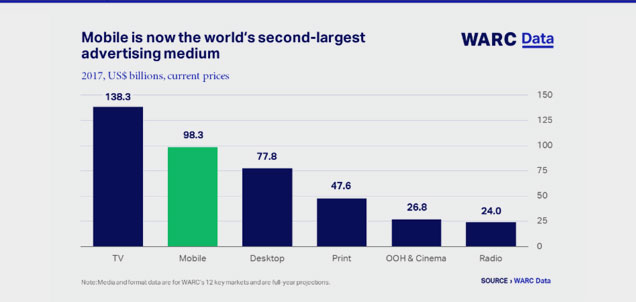
    Mobile is now the world’s second-largest advertising medium: Mobile is now the second-largest ad medium by spend, having overtaken desktop internet for the first time this year. With an anticipated year-on-year growth rate of 35.2%, mobile adspend across all formats is expected to amount to $98.3bn in 2017, representing 23% of global spend.

    WARC estimates that 51% of total mobile advertising expenditure for this year will be allocated to search. Display formats are expected to account for 45% and classified and other spend 4%.

    The largest mobile markets are the US, China and the UK. TV is expected to remain the world’s largest ad medium by spend this year and next, at around $139bn.


    Almost all of Facebook’s ad revenue now comes from mobile: Social networking accounts for over a third of daily online time via all devices (2hrs 15mins), and one in seven people (1.1bn) access Facebook via a mobile device each day.

    Mobile’s share of Facebook’s ad revenue is expected to equate to 88% ($34bn) for 2017, up 5 percentage points from 2016.

    With mobile display adspend expected to reach $45.2bn within WARC’s 12 key markets this year, there is a strong correlation between Facebook’s global mobile ad growth and the growth of mobile display in the markets. However whilst mobile growth will far outpace all other media, as Facebook’s mobile ad revenue growth eases (a forecast rise of 40% in 2017 versus 70% in 2016), global mobile display growth will also cool.


    Facebook and Google account for a quarter of global advertising spend: A comparison of company revenues with data in WARC’s Adspend Database, which contains adspend data for 96 markets, shows that the duopoly of Facebook and Google will account for 61% of all online advertising expenditure this year, up from 58% in 2016 and 47% in 2012.

    Further, the anticipated $133bn in combined revenue will equate to a quarter of all adspend worldwide in 2017, up from a fifth in 2016 and just 9.4% in 2012.

    Said James McDonald, Data Editor, WARC: “Daily mobile time has more than doubled over the last five years – from 1hr 17mins in 2012 to 3hrs 2mins in 2017 – and our research demonstrates how marketers are looking to capitalise on this by investing more in social, video and native mobile formats over the coming years. Much of this influx has been to the benefit of the duopoly – Facebook and Google – where one in four dollars ofglobal advertising is now spent.”


    Global Media Analysis: A round-up of the importance of mobile

    Mobile advertising accounts for:

    • 23% of global advertising spend this year
    • 55% of North American marketers aim to focus on mobile branded content by 2022
    • 88% of Facebook’s ad revenue attributed to mobile in 2017
    • 92% of Facebook’s daily users use mobile
    • 135% increase in daily mobile time since 2012


    Other new key media intelligence on WARC Data

    • Programmatic accounts for over a third of the value of US ad trade
    • Advertising expenditure has grown faster than the global economy since 1980
    • 100% pixels is twice as effective as current online video industry standard


    WARC Data is available by subscription only. For more information visit https://www.warc.com/data