Tag: Walmart

  • With Flipkart, will Walmart finally compete with Amazon in online space?


    By Prabhakar Mundkur

     

    For a long time now, Amazon has been a pain in the side of Walmart. Largely because Walmart has been the traditional brick-and-mortar retailer, who hasn’t yet made the kind of inroads they would have liked to make in the online space. But they have tried hard, even to the extent of letting you place your orders online so that you can just collect your shopping from the nearest Walmart store. In its first fiscal year after the Jet.com acquisition, Walmart online sales grew 44% to hit $ 11.5 billion. However, in the fourth quarter of 2017, it grew just 23% rattling investors and bringing down their stock price by almost 10%.


    But is Jet a good fit with Walmart? One is not sure. Jet has higher income consumers who are urban in their profile. In fact, analysts have questions about how Walmart will integrate Bonobos and Modcloth, its other online acquisitions into the main brand Walmart. But the challenge for Walmart remains. How can it play catch-up with the world largest online store in the world which is Amazon? And how can it make a dent in what it has identified as its key growth market i.e. China and India? Compared to its other acquisitions Flipkart seems like a perfect fit. And there will be very few integration problems with the brand Walmart.


    The problem is not just the fact that Amazon has a headstart in establishing an online business. There is also the question of the brand Amazon versus the brand Walmart. Younger consumers somehow prefer to shop at Amazon rather than Walmart which has to do with the essential personality of the Amazon brand rather than anything else. Walmart has positioned itself through its tagline ” Save money. Live better”. While this might be true, that is also what Amazon offers without saying it quite so explicitly.


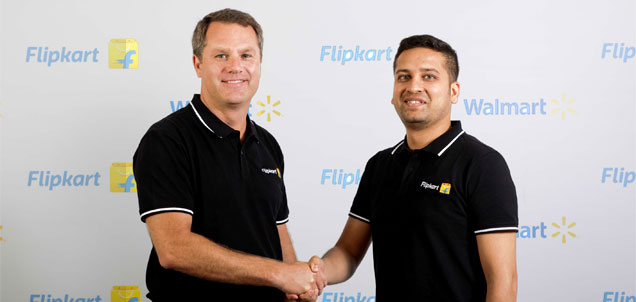
    In this context, the acquisition of Flipkart makes great sense. It gives them a foothold in India, one of their priority growth markets. It gives them growth in online sales, something that has eluded them in spite of their other acquisitions in the online space. And lastly, it positions them as a formidable competitor to Amazon in India, something they have not managed in any other country in the world. So, with the acquisition of Flipkart, they lock horns with Amazon for a piece of India’s growing retail sector. The online sector has always been something of a challenge for Walmart. Doug Chief Executive of Walmart is known to have said ” “We’re learning something new . . . has not been our historic competency.”


    Why Flipkart?


    Source: Walmart

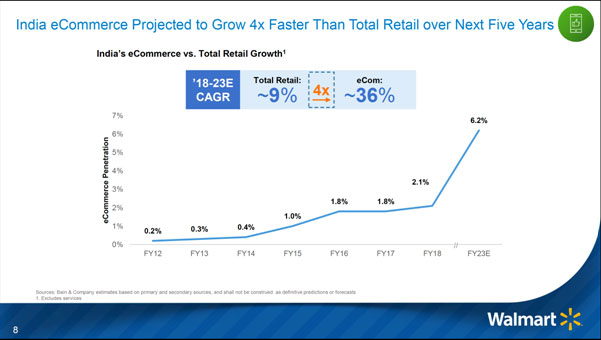
    First of all, India is a growing market with GDP growth rates which are amongst the best in the world. Secondly, India is a young market and has the largest number of millennials and Gen Z accounting for almost 66% of the population. This gives Walmart access to a young market which has hitherto eluded them in the core North American markets of Mexico, Canada, and Central America. India is the second largest internet market in the world and still growing furiously. And lastly, India will have almost 58% smartphone penetration by 2020 easing the way for online sales. And lastly in the future offline retail is likely to show good growth and online retail will be a multiple of offline retail growth. All this makes Flipkart a very attractive proposition.


    Source: Walmart


    Besides being an attractive market the acquisition of Flipkart gives Walmart access to Myntra and Jabong which is India’s leading fashion online destination.


    In many ways, therefore, this seems like a marriage that has been made in heaven.



  • Anil Thakraney: Starbucks: Power of a brand

    By Anil Thakraney


    The night before Starbucks opened its gates to India, I was dining with some friends at Trishna (Kala Ghoda). After we finished with our prawns and fish, we decided to drive by Horniman Circle to check if Starbucks was already in operation, and whether it looked as fancy as some media reports had suggested. The outlet was still to be born, but I was stunned to see all the crowds that had collected there, the heavy action that was underway to give the coffee shop the finishing touches. With major light and sound rehearsals, stuff that even Shah Jahan would not have conceived of when the Taj was first thrown open to the public.


    And of course, the social media has been going crazy over the event. A number of people have been proudly putting out ‘I am at Starbucks!’ tweets. The maha excited reviews in the media have only just begun. And to think Starbucks is just a bloody coffee joint! Although I am not a coffee drinker, I did try out their stuff once on a visit to New York City. And must say I found the potion to be utterly expensive and totally distasteful. Though the loo was quite clean, so I didn’t really leave the place in a huff.


    This tells me two things about us desis: One, that we are still a wannabe nation, nothing much has changed in the last two decades. Then, I spotted a long queue at Linking Road in Bandra, when McDonald’s opened shop in India. And it’s ditto at Horniman Circle today. Two, that we are a brand-starved nation. Clearly, India’s teeming masses want the best of the world, there is heavy demand but poor supply. This is great news for all those multi-brand retail outlets who want to come here. I can already see huge crowds inside and outside Wal-Mart and Tesco. Not to speak of IKEA. Now if only our short-sighted, small-minded politicians would let it all happen.


    ***


    PS: Very interesting article on whether media companies must list down social media usage guidelines for journalists, even if they happen to be freelancers. My belief is that they should. Because whether we like it or not, tweets and Facebook updates posted by journalists do get associated with their employers by most readers. Even if the journos choose to be in denial of it.


    Link: http://publiceditor.blogs.nytimes.com/2012/10/17/after-an-outburst-on-twitter-the-times-reinforces-its-social-media-guidelines/


  • Kiranas dump big brands for high margin Bharti Walmart wares

    By Sagar Malviya


    A few months ago, Dhananjay Jain, a grocery owner at Vidisha Road in Bhopal, decided to stock two alien brands – Right Buy and Members Mark – because they offered much higher margins than national brands and had lower price tags. Today, these floor cleaners, tea and cornflakes brands contribute nearly 20 per cent to his monthly sales.

     

    Many of his consumers may still have no idea where these brands priced 10-30 per cent less than those of Hindustan Unilever, Dabur and PepsiCo are sourced from. Well, they come from the world’s largest retailer, Walmart.


    Mr Jain gets these brands from a Best Price Modern Wholesale outlet – run by Walmart’s joint venture with Bharti Enterprises – just two kilometres from his store.


    Walmart is not allowed to sell directly to Indian consumers yet, but its brands across some three dozen categories have started sliding into Indian homes, as its cash-and-carry venture becomes a hit among grocery shop owners.


    “The idea is that the reseller should make more profits by selling our brands than he does by selling national brands,” said Arvind Mediratta, chief operating officer of Bharti Walmart. He said the firm’s private labels adhere to all the quality norms despite their lower price tags.


    Bharti Walmart operates 17 cashand-carry format Best Price Wholesale outlets, selling products to licensed neighbourhood stores, schools, offices and large enterprises. It has more than 3 lakh members, who own grocery stores.


    The firm launched Right Buy and Members Mark after phasing out its earlier brand Great Value, which is now restricted to Bharti’s Easy Day supermarket chain.


    So far, Walmart has developed a network of 100 suppliers to make private label products ranging from groceries, home care and personal care products to apparel and stationery. And it may soon get into categories such as soaps, shampoos and detergent. “We are planning to add several more categories in coming months and open over 10 outlets by next year,” Mr Mediratta said.


    Company officials say its brands already control 20-22 per cent share in most categories at its members’ outlets. Some shop owners even say they have stopped stocking national brands. “In categories such as floor cleaners and dish washing, we have stopped stocking national brands as consumers just want the lowest priced products in these segments,” said Mohammed Fayaz, a storeowner at Guntur in Andhra Pradesh, where Walmart has opened two wholesale outlets.


    What excites kiranawallahs is the huge margin they get. For instance, a 500ml bottle of Walmart’s toilet cleaner brand sports a price tag of Rs55 but is available to a kirana owner at Rs37. That makes the retailer’s margin a whopping 48 per cent. National rivals such as Reckitt Benckiser’s Harpic and HUL’s Domex are sold at Rs58, with the grocer earning 12-15 per cent margin on an average. Bharti Walmart also provides 10-30 per cent higher margins than national brands on tea, colas and juices that allow shopkeepers earn 10-30 per cent higher margins than national brands. Consumer products companies have been increasingly fighting private labels of modern retailers.


    In fact, private labels outsell several national brands in home care and packaged food categories at the outlets of retailers such as Future Group, Reliance Retail and Aditya Birla Group.


    FMCG companies didn’t feel too threatened because modern trade accounts for just 7-10 per cent of their total sales. But now, with Walmart’s private labels finding place in consumer companies’ largest sales channel – the country’s ubiquitous neighbourhood stores – this trend could become a headache for them.


    “As Walmart and other similar players scale up their cash-and-carry operations, given the price consciousness of the Indian consumer and the fact that kirana stores are here to stay, it is likely that this trend will start to worry large consumer goods companies,” said Siddharth Bafna, partner at advisory firm Lodha & Co.


    Not everybody agrees. The chief executive of a leading consumer products firm, however, said such private labels would not challenge big brands in evolved categories such as personal care. “There are always some categories, especially commodities, that are more prone to losing out to private labels because of pricing. However, several brands in the personal care segment that keep innovating aren’t threatened by private labels even in markets where modern trade is evolved,” the person said, requesting anonymity because Walmart is one of its partners.


    Some shopkeepers say it’s not easy to make people try new brands. “We are able to convince some consumers to opt for lower priced Walmart brands. But there are still many consumers who want to buy popular brands from national companies even if the price is higher,” said Jas Karan Singh, a store owner in Amritsar, where Walmart opened its first cash-and-carry outlet four years ago. Private labels accounted for around 7 per cent of Bharti Walmart’s annual sales of Rs 1,876 crore last calendar at over Rs 130 crore.


    Worldwide, the US retail giant is performing well despite the slowdown. For the fiscal year ended January 2012, it increased net sales by 5.9 per cent to $443.9 billion and ranked first on the 2011 Fortune 500 list of the world’s largest companies by revenues.


    Source: The Economic Times

    Copyright © 2012, Bennett, Coleman & Co. Ltd. All Rights Reserved


  • Tesco expects Bengaluru to up competitive edge

    By N Shivapriya & Harsimran Julka


    The proposal to permit FDI in multi-brand retail may have come a cropper but as technology becomes the next big battleground for retailers, India may well be where these battles are fought.


    Tesco, the world’s third-largest retailer, is building a crack team in Bangalore as shopping goes online and supply-chain efficiencies become more critical in keeping prices affordable.


    From scheduling transportation in Thailand to floor planning for its stores in UK, there’s a bit of Bangalore in everything Tesco does, and its Chief Information Officer (CIO), Mike McNamara, only sees that growing in the days to come. “Digital and technology will be big battlegrounds within each of the markets,” McNamara told ET in an exclusive interview, and he sees the Bangalore office playing a central role in giving it that competitive edge.


    The centre started in 2004 and Tesco was one of the first retailers to set up a captive unit here. The world’s largest retailer, Walmart, also followed setting up Walmart Labs in Bangalore but only a few years ago. Both of them, as well as other global retailers, use Indian service providers for parts of their IT and analytics.


    Mr McNamara himself is averse to calling Tesco’s centre a captive because he finds it subservient. “We’ve watched it blossom from a fairly solid operations centre into something that’s doing this very sophisticated work,” he said.


    The centre employs over 6,000 people, who work on functions as varied as online advertising, mobile applications, store design and transport scheduling, in addition to IT and back-office functions.


    A team of mathematicians in Bangalore and UK work on algorithms for sophisticated supply chain systems that take into account everything from weather patterns to sporting events and seasonal variations. “If we don’t get the mathematics exactly right for the fresh foods, it goes waste. Getting it right is a tricky business – it’s a huge leverage on profitability,” said Mr McNamara.


    Mr McNamara, who is on Tesco’s executive committee, wants to centralise all the skills Tesco has learnt from its 100 years of retailing experience in UK at its facility in India and run the supply chain for its Asian markets from here. These markets are relatively newer for Tesco but they are already key markets from a revenue point. Korea, where it is the second-largest retailer, is also its second-largest market after UK.


    In US, where its business is struggling, the Bangalore office helped to launch a loyalty scheme, which is entirely digital. Most of the IT for US is done entirely from Bangalore. “The US team is very small,” said Mr McNamara. Overall, 70 per cent of the IT across the Tesco Group is from India and that’s likely to increase rather than decrease, he added.


    The centre currently services every single country in the Tesco Group, including new businesses such as banking, where it has built new systems and completed a massive programme to migrate over 2 million credit card customers. Over time, he expects the banking business, which is relatively younger, will do more work out of India.


    As CIO for Tesco, most of Mr McNamara’s time is now spent in marketing and commercial functions as compared to five years ago when it was mostly operations and productivity. “It’s not so much a digital strategy any more but a retailing strategy that is becoming digital. And that’s a very important distinction,” he says, “It’s not just about applications selling things on the internet but about helping people buy things in shops as well.”


    While many global companies are looking to cut down on IT spending, retailers such as Tesco are increasing it. “It’s a good time to be an IT guy in retail. In other industries, IT budgets are under more pressure. In retail, because we need to meet the consumer need for mobile apps, for social views, for all of these things, spending is on the rise.”


    Tesco has switched investments from property to technology, says Mr McNamara.


    “We would typically invest in the billions in property. You don’t have to shift too much of that into technology to make a difference. We have increased our technology spends quite significantly. And much of that increase is going into customer facing technology,” he added.


    Tesco is also unique because it is one of the companies, which has a former CIO, Philip Clarke, as its CEO. Mr McNamara describes Mr Clarke as a retailer by background who’s a technophile and himself as technologist who loves retail. “He (Clarke) has a very deep understanding of what technology can do for business. It’s a huge positive when there’s somebody else in the executive team who speaks the same language as you.”


    In retail, the tough part is to get economies of scale in operations, says Mr McNamara. “You can get them in buying, no doubt. But to leverage your operational skill across countries, that is difficult. Just because you manage supply chain well in UK, doesn’t mean you can do the same China,” he said.


    And this what Mr McNamara is trying to do through Tesco’s India centre – put the skills in one place where it can service Europe and China and leverage the operational skill across the entire group, rather than teach it in every country. The battle lines are being drawn.


    Source: The Economic Times

    Copyright © 2012, Bennett, Coleman & Co. Ltd. All Rights Reserved