By Ranjona Banerji
 If ever India’s insecurity as a nation shows, it is in our relationship to the rest of the world. On the one hand, we are constantly looking for affirmation, especially from the West: India is the greatest, Indians are the greatest, best democracy, best prime minister, most popular leader, best national anthem and so on.
On the other, we are constant “freedom fighters”: Who cares about the West, we are better, our family values are better.
Often both these exists at the same time in one sentence.
And let’s not forget that we are a nation that loves to emigrate. You can find Indians everywhere. Far more than you find people of other countries in our land.
Should I ignore for now the sad fact that those who leave India to settle elsewhere are touchiest about India being criticised?
Thus the talk around Prime Minister Narendra Modi’s visit to the US.
Best, greatest, they said, they love us and more.
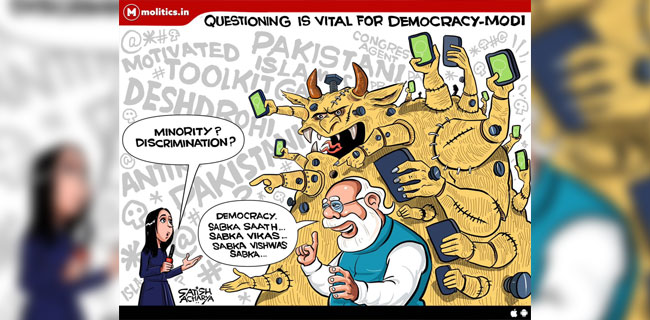
But when Modi is asked about the reality of discrimination of Muslims and religious minorities in India, out comes the anger. How dare, what about America and so on.
And this being today’s India, trolls were quick to pick up on the name of the reporter of the Wall Street Journal who asked Modi the question: Sabrina Siddiqui. Her second name sounds Muslim and that alone was enough to set off the rightwing Hindutva brigade.
https://thewire.in/media/wsj-reporter-sabrina-siddique-modi-question-human-rights-targeted
The harassment reached such a point that the White House stepped in to condemn the online venom being thrown at the reporter.
https://www.thehindu.com/news/international/white-house-condemns-harassment-of-journalist-who-asked-pm-modi-a-question/article67013371.ece
If anything does not show India in a good light, and raises questions about press freedom in India, it is this.
Indian journalists who question the government are relentlessly trolled online and attacked in the real world. From Israeli spyware being used on them to hacking of devices to raids, court cases and worse.
Although we are supposed to pretend that all is well in India, everyone is rich, everyone is happy, to further boost the image and ego of the prime minister, the job of journalists is to tell us that we are pretending.
Does no one see this?
Modi returns to India, he asks “what’s happening” as if he does not know, and then has a meeting. Having the problem of violence, anarchy and possible civil war in Manipur, he then proceeds to include the inauguration of a few more trains.
In other times, history shows us, this is how dictators behave. But in India, you will find a media which promotes and tolerates this dissonant behaviour.
You also have a media which revels in Islamphobia, in othering anyone who is not a chosen upper caste Hindu – “liberals”, civil rights activists, and anyone who criticizes the Modi government loses Hindu status by dint of criticism – and thus furthering the cause of Hindutva.
As Manipur burns, there is a massive Hindutva movement growing in Uttarakhand.
A difficult case like the murder of Ankita Bhandari, where the accused’s father was part of the BJP, is being sidelined. The public prosecutor, says the victim’s father, has been assisting the accused.
There is little in the national or local media about this, even though the murder created much public interest.
https://www.newsclick.in/ankita-bhandari-murder-case-public-prosecutor-colluding-accused-know-what-family-said
At the same time, the targeting of Muslims continues in Purola, Uttarkashi.
https://thewire.in/communalism/purola-posters-muslims-vacate-shops
It has taken the high court to somewhat calm things down:
https://indianexpress.com/article/india/purola-mahapanchayat-uttarakhand-hc-8664504/
The reason I highlight these cases in Uttarakhand is to underline the fact that India is not Delhi and India is not Modi.
Like Manipur, Uttarakhand is a small state away from the national gaze. But if Manipur spirals down any further or the Himalayas collapse, it will affect all of India.
You cannot survive as a democracy if the national media promotes a prime minister who inaugurates trains in the midst of various national calamities.
It doesn’t matter what the outside world says or does not say. Fake online popularity polls will not change this:
https://www.deccanherald.com/opinion/second-edit/douse-the-flames-in-manipur-at-least-now-1228980.html
Ranjona Banerji is a senior journalist and commentator. She writes on MxMIndia on Tuesdays and Fridays. Her views here are personal.