Tag: VUCA

  • Cleartrip ropes in Lowe Lintas

    By Our Staff


    Online travel company Cleartrip has appointed Lowe Lintas to manage its creative duties. The scope of the agency will primarily include “reinvigorating” the brand and crafting a “robust” communication strategy to navigate the brand in the new industry landscape.


    Prahlad Krishnamurthi
    Prahlad Krishnamurthi

    Speaking on the onboarding, Prahlad Krishnamurthi, Chief Business Officer, Cleartrip said: “We are happy to onboard Lowe Lintas as our creative partner. Our approach will be to not only build an innovative portfolio but one that is represented by a brand persona that is memorable and impactful. We will be closely working with the Lowe Lintas team and expect that their strategic, innovative, and forward-looking approach will contribute immensely to further building the Cleartrip brand and propelling our growth. We look forward to a rewarding and long-standing partnership.”


    Sonali Khanna
    Sonali Khanna

    Commenting on the win, Sonali Khanna, Executive Director and Branch Head – South, Lowe Lintas added: “The last year and a half has really taught us the true meaning of a ‘VUCA’ world. In order for impacted industries, like Travel & Tourism, to get back on track, we need to devise transformational strategies. Lowe Lintas is no stranger to bold new ideas, and we’re delighted to partner with Cleartrip to meet this challenge head-on.”


  • Fido Dido is back urging consumers to think fresh

    By A Correspondent


    7UP has launched its new brand campaign titled ‘Think fresh’ with Fido Dido, the wriggly-haired mascot, back in the promotions.


    Speaking about the new campaign, Nobel Dhingra, Director Flavors (7UP and Mirinda) and Area 3 Countries, PepsiCo India, said: “7UP as a brand has always encouraged consumers to be their cool and optimistic self. The Think Fresh campaign builds on this belief and reiterates that even the most complicated situations in life can be easily dealt with if one adds freshness and optimism into the mix. We are confident the new campaign will encourage consumers to Think Fresh and turn any tricky situation to their advantage.”


    Talking about the TVC, Ashutosh Sawhney, Managing Partner & Head, DDB Mudra North and Vishnu Srivatsav, Creative Head, DDB Mudra, added: “VUCA is today’s new normal and it even percolates down to slices of our lives. Consumers across the board have resonated with this reality. 7UP, with its refreshing flavour attempts to enable its consumers to think fresh, thereby turning their life’s little googlies into advantageous situations. The new campaign illustrates this in the most un-mistakably 7UP way by bringing the iconic Fido Dido back and keeping the brand’s tonality refreshing , just like the great taste of 7UP.”


    7UP will also roll out a 360-degree marketing plan post the launch of the TVC which will include outdoor and digital surround.


  • Das ka Dum with Dr Bhaskar Das: Would you say the Festive Season 2019 will be possibly the worst ever for media entities?

    It’s going viral. Each Q&A we hear is firing up the Whatsapp and mail circuit. People have been laughing, screaming out incorrigible reading a response… but there’s no denying that each question-and-answer is profound and funny. Presenting Das ka Dum with Dr Bhaskar Das. And do come back tomorrow for another round of questions and answers.

     Please go to the Das Ka Dum tab on the website’s top navigation bar, to visit the archives of Q&As.


    Q. We’ve asked you a lot question on the health of the media business. Would you say the Festive Season 2019 will be possibly the worst ever for media entities?


    A. You are looking for deterministic answer (usual for a journalist) to a transient situation. There is nothing christened as best or worst times. It’s in our mind. It’s a cycle (one that  frequently happens these days due to VUCA headwinds). Human beings tend to behave bad in good times, so bad times follow good times and vice versa. The old adage  works: as you sow,  so you reap. So the current perception of worst times will also pass. In a VUCA world, one needs to detox more frequently. A bend is not an end.

  • Das ka Dum with Dr Bhaskar Das: Why is it that none of the big Indian news media conglomerates have produced a product like InShorts or Dailyhunt?

    Bhaskar Das

    It’s going viral. Each Q&A we hear is firing up the Whatsapp and Gmail circuits. People have been laughing, screaming out incorrigible as they read a response… hut there’s no denying that each question-and-answer is profound and funny. Please go to the Das Ka Dum tab on the website’s top navigation bar, to visit the archives of Q&As.

    To those who don’t know who Dr Bhaskar Das is: well, he’s the former big boss of the Times of India group and Zee Media and Dainik Bhaskar and now Republic TV. For those who’ve known him or have heard him, Dr Das belongs to the rare species of advertising sales professionals who has this unique combination of being a deeply spiritual being and also a very persuasive salesperson. His unique turn of phrase can make you chuckle, but almost always sets you pondering. Read on and see how every googly bowled at him is hit back in style. And often far out of the park.

    Das ka Dum features on MxM – Monday through Friday, except on our ‘no edition days’. Presenting Week Two, Day 4:


    Q. Why is it that none of the big Indian news media conglomerates have been able to produce a product like InShorts or Dailyhunt?


    A. Going by the behavioural trend of India Inc, with the onset of VUCA as the new normal, a meta-realisation has dawned on me viz non-attachment to a successful business model and inability to inculcate a class of losers within a successful business… these are not easy traits to practise live. This axiom is industry- and organisation-neutral. I am sure there are exceptions but they are few and far between. That’s why disruptors are born and even when disruptors mature in their business, they get disrupted. In business and life there are very few holy cows.

  • Das ka Dum with Dr Bhaskar Das: With so many people losing jobs in the media, would you say it’s a safe place for people to take up as a career?

    There is only one word to describe the response to Das ka Dum by Dr Bhaskar Das: Huuuuge. There are of course many who say that the column was a no-brainer. Those who’ve had a chat with BD are familiar with his repartees and spiritual responses to down-to-earth issues and problems.


    To those who’ve come in late, the link to the last column is: https://www.mxmindia.com/2019/09/das-ka-dum-todays-question-to-dr-bhaskar-das-are-you-really-spiritual-or-is-it-a-facade/. And the link to the one before that is in the last column.


    The questions will be answered by Dr Bhaskar Das, the former big boss of the Times of India group and Zee Media and Dainik Bhaskar and now Republic TV. For those who’ve known him or have heard him, Dr Das belongs to the rare species of advertising sales professionals who has this unique combination of being a deeply spiritual being and a very persuasive salesperson. His unique turn of phrase can make you chuckle, but almost always sets you pondering. At MxMIndia, we enjoy our conversations with him. And for every googly we bowl at him, he hits back like no one has ever before.


    Das ka Dum will feature Monday through Friday, except on our ‘no edition days’. Enjoy Day 3.


    With so many people losing jobs in the media, would you say it’s a safe place for people to take up as a career?


    VUCA  is the new normal. Media is no exception. Stability is the new death trap. And since worry is not a mode of preparation, one needs to upskill oneself continuously to remain ever-ready  for pivoting, both horizontally and vertically. Those who love instability, media is the space for them. It’s not for the faint-hearted.


    Editor: As we mentioned on Friday, some of the words and phrases our dear and delightful BD uses could go over your head. So, purely in reader interest, we will link such words to the dictionary meaning. Like we’ve done in the case of ‘VUCA’ today. VUCA isn’t of course a tough word… it’s just an acronym for Volatility, Uncertainty, Complexity and Ambiguity.

  • Light at the end of the VUCA tunnel


    By Fatema Rajkotwala


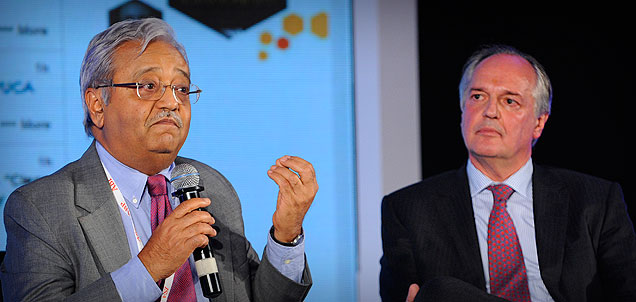
    It’s a VUCA, VUCA world. Indeed. Even as former Procter & Gamble chairman and managing director Bharat Patel may have made light of the acronym with the lyrics of a famed Shakira song, almost all of the 350-odd delegates at the inaugural Indian Society of Advertisers (ISA) Global CEO conference held on Wednesday were in agreement that the prevailing times were indeed VUCA – Volatile, Uncertain, Complex and Ambiguous.


    Unilever’s Global CEO Paul Polman was chief guest at the day-long event which had “Navigating through a VUCA World” as its theme. Mr Polman urged business leaders and marketers present to shift their focus to undeniable international struggles through corporate responsibility. Acknowledging the power of the internet, he stated how the concentration of wealth from few was now passing on as power to many as consumer connectivity has increased and being discovered by the youth.


    R Gopalakrishnan, Executive Director, Tata Sons led the conversation with his illustrative presentation titled “India’s VUCA Moment”. Manu Anand, President, India and South Asia, Mondelez International Managing Director, Cadbury India and Ravi Kant, Vice Chairman, Tata Motors spoke in the pre-lunch session. Later, Marten Pieters, Managing Director and CEO, Vodafone India addressed the gathering, followed by a panel discussion moderated by Sunil Kataria, COO, Sales, Marketing and SAARC, Godrej Consumer Products Limited with stakeholders Sanjay Behl, CEO, Raymond representing advertisers, Kirthiga Reddy, Director, Online Operations and Head, Facebook India from the new media and Ashok Venkatramani, CEO, MCCS from the traditional media side. Before the Polman session, Pawan Munjal, MD & CEO, Hero Motocorp shared his approach and attitude to business in his talk, “Taking Risks in a Volatile World”.


    Meanwhile, Hemant Bakshi, ISA Chairman and Executive Director, Home & Personal Care, HUL, expressed satisfaction with the Global CEO Conference. “We hope to make it an annual affair, and see greater participation in the years to come,” he said. Paulomi Dhawan, Chairperson, Events Committee and Treasurer of the ISA attributed the success to the emphasis on content and the speakers.


    For the record, the ISA was established in 1939 which aims at safeguarding and promoting the interests of organizations involved in Indian advertising, marketing and media industry. Today, the association consists of 160 members of small and large advertisers in the country.


    First half sessions:

    With the population growing steadily, which translates into new consumers and newer markets, while resources are limited, and even though India’s growth rate is slow, it is comparatively better than that of Europe or USA. In an increasingly globalised and boundary-free market, digitization is unleashing forces that are significantly changing the game. In such a setting, a changing market is the new normal and presents huge opportunities for businesses.


    So, is the Indian market and are Indian companies new to a VUCA environment? How real is the Indian downturn or recession with simultaneous stories of companies growing? What adaptive measures need to be taken by businesses in their leadership and business models in the current times? Instead of deploying defensive strategies, how can companies gain a competitive advantage in such a scenario? Hemant Bakshi Executive Director, Home & Personal Care, HUL and Annurag Batra, media entrepreneur and Editor-in-Chief, Exchange4media group threw light on the chosen theme and set the context for the sessions for the day.


    R Gopalakrishnan, Executive Director, Tata Sons argued that VUCA has always been a reality for India and that technological response has kept pace with a constant delta, while it is human adaptiveness that takes time to change. He urged audiences to focus on the implications hereof by developing three insights and observations with the help of examples. “We’ve always been a VUCA country and now our moment has come. That is why Indians are successful entrepreneurs.” In terms of practical implications, he listed out, “We’ve forgotten to look back at nature. We have been programmed to achieve efficiency whereas nature works at effectiveness. We also need to rediscover intuition to make important decisions as a faculty that would be foolish to ignore its role in a VUCA world, as rationality can bring you this far. We need to invest in market and consumer research and face competition with élan.”


    Manu Anand, President, India and South Asia, Mondelez International Managing Director, Cadbury India took the floor next for his talk on “Reigniting Growth in an Economic Slowdown”.  Mr Anand led his speech with the backdrop of how in an economic downturn demand for products decreases, inflation and commodity costs are high which leaves companies two routes – Either buckle down and cut costs or look at this market as an opportunity and ride the wave. Acknowledging that there is no right way and a combination of both can be done, he discussed Mondelez’s growth story during the 2008-2010 slowdown to highlight what techniques worked effectively for the company.


    Finding a balance between where to selectively reduce costs and where to invest for the future; increase brand investments with a focus on master branding and the lead brand propositioning; create innovation pillars by launching new categories through different brand portfolios and focusing on your people, customers and stakeholders – these are some insights listed out by Mr Anand. “There needs to be a greater reliance on intuitive based decision making in a price expectation sensitive market such as India, VUCA times present high opportunities. It would be a mistake to make no change in management models or on the other extreme, to make aggressive investments.” To sum up, during a downturn, management leaders were asked to switch off their auto-pilot business model, keep a check on cash flow, focus on strengthening core business portfolio, increase revenue speeds, and most importantly, exploit and not waste a downturn to emerge stronger and leaner.


    “Leading Business in the New Reality” by Ravi Kant, Vice Chairman, Tata Motors addressed the topic by peering into the past and see how companies have navigated through it. Citing Tata Motors’ example, he stated that the company has moved its business model from hierarchial to cross-functional; from vertically integrated o outsourced; from centralized to poly-centric, from a purely Indian market to one that gets up to three-fourths  of its business from outside the country. “Any change happening in the transitional or contextual environment will have an impact on your business. The new reality is that of high uncertainty with natural disasters no longer being rare events; complexity due to globalization presenting diverse demographics or climate changes; and rapid changes in industries within a span of the last 10 years.”


    As solutions, Mr Kant offered the following advice, “Companies that are quick to self-check, able to experiment and collaborative are the ones that grow profitably in such times. Predictive analysis helps in giving short-term insights and with the help of technology and available data, the power of analytics and anticipation gives time to face situations better. Innovation is key to keep you going, to gain market share or within internal processes. Finally, collaborate because in today’s times, no company can do anything without networking, integrating or information-sharing.”


    Second-half sessions

    Shedding light on the cut-throat industry of telecomm operators, Marten Pieters, Managing Director and CEO, Vodafone India took on a positive approach in his presentation titled, “Not every Consumer has Sealed her Wallet: Finding New Pockets of Growth”. Sharing simple rules that helped Vodafone prosper in the economic slowdown, he pointed out, “As business professionals, we have no other choice but to embrace the change. As a marketer or advertiser, make VUCA a friend, instead of a foe.”


    In the Vodafone context, he shared marketing mantras that worked. His key pointers were – 1. Understanding your customer better – our future customer is already with us. 2. Behaviour change happens more slowly than expected. 3. Business grows by leveraging opportunity not only by solving problems. 4. Acquisition is a must and not optional for brands. 5. Light or infrequent buyers matter. 6. Intensify investments during lean period. “Satisfy consumer needs – customers bend if there is something worth to be picked up. Marketeers tend to get impatient while consumers take time to accept and embrace change. Businesses need to be light on their feet to mine opportunities. During a downturn, brand building can be done while media costs are low. While suggestions for VUCA times may be different for different industries, consumer behavior broadly does not change across categories regardless.”


    A panel discussion on the sensitive issue of “Cut Costs, Not Corners: Smart Marketing for Turbulent Times” moderated By Sunil Kataria, COO, Sales, Marketing and SAARC, Godrej Consumer Products Limited. On the panel were reprentatives of three sides – Sanjay Behl, CEO, Raymond, as the advertiser; Kirthiga Reddy, Director, Online Operations and Head, Facebook India as the new media and Ashok Venkatramni, CEO, MCCS from the traditional media side. The panel gave their views on what is withholding open-hearted collaborations between the media and marketing fraternities and why has this scenario developed. Some interesting suggestions for a VUCA world that emerged from the conversation was of the need for more responsible marketing due to marketing spends being one of the few operational costs that is based on speculation and a plethora of choices. ‘Personalization of messages ‘was pegged as one of the biggest themes leveraged by marketers. CSR moving to BSR, that is, Brand Corporate responsibility was yet another interesting insight by the panelists.


    Sharing the brand’s success story, Pawan Munjal, MD & CEO, Hero Motocorp shared his approach and attitude to business in his talk, “Taking Risks in a Volatile World”. As a pioneer brand in the category that has reached international markets, Mr Munjal shared Hero’s VUCA times. “VUCA is equal to Opportunity. We at Hero, believe in disruption. A clear and steadfast vision will be the anchor that will bring order to chaos and help you make the right decisions in the interest of your stakeholders and consumers with resolve and confidence. It is important to have a mindset of anticipation and embracing change within the organization. Ensuring flexibility is key to diversifying risks. Lastly, courage and unflinching belief will help you through any uncertain times.”


    The Polman Session

    Paul Polman, Global CEO, Unilever shared his eye-opening and inspiring viewpoints on “How Responsible Business Models Can Help in VUCA Times”. Looking beyond short-term ROIs or pricing strategies, Mr Polman took on a human stance at viewing the current global scenario. Citing global realities of lack of food or sanitation for a large part of the planet’s population, or the European slowdown or the political upheaval in Syria – Mr Polman urged business leaders and marketers to shift their focus to undeniable international struggles through corporate responsibility not just as an obligation but as a business idea.


    Acknowledging the power of the internet, he stated how the concentration of wealth from few was now passing on as power to many as consumer connectivity has increased and being discovered by the youth. “If you can get an ingrained political regime out of government in 17 days, you can out a company within nanoseconds. If a political system doesn’t work, trust in businesses also goes down. This is an end of the era of abundance. Transparency can be built only on trust, which will lead to prosperity. This is a unique moment for mankind. As businesses, we have to become solution providers and not just by-standers in the system that helps us grow. It’s time marketers run ahead instead of behind and look at mainstream corporate responsibility. The biggest tool you have as a marketer, is to build your brand to build trust. Give brands a social mission and purpose as a changed business model or become isolated.”

     

  • ISA Global CEO conf to help face VUCA world: Hemant Bakshi


    It promises to be the mother-of-all media and marketing conferences. The Indian Society of Advertisers (ISA), the apex body of advertisers in the country, is hosting a global CEO conference on October 30, 2013 at the Leela in Mumbai. The theme is ‘Navigating a VUCA World’ and a galaxy of speakers including Unilever’s global CEO Paul Polman are scheduled to speak. Mr Polman will be in conversation with Bajaj Auto chairman Rahul Bajaj.


    Other speakers at the event will include R Gopalakrishnan, Director, Tata Sons; Manu Anand, President – India & South Asia, Cadbury India; Marten Pieters, CEO, Vodafone India; and Ravi Kant, Vice Chairman and Former Managing Director, Tata Motors, Pawan Munjal, MD & CEO, Hero Motocorp, Shantanu Khosla, MD, Procter & Gamble India and Prabha Parameswaran, MD, Colgate-Palmolive amongst many others. One of the goals of the conference is to find out how organizational processes and practices need to be recast to deliver to this new VUCA (Volatile, Uncertain, Complex and Ambiguous) world.


    Hemant Bakshi, Executive Director, Home & Personal Care, Hindustan Unilever and Chairman, Indian Society of Advertisers spoke on the theme of the conference and his expectations.


    The ISA CEO-fest


    Over 300 delegates are expected to attend the conference, informed Paulomi Dhawan, Chairperson, Events Committee and Treasurer, ISA. For Ms Dhawan, the conference is a culmination of two months of hectic activity. And very little else.


    Asking global CEOs to come in and speak comes with its share of requirements. Explain to each of them (and possibly their office) what the entire is thing all about and the topic chosen for them, etc etc. But now that the curating is done, and the key sponsor is in the form of Star India, the emphasis for Ms Dhawan is to ensure it all goes off smoothly.


    The day will begin with a talk on ‘Leadership and Managing Human Capital in Turbulent Times’. The next session is themed ‘Reigniting Growth in an Economic Slowdown’ followed by a panel discussion On ‘Cut Costs, Not Corners: Smart Marketing for Turbulent Times’moderated By Sunil Kataria, COO, Sales, Marketing and SAARC, Godrej Consumer Products Limited. The panelists include Himanshu Kapania, COO, Idea Cellular; Sanjay Behl, CEO, Raymond; Kirthiga Reddy, Director, Online Operations002C and Head, Facebook India; KBS Anand, MD & CEO, Asian Paints; Shantanu Khosla, MD, Procter & Gamble India and Prabha Parameswaran – MD, Colgate-Palmolive.


    Post-lunch, sessions on ‘Why Businesses Must Factor in Economic Cycles’ by Ravi Kant, Vice Chairman, Tata Motors with Siddharth Mukherjee, Director - Chocolate Category and Media, Cadbury India Limited.


    There on, a session on ‘Not every Consumer has Sealed her Wallet: Finding New Pockets of Growth’ will be conducted by Marten Pieters, Managing Director and CEO, Vodafone India. The session will be chaired b Narendra Ambwani, Director, Agro Tech Foods Limited.


    Later, Pawan Munjal, MD & CEO, Hero Motocorp will speak on ‘Taking Risks in a Volatile World’. The last session of the day will be on’How Responsible Business Models Can Help in VUCA Times’ by keynote speaker Paul Polman, Global CEO, Unilever. This will be followed by a conversation that Rahul Bajaj, Chairman, Bajaj Auto will have with Mr Polman.


    The inaugural Global CEO conference has an impressive line-up of speakers. What does the ISA hope to achieve from the conference and the theme chosen?

    The ISA has been around for a long time to ensure that the interest of advertisers – large and small – has been taken care of. For us, the mandate of this conference is two-fold. As businesses and the economy face a slowdown, we want to ensure that advertisers can benefit from advice to make sure that our business is stable and strong. In difficult times, you question every line and component in your business and marketing investments make a large component of this whole. How to get the best return on these investments is the second area we will be focusing on. Therefore we thought that we need to get the best of global CEOs in one place to share their experience and wisdom.


    VUCA was a term coined in the 1990s by the United States military. Given that we live in volatile, uncertain, complex and ambiguous times, does the current market scenario require a different kind of leadership?

    Yes, the term has trickled into the world of business and it tells you that in a world which is VUCA your long-term visions and business goals need to be clear but don’t lock yourself into a rigid plan to achieve that destination. If you have a broad understanding of your past and you know where you’re headed then you will be able to be much more agile, consumer-centric and evolve your strategy as you go along. Flexibility and nimbleness are crucial because the strategies that may have worked in the past when change was certain and slow, may not work in the future.


    VUCA also talks about the need for awareness and responsible leadership. Apart from addressing marketing needs and optimizing ROI, how will the theme be made applicable for the advertiser ecosystem?

    In difficult times like these, we can no longer be in an ivory tower and focus on building brand equity and creating great advertising while our consumers are suffering and the business is struggling. It is important that as marketers, we play a role that goes beyond just marketing. Next, it is also important that in such an environment, marketing is done responsibly. The resources that our planet has are getting scarce and if we keep doing things like we have in the past, sustainability will become a serious issue for consumers. We are going through a business cycle of slowdown right now, but what we need to do in this difficult time is to prepare for the future and it’s important to get a much more holistic view of marketing.


    Media vehicles worry that the fallout of a VUCA world is a cutback on spends and pushing down prices. Is offering discounts and giving more value for money a key fallout of such a market scenario?

    That would be a myopic and conventional view of looking at the current scenario. We have observed that brands that build equity during such times reap benefits once the economy starts growing again. If we all start cutting price and promotions, it may benefit in the short run but not in the long term. At the conference, you will see a lot of our leaders talk about how you can cut costs, take risks and reignite growth as well as get consumers to get better value of what’s going on. The conference hopes to highlight alternative strategies that can be used in this period.