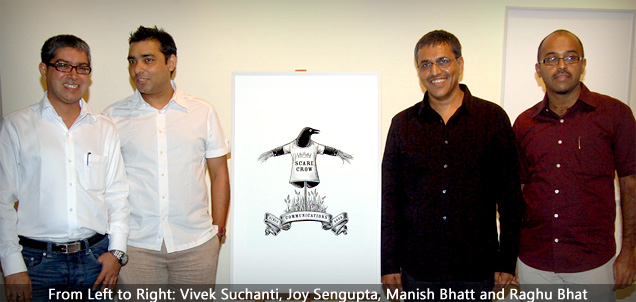
Tag: Vivek Suchanti

  • Scarecrow now a part of M&C Saatchi


    By A Correspondent


    We were all set to do the trek to Ballard Estate in South Mumbai. As also huff and puff up to the second floor office for a roundtable and a revelation. Except that the lure of an exclusive in a pink major killed the idea of the press meet-up.


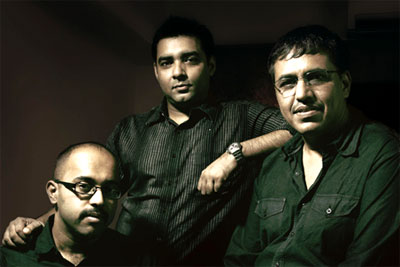
    L to R: Raghu Bhat, Arunava Sengupta and Manish Bhatt

    Guess at the lunch, the rest of the media were to be served the crumbs, while the meat was handed over to the bigger fish. Sigh.


    Scarecrow, the eight-plus-year-old independent agency owned by Vivek Suchanti and Manish Bhatt, Raghu Bhat and Arunava Sengupta, has sold majority stake to M&C Saatchi. A global ad network set up by the founders of Saatchi & Saatchi, M&C Saatchi, has had a failed existence in India thus far. It will use the Scarecrow buy as a means to exert its influence in India.


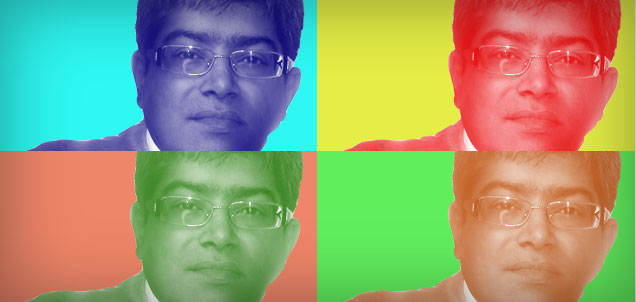
    Vivek Suchanti

    With this transaction – much below the Rs 100 crore tag that has reported in the paper in honour of which Scarecrow compromised its relations with the rest of the press, M&C Saatchi has bought the majority 51 per cent stake that Suchanti owned. According to the info we have, there will be a gradual buy over five-six years of the 16.33% stake that Sengupta, Bhat and Bhatt will own. For now, the trio do not get even the crumbs, but they’ll get it with time.


    Scarecrow, as an agency, has been doing reasonably well with an impressive clients roster. It has done reasonably well on the awards circuit, though it boycotted Goafest 2018 reportedly because (Manish) Bhatt was upset on not being invited to be part of the Master Jury for the Creative Awards.


    So will M&C Saatchi truck with Scarecrow work? Yes, it should, say observers. Even though the 23-year-old agency formed by Jeremy Sinclair (Chairman), Bill Muirhead, David Kershaw (Chief Executive) and the brothers Maurice and Charles Saatchi has floundered in the country. Its buy of Delhi-based February in 2014 and the setting of the mobile arm have not achieved much. In 2015, it sold its digital and direct business to Pi Communcations.


    The Scarecrow co-founders Bhat, Bhatt & Sengupta are known to have the drive and have produced advertising that has been memorable.


    We’ll wait to see what happens next. We can sure it’ll be handed over first to that pink paper.


  • Concept Communication acquires majority stake in Liqvd Asia

    By A Correspondent


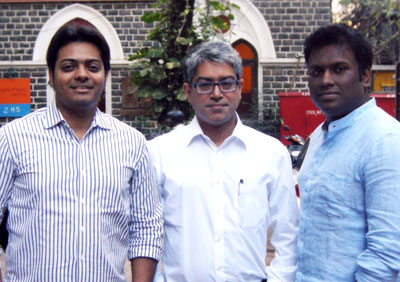
    Zubin Nalawala, Founding member, Liqvd Asia, Vivek Suchanti, Chariman and Managing Director, Concept Communication, and Arnab Mitra, Founding member, Liqvd Asia(l-r)

    Concept Communication announced it has acquired a majority stake in Liqvd Asia, an experiential digital marketing company. With this, the two founding members of Liqvd Asia – Arnab Mitra and Zubin Nalawalla along with their team of 28 will become an integrated part of the Concept Group driving the digital mandate in the country and select markets in Asia.


    Liqvd Asia started operations in 2013. Its clients include Celkon Mobile, Axis Bank, Benetton, LifeCell, Lonely Planet, Sennheiser, Kalpataru, Glanbia plc and Adidas Originals. The company is head quartered in Mumbai and has a presence in Singapore as well.


    Commenting on the acquisition, Vivek Suchanti, Chairman and Managing Director, Concept Communication, said: “This acquisition consolidates our position in the digital space. Arnab is experienced at establishing operational excellence within diverse new age marketing techniques, translating conceptual models into specific growth strategies, and planning and executing multi-faceted national and regional advertising campaigns. His expertise will help us create a bouquet of offerings to our clients across various Group entities. With the addition of Liqvd Asia, we are taking another step in helping our clients ‘get digitally right’. We are delighted to welcome Arnab and his team to be an integral part of Concept family.”


    Before starting up, Arnab Mitra worked as National Director for Starcom Mediavest Group and prior to that he has worked with Havas Media, where he was heading the agency in South Asia.


    Sharing his views on the merger, Mr Mitra said: “We’re very excited to become a part of the Concept Group. Concept is recognized as a formidable brand in the country and Vivek has been one of most respected names in the Indian advertising and related services industry. With this merger we will soon emerge to be the leaders in providing digital experiential solutions in the country and region.”


  • Vivek Suchanti: Garibon ka Martin Sorrell?


    By Ravi Balakrishnan


    Is Vivek Suchanti, chairman and MD, Concept Group building India’s first independent network? He began backing entrepreneurial ventures set up by creative people in 2010. Ever since he’s attracted some top drawer talent. Today, he holds a stake in four creative shops: Scarecrow, Eleven Brandworks, ITSA and Enormous; digital agency Dark Matter and design and branding consultancy Brand-nomics. Add the PR and media clout of Mr Suchanti’s longstanding Concept group, and the contours of a network begin to emerge. One of his agency partners even affectionately refers to him as “garibon ka Martin Sorrell” (the Martin Sorrell of the poor). So is he up for the Quixotic task of taking on the chief of the WPP network, Sir Martin himself, and of course, Publicis Omnicom Group’s Maurice Levy and John Wren and IPG’s Michael Roth? Perhaps even fighting them at their own game? A tempting hypothesis, except Mr Suchanti sees things very differently: “A network is a consolidated balance sheet. I’m not looking at listing and don’t have aspirations to be a holding company. Maybe I will think of it five years down the line.”


    For Mr Suchanti, partnering with creative talent was less grand plan and more necessity. Concept began in 1988 and quickly zeroed in on the lucrative IPO advertising market. After almost a decade of highly remunerative assignments, the first stock market crash gave the group pause. According to Mr Suchanti, the PR practice began to be strengthened as a bulwark against overreliance on an unpredictable and volatile business. Today, 80 to 90% of Concept’s clients are in the BFSI, real estate, retail and education space.


    ITSA

    Emmanuel Upputuru says ITSA was founded as a way of correcting anomalies he noticed in the ad business. Its current clientele includes American Express, DCM Shriram, dot desi and Tatva. It intends working on the innovation end of the communication space. One of its most exciting projects involves designing personalised villas for a real estate property.


    Dark Matter

    Kenneth Augustine has been so swamped with work that the launch of his agency’s website was postponed multiple times. He and partner Sudip Bhattacharya were mainline advertising creatives before making the switch to digital. Clients include SBI, GMAT and restaurants like Kobe and Big Wong. Key insight: “Social media is local and not global.”


    Enormous

    Vivek Suchanti describes the agency as being oriented towards brand transformation and not maintenance. It got a headstart with business from Eleven Brandworks which wound down in Mumbai. While very committed to advertising, Ashish Khazanchi would like to get into an RGA or Droga5-like space, where the agency creates IPs.


    Brand-nomics

    Managing Director Viren Razdan decided to harness his diverse experience in design, branding and advertising. Too many consultancies in this space focus merely on “power point frameworks”. Mr Razdan would like to move into the implementation space too.


    Scarecrow

    With Zee, Rupa, Danone and Emami, it is among the posterboys for indies. Eager to prove they were capable of a lot more than a boutique agency, creative heads Raghu Bhat and Manish Bhatt teamed up with suit Joy Sengupta. Says Mr Bhatt, “Advertisers look for a strategic, marketing or a business solution; not just a kickass campaign.”


    Creatives, however, were not exactly queuing up to join a financial ad and PR-oriented firm. Realising that traditional advertising was (at least compared to the IPO sector) recession proof, Mr Suchanti decided the best way to get talent would be to partner them in their own entrepreneurial ventures. The agency’s IPO business had left it with enough liquidity to fund these without having to raise money from external sources.


    And the creative folk are queuing up now, for several reasons. With some, it’s the realisation of a longstanding dream. For others, an attempt to land on their feet after being unceremoniously shoved out of a cushy job. Besides, Mr Suchanti offers a sweet deal by all accounts. Financial backing, none of the stringent quarterly goals demanded by multinationals and minimal interference. The partnership also takes care of many teething problems that fledgling businesses have: an administrative backend, with a centralised accounting and legal department, leaving an agency head with only the advertising product to worry about. All in exchange for a stake that Mr Suchanti will only describe as “significant”, but which is widely reckoned to be a majority. For his part, Mr Suchanti looks for agencies with proper business plans including target numbers. And for a differentiator: every agency he’s invested in believes it has one on offer.


    As it turns out, Mr Suchanti’s entry into this space has been perfectly timed. Marketers are comfortable looking beyond networks and global alliances for partners, at least on projects. Scarecrow and ITSA have used these to get a foot in the door, which in some cases translates into regular business. Again, coincidence, not strategy says Mr Suchanti. Most of these agencies were built for, and clearly prefer, a retainer model.


    And that’s the advantage of independence. The freedom to tweak business models on the fly and focus on aspects that interest the agency heads. There’s enough business going around, provided these shops look beyond the usual suspects to areas like real estate or the odd restaurant or two.


    Mr Suchanti is uncomfortable calling this agglomeration of talent a network, at least for the moment. There won’t be any networkesque behaviour like a holding company pitch. “Everyone should pull their own weight,” says Mr Suchanti, “At present, we don’t aggressively cross-sell.” Even the agencies believe good fences make good neighbours. In spite of having previously worked with Manish Bhatt, Emanuel Upputturu, one of ITSA’s founders claims to have never interacted with Scarecrow. Mr Bhatt takes it to the next level claiming searches on the internet have delinked Scarecrow from Concept so people are not confused by agency ownership.


    Of course, it has not stopped industry folk from speculating on what it’s all leading up to. The head of a formerly independent agency observes, “It’s a valuation game. Theoretically speaking, he could park conflicting businesses with these agencies and sell two or more. He’s taken a risk and if it pulls off he deserves to benefit from it.”


    Most agencies claim it is too early to think of the future, especially in terms of divesting stake. As Kenneth Augustine, managing partner of Dark Matter puts it, “We are obviously doing this to make some money, but our target is not to sell. The focus and effort is going into creating a product that’s sellable.” Mr Bhatt of Scarecrow says, “There are two types of houses: the one that you buy for an investment and the one you live in. Scarecrow is the latter. We want to make it big enough so even if we partly divest it’s lucrative.” Mr Suchanti has a completely open mind as far as global partnerships are concerned. He says, “The primary objective is what’s good for the independent setup. We are not driven by a financial need since we are all young. I don’t think any of my partners is over 45 to 50.”


    He’s beset by calls as an increasing number of creative people inspired by the sale of Taproot and the frustration of working in an agency system through tough times, look for a way out. Asked if he feels offended or flattered by the “garibon ka Martin Sorrell” sobriquet, Suchanti replies, “I don’t think any of my talent is garib. Martin Sorrell is a big man and our model is not like his. It’s also highly unlikely that Martin Sorrell will sell one of his agency brands. I think it’s a description that doesn’t really apply.”


    Source:The Economic Times
    Copyright © 2014, Bennett, Coleman & Co. Ltd. All Rights Reserved
    Licensed to republish


  • Scarecrow’s simple way to Success


    By Tuhina Anand


    We try harder as we are not number 1! This line aptly sums up the attitude that has helped in the success of Scarecrow Communications. Launched in February 2010, the agency has seen growth which has surpassed the expectation of the four partners – Manish Bhatt, Raghu Bhat, Arunava (Joy) Sengupta and Vivek Suchanti.


    The mantra for success as Manish Bhatt himself puts is that like the name of the agency, Scarecrow: We as an organization are rooted to ground and are earthy in our approach. We believe in doing hard work and we have taken the longer route to success while slogging to reach where we are today. We don’t get swayed by things happening around and do not get into creative indulgence, but do work that brings a real difference to our clients’ brands.


    Mr Bhatt recounts the journey that they embarked on with Scarecrow – even before they started, the duo (Manish and Raghu) were approached by a few network agencies and some independents to work for them as freelancers. So when they actually announced Scarecrow, they had four clients on board.


    CLIENTSPEAK
     

    Subhrangshu Neogi, Director- Brand and Corporate Communications, Religare Enterprises

    Working with Scarecrow has been exciting so far. They don’t approach the engagement like a typical client-agency matrix but do so more from a partnership context. They sit and co-create – co-creation is not just lip service. The team, including the founding partners themselves, make that extra effort to understand the little details and nuances which eventually leads to the creation of a good breakthrough end product.


    Jiby Thomas, Co-founder, VP, Marketing, Quikr

    We decided to partner with Scarecrow because of their ability to  align their creative thinking to business strategy and develop breakthrough creative that connects with consumers. They are young, hungry and passionate about the work they do and brands they work for.


    Dinesh Aggarwal, Joint Managing Director, Anchor Electricals

    From the outset, Anchor was clear that we wanted to associate with a small agency. As the company was evolving and moving away from being a family owned business to being a part of an MNC, there were a lot of processes which were not in place and it was time for a change. What we had in mind was an agency that would become an integral part of our organisation and understand our challenges and meets them effectively. We wanted the agency to grow along with the company. With Scarecrow, the partnership has unfolded exactly as we had envisioned. They understand our issues and requirements and very often they come with more solutions than what we have asked for. In fact, even during the pitch process we were impressed by their involvement with the brand. More importantly, my team is comfortable working with them and I would say that its been a positive relationship.


    One thing the partners were clear about, even when they started, was to not establish themselves as boutique, but as a full service agency. Raghu Bhat said: “We wanted Scarecrow to be one-stop that delivers a client’s business and marketing solutions. Also we were clear that for an organization to sustain growth, we need to deliver diverse solutions.”


    Interestingly, the agency’s digital presence is just one page that gives their contact details along with their logo. The explanation being that they don’t want people to come with any prejudice while approaching the agency, hence the single contact page works best for them as it gives out crucial detail and has even given them many leads.


    As Mr Bhatt explained: “It’s a clean slate for those who want to connect with us with no preconceived notions, and I think this approach has worked best for us.”


    When they started out, Joy Sengupta explained, there were 18 people and within 4-6 months they wanted more people on board. “The truth is that we have ambitions but we were never over-confident or over-ambitious, and in that sense we underestimated our potential. Now the agency has over 50 people on board and has offices in Mumbai and Delhi and is looking to expand footprint.”


    Another reason, according to Manish Bhatt, that has worked to Scarecrow’s advantage: “Advertising is ultimately people’s business and if you don’t recognize that, you would not grow. We have consciously tried to get fairly senior resources in the agency and have focused on empowering our second line of resources. We take pride in the fact that we have invested in people.”


    The focus has been to give best service to the clients, and for this the agency had to do certain trade-offs. Most importantly, the agency didn’t concentrate on any awards nor entered for awards, instead they focused on client servicing and acquiring new businesses. However, getting new business has not been an issue, as many came because of the equity the partners enjoy in the industry.


    Mr Bhatt said: “Scarecrow, since its launch, has managed to create buzz and remain at the top of mind of the industry. For us getting new business has not been a constraint.”


    So what is it that has made the independents take the industry by such a storm – is it because the value for money small sized agency would provide? On the contrary, Mr Sengupta pointed: “We are rather expensive, as we don’t have scale that big agency networks provide. So, if I have a new client, I might actually hire new people to look after that business, than in a bigger agency which might just end up reshuffling the resources.”


    Another practice that Scarecrow doesn’t encourage is taking up businesses on project basis, 90 per cent of their business is on retainer basis, allowing them a sense of stability.


    While they have Nestle, Danone, Religare, Future Capital and a host of other businesses but when asked where are the big ticket spenders who many of the independents have in their kitty, Mr Bhatt said: “We are only two-years old, and I think the big brands would come to us, but we have not designed from the beginning to have them, as we believe we must do good work and we will get good work by default. We have got the mid-sized businesses and probably the bigger spenders too will follow.”


    Right now the focus for the agency is to build the Delhi branch and look at getting more visible work. It has recently come out with 10 second ad for Quickr that has been garnering good reviews.


    Scarecrow also has a gallery that is a platform for encouraging talent. Besides they encourage industry experts to come at the gallery and share their view points with others in the industry. They also have initiated MoM or Method of Madness which is a reverse internship program, where instead of few interns coming and working with them, team Scarecrow goes on campus and participates and interacts with the students.


    Asked if Scarecrow was open to selling its stakes, Raghu Bhat replied: “I think we have enough going in India, so we not looking for selling any stakes. However, we are open to collaborating with partners that will help us in maximizing our potential.” The agency also doesn’t rule out the possibility of acquiring an entity outside of India which will help them in expanding their footprint.


    Mr Bhatt concluded: “We are a group of well grounded, down to earth people. When you see us at any pitch you can make out that we don’t come with any swagger that many in the business come with. We are genuinely interested in the brand and want to make it work for the clients in the market place. We might not have the big telecom spender or the cola giant but our clients, with variety of portfolio, truly gives us an opportunity to bring creativity that will help their businesses grow.”