Zenith has won the global pitch for the consolidated media business of dairy products corporation Lactalis. Zenith has been appointed as the agency partner, commanding 75 per cent of Lactalis’ markets. The win sees Zenith retain all its existing markets in EMEA, APAC and Lat Am and take on 11 new ones, including Canada, UK and USA.
As its agency partner, Zenith will have lead media communications responsibility, with global coordination run from Zenith’s HQ in London. Zenith will now work with Lactalis both centrally and locally to deliver against the company’s growth targets.
Said Vittorio Bonori, Global Brand President, Zenith: “We are absolutely delighted to become Lactalis’ Master Agency Partner. This is a testament to our strong relationship with Lactalis and to Zenith’s approach to driving business growth as the ROI agency.â€
India is #4 in the Top 10 contributors to global adspend growth 2017-2020. But that’s perhaps the only statistic that indicates ‘achche din’ for adspends. India, btw, is not in the Top 10 adspend markets. Neither in 2017, and not even in 2020. But that’s a headline you’ll possibly read elsewhere. Let’s examine the real thing.
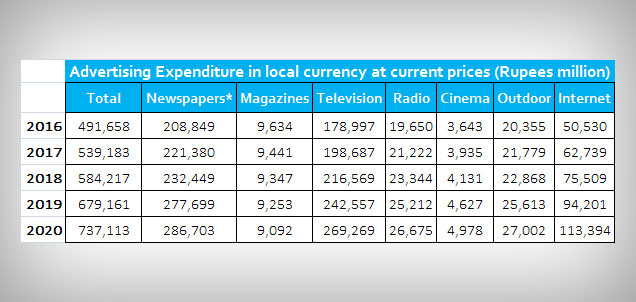
First, take a closer look at the table above. Total adspends, according to Zenith, were Rs 491,658 million in 2016, Rs 539,183mn in 2017 and the forecast for 2018 is 584,217mn. Since we are still in early December 2017, one presumes the 2017 number of 539,183 is an estimate. But given that number, the adspend growth is 9.7% as compared to the forecast of 11.2% made last year. The forecast for 2018 is 8.4%, even lower than the estimated growth for 2017.
Yes, you read it right. Zenith (eka Zenith Optimedia) believes that adspends will grow 8.4% next year in comparison to 9.7% this year. Remember, we are supposed to have seen the worst of the worst in 2017 given demonetisation last November and GST just ahead of the festive season. So why the not-so-achche din in 2018?
Here’s what a communique says: Year 2017 will close atRs 53,918 crore, registering a slightly slower pace of growth is on account of demonetisation introduced in November 2016. Total AdEx for India will climb up to Rs58,422 crore, growing  at 8.4% in 2018, led by television. Growth rate for television is pegged at 9% while newspapers will grow at 5%. Radio will grow at 10%, while cinema and out of home will grow at 5% respectively.
Tanmay Mohanty
Said Tanmay Mohanty, Group CEO, Zenith India: “Growing Internet penetration accelerated by operators such as Jiowill significantly enhance digital adspends in India and give access to previously untapped markets. India has seen some fluidity in overall ad-expenditure but remains one of the fastest growing advertising markets globally. With the dust settling down on demonetisation and GST, we expect a measured recovery on ad spends. Consumer confidence is definitely on the rise. In 2018, mobile handsets, FMCG, automobiles, BFSI, travel and tourism and political ads will drive up the pace on adspends.â€
Here’s more from the communique we received:
Amid growing debate as to whether brands are overspending on digital media, Zenith research has found that the effectiveness of internet advertising has now caught up with digital adspend.
Until 2015, brands struggled to make effective use of internet advertising, and their spend was not matched by the resulting ‘brand experience’(an accurate proxy of market share*). However, by 2016 internet advertising accounted for 34% of global ad budgets but produced 35% of brand experience.Internet advertising is now therefore working harder than advertising in other media.
For many years Zenith’s Advertising Expenditure Forecasts reports have consistently reported sizeable increases in the internet share of advertising budgets. The December 2017 edition of the report is published today. For the first time Zenith has been able to demonstrate the ROI of internet adspend, not just its scale. We used our proprietary Touchpoints ROI Tracker tool to compare internet adspend to internet brand experience over the past few years.
In 2014 advertisers spent 27% of their budgets on internet advertising, which produced only 21% of brand experience. By 2015, though, brands were using internet advertising more effectively: it accounted for 30% of both budgets and paid brand experience, before tipping over in 2016, when brand experience exceeded budget share.
We expect internet advertising’s share of global adspend to continue to rise, reaching 40% in 2018 and 44% in 2020. Its value will rise from US$203bn in 2017 to US$225bn in 2020. The share of advertising expenditure allocated to internet advertising varies widely across the world. In the most advanced markets (Sweden and the UK) it will account for more than 60% of total expenditure next year, and it will account for between 50% and 60% in another six (Australia, Canada, China, Denmark, Norway and Taiwan).
India is placed No 4 in the Top 10 contributors to global adspend growth 2017-2020.
India follows USA, China and Indonesia in that order. (See executive summary)
Between 2017 and 2020 we forecast global advertising expenditure to increase by US$72 billion in total. The US will contribute 27% of this extra ad expenditure and China will contribute 20%, followed by Indonesia, India, the UK and Japan, which will contribute 4% each.
Five of the ten largest contributors will be Rising Markets* (China, Indonesia, India, Brazil and Russia), and between them they will contribute 33% of new adspend over the next three years. Overall, we forecast Rising Markets to contribute 54% of additional ad expenditure between 2017 and 2020, and to increase their share of the global market from 37% to 39%.
In India, internet adspend will capture 11.6% of the market in 2017. India is therefore a leading digital market/keeping pace with global developments/has a lot of scope for growth in internet advertising. We forecast 20.4 % growth in internet advertising in India in 2018, compared to 8.4% growth for the market as a whole. By 2020, internet will account for 15.4% of total adspend in India.
The rise of the internet has had huge consequences for the other media, which are covered in detail in the executive summary.
Big platforms are capturing digital growth
The internet is driving the great majority of global growth in advertising – it will account for 94% of the growth in adspend between 2017 and 2020. And most of this will be captured by just five big platforms – Google and Facebook, plus the Chinese platforms Baidu, Alibaba and Tencent. Between them these five platforms increased their share of global internet adspend from 61% to 72% between 2014 and 2016, and captured 83% of the growth in internet adspend over that time. Baidu, Alibaba and Tencent accounted for 54% of the growth in internet adspend in China, while Google and Facebook accounted for 96% of the growth in internet adspend in the rest of the world. Between them Google and Facebook accounted for 76% of internet adspend outside China in 2016.
Big countries are adding most ad dollars
In dollar terms, most of the growth in global adspend is coming from a few big markets. We forecast that just two countries – the US and China – will contribute 47% of new ad dollars between 2017 and 2020. The five biggest markets – the US, China, Japan, the UK and Germany – will contribute 57%.
Big cities are driving global adspend growth
Big cities are driving global adspend by concentrating growth in productivity, innovation and trade. We have conducted a unique study that attributes adspend to individual cities by estimating the value of their inhabitants to local, national and international advertisers. We forecast that the top 10 cities alone will contribute 12% of all global adspend growth this year, and that the top 725 will contribute 60%.
We predict that between 2016 and 2019, adspend in the 10 biggest-contributing cities will grow by a total of US$7.5bn, representing 11% of growth over these years. These ten cities will be, in descending order: New York (where adspend will grow by US$1.4bn), Tokyo, Jakarta, Los Angeles, Shanghai, Houston, Dallas, Beijing, London and Chicago (which will grow by US$0.6bn).
Advertisers feel the pressure from digital transformation and polarisation of growth
Advertisers are feeling pressure from the rapid transformation of their businesses, exemplified by the rapid shift of marketing communications to online media in response to changing consumer behaviour, and the polarisation of growth to big platforms, big countries and big cities. At the end of November we conducted the third in our series of exclusive surveys about brand growth among key Zenith clients. On a scale from 0 to 100 – where 0 means everyone expects decline in 2018, 100 means everyone expects growth, and 50 means the average expectation is for no growth – the average response was 57, down from 67 this time last year. Food and drink brands have been the least affected, with a score of 66 this year, down just a point from 67 last year. Packaged goods, retail and telecom brands have all fallen to 50, expecting no growth, down from positive scores last year.
“We are seeing a battle played out in business, marketing and media between big players and small players,†said Vittorio Bonori, Zenith’s Global Brand President. “Growth is coming from big countries and big cities, and being captured by big platforms. Brands should focus on upstream strategy, data-informed UX planning and downstream automationâ€.
“Internet advertising is the biggest advertising medium in the world and the biggest driver of growth,†said Jonathan Barnard, Head of Forecasting and Director of Global Intelligence at Zenith. “Our unique research shows that brands are starting to use it effectively after struggling to adapt over the last few years.â€
*Brand experience is a combination of two factors: reach (how likely consumers are to encounter brand messages at eachtouchpoint) and influence (how likely each message is to consumer attitudes or behaviour). It covers all touchpoints across paid, owned and earned media, but because we were comparing it to advertising expenditure, here we measured only the brand experience of paid media.
Touch points ROI Tracker is Publicis Media’s brand contact measurement and planning tool, based on more than 950,000 consumer interviews since 2004.
Advertisers in the media and entertainment category are most confident about seeing growth in their category this year. They are closely followed by advertisers in pharmaceuticals and healthcare.
This is the key finding from Zenith’s just-released biannual client survey. Ahead of marketers attending Cannes Lions 2017, the study finds out what are the key drivers of growth and to assess how confident they are about business growth in their category.
Zenith asked clients how confident they were in the prospects for growth in their category this year. It then ranked each category on a scale from 0 to 100, where 0 means everyone expects substantial decline, 100 means everyone expects substantial growth, and 50 means the average expectation is for no growth.
The results were as follows: Media &Entertainment advertisers came out on top, with a score of 82.1, followed by Pharmaceuticals &Healthcare and alcohol. The lowest-scoring category was telecommunications, at 33.3, followed by Food &Drink and FMCG (non-food).
Ranking of categories by advertiser confidence in growth
Survey of 158 key Zenith clients around the world
Category
Confidence index
Category
Confidence index
1. Media & entertainment
82.1
7. Travel
61.4
2. Pharma/healthcare
70.3
8. Retail
60.0
3. Alcohol
70.0
9. FMCG (non-food)
55.7
4. Luxury
67.6
10. Financial/insurance
53.6
5. Beauty
67.2
11. Food & drink
48.4
6. Automotive/vehicles
63.6
12. Telecommunications
33.3
Â
Key drivers of business growth
The study also asked Zenith clients to look at the drivers of business growth, ranking them according to how important they believed they were for their brand. From most important to least important, the factors were ranked as follows.
Ranking of contributing factors to business growth
Survey of 158 key Zenith clients around the world
1. Data & technology
2. Business transformation
3. New competitive positioning
4. Geographical expansion
5. Diversification
6. Automation
7. Mergers & acquisitions
The first three factors were ranked closely together, with quite a big gap between numbers 3 and 4. Adapting to the challenges of a transforming economy is clearly the main priority for advertisers.
Translating growth in data to business growth
The study asked clients how the huge increase in data has affected three areas of their business: buying efficiency, creating new insights into consumers, and generating profitable brand growth. For each area it gave them five options: data has made it more difficult, has had no effect, has slightly improved it, has greatly improved it, or has revolutionised it. And for each area there was one overwhelmingly popular response, with 50% or more of responses. These were as follows:
:: The huge increase in data has allowed us to make small improvements in buying efficiency.
:: It has allowed us to create much better insights.
:: It has improved brand growth slightly.
So while most clients agreed that data has significantly improved their consumer insights, it has not yet transformed their buying efficiency or brand growth.
“Brands have the opportunity to harness data and technology to transform their businesses and accelerate brand growth, but are having difficulty in turning theory into practice,†said Vittorio Bonori, Zenith’s Global Brand President. “Agencies must step up and work in partnership with their clients to unlock the true potential of this revolution in communications.â€
Media agency network Zenith has unveiled a new global approach to communications, supported by a relaunch of its brand identity, proposition and platforms. Led by Zenith’s Global Brand President, Vittorio Bonori, the move carries forward Zenith’s ROI Agency positioning in 2002.
Called ROI+, the new approach is designed to solve business challenges though advanced communications models, notes a communique, adding:“The approach has three key client benefits. First is the creation of ‘upstream’ strategies that deliver greater ROI through business transformation. Second is a focus on the full consumer journey in order to design personalised communication at scale. And third is maximising ‘downstream’ efficiencies through market-leading automation, such as machine learning. “
Said Vittorio Bonori, Global Brand President, Zenith: “We have a vision for delivering transformational growth for our clients and this required a new way of working that embraces both technology and invention. I believe that Zenith’s new proposition and brand identity builds on our distinctive ROI positioning and sets us further apart from the competition.â€
Added Tanmay Mohanty, Group CEO, Zenith India: “Our first pillar is our ability to create upstream strategies that deliver business transformation. For example, in ad-tech consulting, our upstream strategic development is greatly enhanced through ROI+. Second is our focus on the full consumer journey to deliver more effective communications strategies. And third is our market leading approach to maximising downstream efficiencies. ROI+ enables us to apply sophisticated automation through AI and machine learning techniques.â€
Over the past six months, a taskforce of data scientists and strategists from Zenith has been developing sophisticated automation of digital planning using the network’s machine-learning technology and bespoke algorithms.
Vittorio Bonori, Global Brand President at Zenith, said: “Zenith is leading the way in changing the business model for digital. This important programme is part of our strategy to leverage the power of data and technology to drive profitable growth for our clients.â€
Tanmay Mohanty
Added Tanmay Mohanty, Group Chief Executive Officer at Zenith India, on how machine learning and automation have the power to radically transform businesses:  “Machine gleaned insight and attribution modelling help connect the dots, where data is being collected on a massive scale. It leads to sharper deliveries, enhances creativity and brings in breakthrough strategies and ideas. In the new world, the companies that progress are the ones that are agile with data science, visualisation, automation and technology. We are pleased to be at the forefront of this great change.â€