Tag: Vishnu Som

  • #FF14 Day 2: Traditional or sensationalism – what works more for primetime?

    By A Correspondent


    The tone for the session was already set by the speaker from the earlier session, who was invited to make a keynote address to the audience on Day 2 of FICCI Frames 2014. Having shared with the audience his secrets to being a popular anchor on news television, Arnab Goswami of Times Now became a subject of debate in the next session titled ‘The Big Fight for Primetime’.


    The panelists included Ashok Venkataramani, CEO, MCCS India; Dr Bhaskar Das, CEO, ZEE Media; Vishnu Som, Editor & Sr Anchor, NDTV and Jon Sopel, Senior Anchor, BBC Global News who moderated the session.


    Sounding put off by the adulation that his friend and former colleague had received at an earlier session, Vishnu Som was critical as he said that what sells in news journalism today is an element of sensationalisation or entertainment. “The job of any news journalist is to provide news, not infotainment or entertainment. I find Arnab’s Goswami’s style of reporting a bit more dramatic or aggressive if you may call it. Personally, what matters for me is providing content that is high on quality. In that sense, the old style of journalism is much better and remains desirable even today.”


    Bhaskar Das highlighted how it was essential to have content that was centered around the interest levels of the viewers. Ultimately, he opined, if you manage to provide good content that will result in better viewership which will translate to better revenues for the channel at large. “It is essential that news broadcasters figure out what is the primetime for the viewer and work towards providing content accordingly.”


    On a question on the high number of news channels in operation today, Ashok Venkataramani said that there were too many channels existing in the marketplace which was not feasible. “There are too many news channels operating today and beyond the top 3 players, others will continue to face survival challenges. That is possible by having a sound business model with renewed focus on content.” Mr Venkatramani went on to add that the best way to see that people do not chase TRPs is to stop giving them TRPs. He asserted that it was important to build brands that stayed loyal to their core objective and accordingly, give them enough space to grow.


    Taking a hard jibe on the regulators, Vishnu Som was quite vocal when he said that one of biggest problems arising out of the ongoing primetime battle is due to a flawed measurement system. “I find the ratings system to be highly flawed as it is based on limited number of meters installed at homes. In fact, an internal study undertaken by us show NDTV as the clear No 1 in primetime but that is not the case with the current measurement system.” Adding further Som said that news channels today were relying only on advertisers for making money and therefore when the numbers were not right it was causing a dent on the revenue making model for channels.


    Pointing again to antics followed on rival channel Times Now, Som said that the primetime in India is majorly between 7-11pm and people have realised that all it takes to get numbers is get in people to talk. “Talking is a cheap exercise as there are no costs involved in getting panelists to speak on air for free, but it results in certain channels getting undue favour from advertisers while those offering quality content don’t get the desired returns. All this needs to change.”


    Bhaskar Das opined that the challenge for news channels will be to get the youth hooked on to the content especially since many new platforms were evolving that were offering similar content. But the good thing is that digital is still evolving as a medium and there is still about 3-5 years for television to make changes if it had to stay relevant in the future as well, he remarked.
     

  • @FF12: Entertainment has become a revolution


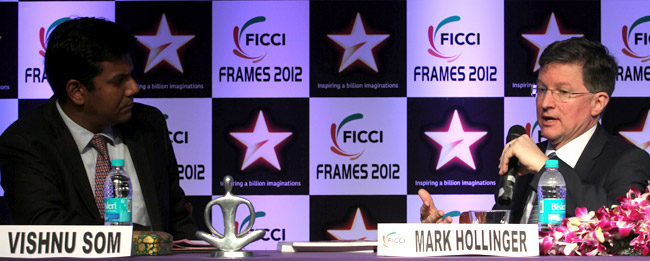
    The second session of FICCI Frames had ‘industry doyens, including key enablers, shed light on challenges and opportunities for the times ahead’. The session was moderated by Vishnu Som, Editor, Documentaries and Senior Anchor, NDTV.


    The session was opened by Mr Som welcoming Mark Hollinger, President & CEO, Discovery Networks International (DNI), who took the stage to talk about DNI’s journey in India. From a single network launched in 1995, today DNI has grown to seven channels. Mr Hollinger gave the credit of this success to DNI’s advantage of being an early mover in the Indian market.


    While talking about the process of digitisation, Mr Hollinger said that it is a great opportunity for a truly interactive pay TV experience. He appreciated the investment  made by the C&S community (the set top boxes and the marketing for the same).


    Mr Hollinger was of the opinion that the viewers today prefer sophisticated technology and the same applied for TV too. He said that digitisation is a win-win situation for all. The consumer gets a better product with ‘wider choices’ and the broadcasters will get a better business model which allows ‘faster and broader penetration of HD channels’. He stated that embracing digitisation will push broadcasters to perform better.


    In the Q&A session with Mr Som, when he was asked about the benefits of producing content v/s revenue, Mr Hollinger said one-third of their operational revenue and profits is recovered from the market due to their early mover advantage. He revealed that they spend almost $1 billion on producing content.


    Being an international channel which enteredIndiain 1995, Mr Hollinger talked about howIndia, as a country, is more open to foreign content. He also said that even then they offer regionalised content created specially for the local viewers and also the option to view the international content in the local language. Mr Hollinger stated that their strategy worked as was evident from the Brand Trust Report which has named Discovery as the third most popular channel and TLC as the fifth.


    In the Q&A session, when Mr Som questioned him about the pros and cons of local v/s international content, Mr Hollinger said that the local staff keeps them appraised about how the content is received. He said that the mix of international and local content is almost 50-50.


    Mr Hollinger saved the best for the last. While closing his speech, he announced that DNI is launching Discovery Kids in India, which is the launch pad for theAsialaunch. The channel will also be launched inIndonesiaandPhilippines.


    He also revealed plans to expand DNI’s scope to DVDs, retail, publishing and merchandising in the “biggest satellite market today”.


    Next up was Puneet Goenka, CEO and MD, Zee Entertainment Enterprises Limited (ZEEL). Mr Goenka opened his address by stating entertainment is no longer an evolution but has become a revolution. He said that digitisation of content is a good move as the drivers of today’s content are “highly motivated youngsters who are high risk takers and have large disposable income”. They have the power to influence products to be customised and digitisation will help achieve just that.


    With the help of a powerpoint presentation, Mr Goenka listed out the pros and cons of digitisation. He listed the fact that the penetration of private channels is still low and there is a lot of scope to grow as a benefit. Citing the example of Ditto TV, he said that now new media is the media to go to.


    During the Q&A session, when asked about the benefits of digitisation, he said that the sheer choice that the consumer gets is the benefit which will also be beneficial to them as the number of channels being offered in HD will go up.


    While talking about self-regulation in media, Mr Goenka said that it is still early days, as the norms have just been laid out by the news and entertainment industry. Time is needed to let them evolve and make a difference.


    Next to address the audience was Carolyn Everson, VP, Global Marketing Solutions, Facebook, whose address featured on how Facebook can benefit the media and entertainment industry. Giving the example of Open Graph, Ms Everson illustrated how Saavn in music, Zinga in gaming and films being released in theUSuse Open Graph by sharing stories built their brand on “top of Facebook”.


    Her ‘Aaha’ moment about Facebook came when, while talking to an anthropologist, she realised that communities and networks have always been around us but Facebook brings them to us at a scale never seen before due to the technology available.


    She said that Facebook is a reflection of the unique individual identity and the social graph is created using the information shared by the individual.


    Ms Everson also dealt with how Facebook is trying to take marketing from ads to stories. The thought behind the idea is that ads may be remembered once but stories are shared and remembered by millions. The best example of this is the Timeline pages for the brands which allow them to communicate one-on-one with their fans.


    During the Q&A session, Ms Everson faced some tough questions from Mr Som, when he asked her about how Facebook has been dealing with objectionable content. She answered that they work very hard to regulate content and address complaints regularly. When she was asked how and why do they decide what is unsafe or objectionable, she answered that the communities regulate the content and Facebook takes their input very seriously.


    Photograph: Fotocorp