Tag: Virginia Sharma

  • JioSaavn appoints Virginia Sharma as VP, Brand Solutions

    By A Correspondent


    JioSaavn has announced that Virginia Sharma has joined the company as Vice President of Brand Solutions. Based out of JioSaavn’s Gurugram office, Sharma will lead the company’s global digital ad monetization efforts across platforms. She will be responsible for driving adoption of JioSaavn’s innovative advertising solutions for brands, while overseeing agency and client relationships.


    Said Sharma: “I am excited to join the passionate and like-minded leadership team at JioSaavn, where music and people take center stage every day. Music is a lifelong companion; it evokes moments and memories, it’s a conduit for emotional expression; and it connects people of all ages and backgrounds. As a seasoned marketer and early JioSaavn user, I already recognize many opportunities for brands to find their voice on the JioSaavn platform, allowing them to engage and build loyalty with millions of consumers. Let’s play!”.
     

    Added Vinodh Bhat, Co-founder, President and Chief Strategy Officer, JioSaavn: “As the JioSaavn user base continues to grow, the company was ready for a strong, seasoned and passionate executive in our core market to scale our advertising business. Virginia is recognized as one of the top digital leaders in the country and set records at LinkedIn for monetization in India. She is an accomplished Marketer turned Sales Leader with the proven capability to understand marketer needs and create durable long-term solutions for them, applying a mix of business creativity and strong ad technology. In addition to her wealth of expertise and strategic understanding of the industry, she is also a great culture fit at JioSaavn. We are pleased to welcome her to the team and very excited to work together on this road ahead.”


  • Top Trends in Content Marketing 2017


    By Santosh Jangid


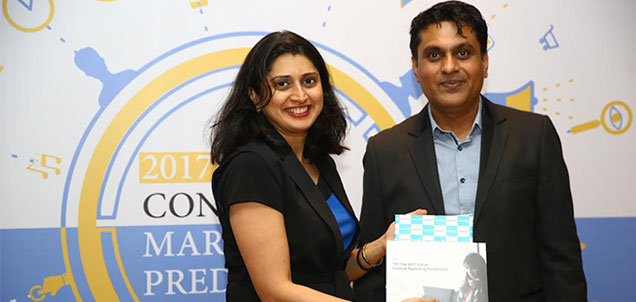
    In India, digital buyer penetration is projected to jump from 43.8% in 2016 to 70.7% by 2020. Indian content marketers equally use social, blogs and newsletters and getting audiences to share brand content means appealing to their interests especially and B2B.  These are some of the highlights of the 2017 Content Marketing Predictions and trends report for India unveiled by DMAi’s Content Marketing Council that were curated by LinkedIn.


    The report hands out 10 trends that we may see in the content marketing world in the next year. Speaking about the report launch, Vatsal Asher, Co-founder and CEO, DMA Asia said: “It is a super exciting day for us and I am so pleased to announced on behalf of the International Content Marketing federation where DMAi is a member we are unveiling the first piece of detailed research around the state of content marketing and content marketing trends and predictions. We feel this is a big step to help our fellow marketers and the industry at large to know what is going to happen in 2017 in the world of content marketing on how marketers can leverage it and what is in store for brands and what are the consumers expectations from content marketing of brands.”


    On how the report will be beneficial for content marketers, Asher said: “Content marketing has evolved to have many definitions and marketers are struggling to find the right answer to content marketing. How do they do relevant content, how do they curate content, how do they disseminate content and in the fragmented media engaging relevant storytelling is still the norm. The methods of distributing content has changed. Businesses are fast adapting to this new methods, how consumers consume content, be it long form text, pictures and videos and the content beyond the conventional text, pictures and videos. So, be it experiential, be it on ground, digital or offline, there are variety of ways in which content is being consumed by consumers and to make the connection with consumers at the micro moment of truth is the test. Our report gives insight to how marketers can look at some of these challenges, what are their peers doing in India and across the world, what are the trends that are predicted by some of the content marketing professionals in India and abroad.”


    Said Virginia Sharma, Director Marketing Solutions, LinkedIn India on the report: “As chairperson of the Council, I am particularly proud of this piece of work as Content Marketing Council we should really represent the best of content marketing in the industry and the fact that we have been able to come out with a very compelling content piece in partnership with many different folks in the industry makes me very proud.”


    Further speaking on what trends we might see next year basis on the report, Virginia Sharma added : “The report has some great trends. I am particularly excited about argumented reality as well as videos but the one that captures my imagination is around user generated content and the growth of user generated content. There was a time when brands felt very strongly that they need to control the narrative and control the content that is generated about their brand. Highly professional produced videos, professionally written blogs was a very controlled mechanism. The fact that brands are getting more comfortable that maybe the brand is not in their control but it’s actually in the control of their advocates and users and will talk about it in the way they see it fit means that content marketing really has an opportunity leveraged user generated content which is really gonna be one of the trends.”


    Jyoti Kumar Bansal, Managing Director, PHD shared her views on the report from a marketer’s point of view by saying: “Content has really become the buzzword with marketers for sometime now and the predictor obviously becomes like a support for us to how things are going. the big challenge that we face as marketers and advertisers is to get enough understanding of how to actually utilise it to really put our brand messages to our consumers while still keeping it interesting, relevant and entertaining for them because otherwise it becomes too much of a plug-in and that’s where reports like this come in helpful because once we know where the consumers are, it’s easier for us to create stories that engage consumers and still gets our brand message across in a subtle and relevant manner to them.”


    LinkedIn – The Top Indian Content Marketing Predictions for 2017


  • Is Digital eroding relevance of TV and Print?


    By A Correspondent


    The traditional media of print and television are under siege, as it were. Though they are still dominant media, they are seeing a sea change in the way they are being consumed. The explosion of new media also threatens their relevance and hold. Or so it is believed. But is it an overreaction and does digital not pose that much of a threat to TV and print?


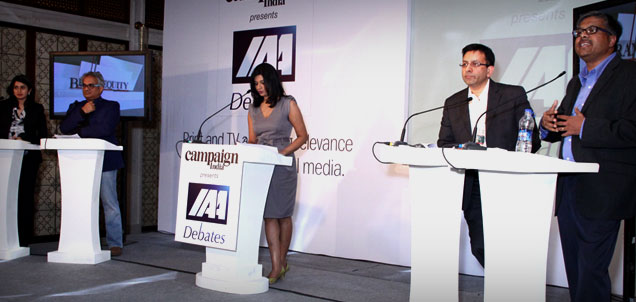
    To find out, the India chapter of IAA organised a debate in Mumbai on Monday (Feb 18) on whether television and print are losing relevance with the growth of digital in India. The debate series is being sponsored by Campaign India and the co-chairs of the IAA debates initiative are Partho Dasgupta and Neville Taraporewalla.


    Seasoned professionals Virginia Sharma of IBM and Mahesh Murthy of Pinstorm (and Seedfund) argued for the motion while Sanjay Gupta of Star TV and Arunabh Das Sharma of The Times of India group argued against the motion. The debate was moderated by Sonali Krishna, Anchor of Brand Equity show of ET Now. A cross-section of industry professionals were in attendance. As were some representatives from MxMIndia.

    We bring you some of the highlights of proceedings. Note, this is only a part of what was discussed.


    Mahesh Murthy: If you look at the Census report, if you see rural India there are just 33 percent homes that have television vis-a-vis 54 percent that have mobile phones. Overall if one compares, urban plus rural, TV used to take 32 percent penetration in 2001 which has grown and is at 47 percent at the moment. But mobile has grown from 9 percent in 2001 to 56 percent today. Mobile today is 24 percent larger in Indian households especially rural where the number is about 50 percent more.

    If you look at the numbers further, television has about 111 million viewers whereas mobile has about 133 million users – which further consist of 400 million users of SMS, 900 million SIM cards, etc. When one compares the publication number of The Times of India that is at 3-4 million which is dwarfed by 18 million users of Facebook every day in India.

    If you look from the consumer’s POV the three most desired audiences from an advertiser’s perspective is the 15-24 yr-old youth that barely reads a paper or watches TV and is highly digital-savvy; 25-34 yr-old females – Facebook alone has 11 million of those and I do not think any other medium in India can give you that kind of access to this age group; and finally 35+ age group – it will be hard-pressed to reach a CEO today as long as he is on his tablet or i-Pad or email, etc.

    When we move on to the advertisers, all of two years ago digital was all of two percent of the ad pie which has now become about 8.5 percent, meaning that digital has grown by 400 percent while the share of television or print has gone down.

    If you look at how digital has been explored by other people like politicians who have more than 200 people to handle just the digital medium, which I do not think is the case with other media. Even when one looks at the credibility factor, Nielsen states that the most credible medium is word-of-mouth, followed by what strangers write online followed by what is written on websites and then comes print.

    So what we are seeing is that print and television are not going zero; while they still have relevance they are losing their relevance because of the advent of digital. I’d like to end by requesting each one to ask themselves as to where do you see yourself in the future – whether five years from now you’ll be seeking a job in a company that does not do digital. The honest answer will decide where your preferences will skew towards the end of this discussion.


    Arunabh Das Sharma: I’d like to begin by saying that what we are discussing here is relevance. Is it about ad dollars; is it about ‘x’ percent more mobile penetration or is it about what these media have stood for the longest time – which is curated content. What digital has done is created a proliferation of choice and when that happens big becomes bigger. In such a situation everything grows. I’d like to share here an example of how the growth of social media has fuelled the growth of television and print and how they the two mediums are getting healthier now that the investment in content is becoming stronger and stronger.

    In the 1950s, it was said that radio was going to kill the medium of print and was followed in the 1970s where it was said that television would kill the medium of radio… none of that happened. There is a reason why different media play different roles in our lives. A recent study by research firm Ipsos talks about what are the global rules that different screens play in your life. So while the mobile screen is a lover, the computer screen is a sage while the tablet is a wizard but the fact of the matter is that you need a lover, wizard and a sage; the fact of the matter is that every medium has a special role to play and we ourselves will be very myopic if we assume that television is linked to a cathode ray tube or that a newspaper is linked to a piece of paper.


    Virginia Sharma: Is your motion that TV and print continue to be relevant or that they are growing in relevance?


    Arunabh Das Sharma: I think the topic needs to be redefined whether print and TV are losing relevance but whether digital will ever gain relevance? In fact I’d like to say here that 2012 saw some of the biggest gains in stock prices of print companies because of one aspect – they had figured out their business model. The issue was that in 1992 when the readership started dropping they had to figure out a business model which wasn’t to be.


    Virginia: Do you have any comparable stats to validate your observation?


    Arunabh: It doesn’t even show on the scale for India. I’d like to add here that a lot of people wouldn’t know about this but a gentleman in the US just brought a bunch of regional newspapers with the assumption that the growth of print will happen through hyper-local and regional papers, which is exactly what will happen here too.


    Virginia Sharma: I’d like to start off by answering the question, ‘What does relevance mean?’ In today’s world relevance means business impact. The fact that it was said that digital does provide a platform of choice is correct; also the fact that social as a medium has grown is also correct.


    Arunabh: If relevance is defined as business impact, are we talking the same scale in that sense in India?


    Virginia: What I am saying is business relevance to advertising agencies…


    Arunabh: But I thought it was also about ad dollars…


    Virginia: No ad dollars is about expense. Business relevance is about business outcomes and about what the CEO measures, particularly the RoI. To quote numbers from a CEO study that was conducted, the use of social and web from 11 percent to 48 percent for social and from 37 to 49 percent for the web in the primary way to interact with the customers.  That for me is business impact and what the boss sees this as a way to engage the audience. What do most brands like Coca Cola, Pepsi, ICICI, HDFC etc have in common – it’s their innate belief that this medium is relevant and their investment in this medium is not just what the ad agency says it is.

    So, two big cases. First, the primary metric of the CEO study for marketers for success is RoI. You can measure RoI based on the ability to understand customers and target them with what they need. You can only measure digital better than you can measure print and television. Therefore the future for marketing where RoI is concerned as a primary measure for success has got to be digital if you want to make the case.


    Arunabh: I think the challenge is not about measurement but about conversion and that’s how a medium works. Measurement that you are saying is how many people have seen the ad not how many people because they have seen the ad went and watched something.


    Virginia: Measurement for me is actually measuring consumer behaviour and doing it successfully. To sum up, the business case is very simple, if you want a good RoI you have to use digital as a key medium to be able to feature consumers and that ultimately is going to be key.


    Sanjay Gupta: When I started working 20 years ago I thought print is going to die and today print is about Rs 14,000 crore from Rs 6,500 crore it was a decade ago. For television the growth has been from 5,000 crore to 16,000 crore. The key points that I’d like to present here are that firstly, consumers love television and it is thriving. The thing is that if you find something relevant you spend time with it. Around 700 million people in this country spend three hours every day watching TV. When they start it is for two hours, which then picks up to three hours. Also in the last one year, 70 million new people have started watching television. That’s more than the number of people who watch digital in any given point in a month. The same is the case in developed countries like the UK and the US where the time spent is around 4-5 hours every day.


    The other thing is that big is becoming bigger on television. The belief is that proliferation of choice will make users fragment. A recent example I’d like to share is of the movie ‘Dabangg’ which was watched by 150 million people. Even shows like Balika Vadhu etc aggregate about 40-50 million viewers in that half an hour. The point I’d like to make is that social media is actually helping the business become bigger and better. The people fall in love with our characters and they do that only on television and not anywhere else.


    Mahesh: So essentially your point is that even TV uses digital…


    Sanjay: TV does use digital. To quote an example our show Satyamev Jayate was the biggest show that we did and we used the channel of social media to make people come and watch it. It was in fact the highest trending topic on Twitter. So what I am saying is that digital is driving our business to do better.


    Virginia: Is it content that drives behaviour and interest or is it the medium?


    Sanjay: It is content. To cite figures, in the UK people watch about 80 minutes of video and out of that 80 percent is either pornography or YouTube – that’s the power of that medium there. Whereas if you provide good content it makes the viewer keep coming back to watch more and more.


    As to what is changing, digitization is changing the way television companies do business. Till now only 20 percent of the revenues from digital medium came to the broadcaster but the transparency with DTH that number is moving from 20 to 100 percent. So subscription revenues of TV companies have grown five times and what does it give us – the power to invest in content. That is what will make it even more relevant in the future.


    Murthy: So your point is that television is using DTH or rather digital to deliver itself to homes?


    Sanjay Gupta: The point I am making is that the medium is powerful, profitable and is growing. The fact is that people will not consume any one or two mediums, they will consume all the mediums. The question is: how do we use the power of each of these mediums as they have to be relevant.  So print and TV will not lose their relevance they will continue to grow. The real question is that we need content aggregators and devices. Digital as a medium is just an aggregator of content and fundamentally the question we need to answer is how meaningful can this content get on the medium if it has to grow even further.


    Arunabh: Statistics do give us a picture. The fact of the matter is that both these media are huge and growing. If they were not then we could have turned around and said that it is not but like all new media they are finding newer ways – whether through a screen, a mobile, an app – of growing the medium. We are not here to debate whether one medium is better than the other, the fact is that we as consumers love to consume media and do it the way we want to. It is not about whether x, y or z is losing relevance, the fact is it is bigger and it is growing. In fact the next round of growth is already visible to us – it is coming from regional markets. Because of our infrastructural issues it will take digital some time to pick up speed but until such time our friends in the digital world would do really well to figure out what kind of content creates stickiness and what kind of content keeps readers going for 175 years. The day one of these digital mediums complete a 175 years in the form and fashion from what they started then we can talk about it further.


    Virginia: I think the four of us together have made a very compelling case for the growing relevance of digital and that it is powerful, profitable and here to stay. Such a combination would make this medium indeed relevant. Print and TV is going digital, decision-makers are going digital, politicians are going digital… the big question is, which side do you want to sit on? And no, digital does not want to be the medium it was 175 years ago, it wants to keep up with the times as well as the generation it is catering to and it will constantly evolve and is eager to change. It will make money regardless of the shape it will take. The question is, are you ready for the future – digital?


    The debate was won by the team against the motion. Before the debate started, 44 people from the audience were against the motion and 31 were for it. After the debate ended, the numbers were 42 against and 34 for.

  • @AIMA Congress: ‘Marketing is always a challenge’

    By Shruti Pushkarna


    RK Swamy BBDO’s SK Swamy @ AIMA 2nd World Marketing Congress
    [youtube width=”400″ height=”200″]http://www.youtube.com/watch?v=WQ-UK3vd3v8[/youtube]
     Maruti’s Mayank Pareek @ AIMA 2nd World Marketing Congress
    [youtube width=”400″ height=”200″]http://www.youtube.com/watch?v=xKv0XlDoh8A[/youtube]

    Yashwant Sinha, Former Union Minister for External Affairs and Member of Parliament, summed up the crux of all discussions at the two-day marketing congress appropriately when he said, “Marketing, as a function will always remain a challenge to marketers because it is an art and a science that will continue to grow.” In the several sessions over the two-day congress, the concept of marketing was expanded to include spheres as diverse as politics, corruption, business and spirituality. Leaders from all walks of life converged at the congress to understand the nuances of marketing and how to leverage the power of marketing.


    The AIMA 2nd World Marketing Congress was held in New Delhi on March 2-3. The two day conference saw a panel of eminent speakers from various sectors who exchanged their thoughts on the changing dynamics of marketing. The theme of the conference this year was ‘Exploding Marketing Power. Speaking of the theme, World Marketing Congress Chairman & Chairman and Managing Director, BBDO RK Swamy, Srinivasan K Swamy said, “Marketing is the only thing that can deliver disproportionate results. Finance, manufacturing etc can only reduce cost to some extent, whereas marketing can provide excessive revenue and it has the power to bring on exponential return, that’s why we have this theme of exploding marketing power.” He also said, “The AIMA World Marketing Congress this year has raised the bar from last year to explore various dimensions of marketing not just in India but globally. The basic concepts of marketing have not changed in the last few decades but their implementation has. Marketing strategies start even before the product is launched, through the purchase and by means of post purchase offers.”


    This was also the third year running for the AIMA-RK Swamy High Performance Brand Award. This year the award was won by Wipro Technologies, with Axis Bank as the first runner up and Voltas Ltd as the second runner up.


    Staying relevant to the consumer

    In the session on ‘Extracting Full Value of Marketing Investments’ both Virginia Sharma, Vice President & CMO, IBM India and Aditya Ghosh, President, Indigo Airlines stressed on the need to stay relevant to the consumers. Ms Sharma said, “You have to stay relevant to the consumer and that’s the toughest job as a marketer. Brand visibility and awareness can be bought- you can plug your logo anywhere and everywhere but what you can’t buy is relevance. So what we need to do is to build authentic advocates for the brand because advocacy shapes belief.”


    Mr Ghosh said that all employees at Indigo are brand ambassadors for the airline. He said, “We need to ask ourselves how do we stay relevant to the customer and what is the customer really willing to pay for. Our aim is to concentrate on the product which remains relevant to the customers. Marketing does not define our business strategy but plays an important support role in pushing it further. Our marketing spend is less than 1 percent of our revenues. We create new innovative experiences and find various touch points with our customers that transcends into all our products and offerings.”


    Mr Ghosh also shared three strategic guidelines that Indigo follows.

    • Stay true to the brand value
    • Carefully curate every possible touch point
    • Make a buzz-worthy yet credible impression

    Mr Ghosh also said that a one-way marketing blast is not always necessary. It is important however to keep innovating the techniques of how you push your message across to the consumer.


    Stretching the product life cycle

    Nita Kapoor, EVP Marketing & Corporate Affairs, Godfrey Philips India Ltd chaired the session on ‘Stretching the product life cycle or product extensions’. In her opening remarks, she said, “Product extensions are fundamental to business strategy. Product extensions have a framework and their simple objective is to maximize revenue and create entry barriers.”


    Alok Bharadwaj, Senior Vice President, Canon talked about product life cycle management as something that is more to do with creating values for the brand rather than a marketing gimmick. He said that it is important to create and add value every time there’s a product extension. He said, “There are two compelling business drivers in product life cycle management. One is innovation, which helps provide new propositions for product extensions. The other is marketing, which makes these propositions relevant to the customer.” He also added that since change is happening globally especially due to fast changing technology, management of product life cycle has to be done globally as well.


    Mr Bharadwaj cited examples from technology products’ business cycle. He said, “Technology products have a slow start but they move up to the peak rapidly, staying at the peak only for a short while, they drop down quickly. Life cycle of these products is less than a year. So to make up for the loss in the second half of the product life cycle, a marketer has to capitalize by the time the product is reaching its peak and push for it to peak a bit higher. This is when product extensions come in.”


    Understanding the rural consumer

    The session on ‘Extracting the full power of Rural Marketing’ was chaired by Manisha Lath Gupta, CMO, Axis Bank and the keynote address was by Siva Nagarajan, MD, Mother Dairy. Ms Gupta started the session with a stress on the need to differentiate a rural consumer from an urban consumer. She said, “The needs of a rural consumer are very different from the needs of an urban consumer. As marketers we need to start innovating for the rural market.” She also said that the word ‘extracting’ had negative connotations attached to it, and as marketers one should really look at ‘serving the rural customer’. She said, “We should serve rather than exploit. We have to give back as much as we take. As marketers, we should be looking at developing sustainable livelihoods in rural areas.”


    Mr Nagarajan agreed with Ms Gupta on the need to redefine the rural consumer. He said, “We don’t even have a proper definition for rural. For us, anything that is not urban is rural. Rural consumer is not a poor urban consumer. Speaking of winning strategies for extracting the full power of rural marketing, Mr Nagarajan said, “Rural India holds a big opportunity for marketers. It is extremely important for marketers to understand rural mindset, their income & spending patterns, penetration of various products in the market and most importantly give value back to the producer. For brands to set up a strong base in a rural market it is essential to realize that the rural consumer is not a poor urban consumer. Marketers need to have an interdependent eco-system which involves players like Government, NGO’s, Banks etc. We cannot look at price-led innovation, rather we need to look at product value. Apart from vivid demos, rural marketing and brand building involves educating the trade and the influencers and not just regular above-the-line activities.”


    Making brands more meaningful

    The session on ‘How to make brands meaningful and powerful’ saw Mayank Pareek, Managing Executive Officer, Maruti Suzuki India Ltd. and Vishnu Mohan, CEO-Asia Pacific, Havas Media, debate and deliberate the need to make brands more powerful and the ways to achieve that.


    Mr Pareek said, “For marketers to make brands more powerful and meaningful, the biggest challenge faced by them is the buyers. Brands need to be relevant to what people are and what they want.” Citing examples of brands like Apple and Beetle, Mr Pareek emphasized on the need to create brands which ‘speak’ to prospective customers and go beyond just being ‘physical’ products.


    Mr Mohan cited some findings from a Havas study which pointed out that 70 percent of brands have no life, which means that if they were to disappear today, customers won’t care about them. The study also says that people in the Asia Pacific region are more concerned about environmental, health and social issues, and they are also more attached to brands as compared to the western world. The study also indicated that people’s expectation of companies’ responsible behaviour have risen over the past two years.


    So in a scenario where consumers recognize that environmental/social problems have an impact on their lives and that’s why they are willing to pay more for responsible products, the challenge for the marketer is to see if his/her brands are contributing to improve the lives of consumers.


    Speaking of what makes brands meaningful, Mr Mohan pointed out three key pillars


    • Personal well being- The customer wants to know how the brand impacts him/her, what are the personal outcomes
    • Collective well being- How does the brand impact the collective outcomes of people, society
    • Communications- Brands need to be able to talk to consumers, make them think and trust


    Mr Mohan concluded, “To be ‘valued’, brands need to transform from ‘value’ to ‘values’.”


    Making it ‘interesting’

    In the session on ‘Exploiting the power of Creativity’, R Balakrishnan, Chairman & Chief Creative Officer, Lowe Lintas India was at his creative best. He engaged the audience by playing some of the best TVCs to reinforce his idea that there are several ways of making things ‘interesting’. He said, “Marketing a brand is all about solving a problem as interestingly as possible after carefully understanding the need of the customer. Interesting can come in different ways, it can make people laugh or cry, or just make them say ‘wow’. Creativity today fundamentally revolves around making the boring seem interesting to the target audience. It can be done in various ways; by making a person feel like the hero of his own life, finding interesting insights about the new generation and translating it onto the advertisement or by giving an idea in a commercial which people can employ in real life.” Balki added, “You can’t teach people about creativity in a structured manner. However, structured thinking is required to make anything interesting.”


    Distribution is about managing the mind of the market

    The session on ‘Distribution/Channel Dynamics- Enhancing result’ was chaired by Paritosh Joshi, Chief Executive Officer, Star CJ Network India with an address by Amrit Thomas, CMO, United Spirits. Mr Joshi said, “Most people’s war stories that I have heard are to do with distribution. In a country like ours, availability comes before choice. Even before you get to choice, you have to arrange for availability. Also as distribution channels have evolved, the nature of the choice of marketers and the choice of customers has also become complex.”


    Mr Thomas said that brands are like ideas in our minds. He said, “The role of advertising is to plant that idea. Having planted that idea, you need to convert the idea into acts- sales. The big shift we are seeing in marketing is the new technology- web and mobile. These have made the propagation of ideas easier.”


    Speaking about enhancing results through distribution, Mr Thomas said that it is important to understand the mind of the market. He said, “The mind of the market is shaped by consumer, shopper, sales team and customer. Word of mouth/influence plays an important role in building brands and driving growth. Marketers need to understand and leverage touch points through consumers and shoppers interact with brands. Marketers also need to understand shopper and shopper occasions and make interventions to build competitive advantage at the point of purchase.”


    Conclusions

    The marketing congress ended with a valedictory address by Yashwant Sinha, who drew a parallel between the roles of a marketer and a politician and said that politicians try to market themselves continuously and if they stopped doing so, there would be no hope left for them in politics. He also said that he was surprised that not much technical work is done when it comes to marketing political ideologies.


    Speaking of a sudden upsurge in demand in India, he said, “We are seeing not ‘exploration’ of the market but ‘explosion’ of the market. So capacities will have to be increased in order to meet that demand.” He urged marketers to contribute a lot more towards rural India as he said, “A great deal needs to be done in the area of rural marketing.” He stressed on the need for marketers to ‘innovate’, to craft their messages in a way that will meet their target groups. He concluded, “Marketing, as a function will always remain a challenge to marketers because it is an art and a science that will continue to grow.”


    At the closing, World Marketing Congress Chairman & Chairman and Managing Director, BBDO RK Swamy, Mr Srinivasan K Swamy shared five personal takeaways from the congress.


    • Marketing is all about single-mindedness- He referred to the Indigo strategy cited by Mr Aditya Ghosh, President, Indigo Airlines, where they stress on not just flying planes on time but punctuality is woven into everything that they do at Indigo, even if it’s about starting meetings on time.
    • Value is more important- It is not that customers are looking for cheap products but they are looking for value for money.
    • Consumers are willing to pay- If companies are ethical, if they have CSR initiatives and they provide environmentally sensitive products, then the customers are willing to pay a higher price for their products.
    • It’s all about being interesting- Consumers like interesting things, interesting people and interesting products.
    • Intuition is passé- Today intuitive decision making is passé because there is so much one can do based on response driven marketing.