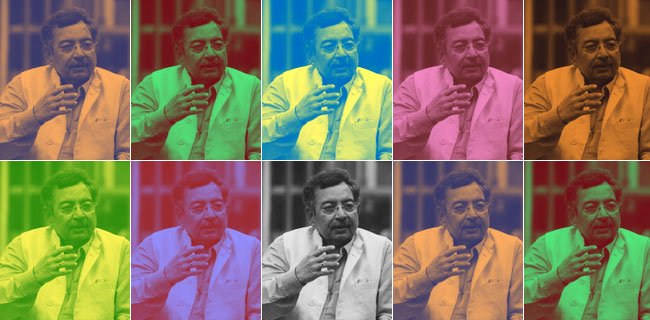
Tag: Vinod Dua

  • Vinod Dua – the Urbane Hindi Voice


    By Parsa Venkateshwar Rao Jr


    I must clarify before I go further that I watched Vinod Dua closely through all the election programmes that he presented with NDTV’s Prannoy Roy through the 1990s. (It was only in the last few that I came to know him slightly. I must also acknowledge that he was warm with new friends as well and never made you feel that you are a new friend.)  But it would be unfair to the man if we do not understand his place in the changing media scenario of the country after 1991. The tributes that I have read were that of his close friends, including journalists, but who bonded with him at a personal level. That he has so many friends showed the humane side of him. It is this humane side that was the undertow of his speech


    This was even before S P Singh launched the daily news capsule at 9.30 pm, where he signed off with his “intezaar kijiye kal tak”. Dua was a curiosity because the bilingual presentation was an effort by metro Indians to reach out to the Hindi heartland audience. Roy, or Dr Roy as he is known to many of his colleagues, seemed to have realised that without Hindi, the audience would be restricted to the drawing-rooms of the well-heeled. What made me curious as well as amused with Dua was his urbane manner of speaking Hindi, as smooth as the English spoken by Roy and others in the programme. One of way of sounding smooth and polished while speaking Hindi was to throw in a few Urdu words. But Dua did not follow that easy option. He spoke lovely Hindi, and pronounced the Sanskritised Hindi words with ease, without letting the accent fall too heavy on any syllable.


    I have always told myself that this Hindi was spoken with a clipped Oxford accent. It sounded good though there were times when the sophisticated ring of the voice became a little tedious even as Roy’s strangely accented English – outdoing the native English speakers – became an irritant.


    But looking back a quarter century and more later, it becomes easier to understand the social context. Dua’s was the first Hindi voice of liberalised India. Before him there were the admirable Hindi newsreaders on All India Radio and Doordarshan, who spoke Hindi with the perfect pitch and they made the unmusical official Hindi sound mellifluous. Economic reforms ushered in by the dull P V Narasimha Rao- Manmohan Singh duo excited urban, metro Indians. Roy and Dua reflected that excitement with their nuanced accents.


    It might seem uncouth to talk about accents while writing about Dua. But the voice and presence was what made a radio and television journalist. And Dua was that. Neither Roy nor Dua moved from print to the electronic media. Their native soil was the electronic media. When people liked Dua, and there were hundreds of thousands, they liked his sophisticated manner. In understanding Dua’s journalistic career, this becomes the keynote.


    One of the questions that came up as I was chatting with MxMIndia editor was: how is it that one of prime movers of television in liberalised India just fell off the map as it were. And it seems to be that he was left behind as what were his strong points – the urbanity in speech and manner – became a handicap as Hindi channels and anchors and reporters increased. The Hindi channels brought with them their earthy flavour of speech quite different from that of Dua. The Bihari accent, the UP accent, and even the Punjabi one, made a niche for themselves. The British Broadcasting Corporation (BBC) once stuck to its stiff upper lip Received Pronunciation (RP) but realised the need to democratise itself and accommodate regional accents of its journalists. Dua represented in a sense the Hindi Received Pronunciation, but soon the democratisation happened. S P Singh brought in earthiness and a certain authority because of his grasp of politics, and he did not fight shy of his Bihari accent. Dua knew his politics, but it seemed as though it was that of a slightly distant observer. The traditional hallmark of a journalist is his or her immersion in politics, and that non-English language journalists display to the hilt. Dua, the Hindi journalist, did not fit the bill. This is not a value judgment about Dua or Hindi journalists.


    Dua did a food show in Hindi, which is a lifestyle feature, and which political journalists are shy of doing because they would say that all they know is politics. For Dua, there were things other than politics in life. With his flair for singing, he could appreciate music along with food. And he loved his drink in the manner of connoisseur. He was an epicure in the general sense of term. He loved the good things of life and he enjoyed them. Dua was drawn into a controversy as the me-too movement caught on in 2018, but it came to nothing.


    It is important to remember Dua because for a flickering moment he projected a facet of Hindi language and journalism that was at once genteel and knowledgeable. And it is from this vantage point that he became a critic of the Hindutva politics of Bharatiya Janata Party (BJP) and of the manner of Prime Minister Narendra Modi’s government. The Hindutva side resorted to his crude arm-twisting methods by filing a case against him in Himachal Pradesh for being an ‘anti-national’, the charge that they bring against anyone and everyone who they disagree with and who they dislike. Dua challenged the false allegation and the Supreme Court ruled in his favour. This is a victory for Hindi journalists as well as journalists in general.


    It can be said that he fought the good fight against political tyrants as well as for his life. He won against the political tyrants and lost against the tyranny of the pandemic.


    Parsa Venkateshwar Rao Jr is a senior journalist and commentator based in New Delhi. His views here are personal
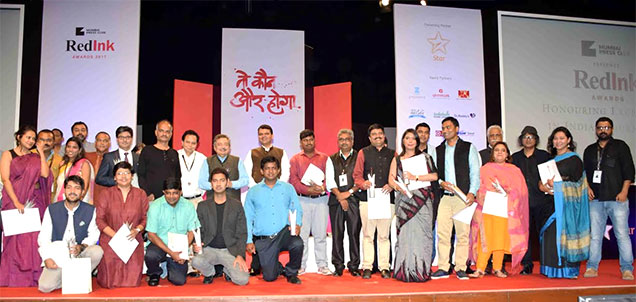
     

  • Mumbai Press Club’s Red Ink Awards presented


    By A Correspondent

    The much-awaited RedInk Awards for Excellence in Indian Journalism 2017 of the Mumbai Presss Club were presented on Wednesday evening in Mumbai with veteran journalist Vinod Dua being conferred with the Lifetime Achievement Award and Raj Kamal Jha the Journalist of the Year Award.

    Maharashtra Chief Minister Devendra Fadnavis, who was the chief guest for the RedInk Awards, said that he does not buy the argument that there is a threat to the fourth estate. “Constructive journalism always has its own value and at the same time we are open to criticism,” he said, narrating his own experience since he took over as the Chief Minister.  “Tolerance is in the blood of Indians…India traditionally had been a tolerant society,” he said, adding “Our democracy is very strong and it has survived turbulence in the past. The democratic system evolves and corrects itself.”

    The Mumbai Press Club felicitated the CM for his role in ensuring the passage of the state Journalist Protection Act.

    The Lifetime Achievement Award was bestowed on Vinod Dua for his extensive and versatile contribution to journalism in different formats and subjects. Accepting the coveted award, Dua said: “It is not just an award… it is an honour to me.” He said that it has been noticed that journalists get too close with people in power and often behaving like that. “This is not something that is good,” he said, adding that journalists should also be content by what they are monetarily getting. Besides, one must do what journalists stand for.

    The RedInk Award for the ‘Journalist of the Year’ 2017 given to Raj Kamal Jha, Chief Editor of the Indian Express, for providing exemplary stewardship over the last couple of years to the newspaper; and for providing focus and restoring what it has always been known best for – investigative journalism.

    “This award belongs to the Indian Express, the entire team,” said Jha, adding: “For us what is important is a good story…and sometimes when we see a good piece from a youngster, we feel that we could not have written it that way.”

    Govind Tupe of ‘Sakal’ newspaper was awarded the special RedInk award of ‘Mumbai’s Star Reporter’ – instituted for the first time this year – for helping empower civil society through hard work and dogged follow-ups. Donning the role of a journalist and an RTI activist, he forced the establishment to change its rules bringing all offices of cabinet ministers and ministers of state under the RTI umbrella of ‘public authorities’.

    Apart from these, awards were also given in the 10 various categories. The organisers received more than 1,500 entries across categories.

    The evening also a discussion on the issue ‘Turning the Searchlight Inwards: Why is the Credibility of News Media Today at its Nadir?’. Senior journalist Vir Sanghvi moderated the discussion that had former Maharashtra CM Prithviraj Chavan, Senior Journalists Bachi Karkaria, NDTV’s Sreenivasan Jain and Paranjoy Guha Thakurta among the panelists.

    Star India was the Presenting Partner for Mumbai Press Club Redink Awards for Excellence in Journalism 2017 while the Aditya Birla Group, Glenmark Pharmaceuticals, Zee Entertainment, Eros International, Indiabulls Housing, Dr Reddy’s Laboratories, National Stock Exchange, Nanavati Hospital and JSW Steel were award partners. The Hindu Group and Facebook are the media partners. MxMIndia was an online partner.

    The event was emceed by Menaka Doshi, Managing Editor, BloombergQuint.


    Winners of Redink Awards 2017


    LIFETIME ACHIVEMENT – Vinod Dua

    JOURNALIST OF THE YEAR – Raj Kamal Jha, Indian Express

    MUMBAI STAR REPORTER – Govind Tupe, Sakal

    SPECIAL IMPACT AWARD – Rahul Kulkarni, ABP Majha


    POLITICS   

    Print – RadhakrishnanRariyamKandath, Frontline

    TV – Sreenivasan Jain, NDTV


    SCIENCE & INNOVATION     

    Print – Nithyanand Rao &ViratMarkandeya, The Wire

    TV – AamirRafiqPeerzada, NDTV


    HUMAN RIGHTS

    Print – IpsitaChakravarty& Rayan Naqash, Scroll.in

    TV – Joint Winners, Abhisar Sharma, ABP News & Maya Mirchandani, NDTV


    BUSINESS  

    Print – Sarika Malhotra, Business Today

    TV – Archana Shukla, CNBC TV 18


    BIG PICTURE       

    Winner – Ashish Sharma, Open Magazine

    Runner Up – Kunal Pradeep Patil, Hindustan Times


    ENVIRONMENT 

    Print

    Joint Winner  TusharDhara, Sanjay Sawant, ShraddhaGhatge&NeeradhPandaripande, First Post

    Raj Narain Mishra, DainikJagran

    TV – Rajesh Kumar, India News


    SPORTS       

    Print – SwaroopSwaminathan, The New Indian Express

    TV – Joint Winner, Moumita Sen, India Today TV & Rajeev Mishra, India News


    HEALTH & WELLNESS           

    Print – Priyanka Vora, Scroll.in

    TV – Archana Shukla, CNBC TV 18


    CRIME        

    Print – Alia Allana, Fountain Ink

    TV – Atir Khan, India Today TV


    LIFESTYLE & ENTERTAINMENT  

    Print – Kathakali Chanda, Forbes India

    TV – Biju Pankaj, Mathrubhumi News


  • Vinod Dua, Sanjay Pugalia to star in revamped IBN7 primetime

    By A Correspondent


    The pecking order amongst Hindi-language channels doesn’t place IBN7 in the Top 3, as per ratings at least. And even in terms of perception. But in a coup of sorts, the channel has announced two shows – Vinod Dua Ka Prashnkaal at 8pm – Monday through Thursday and India 9 Baje at 9pm Monday through Friday with Sanjay Pugalia as the host.


    Mr Dua’s show starts February 17 and Mr Pugalia will be on air from Feb 18.


    Speaking on IBN7’s new prime-time line up, Vinay Tewari, Managing Editor, CNN-IBN and IBN7, said, “Elections are a complex, engaging and diverse event. It needs solid professionals who understand the complexities, who can simplify it for our audience and who believe in clarity over noise and sensation. We have brought in two of India’s leading journalists to take our primetime programming to the next level and who symbolise our beliefs about news. Vinod Dua, with his experience and unique style, is back to give viewers his take on the elections and engage them in our daily discourse while Sanjay Pugalia, whose understanding of politics and political economy is unparalleled, will debate and encapsulate the day’s major news on India 9 Baje.”


    Rajdeep Sardesai, Editor-in-Chief, IBN Network, said, “We are looking at possibly the most crucial general elections in Indian history. And IBN7 is set to launch two new shows anchored by two of the most influential and experienced journalists in the industry.”


    Indeed.