Tag: Vikas Agnihotri

  • HDFC Life collaborates with Google to maximise campaign results

    By A Correspondent


    HDFC Life has announced a tie-up with Google to restructure HDFC Life’s campaigns thereby making them run better with automation. HDFC Life said that this effort has worked well and generated positive results.


    Through this collaboration, HDFC Life, along with its agency partner, iProspect, has been able to leverage machine learning built into Google Ads to target potential customers with relevant ads through fewer search marketing campaigns and targeting groups.


    Speaking about the collaboration, Vishal Subharwal, EVP e-commerce and Digital Marketing, HDFC Life, said: “Technology is the way ahead for life insurance. We have a very clear focus when it comes to reaching out to consumers. We have always believed that our investments in technology will yield results. Keeping this in mind, we have collaborated with industry leaders who have enabled us to achieve our goals. This joint engagement with Google and iProspect has yielded superior results in terms of increase in ROI and decrease the lead costs. This is in line with our continuous endeavour to enhance our reach and offer financial security to more individuals.”


    Speaking about the effort, Vikas Agnihotri, Country Director, Google India, said “With the evolution of technology, brands today are able to optimise their campaigns and get better results and higher return on investments through machine learning. Working closely with HDFC Life Insurance and their agency, our teams were able to simplify the Search Marketing campaigns using automation. Thanks to automation the volume of target groups (i.e. ad groups) reduced by 500X and the teams are now focusing their time on creative experimentation and building further on this success.”

  • Bulk of white goods sale will be digitally influenced by 2023


    By A Correspondent


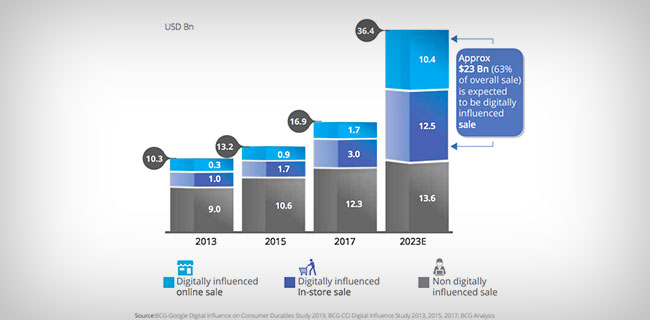
    Capturing the growth of digital influence and key consumer insights in the consumer durables sector in India, Boston Consulting Group (BCG) and Google India released a report titled ‘Digital Powers Consumer Durables: A $23 billion Opportunity by 2023’. Projecting a healthy growth rate for consumer durables, the report states that overall industry will see a growth of 13 per cent to reach $36bn by 2023.


    The report defines a sale as a digitally influenced sale, if the buyer uses internet during any stage of purchase cycle. Today 28 per cent of consumer durable sales is digitally influenced and this is estimated to reach 63 per cent of total sales, amounting to $23bn by 2023. $10bn of this will be online sale.


    Capturing rise in number of digitally influenced urban consumers, the report states that digital is increasingly playing an important role in consumers’ decision to buy a product, and number of digitally influenced consumers have doubled over last four years. Digitally influenced consumers have increased 5X in tier 2 and tier 3 cities and digitally influenced women consumers have increased 10X over last four years.


    Decoding the digital consumer further, the report also highlights important consumer insights as buyers traverse through multiple online and offline touchpoints before making the final purchase. In the pre-purchase phase, approximately 80 per cent of digitally influenced consumers are undecided about their choice of brand when they start their research and spend typically 2-3 weeks on research before making the final purchase. Search, social media, blogs and online videos are the key sources for online research. The report suggests that nearly 2 out of 3 digitally influenced consumers rate online reviews as a significant influencer in their purchase decisions.


    Speaking about the key insights, Nimisha Jain, Managing Director & Partner, The Boston Consulting Group, India said: “18Bn of consumer durable sales will reside with digitally influenced consumers who are undecided on their brands in 2023. Companies will have a short 2-3 week window to influence them and ability to timely & efficiently influence them will determine the winners of the future.”


    Calling specific actionable insights for the consumer durables players to seize this opportunity, Vikas Agnihotri, Country Director – Sales, Google India said, “Consumers are creatures of habit, and with growing access and connectivity, we are seeing consumers research online before they arrive at their purchase decisions for almost everything. And while businesses have started to build their digital presence, there is a need to take a holistic approach to digital as the scale of its influence has grown rapidly going well beyond top metros. Businesses need to create an always on digital strategy and create personalised interventions to tap different consumer demographics across all markets to achieve their business goals.”


  • MMA to address ad fraud issue via roadshows (+MxM View)

    By A Correspondent


    The Mobile Marketing Association (MMA) in India, has announced the launch of three-city roadshow series on ad fraud across New Delhi, Bengaluru and Mumbai. Beginning with the first roadshow on March 13 in Delhi, the series will then move to Bengaluru on March 27 and conclude on April 18 in Mumbai.


    Said Moneka Khurana, Country Head, MMA India: “As per the MMA India Ad Fraud Survey conducted, the top two challenges faced by marketers in mobile advertising are mobile ad fraud and brand safety. MMA is enabling marketers with the required knowhow and expertise through the roadshows to learn about brand safety and Assess, Combat and Track Ad Fraud which is slated to rise by 40 per cent in 2019 and is continuously leading to huge losses in marketing dollars spent.”


    As a part of the Brand Safety Council at MMA India, Partho Dasgupta, CEO BARC, said: “Ad fraud is a battlefield. MMA’s roadshow brings together all stakeholders of the business who will discuss the nuances of app-based performance marketing while highlighting the changing fraud detection landscape of India. Such a platform benefits everyone.”


    Added Vikas Agnihotri, Country Director – Sales, Google India, MMA India Brand Safety Council member: “In order for the free web to work, it needs to be a safe and effective place to learn, create and advertise. That’s why for several years, we’ve invested in technology, policies and talent to help fight issues like ad fraud, malware and content scammers. It is important for us to come together and work towards ensuring safeguards across the marketing ecosystem.”


    MxM View: While the platforms (Google, Facebook & Co) will obviously patronise practices to cleanse the system, it’s critical for advertisers (and marketers) to also agree to the rules of the game. Will they? And if they err, will the platforms expose their big-spending benefactors?


  • Will Data be the Annadata of the future?


    By A Correspondent


    We all know that data is the future of the marketing services business. The immediate future at least. And those who want to maximise on things now, even the present.


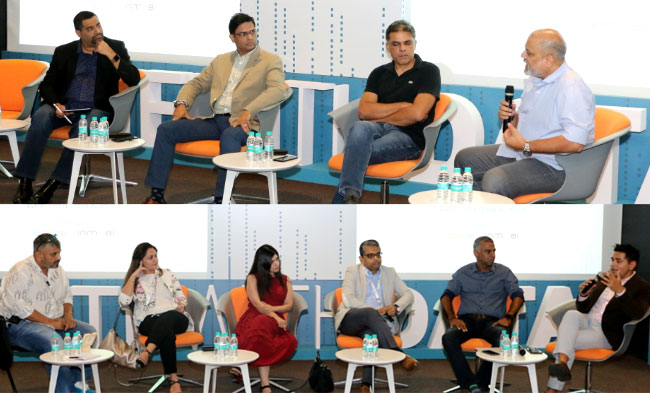
    Marketing services conglomerate WPP organised its first ever ‘Date with Data’ Summit on Tuesday with a galaxy of marketing gods and its own star-studded network.


    The idea was to exchange ideas and insights on data-driven marketing and the use of technology across marketing solutions. Keynote speakers and masterclass presenters emphasised the evolving role of data and its profound influence on the industry across all sectors. And thereby of course underscore its expertise with all things data.

    Speaking on the relevance of Audience Planning: A Journey or a Destination, Gauravjeet Singh, Head of Media South Asia, Hindustan Unilever, said, “It is a great experience to attend industry forums like this which really discuss the cutting-edge work that is happening around data. It is important to validate what one believes which helps during discussions with panellists and eventually leads to the right direction.”


    Addressing the growing need for marketeers and thought leaders in the industry to efficiently utilise the power of data, CVL Srinivas, Country Manager WPP India, said: “WPP strongly believes in driving collaboration amongst various stakeholders of the industry and this event is our attempt to create a platform for sharing different perspectives on how data is helping reshape marketing and businesses. As responsible users of data, we strive to enable thought-provoking discussions around important themes. We witnessed great participation from our clients, partners and colleagues.”


    The Summit opened with masterclasses on Data Visualisation-To Drive Data Adoption and Data Driven Thinking; Building A Data Driven Organisation; Unlocking the True Potential of Mobile Data; Data Privacy and Responsibility and Connecting Data (Data Integration) and Generating Targeted Insights (Data Analysis). These sessions were conducted by experts from Google Cloud, InMobi, Kantar and Data Alliance.


    The afternoon saw panel discussions on topics such as Decoding The Consumer: Fundamentals to Future, that addressed advancements in insights, research and analytics; Connected Commerce: Decoding The Last Mile, which highlighted how data and analytics are being leveraged to bridge the gaps in commerce. Audience Planning: A Journey Or A Destination touched upon innovative approaches of using data whilst Data As A Source of Creative Inspiration explored how data can be used to inspire creative content and communication planning.


    Speakers and participants from companies such as Vodafone, ITC, Pepperfry, Hindustan Unilever, Ford India, Google, InMobi and Nykaa were amongst those that delivered key presentations and business insights.


    And here are pointers from what the various panellists said:


    Panel 1: Decoding the Consumer: Fundamentals to Future


    Siddharth Banerjee – Executive Vice President of Brand and Marketing, Vodafone

    Data signals help to pick up on consumer behaviour. Data collection can be harnessed in days and weeks rather than months and years. Facebook analytics is used to understand consumer behaviour, it is important for marketeers to harness the information. Future models will have evolve. I would rather use two or three word acronyms over artificial intelligence. Some fundamentals don’t change.


    Tushar Vyas- Chief Strategy Officer, GroupM South Asia

    Miniscule part that buys ITC product will be open to understand consumer behaviour

    Machine and data is augmenting the human mind to make the decision.


    Shuvadip Banerjee – Vice President of Marketing Services, ITC limited

    Data is being collected, curated mined on a daily basis. Bringing this data together is a challenge. End-to-end perspective gives a richer view. Quantum has increased.

    Data will help us predict consumer behaviour. Data is supplementing something critical. Never loose contact with your consumers.


    Panel 2: Connected Commerce: Decoding the last mile.


    Vikas Agnihotri – Country Director, India Sales, Google India.

    Certain weather conditions leads to how the food ordering habits change

    Helped a client on-board payments identified catchments areas where merchants will come on board. Omnichannels is going to stay it is a big part. Eg: Maruti has more than 700 dealers in the country. 9-10 customers watch a video before buying a car. It is a yearly study done by Google. There is a very strong correlation that shows customers are able to see and buy products from the store. The customers are now more informed about the car before they purchase it.


    Kashyap Vadapalli – Chief Marketing’s Officer Pepperfry

    Control marketplace, partly how we sell it to our merchants. Data what we use is consumer behaviour. What kind of patterns lead to a completion.

    Buying behaviour is important. Life time value. Then we know category of consumers we have to tap on. Browsing behaviour, gives us an idea of what to do


    Sanjay Suri, Chief Technology Officer, Nykaa

    We save all data (click, search) earlier we used to do base level analysis. Ability to look at the cohorts who have come on week by week.

    Use different Market strategy. Breaking the cohort into a granulated level, figuring each segment and personalising it.


    Panel 3: Audience Planning: A Journey or a Destination.


    Gaurav Jeet Singh – Head of Media South Asia Unilever

    It is all sophisticated marketing. Purchase decision is important.

    Performance marketing is confused with Audience marketing

    Looking at large data structure which don’t talk to each other.

    How does our data marry 2nd party data and how does 2nd party marry 3rd and complement the other.

    You need to go after data that is most recent or refreshed every month. A lot of data set ups are not recent.


    Vasuta Agarwal- VP and GM, South Asia InMobi

    Becomes critical with partners and shares. No one solution to fit different markets.

    Define relevant signal and sources

    In the non-economic world you don’t have a single view of their customers which is a problem. Sometimes we take data we take at face value. We don’t know how many times it is refreshed and how recent it is. Another challenge is authentic data. And needing teams to check the data.


    Rahul Gautam- VP of Marketing Ford India

    Small share in the Indian context of 5%. People are going against others opinions to buy Ford cars. Taking those signals to target my audience that’s success. It will help all advertisers to be sharp on the money.


    Kartik Sharma – CEO South Asia, Wavemaker

    Cohorts of people are being able to identified through audience planning. Initially audience planning was more like demographic planning, now it has become sharper. Look at the consumer take signals and build something of it.

    Recency of data is important. How do you make meaning out of signals is difficult. If you don’t have the resources and people it is task to do.

    Audience planning is a Process


    Panel 4: Data As A Source of Creative Inspiration

    Aditya Swamy – Head of Agency Partnership Google

    Looked at data from audience POV. A strong idea laid across the tool, you are sure to win the market. Mass brands can bunch users by their spending techniques and their behaviour. 2015, YouTube had two YouTubers who had million subscribers now in 2018 there 400 solo native Youtubers who have a million subscribers. These people have looked at data analyst and constantly reading comments.

    Looking for tickets while traveling is something MakeMyTrip would tap onto but Samsonite is tapping on those queries.


    Kainaz Karmakar – Group Creative Director, Ogilvy

    Campaign creativity for awareness – Savlon Swast campaign.

    Target audience children. By simple data point of washing hands, we have reached 2.3million children. We carried out a project where children in villages were given chalk to write with and once done it was used as handwash under water. This data point has made a difference.


    Deepshikha Dharmaraj – Chief Business Growth Officer, Genesis Burson-Marsteller

    It is the biggest challenge to combine data and creativity. Data is pure info unless you can create a story with it. A great campaign is built when it starts with your assumption, thought and then with the data and add a layer of how it work with the audience. Data+ creativity= Magic. It is about storytelling. Influencers are what driving the storytelling technique. Some people don’t want to engage with influencers because of payment. But engaging with them creates a better story telling method. And it also reaches the audience faster.



  • Pepsi uses Google’s Director Mix to push latest digital campaign

    By A Correspondent


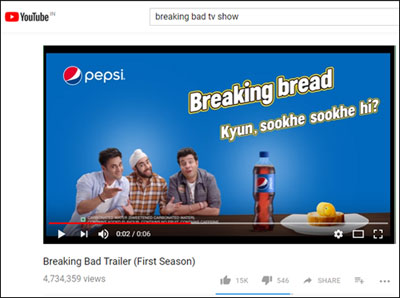
    Pepsi is reaching out to consumers with its message of ‘Kyun Sookhe Sookhe Hi’ by giving a twist to typical YouTube advertising with Google’s advertising tool Director Mix. This tool creates custom video ads from one core creative, turning consumer’s attention into action.
     

    Speaking about the Director Mix and success of the campaign, Raj Rishi Singh, Director Marketing, Pepsi, PepsiCo India said: “Pepsi has always created campaigns and experiences which resonate strongly with consumers. In fact, we are constantly experimenting with different marketing tools and techniques and Director Mix, with its customized creatives, has helped us strike a chord with our consumers better. We have been able to reach our audiences with content which is most relevant for them. By leveraging Director Mix, Pepsi has been able to cut through the clutter in the digital space.”


    Elaborating on Director Mix, Vikas Agnihotri, Industry Director, Google India said: “People are drawn to the contextual creatives as they’re highly engaging and they drive higher awareness for the brands. It’s great to see Pepsi take the approach of personalizing their campaign at scale on YouTube with our latest tool called Director Mix.  Using the tool, Pepsi has turned its video campaign, into many highly relevant and shareable video’s that genuinely connects with their consumers at scale without having to worry about producing multiple video campaigns.”


  • Ford EcoSport initiates innovation with Google Search

    By A Correspondent


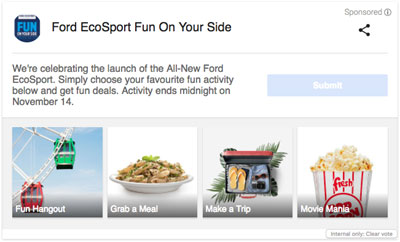
    To celebrate the launch of compact SUV Ford EcoSport, Ford India teamed up with Google to launch what it bills as a first-of-its-kind digital campaign in the automobile space in India.


    Titled “Fun on Your Side”the digital campaign aimed to bring different aspects of fun to lie that customer can experience with the all-new EcoSport even when they search for it online.


    The activity started on November 9 and will be on till November 15. Said Rahul Gautam, Vice President – Marketing, Ford India: “The car that started the compact SUV phenomenon in India is back to win many more hearts and minds. With the Fun with EcoSport campaign, we have worked with Google to ensure that the spirit of fun spreads beyond our dealership floors to everyone searching for it. With the New Ford EcoSport, our engineers have combined style, fun, and technology – all in one package – that we want our consumers to search and experience.”


    Commenting on the campaign, Vikas Agnihotri, Director Sales, Google India added: “Research shows 89 per cent of car buyer’s decision making is influenced through digital and majority of their journey starts from Google Search. The digital campaign for the launch of the new Ecosport combines strong intent cues from consumers with the innovative search voting feature to provide a fun-filled and memorable experience.”


  • India’s domestic travel market to be US$48 billion by 2020, notes study

    By A Correspondent


    Google India, along with Boston Consulting Group (BCG), has released a comprehensive report on the growth opportunities in the Indian hospitality market over the next four years. The report titled, ‘Demystifying the Indian Online Traveler’ charts the decision making journey of the Indian traveler and provides insights on the potential growth opportunities for travel businesses till 2020.


    As per the report, Indian travel market is projected to grow at 11-11.5% to $48 billion by 2020 with the biggest contributor, air travel expected to grow at 15 per cent to $30 billion. Hotels will grow at 13 per cent to $13 billion by 2020 while railways will remain largely stagnant at $5 billion. Additionally, as more people come online, smartphone penetration improves and use of digital payments goes up, the report estimates that India’s online hotel market will grow to US$4 billion with 31 per cent penetration at a CAGR of 25 per cent.


    Speaking about the key findings of the report, Vikas Agnihotri, Industry Director, Google India said; “India’s domestic travel market is on an acceleration path. One of the key findings of the report is that by 2020, one in three hotel rooms will be booked online – a clear indicator of  the growing importance of digital in travel research, planning and booking. There are several actionable insights for domestic online travel players including the role of mobile and the level of curation and personalization that Indian travelers are looking for.”


    Demystifying the travel planning journey of the typical Indian consumer, the report shows that for a majority of Indian consumers a vacation is a well thought through event, the planning for which starts several weeks in advance. On average, travel consumers spend 49 minutes spread over 46 days, visiting as many as 17 different online touchpoints to plan, research and make a booking. However, it is interesting to note that the length of each online session is less than 3 minutes, due to the ubiquity of mobile. Through their journey, Indian travelers tend to flip back and forth across different online destinations, checking availability and comparing prices across different providers and connectivity.


    Talking about the opportunities for the online travel players, Abheek Singhi, Senior Partner and Asia Pacific Head of Consumer Practice, BCG said, “Travel is a high investment – both monetary and emotional – category. Technology has led to democratization of travel through better information and price discovery – and shall lead to 11-11.5% growth in years ahead. The question is “ how to address the 17 different touchpoints of three minutes each over 49 days!”


    Highlighting the purchase drivers, the report finds that there are several touch points in the consumer journey, including OTA (64 per cent reach), search engines (33 per cent reach) and Maps (26 per cent reach). Advocacy and word of mouth form an important input into the travel booking journey with 76 per cent of people gaining inspiration to travel from family and friends. Further, reviews and ratings from other users is the single most important criteria to select a certain booking channel. Finally, the research finds that consumers use a mix of online and offline sources of information during their booking journeys. However, only 12 per cent of the consumers prefer to use offline sources for research. 57 per cent of the consumers believe that online channels give them better deals while 41 per cent find it more convenient for them to book online.


    The consumer research for the report is based on consumer travel journeys across omnichannel pathway. GfK recruited consumers who were planning to book an accommodation for a domestic trip. An integrated methodology was used to capture both online and offline search behaviour. Online behaviour captured via Passive meter tracking app (GfK Leotrace (TM)) installed in the smartphones of 18-45 year olds who were travelling for domestic leisure/ business travel in  a two month period. These respondents were Android users spread across three cities – Delhi, Hyderabad & Ahmedabad and were regular internet users who had booked at least one flight past one year, online. The offline behaviour was captured through bi-weekly diaries and a face to face interview towards the end of the tracking period. The data of eight weeks of usage was captured for 256 intending travellers between Nov’16 – Jan’17.


  • Kotak partners Google to unveil Querimetrix

    By A Correspondent


    Kotak Institutional Equities, a division of Kotak Securities Limited, in collaboration with Google launched Consumer Querimetrix — a tool that demystifies and predicts near-term Indian consumer behaviour by analyzing Google Trends data.


    Using machine learning techniques and merging big data from Google Trends, the first edition of Consumer Querimetrix provides consumer insights into India’s evolving car buying journey. Using Google Trends data, the tool enables ‘nowcasting’ (near-term predictions) on consumer activity, capturing inflection points earlier than traditional forecasting tools to give a complete picture — on car launches, last mile hiccups, cannibals and competition.


    Each edition of the Consumer Querimetrix series will focus on consumer behaviour in a different industry.


    Launching the report, C Jayaram, Joint Managing Director, Kotak Mahindra Bank said, “The digital wave is challenging conventional business practices across industries. Ground rules are evolving rapidly along with the consumer and those in the business of business intelligence need new tools to keep up with the changing landscape. Consumer Querimetrix is our step in that direction. Today, the sheer volume of consumer-centric search data available presents a tremendous opportunity to analyze and throw up actionable insights. These takeaways would be useful to both companies and investors. KIE research is highly valued by our clients and the launch of Querimetrix will further strengthen our ability to cover the Indian markets in a holistic manner.”


    The first edition of Consumer Querimetrix which focuses on the passenger car segment highlights the extent to which the Internet is altering the ground rules for vendors of cars and allied products/services. With growing access to easy information online, the Indian car buyer’s journey from a whim to final purchase has changed dramatically. More than 75 per cent of car buyers are researching online for reviews, comparative specifications, financial products and used car markets before making a purchase. The first edition of Consumer Querimetrix also explains how the traditional ‘funnel’ model is giving way to a more complex purchasing path where ‘initial consideration’ may not always guarantee sales.  Although higher auto-related searches correspond to higher demand for cars, this does not hold true on a brand-wise basis.


    Speaking about the trends for the passenger cars industry captured by analyzing Google Trends, Vikas Agnihotri, Industry Director, Google India said, “With over 300 million Internet users online and growing, India today has a sizeable population which accesses the Internet on a daily basis, making search queries as the most dynamic data input to arrive at consumer insights through machine learning as illustrated by Kotak’s research. If we look at the search trends related to car finance and car purchases, we’re seeing a 40% year on year growth in car purchase queries on Google in India. Over half of the people who evaluate car purchases change their consideration set during their research phase – adding two to three new car models in their consideration, the only non-negotiables are price and color of the car. This alone proves the growing complexity for car OEMs in the country. With this report we’re attempting to demystify this changing consumer behavior into actionable insights for the industry.”


    Saifullah Rais, Quantitative Analyst at Kotak Institutional Equities and the architect of Consumer Querimetrix said, “In the absence of conventional rules, traditional decision-support systems are not very effective. They fall short on scalability and adaptability. Machine learning algorithms learn from data and do not rely on explicit rules, making them the most effective method of dealing with data explosion.”


    The Consumer Querimetrix report outlines the influence of digital marketplaces and calls for carmakers to reassess conventional business practices. The effect is visible as car loans are increasingly being sourced outside dealerships. This trend can eat into financing margins earned by dealers and hurt profitability. On the other hand, carmakers with captive finance arms can use this opportunity to innovate and differentiate themselves during the evaluation process.


    The first issue of Consumer Querimetrix establishes that Google search volumes can be used as a gauge for assessing new car launches. The report underscores the linear relationship between search interest and advance bookings during a car launch. Interestingly, higher traditional media spends do not always guarantee higher search interest.


  • IPG Mediabrands to launch online travel fest in India

    By Pritha Dasgupta


    Media agency conglomerate Interpublic Group (IPG) Mediabrands India has joined hands with the travel industry to launch a festival to boost online holiday bookings in the country. The Great Indian Travel Festival, the first such event in India, will start on April 18 and end on April 26. GITF will offer deals and discounts on travel and stay packages for more than 50 holiday destinations within and outside India.


    “Indian consumers will find great value and deals to enjoy their summer holidays. We expect to reach over 3 million users over the course of the nine-day festival,” said Shashi Sinha, CEO of IPG Mediabrands.


    The participants include Google, travel websites Cleartrip, MakeMyTrip, Goibibo, Yatra and Via, and carriers Jet Airways, Indigo, British Airways and Spice-Jet. Tour companies Cox & Kings and Thomas Cook and startups such as Oyo Rooms and Doorstepforex have committed their participation. “While the industry has seen a major uptake in online hotel bookings, there is significant headroom for growth, and initiatives like these can contribute immensely in promoting the sector and contribute to domestic tourism,” said Vikas Agnihotri, industry director, Google India.


    IPG is building and designing the GITF website in-house and will host the participants on the site. Both Google and IPG are selling sponsorships and the proceeds will be spent on marketing the event and promoting the sponsors on the site.


    Source:The Economic Times

    Copyright © 2015, Bennett, Coleman & Co. Ltd. All Rights Reserved

    Licensed to republish


  • Google & Bain study predicts interesting digital trends

    By A Correspondent


    A joint report released by Google and Bain & Co. to understand the influence of digital on the FMCG sector revealed that the Internet would influence a third of total sales in the FMCG sector over the next five years. The influence of Internet will impact $35bn worth of FMCG sales in India, as more and more users get online to research for FMCG products.


    Projecting the growth of online user population in India, the report revealed that India would have over 650 million Internet users by 2020. Online shopping will continue to see rapid growth and over 250 million users will shop online by 2020. This dramatic rise in the online shopper base in India, will contribute $ 5bn worth of FMCG product sales through online channel, growing 50 times from current level contributing 5 per cent of total sales from current 0.3 per cent share by 2020.


    The study notes that Internet influence will be the most for high engagement categories like male grooming, infant care products and beauty products, as more and more users will research online for information related to these products. For male grooming products, 25 to 30 per cent purchases will happen online, 20 to 25 per cent for infant care products and around 8 to 10 per cent of all beauty products will be bought online by 2020.


    These findings were derived by studying various factors including research conducted for Bain and Google by Millward Brown by selecting a sample of an evolved 1600 Internet users (male and female) from across 13 cities in India including metros and non-metros – across eight FMCG categories – Skin care, hair care, oral care, home care, infant care, male grooming, beverages and food.


    Findings from the study further revealed that 35 per cent men and 22 per cent women are strongly influenced by digital for their purchases. Internet influence differed by category of products, with maximum influence on purchase decisions noticed in male grooming (39 per cent), skin care (26 per cent), infant care products (24 per cent) and hair care (24 per cent) products.


    Speaking about the key findings of the report, Vikas Agnihotri, Industry Director, Google India said, “By studying the behavior of the lead consumers from an FMCG standpoint, it is clear that FMCG companies in India need to start thinking of digital as a more strategic medium and chart out a digital growth path for their products. In terms of key target audience from FMCG perspective as made clear in the report, 200 million digital natives will be online, 30 percent of women population in India will be online by 2020 reaching 200 million and 100 million women will shop online. 200 million plus users will be from rural India, whose disposable income will continue to grow. With these three key consumer segments moving to digital and spending more time online, FMCG companies will need to prepare themselves for this digital future.”


    Speaking about the current engagement levels of FMCG companies with the digital medium, Nikhil Prasad Ojha, Partner, Bain & Co., said, “Most FMCG companies in India have underestimated the impact of Internet and are struggling to ascertain a clear digital roadmap for their products. Companies need to uncover the digital potential for different categories, and align their growth trajectory with the changing consumer behavior. This report will serve as a useful reference point to start thinking and engaging consumers.”