Tag: Viacom18 Group

  • Nakul Chopra is new BARC Chairman


    Nakul Chopra, currently President AAAI and Senior Advisor, Publicis Communications has been elected as the next Chairman of BARC India. Chopra succeeds Viacom18 Group CEO Sudhanshu Vats, who successfully completed his one-year tenure as Chairman.


    Chopra will be the third Chairman of BARC India. He joined the BARC India Board in September 2016 and since then has been an integral part of the various decisions taken by the Board.


    Said Chopra on being elected as BARC India Chairman: “BARC India has been very busy in the past one year, as it further consolidated its TV measurement business. 2017 has also been the year when groundwork was done for key future projects, and in the year ahead I am looking forward to oversee their implementation. Top on that list is the rollout of EKAM – our digital measurement products. Expansion of TV sample using Return Path Data will be the other big piece to watch out for. We are all thankful to Sudhanshu for his leadership over the past year and I very much look forward to working closely with Partho and his excellent team over the coming year ”


    Under the chairmanship of Vats, BARC India expanded its sample panel homes from 20,000 to 30,000. Under his tenure, BARC India also announced its partnership with multi system operator DEN Networks for Return Path Data and announced the digital measurement partner.


    Added Vats: “My stint at the helm of BARC has been extremely rewarding. When I look back at what the team has achieved in a matter of just one year, I feel a sense of pride. It’s been a pleasure to work with Partho and the team. BARC is a bold, paradigm-changing initiative that has already started to redefine our industry. Since inception, BARC has tackled several challenges while several remain. Going forward, I would urge all stakeholders to continue to take cognizance of the pace of change in our sector and the urgent need for us to adapt. A few years out, the next generation of industry leaders needs to look back and admire our shared legacy. This means creating a future-ready, sustainable organization with each of us making some concessions for the greater good. At a personal level, I have gained tremendously in terms of a deeper understanding of how data and analytics can transform our operations. There is never a dull day at BARC India. I wish Nakul the very best as he takes on the reins of a hard-working, industry-critical operation in a fast-changing operating landscape. I am sure that BARC India will touch new heights under his leadership.” Vats has been on the Board of BARC India since its inception and will continue in his capacity as a Board member.


    Welcoming the new Chairman, BARC India CEO Partho Dasgupta said: “I am thankful to Sudhanshu for his guidance and support to the team. Our aim has always been to successfully meet the growing and emerging needs of industry. Our focus now is to establish ourselves as an insights company. Nakul in his new role as BARC India Chairman will be a great driving force in launching our digital measurement products, expanding sample homes via RPD, and launching a suite of new products.”


  • Mullen Lintas creates campaign for MTV Beats

    By A Correspondent


    The recently launched Hindi music channel, MTV Beats from the Viacom18 stable, has announced the launch of its inaugural brand campaign. Conceptualised and executed by Mullen Lintas Mumbai, the campaign highlights the unique bond that audiences share with music which is almost like a marriage between two soul mates.


    Talking about the marketing campaign, Ferzad Palia, Head, Youth and English Entertainment, Viacom18 said: “Music is an important medium to reach out to young people today, and nobody does music better than MTV. So now that MTV Beats is here, we are heralding it as the birth of the ‘Baap’ of music because after all, MTV is the big daddy of music. In true MTV style, the marketing campaign is quirky, unabashed and irreverent yet it clearly communicates the brand’s positioning of being the ultimate destination for Hindi music any time of the day or week. I’d like to thank Mullen Lintas for the creative thought they’ve put into this. The tagline – ‘Blood meinhai beat’ draws heavily from India’s obsession with Bollywood music and reinforces the belief that music is a part of every Indian’s very DNA.”


    Commenting on the campaign strategy, Ayyappan Raj, EVP-Mullen Lintas said: “It’s one of the most fun campaigns that Mullen Lintas Mumbai has worked on in the recent past. When an iconic brand like MTV is launching a Bollywood music channel there is a strong desire to create something big and different. With that in mind, we wanted to make a statement about the launch of BEATS and in the quintessential brand tonality. We are very happy with the way the campaign has come together. Also we are quite happy about the fact that we have ‘delivered’ another successful brand launch for the Viacom18 group.”


  • Viewers, viewership & then monetisation: Sudhanshu Vats


    Last week, Viacom18 launched its OTT platform Voot with much fanfare. MxMIndia caught up with Group CEO Sudhanshu Vats on the launch of the platform, the content strategy and whether the group intends getting into sports. Excerpts from the interview…


    So Voot took a long time coming?

    I have been answering this for everyone. There are two ways of looking at it. One, you could argue that we’ve taken little longer, but I think in digital, it’s important to get it right. The digital ecosystem is evolving rapidly. The number of new consumers on mobile, digital, video eco-system this year will double compared to last year. So I think we are fresh for them. Two, it’s about getting a product and content right. For digital, you have to keep refreshing technology every year. Tech upgrades which are needed for digital products are almost at a frequency of a year so it’s like a new product for everyone.


    So would you say that there’s a first-mover disadvantage for those who came in early?

    No, I would say that I think the point is if you’ve got your product and content differentiated, you are as good as first-mover here.


    There’s a lot of talk about OTT, including the FICCI-KPMG report. On how it’s going to boom in a big way. For Viacom18, this kind-of completes the picture, right?

    Yes, yes. I think it’s good that we have got a product now which sort of stitches all our content for the viewer in a very digital experience. Another differentiation is we haven’t gone TV to digital. Yes, we’ve got a lot of original hours of content of television which will be on this product but we’ve done a digital product and I think that’s a fundamental difference from bringing your TV starting with a brand name, starting with the discoverability. I don’t know whether you notice small small things. Each of our programmes have a 40-60-word description, each of the episode within that tells you what is happening, that’s a very digital product… that’s the way the digital piece goes.


    A lot of work has gone into the existing piece also. But tell me, what’s going to happen is from now onwards the existing websites of the various channesl that you have, whether it’s the Colors or MTV websites, some of which are exceedingly popular will now obviously merge into Voot, right?

    No, I think what will happen is our product websites, for all our channel websites and brand websites will remain because they’re very important marketing tools, they will remain but videos, the moment you want to watch and you will also have an option to start playing the video from there. But, supposing you go onto Colors and you want to watch Naagin, what it will do is it will bring you to Voot and will play Naagin for you… But our websites and our social interaction tools, our Facebook pages, all that will remain.


    You mentioned about all the programming across channels that you have will be on Voot. Does this mean that some of your older shows which aren’t on air right now will also be there?

    Yes. So we do about 10,000 hours of programming every year from Viacom 18. To answer your question, most of our stuff will be there but we’ve picked and chosen things. We’ve not put everything which was there in the past. For instance, if someone wants to see Balika Vadhu from the beginning will that option be there? The answer is yes.


    Specifically, will Comedy night with Kapil be there?

    Obviously it will be there.


    He has left and joined another channel…

    But it is our content so it will definitely be there and it will find a pride of place under comedy.  We are proud of that work, and it is on Voot.


    Coming back to Viacom 18, what else now…? You don’t have sports as part of your bouquet, you’ve just about got back the movie channel which had been exited some years back. What about sports and any other white spaces that you would like to fill up?

    There are white spaces for us to plug and I think movies was one of them which we recently done. Theoretically, there are English movies as well as some regional genres which are white spaces for us. Our focus on youths and kids is a little higher compared to anyone else in the business. In the brands, you’ve got dedicated brands. We’ve got enough white places to plug before we start thinking of sports.


    Is it because the kind of money you need to invest over there is…?

    No, it’s a combination of everything. There are 3 things with this: it’s very high investments, longer gestations and a business model which is not fully proven in the Indian context because subscription is not there so that is perhaps resisting us. The second piece which I was saying however which is that we’ve also got so many new other things to do which are clearer and which have got much better, and which have got better returns are attractive propositions which we would drive.


    One of your joint venture partners is Network 18 and it is going to come up with a huge telecom offering… do we synergies of Voot with that?

    There will be lot of synergy. We are continuously working with Jio and there are synergies at all levels.


    Will there be some exclusive content availed only to Jio subscribers?

    We are looking at all options. With the amount of content we have, there are things which we will be able to do, which are in this area. To give you an example, and this is my favourite example which I keep giving. So, if you look at Big Boss, a Big Brother, we’ve got 70 cameras in the Big Boss house. These 70 cameras are actually shooting for 24 hours. Let’s assume for the moment that for 12 hours people are sleeping and there is hardly any recording. Even if you look at 12 hours, that means 12 hours x 70 cameras which is 840 hours and what you show on the TV is sanitised 40 minutes of that. Therefore, our ability to do content around content and exclusive in this is pretty high. So whether we do it as Voot exclusives or for our partner exclusives, I think those things we will continue to explore and we will drive those synergies as we go forward.


    In the last two years, from the time you took charge, there has been much activity. You’ve had the regional and the English channels, the movie channel, now Voot. What’s coming next?

    We are actively looking at a lot of spaces and we will continue to grow. We will continue to grow our broadcast TV channel space, we will hopefully grow our digital space which we have just done. We will be growing our ancillary space both on consumer products and this.


    One last question… From what we have seen over here, obviously investments have been huge on Voot. Would it be right to say that it’s possibly your biggest investment after Colors?

    It is a substantial investment in terms of our greenfield investments If you look at Viacom 18, there have been three significant investments. There was an investment when Viacom 18 was formed and the investment in Colors was big.Then there has been an investment basically through acquisition of the ETV piece which was also substantial And the third… basically this is also going to be a slightly longer term high investment. I think we need to stay invested here because digital as I keep saying, digital models, across every industry are going to be different models and they are not conventional revenue models of business we grew up with or we were taught. The focus has to first be on viewership, users, usage and monetisation so in our case it will be viewers, viewership and then monetisation and there it will take some time.
     

  • Sudhanshu Vats | Make in India. Show the World


    By Sudhanshu Vats


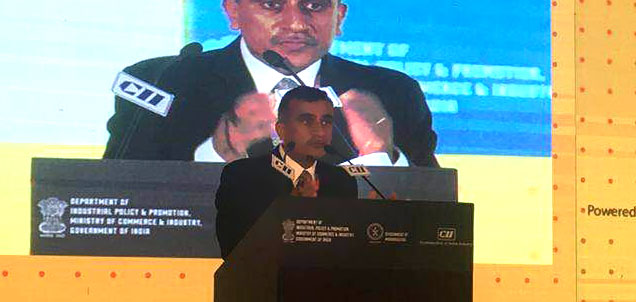
    Sudhanshu Vats, Viacom18 Group CEO and Chairman CII National Committee on Media and Entertainment, gave a closing speech at the Media & Entertainment Seminar on Day 3 of Make in India, chaired by I&B Minister of State Colonel Rajyavardhan Singh Rathore, Sumit Mazumdar and Ramesh Sippy. Here’s the text of the speech:


    Sometimes we get carried away with the concept of Make in India and think of it in terms of big machines, big companies, big resources. But Make in India is at the heart of every Indian, every individual. And it was actually interesting to see that Shri Narendra Modi, our honorary Prime Minister, on Saturday, emphasising on a great point: Make in India is a programme that is supposed to do two things. 1) It’s supposed to generate jobs for our youth, and 2) Be a platform for our youth to become job enablers and entrepreneurs. And I think it’s in this context that Media and Entertainment fits beautifully. The ability of an Indian and everybody associated with the M&E industry to do that is fantastic. And I think it is this concept I would want to build up on first.


    The size of our industry is close to about 18-20 billion dollars. India boasts of the world’s 3rd largest TV audience, 2nd largest print circulation, largest film output and one of its largest Internet audiences. Yet, at ~17 Bn USD, our entire industry earns less than some of the world’s largest media conglomerates. The latest edition of the Star Wars franchise has already crossed over 1.5 Bn USD in global ticket sales, more than 2x of global collections (including gross domestic collections) of all Bollywood films in CY15.


    Some will attribute this dichotomy to our content: is the comparison even valid? ‘Can we even think of matching the production budgets of global tentpole properties?’ ‘Are our stories universal in a way that they appeal to the entire world?’ Others make references to economics to explain the chasm: in terms of purchasing power parity we are significantly greater than based on our ‘nominal revenues’.  There is another lot (including myself) that looks at the regulatory framework for answers: shouldn’t pay TV pricing be completely deregulated if we want to deliver quality content? ‘We need addressability across India to ensure that the entire value chain gets its fair share of revenues.‘


    All these voices are acceptable, rational and attention-worthy. It might be prudent to point out that for our sector to attain escape velocity a deeper, more holistic view is required.


    But I think the Make-in-India programme has placed the (long overdue) global spotlight on India’s economic potential. And for the Media and Entertainment industry to realise its true potential, I would like to emphasise on what our honourable Prime Minister rightly described in his inaugural speech: The idea of the 4 Ds. Reiterating what he said, India is known for 3 Ds, which is democracy, demographic dividend and demand. But now the time is to lay emphasis on the 4th D, which is deregulation.


    For Indian firms to compete successfully, we need a light touch, consistent regulatory approach when it comes to our content, pricing and licensing- one that ensures parity across technology, platforms and jurisdictions. Multi-dimensional capacity building is the need of the hour. This theme has been repeated so often that it’s on the verge of becoming cliché. Yet that doesn’t take away from its relevance even today. If we truly want to transform this country into a global content powerhouse we need to invest in human capital and infrastructure. We employ around 5 Mn people today. We will easily need to double our workforce in the next 5-7 years to realise our goals.  This includes talent from the creative, technical and management spheres.


    We need to invest in this talent pipeline today, if we are to reap the benefits in time. The industry needs to collaborate more with educational institutions, the government needs to facilitate these partnerships and parents and teachers need to create awareness and nurture interest in design, technology and creative skills at the level of primary education. On the infrastructure side, while BharatNet is a commendable step, we need to expedite its rollout. Even today India has mobile-dark villages and some would argue that broadband speeds are too dismal to even be classified in the way that they are. Public Internet access is fast becoming a basic necessity in the lives of most Indians.  Finally, infrastructure in the form of convention centres, stadia and venues for experiential entertainment needs to be built to support our industry. If we don’t get this piece right, the puzzle will remain incomplete.


    Today, the M&E sector contributes to ~1% of India’s GDP, much lesser than its counterparts in developed economies. With time, as it grows in importance and scale, this contribution is bound to increase exponentially. The sector’s very inclusion in this flagship programme underscores its importance. Several policy measures under the aegis of the ‘Make-in-India’ programme are well intended. We are eagerly awaiting the new IPR policy, which is a much-needed intervention to ensure that our industry prospers. A steam-lined investment approval process and favourable foreign trade policy regime is bound to provide our sector with a fillip. The Make-In-India programme is a right step in the right direction. It has captured the imagination of people around the world, bolstered spirits within corporate and policy corridors and set the ball rolling for much-needed reform measures.


    We power several ecosystems, beyond our own. As per press reports, over 18 Bn USD of investment proposals have been received in electronics manufacturing, particularly by mobile handset manufacturers. Have we ever stopped to ask about the utility of that awe–inspiring device with a 5-inch HD screen with 64GB storage and oodles of computing power if we don’t have high-quality, engaging video content? Media rights are the single largest contributor to almost all sporting leagues in this country. FMCG companies spend a significant portion of their top-line (~10-15%) on advertising because it contributes significantly to their growth. French islands and Turkish cities witness an increase in in-bound tourists after they’ve been featured in our films. We’re more than just us.


    To conclude: The first thing is to continue the journey on deregulation. Keep it light with policies that are thought through. The second thing is in the area of IPR. And I think if the M& E industry has to grow further, we will need to have a very well-articulated IPR policy and the good thing is that the honarable Prime Minister himself spoke about this at the Make In India inauguration event.


    We need to seamlessly blend technology and creativity. For that, we will need more physical infrastructure for us to be able to organise events that do so more regularly, more frequently and more safely. I think that is the third area where the impetus is on us for building better physical infrastructure.


    My final point is in the area of building capacity from the point of view of multidisciplinary talents. Because ours in a converged world, I think it’s the combination of talent and management, talent and creative content, and talent and technology which will allow us to progress.


    The M&E sector is a key pillar of the Make in India programme and is bound to gain from it, and gain it should. After all, when we ‘Make in India, For the World’, we also ‘Make India and Show the World’.


  • Thinking beyond 2020: Viacom18 Group CEO Sudhanshu Vats at CII’s Big Picture Summit


    Sudhanshu Vats

    Text of the welcome address by Sudhanshu Vats, Viacom18 Group CEO and Chairman, CII National Committee on Media & Entertainment


    Honourable Minister of State for Information & Broadcasting, Shri Rajyavardhan Rathoreji, respected panellists on the dais and valued members of the audience. It is my pleasure to welcome you all to this year’s edition of the Big Picture Summit.


    To start with, I have a disclosure to make. Disclosures are important, no? Particularly for media organisations. I have been in an extremely introspective mood and therefore what you’re about to hear might sound like a discourse on philosophy. The good news, however, is that I’m going to be extremely candid. It’s always a challenge to address a gathering of this nature. A gathering where leading minds from the private, public and academic sectors converge to paint the ‘Big Picture’.


    This event is one of the first events that I attended after entering our sector and it’s particularly close to my heart. If I can make an honest confession, I’d say that I spend much more time thinking about my speech for the Big Picture Summit that I do for other conferences. This time however, I took the exercise one step further. I went back and looked at almost all the speeches I’ve delivered since the turn of this millennium, first as an FMCG veteran and then as a media professional. You’ll be surprised to know what I found! One of the very first speeches I can recall was at HUL in 2000, my former organisation. I was addressing a bunch of analysts and spoke with great gusto about the organisation’s vision for 2020. There were a few more that I made around 2003-2005 – including some at my alma mater – IIM Ahmedabad and I referred to 2020 again as a benchmark year. Finally, since 2012, whichever industry event I’ve been a part of- Big Picture, FICCI, CASBAA, IDOS- you know the grind- 2020 has been the year at which most predictions stop.


    This got me thinking. Thinking hard. I wondered: Have my colleagues and I run out of imagination? Have we become too old to see beyond 2020? Has the internet made us all ‘intellectually lazy’?


    Trust me, my mind looked in several directions. Finally, the answer struck me. As ironical as it sounds, the future has become shorter. For the sake of clarity, look at it this way: 20 years ago, it took maybe 15 years for ‘x’ number of disruptions, 10 years ago it only took, maybe 10 years for the same number i.e. ‘x’ number of disruptions. Today, it only takes 5 years for the same number of disruptions. So, in a manner of speaking, our definition of the future has become more ‘condensed’.


    This very reality has enormous implications for all of us. 


    For private sector organizations, we need to improve our time-to –market for new products and services, we need to be able to quickly take aim, fire and reload, before repeating the process.


    For the world of academia, the sheer amount of throughput needs to increase. R&D cycles need to have shorter durations and allow for mid-way course correction. Inter-disciplinary learning is another area of focus. Several worlds are converging and academic disciplines should be no exception.


    For the government, and Rathoreji can shed more light on this, the public want the entire government machinery to be able to deliver on its expectations, sooner than they did before. This also means that policy roadmaps have to get shorter. Given the complexity of the Indian market, if we can’t crunch these roadmaps we need to at least ensure that we stick to them. The duration of political lifecycles generally hover around five years, now you see news channels looking at one year, 100 days and even one-month report cards! Sometimes I feel that the government faces more pressure from the electorate than public companies face from their investors for quarterly targets!


    It’s very important to understand these implications because when the public, private and academic worlds align, magic is created. We talk of USD ABCD billion as a target and so on and so forth. It’s simply a fictional goal post if we can’t get different stakeholders to work together. I understand the theme of this conference is aiming for a 100 billion USD target for our industry, but I’d like to challenge the status quo by asking a fundamental question that I hope you can ponder over these two days: what defines our industry? If our audience is empowered to buy the dupatta worn by Ragini while watching Swaragini on Colors on their mobile phones, how will it impact our target?


    I’d like to leave you with a way of thinking that I believe can be applied to any M&E organisation, irrespective of the sub-sector i.e radio, TV, digital etc.. It’s arguably a much simpler definition of our value chain. There are only three participants in this value chain: creators of content, content platforms and communities. Advertisers don’t need to be called out separately as they too are a community. All of these sit on the foundation of a regulatory framework created by the government. What’s even more interesting is that this value chain is no longer, necessarily linear. All three participants can interact with each other in different ways. An organisation’s understanding of where it fits in this value chain has a lot of bearing on the capabilities it needs to build and invest in.


    Content creators have to look at nurturing a dispersed universe of storytellers that is talented, loyal and always engaged. Platforms have to make investments in technology that allow them to reach out to communities. Communities are almost the reason as to why most of us exist, whether it’s our audiences or our advertisers. We have to figure out way of getting them closer to one another and developing a constant feedback loop mechanism to make our engagement more fruitful. Most importantly, we have to look at a voluntary, self-regulation framework in terms of what should be allowed and what shouldn’t – for advertisements and content.


    Thank you all for making it here today and for your undivided attention. You have invested valuable resources to be present for Big Picture 2015. The team from CII has curated an extremely insightful set of sessions for you. Ladies and gentlemen, I urge you, do take this unique lens as you participate in these sessions. The world of ‘realisable possibilities’ has just exploded. The Future has become shorter and our canvas has gotten bigger. Welcome to Big Picture 2015!