Tag: Vi-John

  • Vi-John appoints Dentsu X for integrated mandate

    Vi-John Healthcare India, manufacturer of personal care, healthcare products and cosmetics, has awarded the integrated media mandate of the shaving category to Dentsu X.

    Said Jose Leon, CEO, Dentsu X India: “We at Dentsu X are thrilled to add Vi-John – a reputed CPG brand, to our clientele. By combining creativity, technology, and strategy, this partnership is set to deliver impactful and transformative brand experiences for Vi-John. We are dedicated to innovating and redefining these experiences, pushing boundaries to drive remarkable growth and influence.”

    Added Anita Kotwani, CEO Media, South Asia: “We are excited to embark on this strategic partnership with Vi-John, a brand that holds a deep-rooted legacy in the Indian market. At Dentsu X, we pride ourselves on creating transformative experiences. This collaboration presents opportunities for us to craft innovative strategies that align closely with their distinctive vision. By combining our expertise with their dynamic spirit, we are confident in creating something truly exceptional.”

    Said Ashutosh Chaudharie, General Manager Marketing, VI John: “We are happy to partner with Dentsu X on our Shaving Category. The company is at an important juncture in its six decades of market leadership and we wanted strategic partnerships with a media partner that has both – experience in handling large-scale FMCG brands along with the expertise of giving customized media solutions that are market-specific. Denstu X was a clear choice and we are excited to work with them to meet our business objectives.”

  • Vi-John lathers up on shaving shares


    By Rajiv Singh


    Dapper, with not a hair out of place, Vimal Pande is perhaps an ideal brand ambassador for a company of which he is also the CEO. For the past decade, he’s been a loyal user of ‘Cobra’ deodorant, ‘Splash’ after-shave, ’22 degree’ talcum powder, even ‘BoroShield’ antiseptic cream, all brands of the little known Delhi-based personal care firm, Vi-John. He’s also one of thousands of consumers who annually consume almost 45 lakh kg of Vi-John’s shaving cream, in the process making it the largest label in this category. It’a also a category that’s conspicuous by the presence of a clutch of multinational brands from Axe (Hindustan Unilever) and Dettol (Reckitt Benckiser) to Old Spice and Gillette (Procter & Gamble).


    “In shaving cream, we are much bigger than Gillette in India, both in volume and value,” asserts 52-year-old Pande. And if being ahead of a global leader isn’t enough, he goes on to make another claim. “In fact, we are the largest selling shaving cream brand in the world.”


    According to the latest Nielsen MAT data sourced from industry officials, Vi-John’s volume market share in India stood at 29.2 per cent in May, over three times that of Dettol, almost four times that of Axe and over seven times that of Gillette.


    “Even if you put the next four brands together, they won’t be able to match our volume and value share in India,” affirms Pande, adding that the biggest plus for the brand has been its ‘affordability’ tag. Vi-John is available across 2.5 lakh retail outlets and at over 1 million other trading channels across the country. The brand makes over 15 lakh shaving cream packs every month, says Pande.


    An email sent to HUL and Reckitt Benckiser did not elicit any response.


    What the MNCs lose in volume, though, is being partially made up in value. Consider: Gillette’s 3.9 per cent volume gives it a close to double value share of 7 per cent; Axe 7.4 per cent volume converts into 12.9 per cent value share. It’s only in Vi-John’s case that its value share is less than the volume share. Pande grudgingly acknowledges the problem. “We are quite visible on TV. But our profitability is not as high as others.”


    Even as Vi-John continues with its aggressive intent to further widen its volume lead over its rivals, the price warrior has started working on a strategy to match its volume growth with value. “While the strategy till now was to scale first and reach a sound scale, now the plan is to convert volume into value. So now we will go in for the kill,” asserts Pande.


    The company is making improvements in packaging, quality and more importantly pricing, which would be crucial to push it ahead in the value trajectory. While in 2011, its 125 gram shaving cream pack was available for Rs 20, it now costs Rs 35.


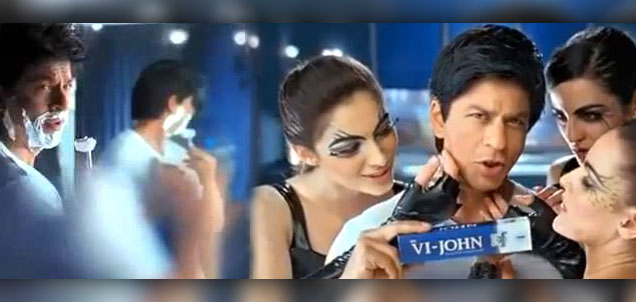
    What has worked brilliantly for Vi-John has been the endorsement by Shah Rukh Khan. Celebrity endorsements has played a significant role in brand awareness, helping it make a rapid transition from a business to business brand to a business to consumer brand, explains Abraham Koshy, professor of marketing at IIM Ahmedabad. “Had it not been for the celebrity endorsement, the brand could not have pulled it through.”


    However, the most discerning element of the strategy that has worked in the favour of the brand is the choice of target segment. While brands like Gillette are targeted at the higher end of the market, Vi-John has chosen to target the mass segment. “This is an intelligent choice as this market has been waiting for a brand relevant to it,” adds Koshy.


    However, converting volume into value at a faster clip won’t be easy. It’s a brand game, which has to be played with finesse, says brand strategist Harish Bijoor. “One celebrity will not turn the tide for it. There are a lot more brand parameters that need to be addressed and tweaked.”


    The biggest problem for Vi-John, according to Bijoor, is that it has not invested in branding. “The product has worked, the brand has not. Not yet. What’s missing is brand imagery. And it needs to earn it fast.” Oui, John?


    Source:The Economic Times

    Copyright © 2015, Bennett, Coleman & Co. Ltd. All Rights Reserved
    Licensed to republish


  • Swad of Success: Regional FMCG firms like Panjon, Bisk Farm, Mapro, raising funds to expand operations

    By Sagar Malviya


    After a gap of almost four years, TV commercial of the once popular Swad digestive candy hit the screens early this month. Swad, which is making a come back, is one of the brands owned by 48-year old Panjon, an Indore-based firm that sells candies to balm and toothpaste endorsed by Shammi Kapoor and Sonali Bendre in its glory days. The plan is to reach out to more states, expand product portfolio and grow sales ten-fold in two years.


    Panjon isn’t alone. Almost half a dozen smaller regional firms such as Bisk Farm, Mapro, Wagh Bakri and V-John, among others, are entering newer states, some advertising for the first time, while others planning to raise funds to survive a fresh salvo by large consumer goods companies that expanded into the turf of smaller rivals last year.


    “While our products are doing well in MP and UP, competition is also getting intense in these home markets,” admitted Atul Kothari, managing director at Panjon, which is in talks with a clutch of private investors to raise funds for expansion. “We are looking to enter Gujarat, Punjab, Haryana and Bihar this year,” he said. The company plans to add more than 1,400 distributors to its existing network of 600.


    So what exactly was the trigger? Well, for one, large FMCG firms have been aggressively reaching out to rural consumers through expanded distribution, which led to smaller regional players losing market share across segments in their core markets.


    Over the past couple of years, P&G has almost doubled its distribution reach and now has a direct reach of 1.3 million outlets, against HUL’s direct reach of 1.60 million outlets. Emami expanded reach by as much as 30 per cent primarily in rural areas, while HUL added more than 50,000 villages to its network just last year. Ditto, in the case of Dabur, which rolled out special rural focused sales initiatives across eight key states and widened reach in 71 high potential districts.


    However, the regional players are now plotting a counter attack, not just in their existing markets but also in newer states. The Rs 500-crore SAJ Food Products that dominatesEastern Indiawith its biscuit Bisk Farm is a case in point.


    “Last year, we entered Karnataka and are planning to reach Andhra Pradesh next month. We aim to have a national footprint by 2013,” saidVijay Singh,MDof Kolkata-based SAJ Food Products. He added that the firm has even discussed internally about coming with a public issue in the next two years.


    But it won’t be easy. And smaller rivals are aware of the fact that price competitiveness with national players would rather be futile with the latter having economies of scale. Hence, they are looking to cash on through their quality proposition rather than being price warriors.


    Maharashtra-based processed food firm Mapro Foods andGujarat’s tea company Wagh Bakri feel that they are better in terms of quality compared with rivals such as Hindustan Unilever. “Large players are very aggressive in terms of schemes and offers. But we believe that consumers want quality and not price-offs,” said Parag Desai, executive director of Wagh Bakri, that is looking to enterPunjaband Haryana.


    Some firms that already have an indirect reach nationally are also keen to distribute products directly and cut costs on intermediaries. Delhi-based Vi-John is reworking its distribution strategy by eliminating super-stockist and instead having selling agents in each state.


    “We are planning to add over 1,500 distributors and 70 stockists to have direct reach in western and southern markets,” said Vimal Pande, CEO of Vi-John Group, which has 30 stockists and 2,500 distributors.


    Modern trade is doing its bit too. “Regional brands need to build stronger consumer connect to keep their consumer franchise or they could expand distribution to add new consumers and grow base,” said Devendra Chawla, president – food and FMCG at Future Group.


    Source: The Economic Times

    Copyright © 2012, Bennett, Coleman & Co. Ltd. All Rights Reserved