Tag: Venke Sharma

  • Toolkit for Crisis Management in the age of Social Media


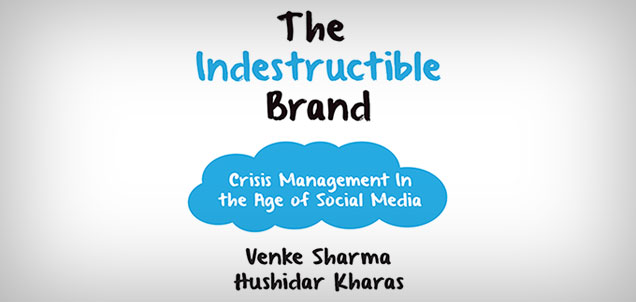
    The Indestructible Brand – Crisis Management in the Age of Social Media by Venke Sharma and Hushidar Kharas is scheduled to be released today (July 19) in Mumbai. Here we publish an extract from the book with permission from the publishers, Sage Response


    By Venke Sharma and Hushidar Kharas

     

    Venke Sharma
    Hushidar Kharas

    So the crisis squad has been created, and the CCO knows who to call when things go awry. The next step is to huddle and put together the crisis playbook, a concise yet comprehensive list of steps to be taken when a crisis hits. This is ideally done via a workshop where the stakeholders can disconnect from the day-to-day activity and focus on the task at hand. It is important that all stakeholders are open about the risks that arise in their piece of the business and are not defensive. There’s no place for turf wars in the crisis squad, and “this is my problem and I will handle it” is not an acceptable approach.

    It’s up to the CCO to drive the spirit of cooperation, perhaps through a series of teamwork exercises at the start of the session or by role plays that encourage people to think in detail about functions they are otherwise unfamiliar with. Getting an external facilitator for the session is also an option, as it allows reps to talk to a neutral body that sees issues from everyone’s perspective.


    Possible exercises to get everyone thinking collaboratively are as follows:

    1. Ask an R&D person to visualise managing the HR aspect of a crisis.

    2. Ask a PR person to identify places in the production, packaging, and distribution processes where a crisis may occur.

    3. Play a game where half the squad represents the environment (consumers, competition, partners, and government) and tries to cause crises for the brand,

    while the other half manages the fort and defends the brands reputation against the assault. The CCO or external facilitator can extend the game until the

    first team runs out of ideas or call an end when one team is clearly dominating.


    We have divided the playbook process into three steps:

    # Scenario Building: Identifying scenarios from which a crisis can arise for your brand.

    # Establishing Benchmarks: Setting up qualitative and quantitative benchmarks that differentiate between an issue and crisis and trigger subsequent predefined

    actions.

    # The Playbook: A detailed set of instructions and resources for the crisis squad (and for all employees) to be used once the benchmarks have been reached.


    Scenario Building

    The first step toward creating a crisis playbook is scenario building. Think of everything that can go wrong for your brand/organisation. Evaluate issues and crises that may have happened in the past to your organization or competition,or in your business environment. Run through every aspect of your value chain step by step, identifying vulnerabilities. It’s important to think like a consumer—make a list of the known negatives and the keywords that consumers tend to

    use while talking about them. Use the grid below, but feel free to fill in examples that are more relevant to your category.


    Establishing Benchmarks

    The next step is to set qualitative and quantitative benchmarks to distinguish between a consumer issue and a fullblown crisis. A degree of judgment will need to be exercised as well, but having numerical benchmarks makes it a loteasier to filter and avoid false alarms. These will vary drastically for different types of crises, for example, 1 negative mention about a product hygiene issue(spitting in a pizza) is enough to go into crisis mode, but it may take 50 or 100 mentions/hour of a known negative (network outage for a telecom or flight delays for an airline) to initiate action. Benchmarks need to be time-bound; velocity isa key component of a social crisis; things that pick up speed quickly are likely to blow out of proportion. It’s also important to see where the mentions are coming from. Identify key influencers in your category (celebrity food bloggers),consumer forums, and major news services and create a dashboard dedicated to them. It is possible to take this a step further and set up successive triggers for a worsening crisis. Each new level of negativity can spur a predefined action such as hiring an ambassador or launching a campaign.


    Building the Playbook

    So, now you have a clear idea of the various things that can go wrong. What next? How does this help you when a crisis hits? Follow the steps below to put together your crisis playbook. Feel free to add more information that you feel is relevant to your organization or industry, but avoid removing any of the elements shared below:

    • Log the names, email addresses, and phone numbers for each of the members of the crisis squad and a backup for each of them in case they’re unavailable.

    • Add similar contact details for each of the digital/ advertising/PR/CRM agencies.

    • Add contact details for the person/people with access to the brands social and digital assets (Facebook page, Twitter handle, LinkedIn profile, and website).

    # Identify the right organizational spokesperson for each kind of crisis (Owner: CCO)

    • Ideally, you should have not more than three spokespersons, possibly the CEO, chief financial officer (CFO), and chief operating officer (COO).Include contact details for each of them and a backup.

    • Conduct media training for each of them; focus on body language, dress code, and choice of vocabulary.

    • Create a code of conduct for these and other highly visible employees. During a crisis, especially one that impacts consumers or small traders, senior employees should not be seen having fun or displaying conspicuous wealth. Such actions are picked up as signs of arrogance or not caring. Most employees will have personal profiles and handles and may notice negative mentions about the organization. Their first instinct will be to get into the conversation and defend the company, but that’s rarely a good idea. Employees should not be used as mouthpieces during times of crises. At most, if they are directly tagged with questions, they can refer the tagger to the official statement released by the company spokesperson. All official responses should only be issued from the brand handle. It is important to remember that social media conversations are glaringly public and can be used in different contexts for or against the organisation.There is, however, an extremely important function that employees can perform to mitigate or assist during a crisis.

    Employees will sometimes pick up a negative mention that escapes your social listening practice, either due to privacy restrictions (Facebook) or incomplete query building. They should highlight these at once to the HR representative on the crisis squad. If they don’t get a response in two hours, they should escalate to the CCO. It is important that every employee knows that he/she should never hide an issue from leadership; it will eventually explode. Escalate, ring the alarm bells early, and get everyone into war mode as soon as possible.


    Reprinted with permission the publisher from

    The Indestructible Brand

    Crisis Management in the Age of Social Media

    By Venke Sharma and Hushidar Kharas

    Publisher: Sage Response

    Paperback, 172 pages

    Cover price: Rs 295


  • CDOspeak | Do less, but effective


    By Rishi Vora


    From the many aggressive moves Star India has made in the past two to three years in the area of content, it is evident that the broadcast major is leaving no stone unturned in ensuring its continuous dominance in the industry.   Digital, which is seen as central to consumers’ lives, is at the core of Star India’s strategy to augment growth, says vice president and digital marketing head of Star India, CVS ‘Venke’ Sharma. A former marine engineering officer with the Indian Navy and an MBA gold medalist, Mr. Sharma, who comes with around 17 years of experience in shaping the digital strategy for brands, was last with Leo Burnett in Indonesia where he built the digital practice in the agency.  Prior to that, he built a marketing services agency Arc for Leo Burnett India and a digital agency Tribal DDB India for Mudra DDB..

    Excerpts: 

     You joined as the digital marketing headfor Star India network a little less than a year ago. What was the brief given to you and how far have you reached in achieving your goals?

    We are  making steady progress. The brief remains  to increase the demand for the network’s content using digital marketing.   As you know Star India is a leading broadcast network in India with 40 plus channels. And digital being central to consumers’ lives today, it certainly forms a critical part of the network’s overall strategy.    Over 600 million watch television in India, of that, about 90 million are on Facebook and other social networks.  In Sports, the English cluster and even general entertainment channels Star Plus and V, there are a lot of young audiences who engage with these brands on social media on a daily basis.

    Generally in India, the dominant social conversations are about sports, entertainment and politics.  As a network, we cover a wide gamut with definitive content in sports and entertainment. Thus our content inspires conversations on social media. Consumers are interacting while consuming content on TV or on any other device. Our endeavorto shape meaningful conversations that can help create content demand for our channels/shows. So that consumption increases and ultimately morepeople watch our channels.

     Has it changed from what it was earlier?

    The fact is that the network is leading across many genres – like Hindi GEC and English, Sports.  We have made progress in reaching out to people via digital media and engaging with them.   We have been far more focused in terms of not doing too much and doing stuff effectively. It’s more about listening, analyzing, and connecting the dots with actionable insights. I wouldn’t say we are already there but with the effort we are putting in, hopefully we should be.


       What are the kinds of mobile initiatives the network comes up with?


    All our digital marketing initiatives are mobile centric.  Social media usage itself is largely on mobile. So whatever digital marketing we do is to connect with the audience on the go.  In addition, we do build  appsif there is a genuine consumer context.  For example, we have an app for Mahabharata where consumers can get some exclusive content and keeps them engaged. The app was an important part of the show launch strategy.  We launched an app for Channel V called Vith U. It is an app devised for women’s safety. It has received a phenomenal response.

    The Star Sports app as you know  is very popular, so yes we do invest in mobile and we believe that mobile and social is the way to go.  

    From a brand’s perspective, do we have enough penetration of 3G to support mobile initiatives? Interestingly, social media platforms are aware of this problem and are coming up with ideas to tackle this. Twitter, is promoting an initiative where you can give a missed call on a certain number and you can converse with or follow a brand without an internet connection via SMS.   What’s happening is that the smartphone penetration is really increasing rapidly and also the operators are pushing usage. There is a reasonable amount of usage happening even from lower end handsets.   In fact, the discovery of internet for many people in India is happening via the mobile phone.  And for these new consumers, the digital initiation happens not through email but social media or search. And that’s a very interesting trend.

     With so many brands across categories trying to reach out to the consumers, is there a method to the madness? What is your view on this from the point of view of promoting Star India’s content via digital media?

    The point is that you need not do too much in the digital space. Do less but be effective and disruptive. That’s our mantra. It is not about how loud and how much we can talk but how interesting can we be. That can come from having the social voice being led by the brand  personality.  A brand is an experience and that has to have a voice. This voice will attract consumers to take part in conversations with brands and that’s how the bonding happens. When you’ve established the voice for your brand, you don’t need to do too much. You don’t need to tweet every half hour. Not required at all. On Facebook, if you do too many posts, the actual reach will go down drastically. It’s better you do limited; do the posts which are content rich and which can get meaningful engagement and a wider reach.   If you look at the Facebook page of Channel V, you’ll find we are far more focused. We are not trying to be excessively funny or  irreverent. We are just trying to be what Channel V is as a brand – “Politically Incorrect, Emotionally Correct”.

    Can you share initiatives undertaken to promote the sports channels of the network in the digital space?

    Take the case of  Wimbledon in India. You got about four to five million fans of tennis on social media, and as you know, tennis is a niche sport. So how do you promote it online so that many people would end up watching it?   We came up with an idea of giving out alerts to tennis fans. The insight was that people follow their favorites and they do not typically know when they are playing.   So we said we will send you an alert when your hero is playing. That was the proposition and we got a terrific response. We gave them a site, a number they can give a missed call on and choose the players for receiving alerts. Thousands of people subscribed and  consumed more tennis on TV. These are the kind of initiatives where digital marketing  increases the buzz and viewership on TV.


    From a network standpoint, is there a bigger thrust on digital marketing vis-a-vis traditional advertising?

    Of course the network strength is in favor of TV – that is a given. But is there a bigger digital push? Definitely there is a lot of thrust on digital marketing from a network standpoint. Star is a very progressive network and have taken to digital marketing earlier than most other brands. Every media has got its own role to play. The network’s digital thrust is very interesting as it goes into areas where no other media can venture.   Digital media engages with consumers when the TV is on (via mobile) and it of course engages with them deeply when the TV is off.

     For the network’s regional channels, do you think language is a barrier as the most preferred language for digital which includes mobile, social and web is English? Is there an attempt to engage with them in their local languages?

    Language is not a barrier. Our regional and GEC channels use the local language to connect with audiences on digital.

    Are audiences moving away from TV and consuming content only on Digital?

    There are over 90 million social media users (whom we can consider as heavy internet users) and the usage varies from user-to-user. There are people who consume everything on the smart phone and there are also people who are active internet users but when it comes to entertainment-they want to lean back and watch their favorite shows onHD television.   We believe one size doesn’t fit all. We need to be prepared to engage with all of them in the way they are most comfortable with. At Star India, our endeavor is to do all of this with a singular goal which is to create demand for our content and increase overall consumption. There is scope to use digital marketing to increase TV consumption as well as digital consumption.


    Wish to feature in MxMIndia’s CDOSpeak? Write to MxMIndia Digital Lead Rishi Vora at rishiv@mxmindia.in with a cc at editor@mxmindia.com.


  • Venke Sharma moves to Leo Burnett Indonesia

    By Amit Bapna


    Venke Sharma, formerly with Leo Burnett India, has been announced as the executive director, head of digital, technical advisor for the agency’s Indonesia office. In this role he would be reporting to Thomas Sutton, country advisor, Leo Burnett Indonesia.


    Sharing the details of the new role with ET exclusively, Sharma said: “In this role, my chief mandate would be to ensure that Leo Burnett Indonesia meets overall growth targets as well as be responsible for formulating digital strategy for clients, ensuring digital revenue growth for the agency and building a talent base as well as work processes to ensure seamless integration with the agency.”


    When asked about what excited him to take this on new role, he attributed it to the fact that Indonesia is emerging as a growth leader in Asia – it is the 3rd most populous Facebook nation, with almost all Facebook users using it from mobile. Indonesians are heavy Twitter users too. 95 per cent use local language (Bahasa) for social media/web usage.


    And in this backdrop, he added: “Brands are looking for direction from agencies to help engage this vast audience. I am looking forward to this opportunity to help brands realise the potential of the medium.” Sharma was earlier instrumental in setting up Tribal DDB in India, post which he was heading Leo Burnett’s marketing services arm, Arc Worldwide in India till recently.


    Source:The Economic Times

    Copyright © 2012, Bennett, Coleman & Co. Ltd. All Rights Reserved