Tag: Venkatesh S

  • 11.8% growth to touch Rs 1.2tn in 2024: Magna forecast

    11.8% growth to touch Rs 1.2tn in 2024: Magna forecast

    The Indian advertising industry will grow from ₹1.1 trillion (US$13.1 billion) in 2023 to ₹1.2 trillion (US$14.6 billion) in 2024, 50% higher than pre-pandemic period, as per estimates released on Monday by Magn Global. However, print, radio and cinema are lagging 2019 levels. The advertising revenue is forecast to grow +11.8% in 2024 . It was +11.2% 2023..

    The digital media is poised for a +15.9% growth with share growing  from its current 47% to reach 50% of the total revenues by 2026. Social will overtake search to become the second-largest media after television. Traditional media is also experiencing growth year-over-year. Linear formats are likely to grow at +8.4% (8.7%, 2023) in 2024. Magna estimates +10% growth in 2025 and continue to grow at a CAGR of 10% to reach ₹1.7 trillion (US$21.1 billion) by 2028.

    Said Venkatesh S, SVP, Director – Intelligence Practice, Magna India: “The Indian advertising market is set to expand by 11.8% in 2024, reaching ₹1.2 trillion, driven by a robust 15.9% growth in digital media. Traditional media formats are also growing, enduring the relevance of Print, OOH and Radio in addition to Television. The government’s emphasis on digital public infrastructure is propelling digital ad spend to nearly half of total revenues by 2026. Our forecast highlights social media’s significant rise, overtaking search as the second largest media format after television.”

    Here is the rest of the information as received from Magna Global:


    Growth in India is projected to remain strong at 6.8 percent in 2024 and 6.5 percent in 2025, with the robustness reflecting, continuing strength in domestic demand and a rising working-age population according to IMF. With the per capita income increasing multifold, consumer spending outlook remains positive. India has been evolving as one of the world’s most dynamic consumption environments and is expected to maintain steady economic growth. The fastest growing economy is projected to surpass China’s growth rate by over 2% points. India, by 2028 is expected to become the 3rd largest economy leaving behind Germany and Japan.

    Inflation is projected to decline from +5.4% in 2023 to +4.2% in 2024 and long-term inflation estimates remaining anchored, monetary policy stance of central bank is expected to support growth.


    In 2024, total advertising revenue from ₹1.1 Trillion (US$13.1 billion) will touch ₹1.2 Trillion (US$14.6 billion). Digital formats or new media contribute over 60% to the incremental revenue. Digital is estimated to grow +15.9% and linear growth will be at +8.4%. In a normal year, H1 contribution is generally less than H2, however general elections scheduled from March to May followed by ICC T20 Cricket World Cup in June-July will boost H1 growth (+11.8%) equal to second half of the year (+11.9%). Both general elections and live sports will lead to a significant growth in adex across both Digital and Linear media.


    In 2023, listed companies’ average income and profits have grown in double digits. This is encouraging as private investment in capacity building and marketing activities will increase. Auto sector demonstrated significant growth across all segments in 2023, this is expected to boost marketing and advertising budgets in 2024. CPG continues to rise as more people start to move up the economic ladder and the benefits of economic progress become accessible to the public. The urban segment is the largest contributor, however, in the last few years, the growth has come at a faster pace in rural India. With normal monsoons expected, rural demand will pick up and this bodes well for the sector. Retail sector is experiencing exponential growth across pop strata. Sizeable middle class, changing demographic profile, increasing disposable income, and urbanization are some of the factors driving organized retail. E-commerce has transformed the way business is done and has enabled newer segments like D2C. Rapid expansion into Tier-2 and Tier-3 cities will aide sectoral growth.


    CPG, Auto, Retail, Government & Political advertising, and Finance are expected to be the most dominant sectors contributing to India’s adex growth in 2024, followed by Pharma, Education, Real Estate, Media & Entertainment and Building Materials making up the top ten sectors.


    Consumption trends continue to favour digital media. The liberal and reformist policies of the Government have been instrumental in developing digital public goods. All digital formats are growing at a healthy pace specifically social, video & audio streaming and online gaming. With the democratisation of content consumption, Ad-supported video on demand platforms have transformed viewership by providing easy and affordable access to live sporting events. As of 2023, wireless base stood at 1.15 billion subscribers and 95% of the data consumed have come from 4G connections. Rise in mobile penetration and decline in data costs is expected to add to the internet base. In 2024, digital ad spends will grow +15.9% to top ₹580 billion (US$6.9 billion). Social & Search with 34% and 33% shares drive the digital pie followed by Display & Video at 19% and 14%. In terms of growth, Social (+21.9%) and Video (+19.1%) are the fastest growing formats.


    Television reaches 778 million viewers (759 million 2022) and overall time spent has increased to 230 mins (218 mins 2022). Close to a third of homes do not have television and linear TV has potential to grow. Probable launch of Direct-to-mobile will increase the reach of Television, trials for this home-grown technology would soon be planned across cities. Overall Television ad revenues in 2024 will grow +8.7% to reach an estimated ₹393 billion (US$4.7 billion). Elections will drive advertising growth for TV, specifically for news and T20 World Cup will further boost revenues.


    Print media has reinforced itself as the most trustworthy source of information. The circulation in 2022-23 has gone from 391mn to 402mn copies and the largest local media is still relevant providing the geographical spread and audience size. Advertisers’ belief in this consumption story led to a handsome growth of +7.0% last year. In 2024, ad sales revenue will grow +6.1% to ₹188 billion (US$2.2 billion) but it is still 11% below pre-covid levels. Digital print revenue is estimated to be ₹13 billion (US$159 million). Drop in social media referral traffic as Meta dissociated itself with news is hurting publishers. Print advertising growth will come on the back of national elections and local elections in 8 states.


    Radio is still ailing from the slowdown caused during covid, recovering only 86% of the 2019 levels. While there is enormous increase in volumes, ad rates have remained soft. The long-standing challenge of audience measurement capabilities is hurting the medium. Increase in Government ad rates will help growth considering this is an election year. Government recommendations on News broadcast, reduction in license fee and mandatory FM tuner on mobiles will bring windfall to the industry. The revenue for 2024 is estimated to be ₹19 billion (US$231 million) reflecting a growth of +9.0% over previous year.


    OOH media is on a growth trajectory and is expected to cross 2019 levels this year. All 3 forms, Traditional, transit and DOOH is showing incremental revenues. Government push on infrastructure and urbanization will boost OOH inventory especially premium formats. In 2024 OOH revenue will increase +16% to reach ₹34 billion (US$402 million). DOOH share to total OOH is at 6%, growing at a CAGR of +33%, by 2028 share of DOOH will touch 11%. Roadstar, a unified audience measurement tool for the OOH industry developed by the national body for Outdoor Media, is likely to see light, this should help demonstrate effectiveness of the medium and facilitating growth. In-cinema advertising was the biggest casualty of covid which has recovered to the extent of 72%. Successive come back from all languages with box office hits in 2023 and good inflow of content in 2024 will drive both demand from advertisers as well as surge in audience foot falls. In 2024, the growth is estimated to be +19% to reach ₹8 billion (US$95 million).


    Added Hema Malik, Chief Investment Officer, IPG Mediabrands India: “India’s advertising industry is gearing up for an impressive 2024, with significant growth driven by pivotal events like the general elections and ICC T20 World Cup. We expect substantial ad spend increases across sectors such as auto, retail, and CPG. The anticipated 11.8% growth in ad revenues highlights the market’s resilience and potential. With rural demand expected to rise due to favorable monsoons and digital ad spend projected to reach ₹580 billion, the convergence of traditional and digital media presents unique opportunities for advertisers.”

  • Indian adspends to grow 18.4% next year: Magna Global


    By A Correspondent


    In its latest report on the global advertising marketplace, market services conglomerate IPG’s strategic research arm Magna Global estimates that media spends will grow 18.4 percent in 2016. Media owner advertising revenues grew by +3.2% in 2015 to $503 billion. This is lower than the previous forecast (+3.9% in June 2015) and represents a slowdown compared to the 2014 growth (+4.9%).


    Erosion in shares is a reality even for television: Venkatesh S 

    Like every year, we posed a few questions to Venkatesh S, EVP, Director Intelligence Practice on the basis of the numbers and report posted by IPG’s Magna Global


    16.3 percent this year as against your forecast at this time last year for 2015 being 13.3 percent. And now a forecast of 18.4 percent growth next year? Way too optimistic, na?
    In 2015 both television and digital has seen unprecedented utilization. In the case of television, supply restrictions have been breached even by the networks which were following earlier. On Digital, E-commerce, M-Commerce, other services like Housing and Quikr and auto aggregators have increased their spends


    Digital will see a one off blip in revenue in 2016 thanks to opening of new advertising platforms from Instagram and Twitter. Content creators like AIB and TVF have seen success in audience acceptance. Native advertising is another format which will start contributing to the overall pie.


    Television adspends are going to be down further next year as per your forecast. What would you attribute this to?
    From +18.5% to +15.1% is because of the NRS (non-recurring spends) getting neutralised. 15.1% is a very healthy growth when globally TV is diminishing


    The total market share of all digital has just got into two digits even though growth is very high. Your comments
    Digital is still 1/10th of traditional spends and traditional is still growing even at its current scale. 17% market share in 2016 will give this category scale and by 2020 we expect the shares to equal print.


    From the 12th largest in 2015 to the 7th largest in 2020. Given that we have a population of a billion-plus and are the world’s largest democracy with a not-down-in-dumps GDP, this rise from #12 to #7 is pretty slow, right?
    India is in the bottom of the Ad Spend per capita ranking (at $7 compared to APAC at $40 and Global at $87). I think we have made progress in making media accessible to the entire populace through cable digitisation, mobile penetration, radio privatization, publishers expanding their edition network etc. On the measurement front too TV has expanded. This will aid media owners to monetise their audience and in turn grow the advertising economy.


    So guess the biggest headline forecast is that India will see market share of digital equalling that of print by 2020?
    This was expected to happen one day and not that print has stopped growing but digital volumes are attaining scale.  While globally digital is going to be the number one category in two years, India will take a long time to achieve this.


    You hope that IRS or some such study will help print win back market share in 2016. Since it doesn’t appear to be happening as of now, is the erosion here to stay?
    Erosion in shares is a reality even for television. Measurement permanency will help reduce the intensity of this and gives an opportunity for the 2nd and 3rd rung publications to get their due advertising share.


    So which sector was the biggest advertiser in 2015 (sports, e-comm, telecom, polls…)? And which do you expect to be in 2016?

    Sports have been one of the marquee content because of ICC World Cup. In 2015 while E-commerce has been the major driver of growth in 2016, E-commerce and Telecom will fight out for a larger share of media space.


    As China is slowing down ((slightly), India has become the most dynamic economy among BRICs and among all the large nations monitored by Magna. Real DGP grew by +7.3% in 2015 and will grow again by +7.5% in 2016 according to the IMF, with consumer price inflation at around 6% per year. In that context advertising spending grew by +16.3% in 2015 to 487 billion rupees (approx. $8 billion) allowing India to become the 12th biggest ad market in the world at the expense of Russia.


    In 2016, ad revenues will be boosted by economic stabilisation and the incremental spending generated around non-recurring even-year events (US Presidential and General elections, UEFA Football championship in Europe, Summer Olympics in Brazil). Magna Global is hence predicting ad sales to grow by +4.6%, marginally less than its previous forecast. Neutralising the impact of non-recurring events (NREs) in 2014, 2015 and 2016 (generating approximately 0.9% of extra growth in even-numbered years), the global ad market would have grown by +4.1% in 2015 and +3.7% in 2016, which suggest no real 2016 acceleration in the underlying ad demand, beyond the cyclical drivers.


    In terms of geographies, Asia-Pacific was the most dynamic region (+6.5%). Latin America and Central and Eastern Europe, once the fastest-growing regions, are both suffering from dramatic economic slowdown reflected in ad spend cuts (-3% in CEE, +3.8% in Latam). Meanwhile, Western Europe continues its recovery (+2.9%), while North America is slowing down (+2.0%).


    Of the 73 countries analysed by Magna Global in this update, 62 experienced ad revenue growth this year and eleven (incl. Russia, Finland, France, Greece, Peru, Singapore) suffered a decrease. The biggest contributors to the 2015 slowdown are the two BRICs countries affected by severe economic difficulties: Russia, where ad revenues are now expected to decrease by -12% (previously -11%), and Brazil (+4.4%, unchanged). On the other hand, the 2015 growth estimate for China, India and the US have increased. For 2016, only four markets are expectred to remain in the red while 69 (including Russia) will experience some level of growth.


    Asia-Pacific: this year +5.6%, Next Year +5.2%

    Media owners ad revenues increased by an estimated +5.6% in 2015 to $146bn, making APAC the second-largest region with nearly 30% of global spend. This is down slightly from previous expectations of +6.3%, despite the fact that growth was slightly stronger than expected in two of the region’s biggest markets (China +9.9%, India +16.3%).


    Growth in 2016 is expected to be slightly weaker, at +5.2%, due to continuing slowing of the region’s economy. APAC is now the second-largest global region, behind North America, having passed EMEA, with 29% of global ad revenues generated in the region. Given the high growth rates expected in APAC going forward compared to EMEA, the region will become increasingly critical to global advertising spend growth, notes Magna Global.


    APAC’s GDP growth is expected to be +6.5% in 2015 according to the IMF, down from +6.8% in 2014. Economic growth will again slowdown slightly in 2016 to +6.3% as China continues to transition to a consumer economy while India accelerates. Despite concerns about APAC growth weakness and the spillover to the global economy, it’s important to keep in perspective that it’s only modest slowdown and APAC growth remains significantly ahead of most of the western world, notes the Magna Global report.


    India: this year +16.3%, Next Year +18.4%

    Advertising revenue increases by INR 68 billion to touch INR 487 billion in 2015.  On the back of increased volumes, Television revenue will add +18.5% (Dec 2014 +11.9%) to reach INR 200 billion.


    While television market share is up by a percentage point (41%) Print goes down from 41% to 38% to touch INR 183 billion (growth of +7.7%). In 2016 Television is estimated to grow +15.1% and Print +8.2%.


    Digital formats continue to grow the maximum at +49% to touch 57 billion rupees and thereby increase its market share to 12%. Ad sales generated from Video and Social increasingly will be through mobile impressions while Desktop in the near future will still be the domain for Search and Display. Share of mobile from 32% will be close to half the pie in 2016. Programmatic outside of Search will grow +5.7%.


    Newer formats and revenue streams (Twitter and Instagram opening up new advertising and influencer management platforms), bandwidth expansion through 4G launch and traditional advertisers increasing their digital budgets will contribute to the growth of +67.3% in 2016.


    Radio with a market share of 4% will grow +14% in 2015. Through the expansion of foot print and there by volume is estimated to add +16% in 2016. OOH will grow +11.9% in 2015 and by another +10.4% in 2016.


    Magna Global estimates total advertising revenue to touch 576 billion rupees in 2016.


    The T20 World Cup, encouraging response from audience to non-cricketing leagues, state elections, 4G launch are some of the drivers for the advertising economy in 2016. E-commerce will continue to pursue GMV’s, most action will be seen in the telecom sector followed by Auto and FMCG advertising.


    Digital television and expansion of the measurement panel will allow advertisers to reach more consumers and broadcaster to better monetize their audience in 2016. While so far India is bucking the global trend of declining spends on Print by growing at a high single digit rate, Digital market shares are projected to equal Print by 2020. Magna Global hopes the 2016 round of data will get the currency out of the data dark period and aid the category to fight market share erosion. The second round of the Phase III auction, commissioning of the new stations won in the first round of bidding will keep radio top-of-mind, the report adds.


  • India ad rev to grow 11.3% in 2014:Magna Global


    By A Correspondent


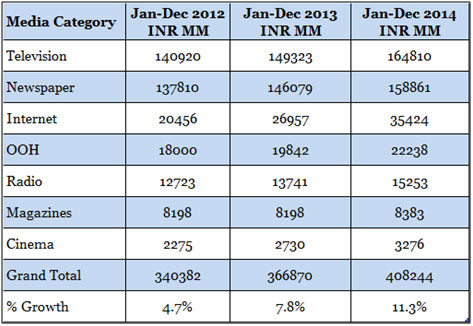
    Indian media companies will see ad revenues growing by 11.3% next year with the internet again leading the growth at 31.4%, according to Magna Global’s annual advertising forecast for the year 2014.


    The growth in television adspends will be 10.4%, while that for newspapers will be 8.8%. Magazine adspend growth will be 2.3% while OOH will be 12.1% and Radio at 11%. Cinema, given its lower base, will grow at 20%.


    Last December, Magna Global had predicted an 8.7% growth for Indian adspends. This was revised in June this year to 7.8%. The growth for 2012-13, although based on its current estimates, is 7.8 percent. Magna Global is the strategic media unit of global media agency conglomerate IPG Mediabrands. IPG Mediabrands is headed by Shashi Sinha in India.


    The economic environment remained weak throughout 2013 but is still expected to improve in 2014, especially in the developed world which has experienced four years of slow growth and stubborn unemployment, according to the IPG Mediabrands firm. As per the International Monetary Fund’s World Economic Outlook projections, India should re-accelerate at 5.1% following 3.8% in 2013. “That level of economic activity is not particularly impressive by historical standards but confidence indices keep improving and we believe advertising spending will reflect and amplify that economic trend,” said Venkatesh S, EVP, Director Intelligence, Magna Global, India.


    Venkatesh added that the growth estimates of 7.8 per cent for 2012-13 are end-2013 estimates and he does not foresee any extreme changes.


    Mobile share to total internet in adspends is 7.9%: Venkatesh S, EVP, Magna GlobalQ&A with Venkatesh S, EVP, Director Intelligence, Magna Global, India


    The annual forecast made in December 2012 had your annual year-on-year growth forecast for India pegged at 8.7%. In June this year, it was revised to 7.8% which has been maintained in your year-ahead report. Since we haven’t yet closed December, do you think this growth of Jan-Dec 2013 will stay at 7.8%?

    These are end-2013 estimates and we don’t foresee any extreme change in growth rates


    Any noteworthy changes in your estimate made in Dec 2012 and June 2013 to what it is now?

    Newspaper and Magazine growth rates have been revised downwards compared to December forecast and the growth rates are pretty the same as it was in June 2013.


    By your estimates now, will India be among the Top 10 markets five years from now? In December 2012, your report said India would be among the Top 10 markets in the year 2017. That was not the case when the mid-2013 numbers. What is the status as of now?

    Following a significant slowdown and given the current market environment, long-term forecast was revised downwards and is not in a hurry to be part of the Top 10 anytime soon. Currently India is the 13th largest advertising market and is forecast to retain its position in 2018.


    How does Indian adspend compare with our neighbours, BRIC countries and internationally?

    The adspend/capita in APAC varies significantly from $558 in Australia to $2 in Pakistan. While India adspend/capita is $5, its BRIC peers are way above – China $29, Russia $67 and Brazil is on par with the global average of $84. India is slightly in the high growth potential zone.


    Internet doesn’t seem to be growing at a significant pace – it continues to hover around 30-odd percent. Comments?

    India has been growing at a phenomenal rate compared to the global average (+15.5%) and also within APAC (+22.4%). Having said this, mobile internet is promising and will overtake desktop internet. However lots of questions need to be answered to see this medium unfold its potential.


    What would you say is the contribution of mobile as against the whole of the internet.

    Mobile share to total internet is 7.9%.


    And how does this compare with developed economies and BRIC countries?

    While BRIC countries are averaging 9%, developed economy is 15%


    Last December, you had predicted a 4.2 percent growth in the magazine sector. That is now 2.3 percent. Do you think there is a trend out there and we could magazines degrow even further?

    A small base of loyalty is a major deterrent for magazine publishers and advertisers, though language magazines still hold ground locally. Staying relevant to digital audience and retaining revenue streams is a challenge.


    Given an election year, shouldn’t we have seen a greater growth for newspapers?

    In 2012, the category saw a lower single digit growth rate. Our estimate for 2013 including political advertising is 6.0% and 8.7% in 2014.


  • India ad revenues to grow 11.3% in 2014: Magna Global. 2013 Growth: 7.8%

    By A Correspondent


    Indian media companies will see ad revenues growing by +11.3% next year with the internet again leading the growth at +31.4%, according to Magna Global’s annual advertising forecast for the year 2014.


    The growth in television adspends will be 10.4%, while that for newspapers will be 8.8%. Magazine adspend growth will 2.3% while OOH will be 12.1% and Radio at 11%. Cinema, given its lower base, will grow at 20%.


    Last year, Magna Global had predicted an 8.7% growth for Indian adspends. This was revised mid-year to 7.8%. The growth for 2012-13, although based on its estimates, is 7.8 percent.


    The economic environment remained weak throughout 2013 but is still expected to improve in 2014, especially in the developed world which has experienced four years of slow growth and stubborn unemployment, according to a communiqué. In its October 2013 update, the IMF forecast world output (real GDP) to accelerate to +3.6% in 2014. This is marginally below its April forecast (+4.0%) but still stronger than the 2013and 2012 growth (+2.9% and +3.2% respectively). The latest IMF update also confirmed that the Euro markets are finally emerging from recession as of the end of 2013 (+1.0% GDP growth expected in 2014, +1.4% in Germany). The US will accelerate from +1.6% to +2.6%. Meanwhile,the emerging “BRIC”economies will also re-accelerate after experiencing a “soft landing” in 2012-2013: India +5.1% (following +3.8% in 2013), Russia +3.0% (following +1.5% in 2013); Brazil and China’s are expected to grow by +2.5% and +7.3% respectively (on par with 2013).


    Venkatesh S

    That level of economic activity is not particularly impressive by historical standards but confidence indices keep improving and we believe advertising spending will reflect and amplify that economic trend says Venkatesh S, EVP, Director Intelligence, Magna Global, India.


    Look out for our detailed report on the Magna Global numbers on Tuesday, December 10


    Caption: India advertising revenue by media category 2012-2014