
Tag: UTV Bindass

  • Will switching to youth ent work for V?


    By Meghna Sharma


    Prem Kamath

    Launched 16 years ago as a music channel, Star India’s Channel V is now turning into a full-fledged youth entertainment channel. Starting July 1, V will stop airing music programmes in India and focus on fiction and non-fiction shows. The reason: “Over the last two years, there has been an explosion of ‘music only’ channels, but everyone’s playing identical playlists,” says Prem Kamath, executive vice-president and general manager at Channel V. “In order to grow as a channel and as a brand, it has always been critical to have an offering that is unique in our competitive space,” he adds on being quizzed on the decision.


    Many experts feel that it was bound to happen as more and more channels try to mould themselves to stay connected with what their target audience wants. But there many questions arise: could this mean the beginning of the end of music on TV? What is the future of music genre? Where is it headed?


    The beginning

    The scene for Indian music channels was set with the launch of MTV in the early 90s. Soon after, Channel V was launched in 1994, and since then there has been no looking back.


    The launch of these music channels also led to a boom in international as well as Indie pop culture. However, it was shortlived and Bollywood music took over, and the two channels, along with many other launched afterwards, started playing popular filmi songs. But over a period of time, these two channels moved beyond playing only music with shows like Roadies, Splitsvilla and Dare 2 Date.


    Hemant Kenkre

    According to music columnist Narendra Kusnur, somewhere down the line for these channels, music took a backseat: “I’m sure any channel would do thorough research while trying to change their gameplan. So, if a music channel shifting towards being a youth entertainment channel is proved beneficial – for viewership as well as revenue – then it wouldn’t harm them to take such a step.”


    He’s not alone in voicing this. Even Hemant Kenkre, a former music channel professional and a corporate and brand communications veteran, feels that channels are now branding themselves differently to reach out to their TG. He, however, does blame the availability of music on various platforms – radio, cellphones, laptops, iPods – as the reason for this shift. “Today, the youth is moving towards reality shows and they want it from the channels meant for them. As for music, they get their share of it from other mediums too.”


    Luke Kenny

    Former VJ, musician, actor and 9XO programming head Luke Kenny, on the other hand, feels that the channel (Channel V) decided to shift long back and has been moving slowly towards it, but there are still many who want music on television. “If music was dead on TV, then how would you explain other new music channels cropping up and doing well too?”


    He added: “Having said that, I do believe that with more channels showcasing Bollywood songs, music channels have lost their niche and have just became promotional channels. Therefore, if a channel decides to change colours, it might work. And you never know, Star India might come up with a new music channel called Music OK.”


    Industry talk

    If one takes a look at various channels, be it music or a GEC, they will find that, there is a great deal of music in some or the other. We have music trailers/songs aired across all channels. Award shows, too, have musical performances and talent shows like Saregama, Indian Idol, DID and even celeb dance show Jhalak Dikhla Jaa  are high on ratings.

     

    Mohit Joshi

    Therefore, according to media planners, the existence of specialised music channels is a difficult game. “Today, unfortunately for the masses in India, music equals to Bollywood. This is the challenge. This was not the case in the ’90s when there were a lot of private music albums that were launched -Silk Route et al, and the music channels were used for their amplification. So, there was something more than Bollywood, which is not the case today. In the current scenario, if music channels do not experiment with music or the content, then there is a fear that they will dilute their relevance over a period of time,” says Mohit Joshi, managing director, MPG India.


    Adds Carat Media India’s senior VP Himanka Das: “Channel V’s decision to discontinue music is a welcome change and would offer interesting opportunities to build engagement content with the youth, considering the very little content that is available to them in entertainment beyond music. Music as a genre gets 6-7 per cent share in the youth segment of viewers with Channel V contributing 24 per cent to this share amongst 20+ channels. Channel V vacating this space is someone else’s gain!”


    Punit Pandey

    Meanwhile, other music channels aren’t perturbed and are waiting to see how the channel is accepted in its new avatar. As per TAM (CS4+, All India market), there has been a consistent growth in the music genre. In 2007, the genre share of music channels was 2.02 per cent whereas in 2012 (till week 24) the share has grown to 3.62 per cent.


    Punit Pandey, senior VP and business head, 9X Media Group, agreed with Mr Das and added: “Music has, and will continue to, work on television. It is close to a Rs360-370 crore industry (in the HSM belt) and growing. More and more people are ‘watching’ music, so there is nothing to worry about for music channels at large.”


    Nikhil Gandhi

    Similarly, the view from UTV Bindass which started out as a Youth Entertainment Channel (YEC) and has been a pioneer in the segment is that though in the recent past music channels, especially MTV and Channel V, have started shifting focus from music to fictional and non-fictional shows, there is no reason for sleepless nights. “We have an advantage over other channels entering the YEC genre as we have already created a connect with the TG,” says Nikhil Gandhi, Disney UTV Executive Director – Youth Channels, Media Networks. And adds an alert: “So, I would like to tell other channels entering the YEC genre to work on their strategies well.”


    Apprehensive marketers?

    The change in positioning is due to the feeling that youngsters now have a strong spending power. And, hence, are targeted by various brands more than ever before. TV forms a core part of advertisement for these brands as youngsters also spend a lot of time in front of the television sets.


    Simeran Bhasin

    But what happens to youth brands if a channel changes its content strategy? According to the various marketing heads, the apprehensions will emerge if the channel isn’t clear about the shift and isn’t able to help a brand reach its TG.


    “If the TG of a brand matches that of the channel, it won’t matter if they decide to change over a period of time. However, if there is a shift in TG then a brand would think twice before advertising on that channel,” says Simeran Bhasin, head – Marketing and Retail, Fastrack.


    Harkirat Singh

    MTV’s latest show Sound Trippin was partnered by Woodland because the brand feels that youth oriented channels helps them reach their TG. However, the brand is clear that it get associated with channels or shows only if it feels there is a connect between the brand and the viewers. “Like any other brand, while media planning, the TG of a certain channel is important for us. We look for shows which are able to reach and connect with our TG. So, if a channel changes its content plan, we will want to go through their new strategy to figure out where do we figure and how it can benefit us,” says Harkirat Singh, MD, Woodland.


    Will the shift work?

    According to the industry professionals, the change in content plan by a channel is done after a lot of research and only time can decide if it will work in its favour or not. However, they believe that a channel should remain true to its philosophy because otherwise it will lose its identify as well.


    Samyak Chakrabarty

    Expanding on it, Samyak Chakrabarty, MD, Electronic Youth Media Group and Chief Youth Marketer, DDB Mudra Group believes that ‘youth’ is a very misunderstood word and youngsters cannot be defined in one category as all depends on the exposure and the background one comes from. “In their perception to become ‘youth’ channels, they are getting muddled up and don’t know where they are headed. Today, a youngster cannot associate MTV or Channel V with anything like they do for other brands. For instance, technology means iPad, connectivity means Blackberry etc. I think music channels should have remained with what they started as, instead of losing their identify to gain more TRPs. Such moves will only lead to their downfall, in the long term.”


    From being largely optimistic to one predicting a downfall, we received mixed reactions to the proposed change in Channel V’s identity. However, one thing is clear, no matter what Star India decides, there will be many who will wait to see what this mean for them and the genre, at large.



  • It’s not about co-creation, but increation: Boschma

    The “youth” of today have been touted as being the marketer’s favourite TG for some time now but it’s not just about catering to their apparent behavioural habits. The effort by marketers has to be able to reach out to the subliminal preferences of the youth that are redefining the way they communicate with a brand. Having studied their behavioural patterns and preferences from early 2000, the one person who has seen this group evolve over the years rapidly is well-known international author and speaker, Jeroen Boschma.

     

    In India to launch his book ‘Generation Einstein’, that has been co-authored by UTV Bindass, MxM India got Boschma to delve on the emergence of the youth of today, why brands and marketers should be wary of this TG, and what are the learnings that could be picked up from this book by those interested in catering to the highly volatile TG. Excerpts:


    After having vowed the world, your book Generation Einstein finally makes its debut in India. What are your first thoughts on the book seeing the light of the day in India?

    The book is about the first global generation from around the world – even the Indian youth is not Indian but is really a part of the global youth. The book delves into the behavioural aspects of the youth, their habits, preferences, and so on. Of course, the behavioural background of Indians is different from those of the generational background of youth fromHolland, where the book was first launched. It also provides an insight and a view to everybody that wants to communicate to youngsters – not only marketers and brand managers but I think even school teachers, professors and others. Basically, it is aimed at those seeking to make an impact on the youth of today.


    Could you delve on the thought process behind narrowcasting the next generation youngsters as your core TG towards writing the book?

    It took me five years to write the first version of the book. The way I approached it is I made notes of my learnings, which at the end totalled in excess of 400 pages. There was also a heavy amount of research that was done and then all the elements were brought together to be edited and written in a proper way. I am grateful to the help from my Indian colleagues who helped me in putting together this book so as to reflect the findings and tastes of the Indian youth of today.


    How different are the three versions of the book from each other?

    The first edition was published when Facebook didn’t even exist. So the other two editions had to be rewritten to accommodate learnings and findings from the social media space as well.


    What are some of the trends you came across while you got down to analyse the youth of today?

    The fact is that the youth of today do care of the world and they want to associate brands with respect to nature and for the sake of humanity. Another big trend is that the youth of today are very entrepreneurial and start their start-ups at a very young age. I have seen so many new ventures set up by young people inIndiaand they have been performing phenomenally well. I would say that is one of the big trends transpiring around the world today.


    You have pioneered the term Increation. Could you throw more light on the significance of the term?

    Increation is the process of coming up with marketing campaigns that work. We have been working on it for five years and now we have a firm grip on the way it needs to function. It provides a learning experience to ad agencies and brands to source their creation. It’s different from co-creation which doesn’t work; Increation works.


    How would you rate your experiences of co-authoring this book to suit the tastes of the youth of India?

    It’s been a long process putting this book together for the Indian audiences. It’s not easy as constructing a house; it’s about putting together thoughts together and creating an environment that the youth of today are familiar with.


    What is the lesson that Generation Einstein throws up for marketers and brands of today?

    What I have observed with Generation Einstein inIndiais that it is getting more extreme; we really do not have a choice – we have to change. We all are trying to keep the old world alive but the old world doesn’t exist anymore. It’s about the new generation and their understanding of the trends of today. The marketers and brands of today have to unlearn everything they know about the old world and channelize their focus on the youth of today.


    What are your plans for the future?

    The plan next is to organise a full-day Generation Einstein conference to get into the depth and help marketers come up with solutions to cater to the youth of today. I am also in the process of writing another book which I plan to launch internationally very soon. It still is in the early stages and the full context will only be known later.


  • Understanding young minds with ‘Generation Einstein’

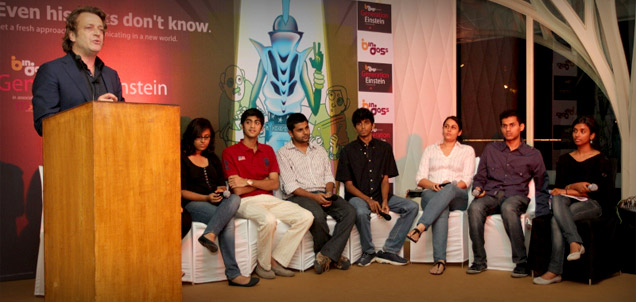
    Jeroen Boschma with young minds on the panel ahead of the release of ‘Generation Einstein’


    By A Correspondent


    It was youth power in all earnest as Bindass launched the India edition of ‘Generation Einstein’ on Monday evening at Mumbai’s tony Tote on the Turf. The book is co-authored by Bindass along with well-known international author and speaker Jeroen Boschma.


    The book describes the new generation, ‘Generation Einstein’ that was born during the last decade of the previous century. It also stresses upon the significance of the youth as an important part of the market and how fast the new generation understands the world better than anyone else. The book attempts to decode this generation and help marketers reach out to them.


    At the event, Mr Boschma spoke about how today’s generation is completely different from the previous generations. He was of the view that unlike the youth of previous generations which lived in a world of their own, the youth of this generation are very much in this world as they understand brands and marketers better: “Strong brands worldwide are brands that believe in what they do and youngsters who connect with these brands are madly in love with them.” (see interview: It’s not about co-creation, but increation: Boschma)


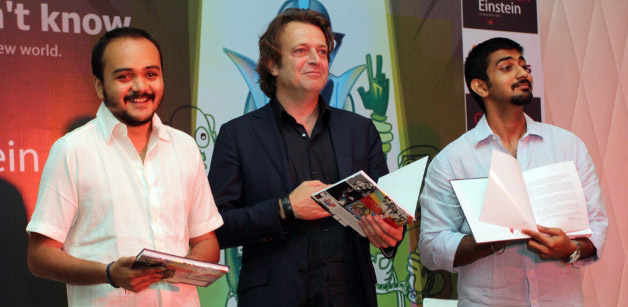
    Jeroen Boschma (centre) with Samyak Chakrabarty (to his right) and Arjun Paul Vednayagam


    The Indian edition of Generation Einstein is authored by Samyak Chakrabarty and Arjun Paul Vednayagam. “The aim of the book is to open the mind of brand managers, and to stop defining the youth, as it is not possible to define them. It is all about making interesting campaigns and allowing the youth to decide the fate of the brand,” said Mr Chakrabarty.


    The objective of the study conducted for the book is said to be about understanding the thought process of a young consumer, the factors that influence the youth to build their brand preferences, how they come to their final choice, and then using this knowledge to effectively engage the youth.


    “Every brand today has fanatic fans. Marketing is nothing like what it was before. If you want to communicate with this generation, forget what you have learnt. This generation understands that advertising is about lying. Generation Einstein says that the future of marketing is to find the purpose of their life and we need to find out how to be part of their life,” Mr Boschma added.


    In a panel discussion, moderated by Mr Boschma, the panellists, including college going teens, spoke about their favourite brands and the factors that influenced their buying decisions.


    Mudit Ganguli, a student from JaiHind College, Mumbai said that his favourite brand is Blackberry because it is cheap and convenient to use, it has versatile features, helps him get regular updates and allows him to communicate easily. Another reason why he preferred a Blackberry is because of good advertisement.


    Mohini Mukherjee, also a Jai Hind student said her favourite brand is ‘Bingo Chips’, primarily because of good advertisements, but also due to no celebrity involvement, funny advertisements, and good quantity of chips.


    Another student said that Twitter was her favourite brand because it helps her express her feelings, provides instant updates, and allows her to follow her favourite celebrities.


    One of the students talked about the reasons he trusted ‘Nike’ as a brand – good advertisements, the quality the brand offers, and the ‘Just do it attitude’ that it displays. He also spoke about how the brand is empowering the youth. He said that brands need to go back to delivering quality products and not try to create a product for everyone and eventually reaching no one.


    In conversation with MxMIndia, Samyak Chakrabarty spoke about his marketing plans for the India Edition of ‘Generation Einstein and his learnings from the study: “We would like to put this into the curriculum of mass media courses where the next generation marketers can learn about how to engage the youth. We plan to take Jeroen Boschma to colleges and deliver lectures and, of course, the book is available online for Rs200. The biggest learning we have had is that in order to understand and engage the youth, one has to keep his mind open and the fact that brands cannot define or assume or presume about the youth today.”


    The event was organized in association with MxMIndia.


    Photograph: Fotocorp

  • Bindass to host ‘Generation Einstein’ tonight

    By A Correspondent [updated]


    All roads lead to the Mahalaxmi racecourse today (Monday, May 14) as Bindass will launch the Indian edition of the very successful book ‘Generation Einstein’.  Co-authored by UTV Bindass along with the well-known international author and speaker Jeroen Boschma, the book is being launched in India keeping in mind the specifics of the Indian market and traces the emergence of a global generation in India, their likes, dislikes, lifestyle and what sets them apart from the others.

    The Indian edition of Generation Einstein – authored by Samyak Chakraborty and Arjun Vednayagam – also goes on to explain the communication strategies that marketers could adopt in reaching out to the youth with the help of India-specific case-studies like Tata Docomo, Bindass, Virgin Mobile and many more.

    The book describes a new generation, ‘Generation Einstein’ that was born during the last decade of the previous century. It also stresses upon the significance of the youth as an important part of the market and how fast the new generation understands the world better than anyone else. The book attempts to decode this generation and help marketers reach out to them.


    Commenting on the association of Bindass on the launch of book, Kunal Mukherjee, Director-Marketing, UTV & Bindass Networks, said: “Bindass being a 360-degree youth brand continuously looks out for avenues to work with people who engage or reach out to the youth in various ways. Generation Einstein 3.0 provides an insightful look into the working of the youth’s minds, how they make choices, evaluate mediums and more importantly how to establish a connect with them as equals. One of the hardest things to do for any brand today is to get their communication across to the youth and Generation Einstein helps each of us do just that as we decode the youth step by step.”

    The book will also throw light on the new age communication strategies like “Increation’ which is a more effective method of communicating with a youth segment. The new methodology of research – Increation involves putting many ideas to test, then trying to use the reactions to narrow down the ideas. The researcher will look for overlaps on what connects to solutions…leading to that one big insight that results into that one big idea.

    Young people are ultimately suited to working with increation projects. They are extremely creative because of the world in which they live and their present stage of life.

    Entry to the event, which is being organised in association with MxMIndia, is by invitation only. It will be followed by cocktails and dinner.


  • We’re a one-stop shop for broadcasters: Santosh Nair, UTV

    UTV Television, known to be a pioneer in the TV content business in India, was started by Ronnie Screwvala in the early nineties. Though the group has expanded its wings to being a broadcast major, its television business, which has now, in a way, been overshadowed by the international companies’ foray into India, is slowly but surely taking bigger strides in becoming a significant player in the business.


    as put by Chief Operating Officer Santosh Nair, the content house’s biggest USP is the fact that it offers fiction and non-fiction shows, plus the company’s wide experience in the regional space. In a freewheeling interview with MxM India’s Rishi Vora, Nair speaks about the content business in India, UTV’s role in that, company’s plans and much more. Excerpts:


    Q: So how was 2011 for UTV Television?

    The year 2011 was very good for us. Saubhagyavati Bhava, which was launched at the end of the year, is doing well. Dor, which aired on Star Plus, was launched early in 2011 too performed fairly well. The non-fiction shows, especially on UTV Bindass, such as Big Switch and Emotional atyachar too have delivered.


    Q: Is it tough competing with the likes of Endemol, Freemantle, Balaji and a host of other content houses?

    all businesses are tough in that sense. My sense is that there is space for everybody. Yes, there are international format companies, but we’ve been successful in doing home-grown formats. The first season of Dance India Dance was done by us. and that’s the first and the best example of a successful home-grown format. Ek Khiladi Ek Hasina -India’s first cricket format show too is a great example of a great home-grown format. and not to forget Emotional atyachar – that too is a home-grown reality show.


    Q: But not all home-grown formats have been successful.

    Most of them have done fairly well. Dance India Dance is doing well season after season. The show is now in its fourth season. These are tried and tested formulas. and that’s one reason I feel there is space for everyone in the industry.


    Q: While there are home-grown formats done by Zee and various other channels, international formats like KBC, KKK, Bigg Boss and others are more popular. Why is that so?

    International formats are formats which have worked internationally – they have worked well in many countries and hence are successful formats. There is a big market for international formats in India and that’s one of the main reasons why international production houses like Endemol, Freemantle and others have entered India.

    Look at KBC for example. That’s a show that has seen a lot of success. Some have worked, some have not. But broadcasters will always look to do international formats more as these are the shows that have seen some success in overseas markets.


    Q: are you also doing an international format show?

    Yes, there is one in the pipeline.


    Q: For a content house like yours, are non-fiction shows profitable?

    Non-fiction shows are seasonal and each season lasts for about 13 to 26 weeks. So often they turn out to be more profitable because fiction shows usually takes about 200-250 episodes to break even. It takes that much time to understand how your fiction is doing on the ratings front, whether it is a good call to continue or not.


    Q: UTV Bindass is a sister company, so if I may ask: How do reality shows like Emotional atyachar and Big Switch benefit you and the channel from a cost perspective?

    These shows target the youth. So from a cost perspective, it is working out well for the channel and for us, too. That’s the reason why we’re doing them every year. So I’m pretty certain that the channel makes a fair amount of profit on these shows.

    To be very clear about how we deal with Bindass: We treat the channel as any other broadcaster, the way we work with Star or Sony or Imagine, it’s the same way we work with Bindass. We pitch to them – and if in case they don’t like it – we take the project to someone else.


    Q: So Bindass also works with an Endemol for example?

    Yes, Bindass works with Endemol.


    Q: Which means UTV Television is not much inclined with Bindass.

    No-no, it’s not that way. What I’m saying is we are one of the content houses for Bindass.


    Q: There is a buzz that some of the non-scripted shows are not really non-scripted in the true sense.

    No-no. The kind of shows we have done, we have never done any doctoring, purely in terms of making a non-scripted show a scripted one. I can’t comment about other shows, but my fair sense is that nothing is scripted in non-scripted shows, apart from anchor lines.


    Q: What is it that makes UTV Television stand out in the clutter?

    Look at any content house right now in the Hindi space vis-a-vis UTV, which is the only content house that delivers both scripted and non-scripted content. That for us is our USP. We are doing some work in the southern market. We are doing shows languages such as Tamil, Kannada, Malayalam or Telugu. apart from being present in the Southern market, we’re also doing shows in Marathi. We recently did two fiction shows in Marathi, so the kind of programming we do – we are into six or seven languages.


    Q: So where do you focus more: fiction or non-fiction?

    We’re strong on both – fiction and non-fiction so we focus on both the formats. We’re a one-stop-shop for any broadcaster to look at fiction as well as non-fiction.


    Q: a lot of content is being produced in regional languages, so is it a beginning of a trend in the content space?

    apart from UTV, I don’t think many players have made a foray into the regional space. The reason why I’m saying this is because we have a decade old relationship with the network and we have been doing quite a bit of work down south. apart from the local players, I don’t see many of the Hindi players getting into the regional space.


    Q: What is your view on the issue of IPR, where the broadcaster owns it when it is the content house that is producing the show…?

    The broadcaster owns the IPR because he commissions the content house to produce the show. There is a budget which is rolled out, the content house keeps its margins and that price is fixed. That’s the model which is operational in the industry now minus Sun Network. With Sun Network, we spend the money on producing a show, we pay them slot fees and the IPR lies with us. So that’s a slot model.


    We are doing Shubh Vivaah on Sony, a remake of a Tamil show; Saubhagyavati Bhava too is a remake of a Telugu show…


    Q: So for all these shows, the IPRs lie with you?

    Yes. In fact, there are two other shows in the pipeline which are remakes of south shows (we are currently in talks with broadcasters) and we own the IPRs.


    Q: What is your view on broadcasters’ interference in terms of storylines or tweaks?

    It’s team work. Broadcasters respect our expertise in terms of creative formats that we bring to the table. While we respect them in terms of their understanding about the business, so it’s a mutual thing.


    Q: What are we going to see from UTV television this year?

    We’re doing Shubh Vivaah on Sony, an international format show with one of the GECs. Two more fiction shows are lined up with top broadcasters and we will be launching a few fiction shows in the south. So a lot happening this year.


  • Saregama, UTV Bindass tie up for music talent show

    By A Correspondent


    Saregama India has announced the launch of a new platform for popular mainstream artists to reach iconic heights in the music world called ‘Saregama’s Icons Nxt’ with UTV Bindass.


    Saregama will create original music and will promote it on UTV Bindass. The initiative has yielded five exciting young talents and their performances will be showcased on UTV Bindass in a variety of contemporary genres. The artists that are being featured are of the likes of Samar and Sanam, Phoenyx, Nasha, Paapi 4 and The Dhol Factory.


    Apurva Nagpal, MD, Saregama India said, “There has been a huge vacuum in the pop genre in India for many years. This is an endeavour to resurrect the genre.”


    Adarsh Gupta, Business Head-Music, Saregama India said, “Saregama Icons Nxt with UTV Bindass is a platform to launch a wave of new artists year-on-year for reviving mainstream popular music. We believe that going forth this will be the leading platform for creating music icons of the next generation. We have tied up with several partners to promote this flagship property across platforms.”


    Keith Alphonso, Business Head – UTV Bindass, said, “There is nothing new about the innate connection between music and youth. The youth has consistently defined the next wave of music. To create the next generation of music icons we are pleased to partner with Saregama Icons Nxt to promote the country’s finest and most talented young musicians. Through this partnership we look forward to further strengthen our connect with music and thereby with our audiences too.”


    David MacDonald, Head of YouTube Partner Operations, Asia Pacific said, “We’re very excited to see a leading industry label like Saregama stepping forward to give budding singers and artists a platform to showcase their work and earn the praise they deserve. India is home to many talented singers and YouTube is a democratic platform that provides a unique opportunity to every individual to express themselves and pursue their passion online. Over the years we’ve seen many artists use YouTube to showcase their work, connect with their fans and become a overnight success. We’re confident that initiatives like these will go a long way in recognising and celebrating the independent artists in the country.”


    Talent house, a global talent networking portal that addresses artists across creative initiatives is also supporting the endeavour, having agreed to front the search for this property for the next five seasons. Arun Mehra, CEO, Talenthouse India said, “Talenthouse is the world’s largest collaborative platform undertaking crowd sourcing creative invite’s for globally renowned industry names like U2, Metallica, Lady Gaga, Maroon 5, etc. We, at Talenthouse India are excited and looking forward to provide opportunities for creative artists to showcase their talent in India. Saregama India will be the perfect collaborative partner for the same”.


    Flipkart, one of the largest Indian online shopping stores, has come on board to promote and retail the artist albums with heavy online support across platforms. They have initiated a pre booking feature for sale of CDs online.


    Nokia has partnered Saregama India to launch the music of these talented artistes on Nokia Music Unlimited service – Nokia’s revolutionary digital music service for its devices. Mr Viral Oza, Marketing Director, Nokia India, said, “India certainly needs more platforms like Saregama’s Icons Nxt, given the enormous musical talent out there waiting to be explored. We are sure that our partnership with Saregama India will contribute towards promoting independent music in the country.”


    The other brands associated with the property are Planet M which will promote and sell the music albums of the artist; and Big Cinemas the leading multiplex chain for promoting the property across their multiplexes.