Tag: Uttarakhand

  • Ranjona Banerji: But why was the tunnel built in the first place?

    Ranjona BanerjiBy Ranjona Banerji

    It’s been seven months since civil unrest began in the Indian state of Manipur, six weeks since Israel started bombarding Gaza with its military might after a Hamas terrorist attack on October 7 and 10 days since 41 labourers have been trapped in an under-construction tunnel in the Uttarakhand Himalayas.

    In all these three situations, either little has changed or things have got much worse.

    During this time, the cricketing world played a World Cup in India. Like quidditch in the Harry Potter series, this is a compelling game but has few takers worldwide because of its playing norms and ethos. Even without the requirement for flying brooms.

    Priorities however must be kept and cricket is cricket, a religion in India, an Indian game invented. Add to the clamour for the game itself, the political involvement, from some important person in the Board for Control of Cricket in India to the Prime Minister himself. Please forgive the order in which I have written the last sentence. Under no circumstances did I mean to imply that the important person in the BCCI is more important than the Prime Minister himself.

    This meant that all eyes were on the final, which India was destined to win according to the dispensation’s organisation system. I don’t know the going rate to hire the Indian Air Force to fly past your home when you have a big party, but the BCCI managed to hire out nation’s fighter jets to fly over the Narendra Modi stadium in Ahmedabad.

    As the game progressed and Australia refused to follow the Indian script, a somewhat less-than-perfect scenario emerged. The Presence of The Great Man did not lead to sport changing its rules. A hasty trophy ceremony full of bad hospitality was the result, plus the usual behaviour of something not going the dispensation’s way – insults and abuse at the winning team. But a quick photo op with the losing Indian team was quickly cobbled together. Where you have cameras and a captive media, why lose the opportunity to make yourself look better under any circumstances?

    Should we return to the first three events mentioned at the beginning? The civil war is still on. Sporadic incidents of violence continue. Anger continues. Government inaction and media disinterest continues. SNAFU is some air force somewhere or the other put it.

    The bombardment is still on. India’s media put on its camouflage costumes, popped down far from the violence zone and did its best war-time acting and returned. It then lost some interest in proceedings, unless it could use them to stir anti-Muslim sentiment in India. The signals from their masters were mixed anyway. The ruling party supports Israel, so the mainstream media had to support Israel. But the official Indian government position has always been to support Palestine. Therefore in India, you can be stopped by the police for supporting the official Indian position and lauded for supporting the official party position. If you were a cowardly TV studio, what would you do?

    The trapped labourers have finally got a bit of traction from some sections of the media. The reasons for the collapse of the tunnel have got little or no attention. Instead, the company tasked with making the tunnel, engineers involved, bureaucrats, the labourers themselves are all going to have to share the blame.

    Why the tunnel is being built in the first place – well, you cannot expect the media to get into that.

    Why were scientists, geologists, various experts ignored – well, you know experts, they rarely say what you want them to.

    I forgot about some assembly elections. They happened and will still happen. We know these to the extent that the Great Man jumped into a costume and waved at crowds. TV told us. As for the results, it all depends on the co-relation between machine and man.


    Ranjona Banerji is a senior journalist and commentator. She writes on MxMIndia on Tuesdays and Fridays. Her views here are personal.
  • Anil Thakraney: Are reporters adequately trained?

    By Anil Thakraney


    If you happen to know this dude called Narayan Pargaien, please tell him never to come face to face with me. If he does, I am going to sit on top of his shoulders and make him give me a ‘lift’ when Mumbai’s streets get flooded with gutter water. In case you haven’t heard, not only did this News Express reporter do something totally disgusting in flood ravaged Uttarakhand, he has brought global disrepute to the entire Indian media, the world press is busy sniggering at us. (The firangs love, love, love stories like this from Incredible India.) Here’s the link to his shameful deed: http://www.youtube.com/watch?v=RMq7KPgynU0


    This incident reminds me of another equally sickening one I personally witnessed in Nagapattinam, in the after-math of the tsunami. A TV reporter found a very old woman wailing by the beach, she had lost her entire family. Our chap started filming her, and began demanding she wail harder so that it looks ‘good’ on television. He even encouraged the unfortunate lady to beat her own chest. Even better television!


    I hope the rest of the Indian television reporters conduct themselves better on the field, but such incidents are a reminder of the woefully poor quality of training that happens in the media companies. We like to call ourselves ‘The Vibrant Indian Media’, but do all these channels/portals/newspapers bother to educate their reporters before letting them loose? I seriously doubt it. Pargaien has been sacked, but is that the solution? This is like punishing the traffic havaldar who got caught for accepting a fifty buck bribe, and hoping that the problem is solved.


    Most Indian media barons are reeling because of cash crunch, we are all aware of that, but they simply have to find a way to invest in training so that their reporters and cameramen conduct themselves with dignity while covering a story. Despite the mad rush for ratings and scoops, there have to be specific dos and don’ts outlined with a clear warning: Follow them or get out. Each media company must never forget one hard truth: If your staffer behaves shoddily, it directly damages your brand’s name, since he/she is representing you to the public. Therefore ignore training at your own peril.


    PS: This outdoor campaign from IBM scored big at Cannes this year. Richly deserved, I say. Such a simple but powerful idea. While Balki envies work done for Gujarat Tourism, this is the sort of work that makes me feel jealous.


    Anil Thakraney is a senior journalist and commentator. He is also Editor-at-Large, MxMIndia. The views expressed here are his own. He can be reached via Twitter at @anilthakraney


  • Comment: News media must black out netas at Uttarakhand

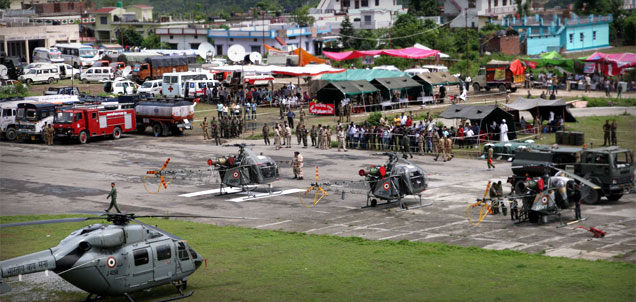
    Representative picture courtesy PIB of the IAF rescue helicopters at Gauchar airport, in flood-hit Uttarakhand on Wednesday, June 26


    It is indeed sad to see several dead and many injured as rescue operations are still on in Uttarakhand. What rages us is the game of one-upmanship between political leaders in grabbing camera time and the importance our news vehicles give to these visits. We present the comment by our Editor-at-Large and senior journalist Anil Thakraney on the issue which would normally appear as Hard Knocks on a Friday. – Editor


    By Anil Thakraney


    In the entire television din over the role of politicians on the Uttarakhand disaster, Prasoon Joshi made the most valid point. (Prasoon, if you are reading this post, I would urge you to take part in the tube debates regularly, we need a few sensible voices out there.) While the others were heatedly accusing the netas of seeking photo-ops during the tragedy, Joshi said the media must consider WHO is providing them with these photo-ops. Very true. If the media stopped covering these opportunistic politicians, they will immediately vanish from the scene.


    The defining neta moment so far was the two Andhra politicians exchanging fisticuffs at the Dehra Dun airport, as they fought over who would fly with the ‘cargo’. And no, the cargo in this case wasn’t medical supplies for the victims, but those people who had been rescued, and were anxiously waiting to be flown back home. Absolutely pathetic. And then there is Pheku and Pappu busy scoring brownie points over each other, and the many chamchas defending their actions. At least half of the media time and space gets spent on these jokers. What a bloody waste!


    My humble request to colleagues in the media is this: For the Uttarakhand news, take a firm decision not to provide any coverage whatsoever to the visiting politicians. Not only are they unable to help in any way, with their shenanigans, they come in the way of rescue and relief operations. And there’s no keeping these hyenas away, they will come to feed on the dead, it’s in their nature. Emotional situations like these give politicians a cool opportunity to win more fans, or so they believe. Let’s deprive them of it. And let the entire media effort be focused on the victims, the rescue and rehab. And on the jawans who are doing all the hard work, these brave souls who are putting their own lives on the line so that maximum number of people can be saved. I want to see their faces, I want to hear their voices, I want to know their stories. And this is what the media must provide us.


    Net net: Let’s make Uttarakhand a template for future disasters. No spotlight on any neta. Let it only be about those who matter, and those who do the real work. That done, no politician will ever arrive to disturb rescue operations. Once the oxygen supply (cameras) is cut off, they won’t see any point of jet-setting in. Good riddance.


    Anil Thakraney is a senior journalist and commentator. He is also Editor-at-Large, MxMIndia. The views expressed here are his own. He can be reached via Twitter at @anilthakraney


  • Ranjona Banerji: Tablets & tabloids – shape of news to come

    By Ranjona Banerji


    Having spent too long in a newsroom bossing about, I’d almost forgotten the cliquish little world that reporters live in, especially same-beat reporters. But one day of covering the Wimbledon tournament for Mid-Day and I feel that I am ready to write a thesis on the tribal customs of travelling tennis journalists.


    I had the same feeling years ago when I covered – just one, mind you – a film shooting for fun once. (Thanks actually to the founder editor of this website). All the habitual film journos hung around together and demanded entertainment from the PR guys who had organised the trip. They paid no attention to the shooting or the stars. Because it was a novel experience for me, I hung around the set – interminably boring – and interviewed one of the two main stars. The other never emerged from her room.


    In the same way, the Wimbledon press centre remained full of people watching TV and filing while I the wide-eyed rookie ran around the place. Great fun. However, more seriously, it seems that in spite of the fact that there were some women about, the media is the preserve of what NGOs call “male, pale and stale”. That is, sports journalists tend to be old white men! I tried to take aphotograph of the press enclosure on Centre Court to prove my point but apparently journalists in the press enclosure are not allowed to take photographs. Go figure.


    **


    There seems to be a lot of anger against the television media in India for its coverage of the Uttarakhand floods. It is impossible to know what went wrong from so far away but I can conjecture that as usual Indian TV went into “blame mode” rather than reporting mode and this meant that the issue became a school-playground level debate between opposing yellers and screamers. How this is of any help to anyone is a pointless question however since TV editors evidently cannot think beyond “discussion journalism”.


    But one story was intriguing and that was The Times of India report that Gujarat chief minister Narendra Modi travelled to Uttarakhand and rescued 15,000 Gujaratis. It was not made clear in the story how exactly the Gujarat state administration left behind the other people or how in extreme weather conditions they identified who was who. A petition on change.org (http://www.change.org/en-GB/petitions/chairperson-press-council-of-india-inquire-into-serious-violation-of-media-ethics-by-times-of-india?utm_campaign=share_button_action_box) has asked some questions about violation of ethics. The implication in the petition is that the story was a PR exercise for the Gujarat chief minister to show how efficient he is. But the underlying feeling is a bit of holocaust-type politics where you save only one kind of person (depending on ethnicity) and abandon the rest. Which is pretty bad PR if you think about it…


    **


    Meanwhile, here in the UK, once again you notice how news dissemination is no longer what it was. Newspaper subscription on tablet devices is winning the battle against paper. And on the tube, tabloid newspapers are common, free or otherwise. Some lessons which India will have to pick up on sooner or later. Sooner for the media industry’s own good but who knows.


    Ranjona Banerji is a senior journalist and commentator based in Mumbai. She is also Contributing Editor, MxMIndia. She can be reached via Twitter at @ranjona. The views here are her own


  • Anil Thakraney: Uttarakhand disaster: TV anchors screw-up yet again

    By Anil Thakraney


    You know who’s the biggest moron in this world? The man who reaches a building on fire, stands outside and wants to discuss in detail with those trying to douse the flames exactly what was the cause of the inferno, and who screwed up.


    Don’t know if this occurs to them, but some of the news channel wallahs have been doing exactly this on the Uttarakhand calamity. My friends in television must understand that their job differs from the newspaper editors when it comes to covering natural disasters or terror attacks. As the disaster strikes and the aftermath plays out, television journos must do one and only one thing: Focus on the 3Rs… rescue, relief and rehabilitation operations. And only discuss the whodunit and the whydunit after some amount of normalcy has been restored, after the victims have limped back to safety. This is because television is a live medium, it carries immediacy of news. But instead of doing this, on prime time, some news channels got those usual crappy, noisy debates going, to pin responsibility on who was behind this ‘man-made’ disaster.


    Just think about this: What if one of my friends or relatives is marooned in Kedarnath right now? Frantic, I would be madly surfing the news channels to see how folks are being rescued, and would hope get some details of the persons stuck out there. Or, god forbid, discover if the individual dear to me is gone. In fact, this is how a BBC would go about things. Instead, I see star anchors in a free-for-all with netas and the usual studio guests. Can you blame me then if my blood goes on the boil?


    While newspapers and magazines can and must cover a natural disaster with a 360-degree view, television has to cover the story step by step, and only shift gears at the right time. The question is: Why aren’t the idiot box runners doing the obvious thing? I can think of two reasons. One, perhaps because they are idiots. Or two, the anchors are convinced that shouting and screaming inside studios is the only way to gain ratings, whatever be the subject. You are free to pick the right reason.


    ***


    PS: An eerie anti drink driving campaign from the UK, one that might give you a heart attack in the pub itself. If they try this out in the Indian pubs, I suggest using only male mannequins. Else the BMC lady will object.


    Link: http://www.dailymail.co.uk/news/article-2338000/Shocking-anti-drink-driving-campaign-scares-pub-goers-simulating-car-crash-complete-fake-blood-toilet-mirror.html


    Anil Thakraney is a senior journalist and commentator. He is also Editor-at-Large, MxMIndia. The views expressed here are his own. He can be reached via Twitter at @anilthakraney