Tag: UNESCO

  • India 2nd Worst Nation in handling of Covid-19: Brand Finance Global Soft Power Index


    By A Correspondent


    As the world’s 27th soft power nation and with a Global Soft Power Index Score of 41.6 out of 100, India is leading the charge amongst its South Asian neighbours in the soft power stakes, but clearly underperforms relative to other leading nations, given the size of its population, economy, and its rich heritage.


    Brand Finance, the leading brand valuation firm, has released the findings of the Global Soft Power Index, which will be launched at Global Soft Power Summit on February 25, 2021.


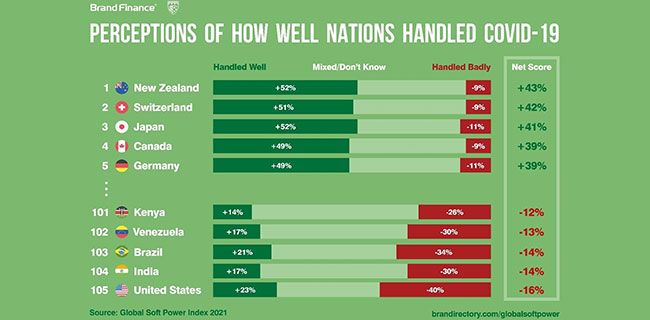
    India has the second-lowest rank, a notch better than that of the United States. In the specific area of nations handling the Covid-19 crisis, 30% people felt that it was handled badly, while 14% felt it was handled well.


    Adds the report: “Nevertheless, India is to be commended for the way in which it has invested in cultural diplomacy and for the major investments in global tourism spend. Prominent marketing of its “Incredible India” slogan has attracted a growing number of foreign visitors to India, raising awareness of the country’s diverse historical, cultural and numerous UNESCO world heritage sites which promote it as an appealing destination for travellers. This rings true with the general public survey findings where India scores 6.8 for Familiarity. The work of The Indian Council for Cultural Relations (ICCR) is a perfect example of India’s soft power priorities, as the government entity ramps up its presence to foster and strengthen mutual understanding between India and other nations. A fine example is The Nehru Centre in London, which acts as the cultural wing of The High Commission of India in UK. Established in 1992, it is regarded by ICCR as its flagship cultural centre abroad and has emerged as a premier institution engaged in India’s cultural interface with the UK. Following the controversial revocation of autonomy for Kashmiris by the Hindu nationalist Bharatiya Janata Party (BJP)-led government, India must build upon its soft power strengths instead of turning to more hard power initiatives. Yoga and Bollywood are two of India’s finest soft power tools. Bringing in tourism and talent, both can be seen as working their magic in order to boost India’s global image and project is as a peaceful rising power on the world stage.”


    As part of the Global Soft Power Index. Brand Finance asked 75,000 respondents from the general public and 750 from specialist audiences about the handling of COVID-19 by 105 nations worldwide. The respondents were asked to rate the nations’ efforts in terms of stimulating the economy, protecting the health and wellbeing of citizens, as well as cooperating on the international stage and providing aid.



  • Does anyone care about radio?


    “Radio is a wonderful way to interact, learn & communicate. My own #MannKiBaat experience has connected me with people across India.” Prime Minister Narendra Modi was a huge thumbs up to the medium that is being celebrated across the world today. “Greetings on World Radio Day. I congratulate all radio lovers and those who work in the radio industry & keep the medium active & vibrant,” the PM tweeted earlier.

    Indeed it was the monthly ‘Mann Ki Baat’ airing soon after he assumed office that confirmed the reach, power and vibrancy of the medium. While television and the internet have assumed prominence, radio has been flourishing.

    In fact broadcasters are the biggest advertisers on radio, underscoring the fact that to be successful on telly, you can’t not be on radio.

    More Power to Radio on World Radio DayBy Sunil Kumar

    Today, the world has more radio than ever before. Almost every Feature Phone and an Android Smartphone offers local, analogue radio. (People the world over hate Apple not offering that on iPhones). So the number of people with personal access to radio in the world is pretty much uncountable. That aslo makes radio more intimate a medium than any other.

    There are more ‘radios’ than ever before, thanks to advances in engineering and technology. Digital Audio Broadcasting (DAB) has increased the number of local radio stations in many a country to a phenomenal number. As a matter of fact, Norway has shut down FM to optimise the use of available spectrum. Apps such as Tunein and Streema can get you a ‘local’ radio station from any part of the world to any other. And how can one miss the ‘radio’ button on any music streaming app – iTunes, Gaana, Wynk, Saavan.

    Live radio has far longer shelf life now by way of archives and Podcasts.

    Podcasting has meant emergence of thousands of listening communities, and they are largely about technology, news and current affairs, business, sports, literature, comedy, history, wellness, trivia, spirituality and so much else, not just music. That has made radio so much more democratic. Anyone can broadcast to anyone on this new form of radio. No regulation, no censorship, no major investment.

    Not to forget, India has more radio stations than ever before. We have 800 or so terrestrial stations in the country. We are going to have these many more in the next couple of years.

    All this means, people are consuming more radio than ever and advertisers are spending more money on it.

    Sunil Kumar is Managing Director of Big River Radio, a radio consulting firm; and Managing Partner of Blue Broadcast Systems, a company engaged in FM transmission infrastructure in the private sector. He moved from advertising to radio in 1993 and has since been actively evangelising the medium.


    On January 14, 2013, the United Nations General Assembly formally endorsed UNESCO’s proclamation of  World Radio Day. During its 67th Session, the UN General Assembly endorsed the resolution adopted during the 36th session of the UNESCO General Conference, proclaiming 13 February, the day United Nations Radio was established in 1946, as World Radio Day.World Radio Day is now in its 6th year and the 2017 edition being celebrated has seen UNESCO inviting radio stations and supporting organisations to join in to celebrate radio and how it helps shape our lives.

    In India, where some parts are media dark and literacy and income levels are low, radio plays a key role for information and entertainment.

    However, as Prime Minister greets us on World Radio Day, his government has done all that it could do to ensure the medium doesn’t stay active and vibrant.

    As per newspaper reports, the government has informed the Supreme Court that it is against permitting community and private FM radio stations to air news because of a “possible security ris.”

    Legal news portal quotes a Home Ministry Affidavit saying: “All these stations, channels are run mainly by NGO/other small organizations and private operators, several anti national radical elements within the country can misuse it for propagating their own agenda”.

    The apex court is is hearing a Public Interest Litigation (PIL) filed by NGO Common Cause in 2013, seeking a direction to the Centre to allow private radio stations and community radios to broadcast news, arguing that radio is a more accessible medium for the masses, particularly the poor, notes the LiveLaw.in report (http://www.livelaw.in/cant-allow-pvt-fm-stations-air-news-centre-sc/_). The NGO is being represented by noted lawyer Prashant Bhushan.

    “It is believed that news and current affairs, with their inherent capability to manipulate the minds of the people have been advisedly kept beyond the limits of private radio stations. Any shift in this policy would necessitate to an adherence adherence to a rigorous code of conduct; a proper monitoring mechanism and penal provisions of violation of such a broadcast code”, said the home ministry affidavit the report adds.

    India is perhaps the lone democracy where the dissemination of news and current affairs programmes on radio remains a monopoly of the Government-owned broadcaster, the PIL added as per the LiveLaw.in report.


  • Conf on managing media libraries & archives on Feb 4-5

    By A Correspondent


    The Association of Media Libraries & Archives (AMLA) has organised a National Conference (AMLANC 2013) on February 4-5, 2013 at the Convention Centre, JNU, New Delhi in association with Central Library, Jawaharlal Nehru University and UNESCO. The conference themed “Managing Media Libraries & Archives ” will be followed by a one-day training workshop on Capacity Building on “Digitization, Digital archiving and Digital video archiving in Media Libraries and Archives” on Feb 6.


    The conference aims to provide a professional platform to deliberate, discuss, examine and debate the various issues in managing all aspects of media libraries, across the various mass media segments such as print, TV, radio and online.


    According to Dr Ramesh Gaur, University Librarian, JNU and Chief Patron of AMLA, the conference is expected to be attended by over 200 librarians and other professionals associated with media libraries, national and institutional archives from across India. Various guests and speakers from media companies like The Times of India, The Hindu, DNA, ETV as well as UNESCO, Prasar Bharati and JNU will also be expressing their views on future of media libraries and archives in India.


    Details on the conference including registration form are available at www.amla.org.in.