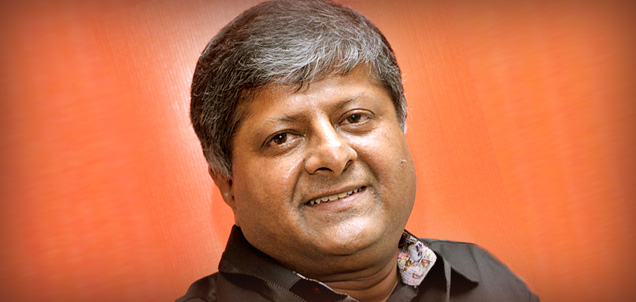
Shashi Sinha has done a lifetime in the business of advertising and media. It’s been an interesting journey for an engineer who went from selling booze to crunching complicated numbers. The CEO of Lodestar UM shares his views on many important issues, including media research, the demise of the full service agency, key challenges facing media buyers in today’s market and how he managed to restore some credibility in the creative awards. The 54-year-old, who’s usually soft-spoken and politically correct, candidly speaks his mind on this occasion. Media buyers and creative directors must pay close attention. He makes some very valid points.
By Anil Thakraney
You work for two companies?
I work for the Draft FCB group where I handle Lodestar. And recently I have taken charge of a creative agency called Interface. But my primary responsibility is Lodestar.
Whom do you report to?
I have dual reporting. I report to the Draft FCB Global CEO, Laurence Boschetto. On the Universal McCann side, I report to a gentleman called Jim Hytner who’s based in London.
Dual reporting is always a tricky thing…
It is tricky. Since they are sister companies you have to keep both masters happy. One of my strengths is getting along with people and ensuring that their objectives are met. I have been doing this for five years now. As long as the combined operation is successful, things are okay.
Cut to the past. What attracted you to advertising, when you were a sales manager with the UB group?
I actually came into advertising for the wrong reasons. I grew reasonably fast in the UB group at a young age and I was in sales there. But I wanted to migrate to marketing and that would have been an effort. Then a friend said to me I should work in advertising as I would get to work on many brands at one shot. And so I joined the ad world in 1986 and stayed on.
And you started out as an account planner in Ulka. How did media happen?
In those days planning was an unknown concept. Bal Mundkur used to run the agency at the time, and he thought planning was an airy fairy function, that it had lost steam. He asked me to do some ‘real work’. So I started doing odd jobs like running the financial advertising cell, selling sponsored prorgammes, etc. Later I shifted to client servicing. Along the way my interest in media grew. When the FCB guys decided to make India the regional hub, Anil Kapoor said the time had come for me to fully move to the media function.
Share an interesting memory of Bal Mundkur.
He had balls. Today our revenues and profits are huge and yet I would not take a decision which Bal took in the late eighties. The servicing team handling a large multinational client was very unhappy, they said they were being treated like shit. Bal wrote a six-page hand-written letter to the client explaining why the agency would like to part ways with them. When he told me about it, I was horrified. I asked him to instead change the team on the account. But Bal said, “No, it is a matter of pride.” (After some prodding Shashi reveals the name of the client. It was Glaxo.)
You are involved in many activities, you run the GoaFest awards, now you are heading the Ad Club as well. Â You have excess time on hand?
(Laughs.) I have enjoyed it for the last three years but it’s getting to me now. I believe when you take something on you must give it your best. I took on GoaFest last year because it was in a mess. So one had to get some credibility back, I had a point to prove.
I guess next year you would not want to do it.
I will definitely not run the awards next year.
Why has the Bombay Ad Club gone dead in the last few years? I recall they used to hold many events in the past.
You are right, it has ended up becoming an awards-only body. The regular interactions have reduced. The agenda for the future is to make it broad-based. The Delhi market has become very big and it’s a starved market. So we can collaborate and do things. As soon as GoaFest is over you will see a lot of action happening in the Ad Club.
Do you miss the days of the full service ad agency?
I do. In fact, I’ll let you in on a secret. I want to go back to the integration system with Interface, and the response I have got so far is very good. I genuinely believe that full service is the final solution. The best ideas come when you are sitting around the table.
Shashi, after all these years of happily running a media buying agency you are suddenly talking of integration.
One has been playing to a role. One is building the media agency, building one’s clients. But the best quality works happens in a full service agency.
And the media buying market has become like a sabzi mandi. How much fun can that be for someone who comes from the old school?
This is the unfortunate downside of globalization, global clients and global processes. Truth is that internationally advertising is not a hot profession any more, it comes way down the totem pole. Though in India it still has a pedigree, there’s some respect left. Ten years later it may not be there.
One super media innovation you are most proud of having effected.
It’s always teamwork so it’s embarrassing to say I did it. We have enabled many, but the one I am most proud of was for Nerolac Paints about five years ago. We took up a Mumbai local and deposited the shades onto the train. Nerolac deposited their paint on the outside of the train and made a shade card out of it. It was a wonderful idea.
How many years do you give the print medium in this country?
I can’t say about Bombay, Delhi and Bangalore, but as a country, print will be here for a very long time. The smaller towns are under-leveraged. Secondly, even if there’s internet access, there’s no power supply in these places. So how much can one use the computer, how much can one read on the mobile? If the time spent in Bombay on a newspaper is 15 minutes, for a town in UP it would be forty minutes. The entire family reads it.
Key challenges the buyer faces in a highly fragmented media market.
Everyone chases the rate game and how to buy it cheap. To me that’s stupid. For most of the organized media there are metrics in place to measure the media efficiencies. So in media terms how many consumers we’ve reached is all bull. The big challenge is to find whether that’s working for my brand or not. That, no one is able to answer.
That’s the media planner’s job. And the industry has killed the planner.
Correct. The problem is that the media business has become all about volumes, the business has become transactional. The planner today has become a zombie, a computer programmer.
How can the industry improve media research in this nation? There are too many question marks on television audience measurement and print readership studies.
Someone has to put money on the table, it’s as simple as that. The solutions are all known, I know very bright and talented people in research, what needs to be fixed is known. The problem is: No one is wiling to invest. Today, if television measurement costs Rs 20 crores, what if Rs 100 crores was spent on it? Or, for readership surveys, which cost Rs 4 cores today, what will happen if they had Rs 15 crores? So it’s nothing but lack of funds. Neither the newspapers nor the media agencies nor the clients want to put down that kind of money. And that’s the only problem.
GoaFest will be a sub-continental event this year?
This being a tough year, we’ll have to see how to bring Pakistan and Bangladesh in. We have to see how many of them will come, it’s early days yet so I don’t know the answers. We are also trying to get the clients in.
On the awards, how did you lick the problems of self voting and media leaks?
On the problem of self-voting, it was very simple, it didn’t need a very bright mind. We stopped the practice of raising hands during the judging, and they had to vote on a piece of paper. So if a judge voted for his own agency’s work, we would block that score.
You must be very disappointed with the creative directors who were indulging in this.
Yes, 110 percent. In the Effies, the majority of the judges are the clients. And they are not as desperate to win as the creative directors. Which is why the creative directors take short cuts. And as long as you allow short cuts to happen, people will get even more emboldened. As far as the issue of the leaks goes, we solved it from the media end, because it’s very difficult to nab the person who was doing it. I reached out to various people in the media and got a commitment from their senior leadership that they won’t do it. Also, the switch to secret voting format helped.
And yet, Lowe refuses to take part. Which means you still haven’t been able to crack the core credibility issues.
Balki has taken a position and his problems are beyond the purview of someone running the awards. I am just a process coordinator. If he says he does not like his peers judging his work, that he doesn’t respect them, I can’t do anything about it. I can only clean up the processes. But forget Balki, there are other people who have their own agendas for not entering the awards, they fire over the awards committee’s shoulders. Privately they’d say to me they don’t have a good enough body of work so they won’t take part. But their public posture would be very different.
Can’t you change the composition of the jury? Does it have to consist of creative directors?
I would definitely like to bring the clients on the jury. Perhaps 50 percent of the panel. But I have been told by creative directors that ‘these are our awards’. You must understand that one is running an industry association and there will be many voices. And so it’s like a democracy; I may have a point of view but there are nine other people voting.
One rival media buying agency head you admire.
Jasmin Sohrabji (Managing Director, OMD India). She is far younger than I am but I respect her for building something from the start. She’s built the company from scratch in the last five years, and she’s done a terrific job.
What are the future goals you’ve set for yourself?
I think there’s a huge opportunity in the content space. And one would like to do something that’s related to advertising. It could be digital or television content. We have taken some baby steps in that direction but haven’t been able to ignite it. In fact, I have told our global parents they should offer quasi-entrepreneurial opportunities to the team members. In the sense that people within the company are given pilot projects to run, in which they have some stake.
One big life regret.
It’s not a regret but sometimes I wonder if after completing my IIT I made the right decision to stay on in India. I had the opportunity to get a scholarship to do my MBA abroad, and I could have stayed on there.
Why? Don’t like working in India?
Nothing like that. But the scale of operations abroad is dramatically different. The quality of life is good out here, but one is a big fish in a small pond.
Click here to view all Goafest 2012 stories
 Buzz me if you have a story to tell and gossip to share. Confidentiality assured. Andar ki baat will stay under. There are various ways you can reach me: pradyumanm[at]mxmindia.com, BBM @ 23050B5D, Whatsapp/Gtalk pradyumanm[at]gmail.com, @pmahesh, 98338 76278.