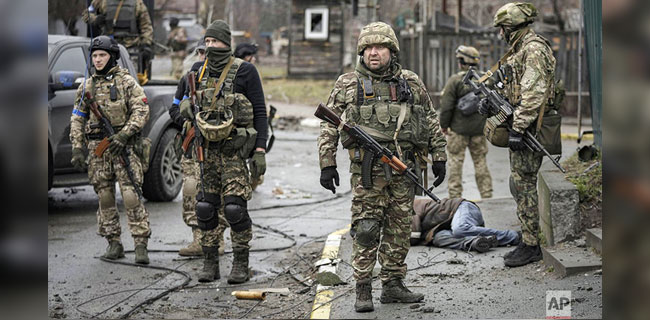
By James Rodgers
The media war that has accompanied Russia’s invasion of Ukraine has shown how important a part of 21st-century conflict journalism is, and also demonstrated the power authoritarian regimes possess to restrict reporting – even in the age of smartphones and social media.
In a move that echoed the draconian censorship laws of earlier ages, the Russian government declared its media war just days after it invaded its neighbour. New legislation meant journalists risked jail if they refused to follow dutifully the official line that the war was “a special military operation”, and not a war at all.
As the BBC director general, Tim Davie, said at the time, the legislation “appears to criminalise the process of independent journalism”. The BBC temporarily suspended its reporting from Russia, presumably while it sought to establish the real extent of the risk to its reporters.
Eventually, they resumed their work, with Steve Rosenberg and his colleagues bringing to international audiences stories such as that of Denis Skopin, a university lecturer in St Petersburg, sacked for his protest against the war. For The Guardian, Andrew Roth has also reported on anti-war activism, including the quiet defiance of those who mourn Ukrainian victims of the Kremlin’s war machine.
Many others, though, left – often when their editors felt it no longer safe for them to stay – and are yet to return.
Echoes of 1920s Bolshevik ban
What is in effect a ban on independent journalism may be seen as a kind of compliment: a testament to the power that reporters have to challenge the Kremlin’s justification for making war.
Combined with the inaccessibility of many international news websites and social media platforms since the start of the war, the effect is that reliable reporting from Russia is more restricted than at any time since before the era of reform and openness that characterised the late Soviet period.
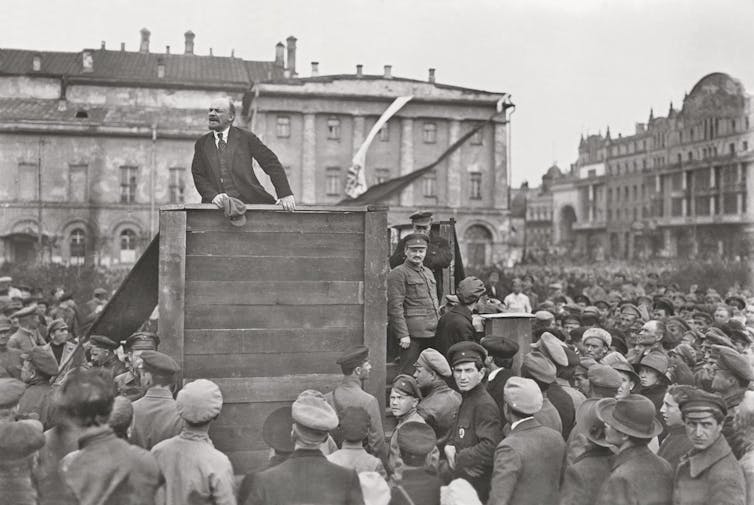 Controlling the message: Lenin was well aware of the power of the press as a tool of state control.
In fact, the situation today bears comparison with that of a century ago, when the fledgling Bolshevik government had banned international correspondents from Russia on the basis that their governments and newspapers had supported the wrong – the counterrevolutionary, “White” – side in the civil war. Then, as now by some correspondents, events in Russia were reported from Riga in neighbouring Latvia.
With the threats of punishment and prison, Russia’s approach to the media war has been crude – and also, in some respects, as explained below, effective.
Zelensky: consummate media performer
In others, much less so. Ukraine’s president, Volodymyr Zelensky, has shown great skill – and presumably drawn on his previous acting career –in using modern media and formats (his second world war “Victory Day” video, in which he drew parallels aimed at a Russian audience, between the second world war inflicted by Nazism and the invasion of his country, being a great example).
Zelensky’s surefooted and engaging media appearances have contrasted with videos of Putin that have prompted British tabloid speculation both about his health, and whether he is using actors in some of his TV appearances.
How Russia uses military and media in wartime
But if Ukraine is winning the war for western public opinion, Russia seems to be successfully shoring up public support at home.
This has been a long process. I visited Russia in 2019, for the fifth anniversary of the 2014 annexation of Crimea, and was struck by the prevalence of militaristic imagery and sentiment – not only in the news media, but in murals overlooking the streets of Moscow and other cities I visited.
This combination of media and militarism has been an indispensable, integral, part of Russia’s use of war in international relations in the Putin era, as my co-author, Dr Alexander Lanoszka, and I argued in our 2021 paper: Russia’s rising military and communication power: From Chechnya to Crimea.
The Kremlin’s biggest success has been placing 20th-century controls on 21st-century media. Yes, these can be circumvented. Russia is a highly technologically literate society (think how many incidents of hacking are blamed on Russians) and those who want to read news from the west can do so if they put in a little effort.
But many do not seem bothered to try. As Rosenberg discovered in a report for the BBC from Belgorod, not far from the Russian border with Ukraine, on February 10, official messaging seems largely to be taken at face value. “The west has always wanted to destroy Russia,” one resident of the city told him.
This is the stage which, 12 months since Russia’s large-scale invasion (Ukrainians will rightly point out that the war itself really began in 2014), the media war has reached. The rapid victory the Kremlin seems originally to have envisaged not having happened, the war has now been reframed – on the basis not only of Putin-approved versions of history, but also deliveries of western weapons to Ukraine – as a conflict between Russia and the west.
What next for the media war
Ukraine will need to keep international news organisations engaged. Zelensky’s speech in London on February 8 – that appeared so greatly to inspire the British parliamentarians who heard it – had to be on television and social media to have the desired impact, and for the visual gesture of handing over an airman’s helmet to make the desired impression.
There is one western policy that should change in the next stage of the media war, though I have little hope it will. The EU and the UK were wrong to ban Sputnik and RT. It gave them credit for greater reach and influence than they ever enjoyed. It allowed them the chance to masquerade – however absurdly – as martyrs for free speech. Western audiences need to see what Russian audiences are being told. In a media war, as in any war, the more you know of your enemy, the better.
As Vladislav Zubok, a professor of international history at the LSE, told me recently:
We still find even at the worst moments of the Cold War journalists talking to each other and acting as intermediaries. These people met. These people had a dialogue. Not any more.
That should change. One day this war will end, and the US, UK, EU and others will have to forge a new relationship with Russia. It is unlikely to be one of friendship – but even one accepting distance, division and discord can better be managed by the kind of dialogue of which journalism can be the starting point.
This level of mutual understanding must not be yet another casualty of this media war. Let journalists do their jobs.
James Rodgers is a Reader in International Journalism, City, University of London. This article is republished from The Conversation under a Creative Commons license. Read the original article.
 As we read this, over 300 brands from across the world have taken a stand against Russia since it invaded Ukraine. Some real big names like Apple, General Motors, Volkswagen, Levi’s and MasterCard have decided to halt/ suspend operations and shipments. Consultancy firms like BCG, McKinsey and Deloitte have taken a call. Even some Chinese brands like Bank of China and Tik Tok have joined the list. All non-Russian energy companies have moved away either like BP and Shell divesting their shareholding in Rosneft or ExxonMobil walking away from the Sakhalin 1 project.
