Tag: Uday Verma

  • 3-day informational event fulfils tryst with destiny, almost!

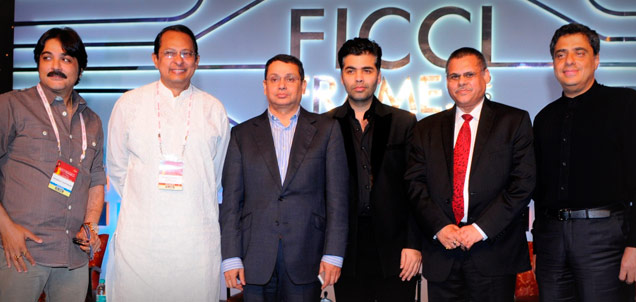
    Actor and Convenor, FICCI MEBC East Prosenjit Chatterjee, Bangladesh Information Minister Hasanul Haq Inu, FICCI M&E chair Uday Shankar and co-chair Karan Johar, I&B secretary Uday Varma and Ronnie Screwvala, MD, Disney UTV


    By Johnson Napier


    If there was ever a platform that was going to foretell the future that lay ahead for the M&E industry in a manner that was befitting, it had to be at the FICCI-Frames 2013. After an invigorating, insightful, challenging and forward-looking three days of deliberations, the biggest informational event for the M&E industry in India came to an elaborate end yesterday.


    While the day began with a series of interesting sessions that centred around topics like the economics of running a sports business, long versus short form of content consumption, skills in the M&E sector, unleashing the power of data, single window clearance for films, reinventing regional media and electronic news media among others, an equally power-packed panel of speakers made sure that the delegates had a lot to take away as learnings from the sessions.


    Perhaps the mood that was prevalent over the entire three-day event at the venue was summed up at the valedictory session on day 3 at FICCI-Frames. The session once again saw a line-up of dignitaries who had words of wisdom and promises to make to the gathering.


    Union I&B Minister Manish Tewari was not present at the event but shared a recorded message with the audience. Affirmed the minister, “The I&B ministry exercises various limits – we are licensors, we are players and stakeholders and are also regulators… so it’s a mixed bag of duty for us. But it’s incumbent upon the government to try and play the role of a facilitator and enabler in order to ensure the growth of this sector takes place at a more rapid pace than what it has witnessed over the past few years.”


    Highlighting his observations over the entire digitization exercise and the demand to do away with the hike in duty on STBs the minister said, “In the first phase we went through a digitization process in the four metros and what was observed was that the STBs are important from also a regional point of view – South East Asia. In order to give a fillip to the Indian manufacturers the Union Finance Minister therefore decided to hike the duty from 5 to 10 percent. So while a rollback is not possible we should see it in the perspective that we as a country also have a duty towards seeing that the other sectors are also benefited and a robust mechanism be established. To achieve success in the second phase across 38 cities all the players, stakeholders and MSOs and LCOs have to come together and make it a reality.”


    Adding further Mr Tewari said, “The other issue that had been highlighted was the issue of pricing of talent and that is something I feel has to be handled between the private-public players jointly. While the government has its own institute for providing training and other skill-sets it will take the combined efforts from the private sector to make that dream a reality.”


    Sounding a word of caution to the industry, Mr Tewari said that where the issue of freedom of speech and expression was concerned, it is something that is guaranteed by the Constitution but it also carries certain restrictions. “The challenge is to see how we can find the golden mean between liberty and the reasonable caveats that have been imposed by the Constitution. If you ask me the freedom of speech and expression does include the right to offend but we also need to ask ourselves the question – what about the remedy? As we unfold the debate further, it is worth that the industry also introspect that there is a distinction between a debate that is honest, candid and something which can be corrosive to the national spirit.”


    Next it was the turn of Ronnie Screwvala, MD, Disney UTV to put forward his predictions as he presented the keynote address. “Some of the good things that have happened in the recent past is the onset of digitisation that has had a huge impact on us. But I think we should hold on to popping the champagne as it will be another 2-3 years before the monetisation from this exercise comes about. So while we have made the investments, the consumer doesn’t necessarily reflect them. But it’s good news that after 20 years of waiting the move has finally come to fruition,” said Mr Screwvala.


    Adding further he said, “Where new media is concerned there is a lot to celebrate about, but unfortunately we have not been able to monetize it. The fact that we are going to be a 150-200 million smartphones market in less than two years, and the fact that large digital and mobile players look at this market as the second or third in the world is phenomenal. There is a need to take this growth further.”


    According to Mr Screwvala the future will belong to dominance from a single screen. “We all talk about the second-television household but that will become irrelevant as it is going to be our personal screen. We will be surprised to see how consumers from all corners of India wake up to using mobile as their primary source for entertainment. The issue is going to be of bandwidth and pricing,” asserted Mr Screwvala.


    Taking over from Mr Screwvala, Uday Verma, Secretary, I&B Ministry began by thanking the industry and the stakeholders for the response that was elicited for the digitization exercise. He said, “The digitization exercise has come about to be because of the alignment of the industry and the stakeholders. It was a difficult task but we are satisfied with what we have managed to achieve. It is something that has happened in a record time and has happened in a smooth manner. Also, it is something that has happened with no intervention from the government where cost is concerned; it has all been borne by the industry.”


    “Where Phase 2 is concerned the progress has been satisfactory with more than 60 per cent conversion having already taken place. There are 21 cities that have reported more than 50 percent digitization and about 10 cities have reported more than 75 percent digitization. There are just four cities that have been posing problems with a conversion rate hovering around 30 percent,” added Mr Verma.


    On the issue of measurement, My Verma said that the option of the industry making its own rating system is already there and the IBF is working hard towards making it a reality. “If there is a consensus that the government should intervene in this matter in terms of guidelines we can do so for the benefit of the industry.”


    Mr Uday Shankar, chairman of FICCI Frames summed up the proceedings by announcing the rollout of a Centre for Regulatory Excellence in collaboration with the industry. “This won’t be limited just to M&E but the entire corporate sector. It will also act as a facilitator in aligning corporate India’s objective with that of the goals of the government and policy establishments. We hope we receive active participation from all quarters.”
     

  • Govt may set up own body if it doesn’t see action on BARC by November

    By A Correspondent


    Even as I&B secretary Uday Verma met stakeholders of the three industry bodies who are setting up the Broadcast Audience Research Council (BARC) – the Indian Broadcasting Foundation (IBF), the Indian Society of Advertisers (ISA) and the Advertising Agencies Association of India (AAAI) – yesterday, MxMIndia learns from sources that the government is exceedingly upset with the delay and if it doesn’t see any action by November 2012, it may set up a joint government-industry committee to take things forward.


    Other than the collective pressure of the News Broadcasters Association, the NDTV case against TAM and its principals and Doordarshan’s own misgivings on the issue are among the compelling reasons why the I&B ministry is in a rush for the formation of the BARC. The government is aware that like in the case of content regulation, it would not like to play a role in the issue, however it believes that precious time has been lost. MxMIndia was told the pressure consumer/advocacy groups and Members of Parliament have also been asking for a look-in at the ratings process.


    While representatives of the IBF, ISA and AAAI have reassured the Secretary that all is well, the fact is that misgivings are still simmering given the recent charges that have been traded between the IBF and the ISA and AAAI.


    BARC was mooted way back in 2008 and the formation process had started in 2010, with an announcement on the setting up earlier this year – in March at FICCI Frames, to be precise. However, there have been stumbling blocks, all of which have been are said to have been cleared.


    BARC and consequently an all-new system of data collection could mean investment of around Rs 1000 crore, depending on the number of measuerement boxes to be installed. To start with, a CEO needs to be appointed as presently all stakeholders have their own business responsibilities, the demands of which are increasing with the festive season coming up.


  • @FF12: Text of Star India CEO Uday Shankar’s keynote

    Good morning.


    Senator Dodd, Secretary Uday Verma, Chief Minister Chavan, Prosenjit, Jehil and my dear friend Karan Johar, the remarkable team of FICCI that has organized this fabulous event, friends from media, ladies and gentlemen.


    A couple of years ago when I was asked by FICCI to take over the chair of FICCI Broadcast Forum, none of us had an exact idea of the timeliness of that decision.  FICCI was seized off the maturity and the size of Broadcast media and felt that the time had come for it to sharpen focus on this aspect of media and not merely treat it as an adjunct of films.  However the momentous changes that have happened in the Broadcast media landscape in the last 2 years clearly justify the wisdom of FICCI.


    I find a powerful validation of the significance of television and broadcasting in “Positivity” – a report by the IBF on the impact of television. IBF has gone ahead and spoken to our viewers – the key findings of the research are gratifying and humbling for the industry. I don’t want to give too much away, but must highlight two interesting results – Over 90% of our respondents believe that television is a source of encouragement and motivation and a similar percentage of women respondents believe that Television has given them the confidence to believe in the capabilities and potential.


    Gratifying as it may be, it is just the beginning. We are at the cusp of what is set to completely transform broadcasting in India forever.  I am talking about the universal digitization of television distribution.  This is a subject that has dominated all discussions at all forums in the last year and I presume will continue to do so for a long time to come.  But let’s pause a minute and recall what the discussion is centered around.  Most of the discussions that I have participated in are still around whether digitization will happen and if it indeed were to go through, how chaotic it would be.  With all humility may I suggest that it is a meaningless discussion triggered by a bunch of retrograde interests who are living in denial.  Let’s get some basic facts -The Cable Television Networks Amendment Act is not the beginning of digitization.  Digitization of distribution is a big reality and the 40 – 45 million homes that have bought DTH boxes at some point or the other are a conclusive evidence of that.  In fact as we speak, India may just have overtaken the United States as the world’s largest DTH market.


    What Minister Ambika Soni, Secretary Uday Verma and his team are doing is to create a structured, institutional framework for shaping this big social reality.  More than 25 crore people who have stated their preference for DTH over analogue cable have clearly spoken out that this country is now ready for universal digitization and the current move is merely to create a level playing field.


    So, to the critics and the cynics who are still wondering whether digitization would happen, my answer is: Look around, it is already happening and the rest of it is bound to happen because even in this country it would be difficult to undo such a momentous shift. To those who wonder how chaotic it would be, my response is that there would be some chaos, but chaos is not necessarily bad if the alternative is status quo or regression.  When a transition at such a scale is happening that affects the illegitimate but strong vested interest in certain pockets, then there is an incentive to put up with chaos in the interest of the larger social objectives.


    Actually my biggest concern now is a chaos of another kind that we are all set to create by our inaction.  Whether we like it or not, in a few years time, the vast majority of this country will receive its content through digital media – digital cable, DTH, 4G, wireless and internet.  But are we preparing for that? The answer is a big NO.  I worry that while we debate a digital future day-in-and -day-out we are doing nothing to transform or find business models for a digital world. Let’s face it – universal digitization is going to force us to change the way we do business and we are so not ready for it.  We often blame the cable operators and MSOs that they are not ready but I am afraid that even the broadcasters and the content creators are not ready for a digital world.  Are we then setting ourselves up to become uncompetitive and irrelevant?


    In case you think I am a scaremonger, let me ask a question – we all know how many people DTH services and now a large number of them have evolved services like HD, DOLBY sound and digital video recorder and yet what are we doing differently to service this segment?  DTH has been around now for about 6 years and is there one thing that we as broadcasters or the content community have done that we could point out as an example of a strategy to exploit the new technology?  This is despite an intuitive and an experiential understanding that the behavior and the consumption patterns in DTH homes are significantly different from analogue homes. The data also show that the average time spent on content in digital homes is much more and yet we do not treat them differently.


    It is perhaps scary how we have force-fitted an analogue broadcasting model into the digital domain.  Is that what we are going to do even after cable goes digital?  I am afraid if the past behavior is anything to go by, we are not ready to offer anything significantly different and therein lies the biggest crisis and risk of a chaos.  We have often spoken about how digitization would enable a multiplicity of niche channels to emerge.  Digitization of TV and even film infrastructure for that matter can revolutionize the way media is consumed in India.  There is enough global experience to suggest that digitization leads to de-centralization, regionalization or localization of content creation and distribution.  Creatively, it is a huge catalyst for innovation and diversity.  Essentially what it means is that with universal digitization the business models of broadcasting which are built on centralized creation and distribution of content and even a centralized advertising revenue model may come under a huge pressure.  I am proud to lead one of the finest media companies in this country and the world and yet I must confess that all of us have built our businesses in an environment where access to distribution was complicated, expensive and even impossible.  That is all set to change. So the big incumbent advantage is set to slowly, if not rapidly disappear. Socially, it is all very desirable because the plurality of this country is very valuable and digitization is a big catalyst for that plurality.  But, are we ready to re-tool our strategies and our businesses?  The cable community is still busy lamenting the potential loss of carriage fees not realizing what an amazing opportunity it has to participate in the local economic boom that is sweeping most parts of this country.  The first phase of digitization that covers the 4 metros will be a huge unshackling of broadcasting and content opportunities.  These are the cities that have crumbled under the weight of analogue frequency limitations.  Just imagine the opportunities that these metros also our economic hotspots present when, from the first of July access to frequency will no longer be a constraint.  So to my mind the MSOs and the cable operators may potentially become a powerful content creator that the traditional broadcasters have to contend with. There may be new creative talent ready to ride this technological transition.  As the subsequent phases roll on, the decentralization of broadcasting is bound to gain enormous momentum.  However, I don’t see anyone trying to race ahead to take a pole position here.


    Now let’s look at the content and the creative community that I myself am a part of.  But I am struck by our obliviousness to the opportunities and changes awaiting us.  Let me explain this with a slightly different example.  It’s been for a few years now that HD TV sets have been available in this country.  While many people were buying them, their off-take was still low primarily because there was no HD content and nobody was willing to invest in HD content because there were not enough HD consumers.  It was the classic chicken and egg problem.  However early last year, when we at Star launched 5 HD channels with DOLBY 5.1 surround sounds even we were surprised by the rapidity with which HD gained acceptance. Today, in less than a year there are around 25 HD channels. But, I have to admit with a touch of disappointment that I am yet to see an adequate recognition of the potential of HD and a superior sound possibility by my fraternity.  It is a classic case of the old mindsets struggling with a new technology.


    Are we going to stay locked into this struggle or are we going to create a new generation of television which would be designed for the digital world?  It will require all of us to change.  The creative and broadcasting community has to change their approach to content and the distribution mindset needs to change equally. If you are a cable operator or an MSO -  carriage fees is not the reason why you came into this business and people do not take a connection so that you can earn carriage fees. We are all in the business of delivering best television experience for the consumers and they will be happy to pay for it.  There is enough evidence that people want to consume content and lots of it – but they love it when it is customized to their taste.  Today there is an opportunity to do that and let’s put our heads together to take advantage of that opportunity.  Let’s determine what we require from the Government and the regulator. I have been an admirer of the current information and broadcasting dispensation which I think has shown more vision than any other dispensation in my two decades of interaction with the broadcasting establishment.  However, let me point out that we still need a lot of official and legislative enablers to remove the bottlenecks on this expressway.  For instance, a clear policy to enable multiplicity of beams and splits would be a powerful trigger for proliferation of content and revenue opportunities.


    I could go on.  But I would like to end by just reminding you of the latest Oscar success from Hollywood – The Artist – which is an amazing portrayal of how a talented and accomplished artist from the silent era could become completely irrelevant because he refused to see that the times have changed. Let’s not try to thwart a revolution which people are crying for.  We will only hurt ourselves.  The question is whether we will lead the change or whether we will vacate the space for a new set of entrepreneurs and visionaries who will replace us.  It is up to us to use it or lose it. Thank you very much.


    Photograph: Fotocorp