Tag: TV TRAILS

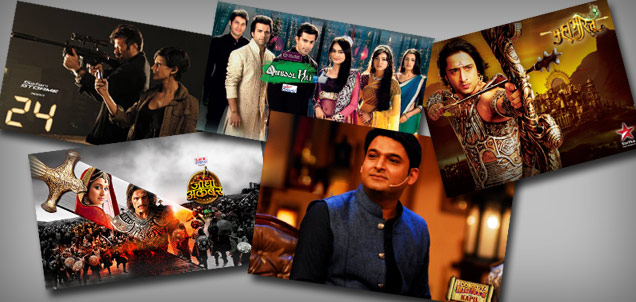
  • Top 5 Gamechangers on Hindi GECs in 2013


    By Shailesh Kapoor


    For the television industry, 2013 will be best remembered as the year of digitization. Similarly, we hope to remember 2014 as the year of a ratings system overhaul, with the industry shifting to the new system being developed by BARC. We are evidently in a period when technology and not content is emerging as the gamechanger.


    Yet, there were gamechangers that stood out on the content side in Hindi GECs too. Here’s a look at my list of Top 5 such shows. Established successful shows like Diya Aur Baati Hum, Saathiya and Balika Vadhu are not a part of this list, as their ongoing success is simply a continuation of what they promised in the last few years.


    5. 24

    The much-hyped 24 did not deliver high ratings. But it makes it to this gamechangers list for simply trying. As the Indian television market matures, we are bound to see fiction experiments beyond the regular family-based shows that currently rule the roost for the right reasons. When one such idea clicks, the floodgates will open. But 24 on Colors will always be remembered as the pioneer that brought this change. Here’s hoping for a more-Indianized second season.


    4. Qubool Hai

    Launched in late 2012, Qubool Hai scaled great heights of popularity in early and mid 2013, before losing some of the steam towards the end of the year. Driven by good casting that combined eye candy with solid performances, this Muslim social offered cultural variety, but with a contemporary and youthful treatment that had the college girls asking for more. Along with Sapne Suhaane Ladakpan Ke, it gave Zee TV a younger audience base that in turn helped the channel grow during the year, and sizably so.


    3. Mahabharat

    Star Plus challenged the status quo on production of daily fiction shows this year. After a rather half-baked attempt with Saraswatichandra, Mahabharat saw a real shift of scale. The show is easily the best-mounted fiction show ever in the history of Indian television. Its perspective on the epic tale is applause-worthy too, with considerable focus on the grey, than just the black and the white. Uneven pace and language comprehension issues may have limited its viewership in the early period, but the serial is now set for a creditable finish in 2014.


    2. Jodha Akbar

    Zee TV’s Jodha Akbar is a live case study on how to make a historical theme engaging by giving it a contemporary treatment. Story-wise, the programme uses the tried and tested elements of family and romantic dramas, exploited earlier to hilt in shows like Pratigya and Saathiya on Star Plus. It keeps the language simple, allowing for easy, fun viewing of what could have been an otherwise-overbearing show. Yet, the period look makes the show stand out in the crowd, offering the best of both worlds.


    1. Comedy Nights With Kapil

    This has to be a one-horse race if there ever was one. The success of Comedy Nights With Kapil on Colors cannot be measured by its ratings alone. Its consistently top-notch and flawless execution, combining fiction with live entertainment, has left me amazed episode after episode. How can you get something so right, I have often wondered. The show delivers two popular genres, which were beginning to look a bit jaded on television, in a refreshing avatar – Comedy and Bollywood.


    The comedy stays away from being crass or lowbrow at all times, yet manages to focus on popular culture and mass themes. The celebrity interaction is nothing we have seen before. It is audience-indulgent, not celebrity-indulgent. By now, it is common knowledge in the industry how celebrities aspire to be on the show and nervously prepare for it, so that they can match up to Kapil’s wit and timing.


    Comedy Nights With Kapil is the unifier show we have missed since KBC in 2000 – a show that various sections of the family and the society have an equal appeal towards. Thankfully, its success is not replicable, so we may not see too many clones coming out. Meanwhile, another 100+ delicious episodes await us in 2014.

     

  • Shailesh Kapoor: Care For A Drink? No We Are On TV

    By Shailesh Kapoor


    The anti-smoking infomercial that precedes film screenings is now an in-joke in the media industry. It can be argued that the government’s obsession with smoking shots in films, however passing, is not entirely misplaced. But the banal and utterly ineffective execution of the now-infamous Mukesh infomercial kills the idea.


    Television has no such problems. I just don’t remember when I last saw anyone smoking in an originally-produced Indian programme, fiction or non-fiction. Everyone is clean to the bone. Even when a teenage character goes astray and takes two puff of a cigarette to “try it out”, it happens off-camera, though the ensuing conflict may stretch over two weeks.


    Television’s take on alcohol is not very different. Yes, there have been shows where key negative characters are portrayed as alcoholics (including a sisters’ trio in Colors’ now-off-air Laagi Tujhse Lagan). But the stereotyping is striking. They are meant to be bad people because they consume alcohol. Or maybe they consume alcohol because they are bad people!


    Except Ram Kapoor and Sakshi Tanwar enjoying their drink in a couple of (and some of the best) episodes of Bade Achhe Lagte Hain, all heroes and heroines squirm at the idea of a bottle being anywhere in their vicinity.


    Television’s aversion to all things alcohol is a symptom of the traditional mindset the medium targets at large. And indeed, there may be merit in arguing for their case. In our research across markets, especially non-metros, discussions on alcoholism can touch raw nerves in the housewives community. Many of them face it as a real issue in their lives, where the husband, the father-in-law or the brother-in-law are spending disproportionate share of the household income on booze. And there is a direct linkage between alcoholism and domestic violence, as we all know.


    Of course, there is the other side of the argument too, which says that all television is not supposed to cater to middle-class housewives who face such real issues in their day-to-day lives. There is an audience beyond that: The urban elite, the youth, men and women in professional jobs, etc. But these characters are conspicuous by their absence in our serials anyway.


    Back in the early ’90s, Amita Nangia played the beer-guzzling Sheena in the much-popular Zee TV weekly Tara. But that was an era of less than 10 million C&S households, with most of them being upmarket metro audiences who were early adopters with a progressive mindset towards new ideas. As television has penetrated deeper, this audience segment has become far too miniscule to interest the broadcaster community. Even niche channels today are targeting SEC BC audiences in towns like Lucknow, Bhopal, Jaipur and Kolhapur.


    There are 41 alcohol scenes in Yeh Jawani Hai Deewani. But that did not deter the theatre-going Indians from making it one of the biggest box-office grossers in recent times. In fact, the casual presence of alcohol, albeit a bit overdone, made the film modern and cool in its own way, and that went well with the grammar of the film at large.


    I am most interested in seeing how the Indian version of 24, and the upcoming Amitabh Bachchan fiction show on Sony, handle “liquor” as an idea. In a country where having a glass of red wine can get someone to be labeled as a “sharaabi”, it will be good to see mass television influencing a few minds in the right direction.


    Shailesh Kapoor is founder and CEO of media insights firm Ormax Media. He spent nine years in the television industry before turning entrepreneur. The views expressed here are his own. He can be reached at his Twitter handle @shaileshkapoor


  • Shailesh Kapoor: What Do You Mean By ‘I Should Know Why I’m Doing This Campaign’?

    By Shailesh Kapoor


    They are omnipresent. They are on TV, in the newspapers, on the radio, on the hoardings, in the theatres, on Facebook, on Twitter. No matter where you go, a launch campaign of a new TV programme, a new TV property or a new (or being-presented-as-new) TV channel will find you out. Across just the national channels, more than 150 such campaigns of various sizes and shapes are executed every year in India.


    Everyone has a view on an ad: Bad ad, good ad, stupid ad, clever ad, and so on. It is natural then that TV campaigns are discussed with great interest in the media industry. “Did you see the promo of the new show on Colors”, “What do you think of the &pictures campaign”, “I really like the IBL promos on Star”, “Jee Le Zaraa looks interesting from the promos”, etc.


    One of the professional hazards of my work is that I invariably end up being dragged into these discussions. Either a question is posed to me, or an opinion is stated, more like a cue to respond with mine. Yes, like everyone else, I too have a view (sometimes a more confidential one, having “tested” the campaign in question). But I really don’t know what to say at most times, and my attention is focused on finding an escape route.


    The reason for my response is not diplomacy but something more direct and relevant to the idea of a “campaign” (or “ad”, for that matter) itself. Any campaign, across categories, should be designed to address certain sharply stated campaign objectives, i.e., the desired consumer messaging or response the campaign aims to achieve. Hence, the measure of a successful campaign is its ability to deliver on the campaign objectives successfully. Hence, how can one even begin to comment on a campaign without knowing its objectives?


    Many of us in the media cannot distinguish between a campaign that does not deliver to its objectives, and a campaign that is designed to meet wrong or strategically-flawed objectives in the first place. The latter is not a case of a bad campaign but a bad strategy. That’s a different discussion altogether. But invariably, the discussion gets mixed up and before we know, we are questioning why the brand even exists!


    But there is a bigger problem. Most campaign creators in television don’t even set objectives to start with. I have often tried asking the seemingly innocuous question: “What are the objectives of this campaign?” Some of the answers I have got, and I kid you not, have been:


    • To promote the show (as against promoting competition?)
    • To get eyeballs (you may as well have said “to make money”!)
    • To create awareness (rudimentary as it may be, it’s not entirely inane)
    • To create buzz (still more acceptable, given the ones above!)


    Recently, I met an MBA batchmate who is the brand head of a category in one of the leading FMCGs in India. As I shared my predicament with him, he looked wide-eyed and reasonably speechless, before gathering the courage to say: “I would have been sacked for saying any of that even in my first year of work!”


    Setting campaign objectives is not an easy task. It requires discipline and debate. In the earlier working model, ad agencies would own the brand and drive this area. Today, the strategy is reasonably scattered across functions: the brand team, the ad agency, the media agency and the research partner. Yes, there are some channels that are objectives-oriented in their approach towards some campaigns, but those are case studies that are far and few in between.


    Next time you have a big campaign coming up, try defining what you EXACTLY want the campaign to achieve. The answer may not be as easy as you think, and like it’s often the case, the God may lie in the detail!


    Shailesh Kapoor is founder and CEO of media insights firm Ormax Media. He spent nine years in the television industry before turning entrepreneur. The views expressed here are his own. He can be reached at his Twitter handle @shaileshkapoor