Tag: Tushar Vyas

  • GroupM forecast for 2022: 22.2% AdEx growth


    By Our Staff


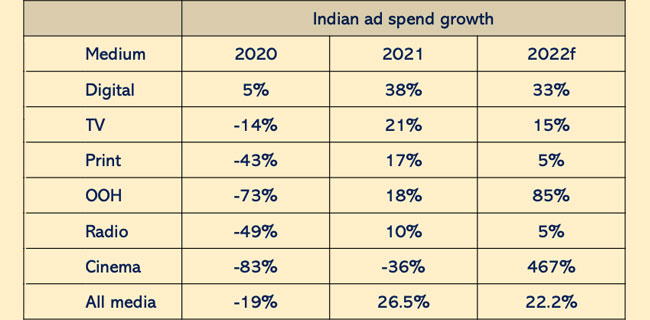
    WPP-owned media investment conglomerate GroupM has  announced its  advertising expenditure (AdEx) forecasts for 2022. As per the GroupM futures report ‘This Year, Next Year’ (TYNY) 2022, the adspends are estimated to reach 107,987crs in 2022. This represents the estimated growth of 22% for the calendar year 2022. India will be the fastest-growing market among the top 10 global markets and retains its 9th rank in 2022, as per the report. See GroupM TYNY2022 deck.


    Commenting on the TYNY 2022 report, Prasanth Kumar, CEO, GroupM South Asia said, “The pandemic has pushed the envelope towards digital and has hence topped the pie, with advertisers keen to explore more of it. Ecommerce and Telco will drive the economy, we also expect FMCG and auto to slowly catch up and contribute towards this growth.”


    Added Tushar Vyas, President – Growth and Transformation, GroupM South Asia: “With the pivot to digital by consumers and companies alike, digital emerges as the largest medium in 2022 with an estimated share of 45%.  Digital is estimated to grow by 33% in 2022. As digital capabilities enhance and connectivity becomes omnipresent, technology will further poise and change almost every sector of India’s economy.”


    Said Parthasarathy Mandayam, Chief Strategy Officer, GroupM South Asia: “With consumers gravitating towards themes like sustainability and sensitivity, brands are adapting rapidly, and media has the power to lead this change. Flexible, specialist and distributed teams are the order of the day and this trend will be further enhanced with the arrival of 5G. The emphasis on performance marketing has further accelerated and is at the very core of marketing. Intelligent & responsible leverage of first-party data will be critical for brands & marketers in driving this.”


    Said Atique Kazi, President – Data, Performance & Digital Products, GroupM India: “Marketers will have to bring together innovation, intelligence and integration in their strategy to win on Digital. In 2022; we will also see addressable TV coming to India in some scalable form and connected tv surge with smart TV sales and new fibre/broadband connections will be on the rise. Focusing on eCommerce, performance marketing, outcome-based media and addressable data is winning formula in 2022.”


    Added Sidharth Parashar, President – Investments & Pricing, GroupM India: “While digital is set to take the larger pie, we are expecting a noteworthy revival for OOH & cinema too after a tough period. Advertising on e-commerce, the rise of influencers and short format videos along with OTT has witnessed growth in 2021, which would continue in 2022.”


    Said Ashwin Padmanabhan, President – Partnerships & Trading, GroupM India: “The rapid digital transformation of companies, brands and the way they connect with consumers is reflected in the global advertising spends as well as the way even traditional media is expanding with their digital extensions. India in 2022 will see a rapid manifestation of these Global trends and thus fundamentally altering the media industry.”
     

  • MMA, GroupM & Amazon advertising launch festive season playbook

    By Our Staff


    MMA, GroupM and Amazon Advertising have launched the ‘Decoding Consumer behavior and Winning the 2021 Festive Season Playbook, a handbook for marketers on expected consumer sentiment along with recommended strategies for Diwali this year.


    Said Tushar Vyas, President – Growth and Transformation, GroupM South Asia: “Digital influence in consumer journeys has increased significantly while the e-commerce adoption has accelerated in last 18 months. Hence, Digital is no more a support media platform but is core to media plans.  Ecommerce platforms offer brands the opportunity to hand-hold consumers across the purchase funnel by not only aiding in active/passive brand discovery but also in closing the loop by measuring performance objectively. This playbook contains several key insights and is a must-read for any marketer who is planning for the festive season.”


    Added Vijay Iyer, Director-Ad Sales, Amazon Advertising India: “Digital is a part of our lives now like never before and the influence is only increasing. Ecommerce portals act as gateways to this world that we are so quickly embracing and are playing a crucial role in brand and product discovery. For marketers, this presents an unprecedented opportunity – to be able to identify and leverage customer intent at an unprecedented scale. This playbook will help brands in not only sharpening their online strategy, but will redefine how they measure and drive business outcomes.”


    Moneka Khurana, Country Head, MMA India commented: “MMA is proud to have co-authored the white paper in collaboration with GroupM and Amazon Advertising to provide the much needed insights and guidance for the upcoming festive season for the ecosystem helping brands navigate the challenging times and drive optimal visibility and performance . 76%of marketers mentioned they will be allocating more spends for digital as compared to last year. Hence it’s key to understand omnichannel users better in the changing times as we continue to drive the narrative of shaping the future of marketing.”


  • 62% of urban Indian Net users research for products online


    By Our Staff


    GroupM along with Amazon Advertising India, have launched a Search Advertising playbook titled ‘Decoding the shift in consumer behaviour to win on search’ with a report on search consumer journeys and how consumers are leveraging online platforms for not only buying products but also for holistic product research.


    Notes a communique: “Over the past year, consumer behaviour and purchase patterns have seen a drastic change. Urban consumers have started conducting their product research thoroughly before making any purchase online or offline. The playbook indicates that urban consumers are researching on at least two platforms before making up their mind while Amazon.in is has emerged as a preferred platform for product research. Around 62% of urban internet users research for products online, before making any online or offline purchase; 52% of urban internet users who research online, visit amazon.in to research products before making an online or offline purchase.”


    Online product research influences offline sales since 50% of offline shopping across categories involves prior online product research.


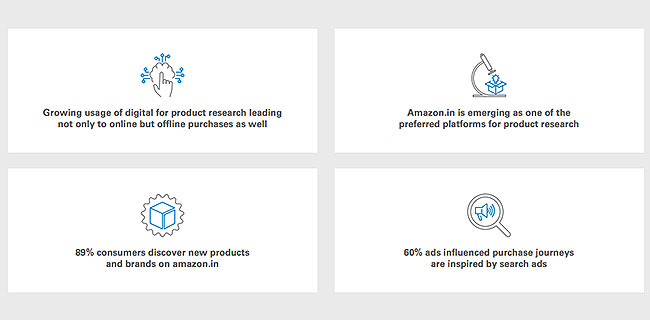
    A few takeaways from this playbook are:

    • Growth of digital for product research before making purchase decisions

    • in is emerging as one of the trusted brands for product research

    • 89% consumers discover new products and brands on in

    • 60% ads influenced purchase journeys are inspired by search ads


    Said Tushar Vyas, President – Growth and Transformation, GroupM South Asia: “The last year has seen a rapid shift in purchase decision making and channel preference for purchases with more consumers now researching and purchasing online. This trend is only accelerating with not only metro consumers but consumers from smaller cities and towns. Furthermore, the role of e-Commerce platforms in the purchase funnel is undergoing a change with more consumers relying on them from a product research point of view. With most of these behaviors set to only accelerate in the coming years, we at GroupM will continue to prioritize and focus on creating knowledge and bringing forth solutions to our clients to effectively navigate this ecosystem.”


    Added Vijay Iyer, Director-Ad Sales, Amazon Advertising India:“With the drastic increase in media consumption, online and eCommerce platforms have become the go-to destination for urban consumers to make a product and brand choice before making a purchase online or offline. The search environment provides brands the opportunity to reach ‘intent’ consumers and create awareness in the early phase of the purchase journey. Native search advertising formats aid in establishing a seamless connection with researching audiences. This playbook aims at helping brands understand the behavioral trends with respect to consumer demand and discusses recommended strategies to drive awareness and performance on amazon.in”


    The playbook can be downloaded here.


  • Achche Din… GroupM forecasts 23.2% in CY2021

    GroupM share of adspend


    By Our Staff


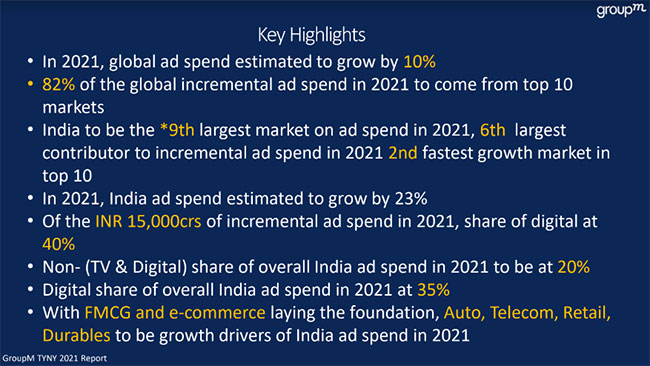
    GroupM India has announced its advertising expenditure (AdEx) forecasts for 2021. As per the GroupM futures report ‘This Year, Next Year’ (TYNY) 2021, India will see a major ad recovery in 2021 given the downfall of ad spends in 2020 due to the pandemic.


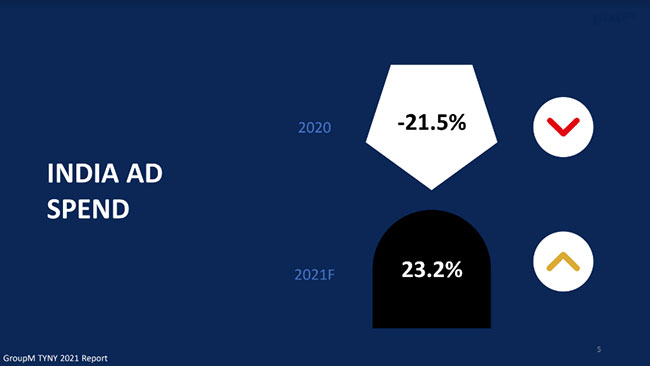
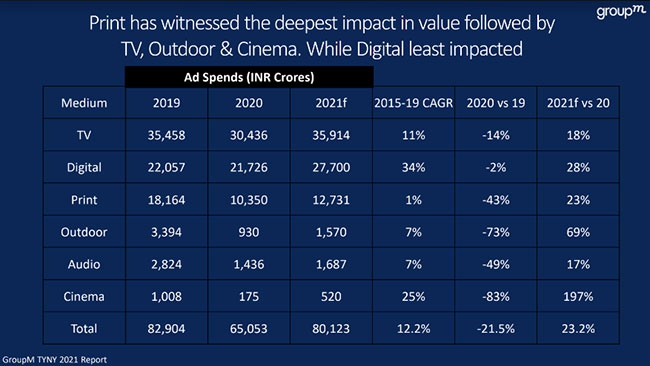
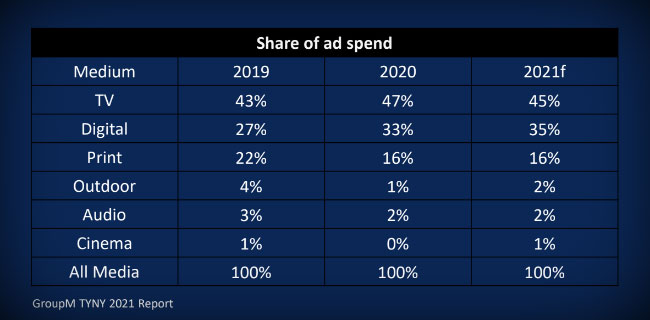
    TYNY forecasts India’s advertising investment to reach an estimated Rs. 80,123 crores this year. This represents an estimated growth of 23.2%, for the calendar year 2021. India is the 2nd fastest growing market in the top 10 countries and will be the 6th largest contributor to incremental ad spends in 2021 globally. While India was ranked 9th in the global ad spend rank in 2019, it dropped to 10 in 2020 and is likely to regain its 9th rank this year.


    Prasanth Kumar, CEO - GroupM South Asia
    Prasanth Kumar

    Commenting on the TYNY 2021 report, Prasanth Kumar, CEO – GroupM South Asia said, “2020 was an unprecedented year. The pandemic impacted across sectors and it, therefore, affected the media investments too. As we are aware, the year that went by had a mixture of lockdowns, many restricted market momentum and overall threw a challenge and impacted multi-industry economies. The ad industry too had its challenges and 2020 witnessed a steep drop in the overall media investments. However, we have witnessed a month-on-month upturn in the industry starting Q3 last year and we are quite optimistic about the revival that 2021 will see. With the gradual easement of the lockdown backed by seasonal spends and big-ticket events like IPL, we expect 2021 to continue to build on that momentum. While the global ad spends are estimated to see a rise of 10% in 2021, digital is expected to take 67% of ad spends. With the help of technology, marketers have adapted to pandemic-proof ways by constantly innovating, staying relevant and offering digitally charged solutions to brands.”


    Digital was the only medium to witness a gain of USD 27bn globally in 2020. Digital as a media vehicle will continue to skyrocket due to the increase in digital dependency and changing consumer patterns.


    Tushar Vyas, GroupM
    Tushar Vyas

    Added Tushar Vyas, President – Growth and Transformation, GroupM South Asia: “2021 will see 90% incremental ad spends on digital globally. The massive switch to digital reliance over the past 1 year has been a major driver for this shift. Brands have been forced to think big and different to transform their businesses, match the newer expectations and overcome the challenges faced. The post-pandemic era will continue to see this upsurge in digital demands. The crisis has brought about a sea change in mindset, adoption, and role of technology in doing business. Brands are seen renewing their business models and are constantly ideating to find better ways to connect with the consumer on a digital tangent.”


    Ashwin Padmanabhan
    Ashwin Padmanabhan

    While Covid-19 resulted in an overall slowdown in the global economy, Indian adspends will continue to see a month-on-month recovery considering the overall media landscape. Said Ashwin Padmanabhan, President – Partnerships and Trading of GroupM India: “Based on a strong foundation built on the back of FMCG and e-commerce, 2021 is expected to see growth across sectors like auto, telecom, consumer durable, retail and education. Manufacturing, which was severely impacted by the pandemic, is now stabilising and moving toward a positive outlook enabled by automation, technology and supply chain optimisation. 2020 has accelerated the adoption of agile, cost-effective business models, which will help brands and marketers offer better products, services and experiences to consumers.”


    Sidharth Parashar, President - Investments and Pricing, GroupM India
    Sidharth Parashar

    Added Sidharth Parashar, President-Investments and Pricing of GroupM India: “Along with digital, television saw a spike in consumption during the lockdown. With acceptance on the subscription bandwagon increasing, OTT will continue to witness a constructive growth and is likely to develop with more players attracting users by investing in content. Print & Radio expected to be backed by local advertisers and certain categories with marketeers leveraging the brand solutions that these media offer. We expect OOH and cinema to see double-digit growth after a difficult year. Given the uncertainty and cautiously spending consumer, brands are realising the importance of being present wherever consumers are. Hence along with continued relevance of television & other mass media, we will witness advertisers leveraging relevant platforms to reach out to its audience.”


    GroupM TYNY Key Highlights

  • A Roller Coaster Ride of Adspends


    By Indrani Sen


    It appears from GroupM’s This Year Next Year (TYNY) 2020 report that the Indian ad Industry is on a roller coaster ride in spite of the slowdown in certain sectors of the manufacturing industry and hits and misses in agriculture during 2019. Prasanth Kumar, CEO – Group M South Asia expects sustained and stable investment across the media in India in 2020.
     

    GroupM predicted in TYNY 2019 that the World AdEx will grow by 3.67% from 2018 to 2019 and the Indian AdEx will grow by 14%, higher than the CAGR growth of the previous four years. In TYNY released last week, GroupM has estimated that world AdEx grew by 3.7% from 2018 to 2019, but Indian AdEx grew by only 9% against the earlier estimated growth of 14%. However, there was no comment on the drop of growth rate in the press release issued by Group M.


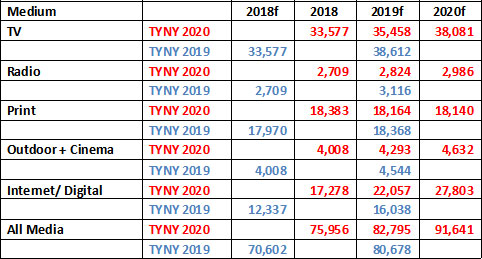
    I initially thought that probably the drop in the growth rate of adspend was due to the slowdown in the industry, but a closer look at TYNY2019 and TYNY2020 statistics showed that upward revision of the estimate of the total adspend in India in 2018 led to lowering of the growth rate from 14% to 9%. A comparison of the two reports is shown in the following table.


    Indian Adspend (INR crore)


    It is interesting to note that the forecast for 2018 for Digital as shown in TYNY2019 was increased by 40% in actual adspends of 2018 shown in TYNY 2020. Estimate for Print was also increased marginally while all other estimates remained the same. These changes in Digital and Print adspends resulted in an overall increase of total ad spend from 70,602 crore to 75,956 crore in 2018. GroupM should have added an explanatory note in their press release to warn the users of TYNY about these changes in their estimates as reflected in TYNY 2019 and TYNY 2020.


    As per TYNY 2019, India was 10th largest market in adspends in the world, the 3rd highest contributor to incremental global ad spends and the fastest growing major ad market in the world. In TYNY 2020, India continues to be the 3rd highest contributor to incremental global adspends and the fastest growing major ad market in the world and has come up to 8th position in the list of largest markets by ad spends by beating Canada and Australia. In 2020, adspends in India is predicted to grow by 10.9% against a global growth of 5.1% in adspends.


    According to Kumar, Digital would garner 65% of incremental ad spend in India in 2020. Tushar Vyas, President Growth and Transformation – GroupM South Asia further commented: “There are multiple advancements happening in technology which is transforming digital advertising and other mediums. India being a diverse country, digital will keep growing, especially with the rise of content platforms and its availability in multiple languages powered by the growth of 3Vs (video, voice and vernacular)”.


    In conclusion, I agree that Digital media has gained its own momentum of growth in India and most advertisers do not want to miss out on the opportunities offered by the new media. Slowdown in certain sectors of manufacturing industry is unlikely to affect the investment in digital advertising in particular which would be the engine of growth in ad spends in India in 2020 as predicted by TYNY 2020.


  • 10.7%: GroupM forecast for AdEx 2020


    By A Correpondent


    GroupM formally announced its advertising expenditure (AdEx) forecast for 2020.  As per the GroupM futures report ‘This Year, Next Year’ (TYNY) 2020, India will continue to top the list as the fastest-growing major ad market in the world. TYNY forecasts India’s advertising investment to reach an estimated Rs. 91,641 crores this year. This represents an estimated growth of 10.7%, for the calendar year 2020.


    India will continue to be the third-highest contributor to the incremental ad spends, only behind UK and USA while China drops to the fourth spot and the eight fastest-growing country with respect to ad spends across the globe.


    Commenting on the TYNY 2020 report, Prasanth Kumar, CEO – GroupM South Asia said: “We expect the global AdEx to grow by 5.1%. The Indian media landscape is constantly evolving, will continue to witness the fastest growth of 10.7% to reach Rs 91,641 crores. While we expect sustained and stable investment across media in India, Digital to garner 65% of incremental ad spends in 2020. In 2020, India faces challenges and uncertainties across sectors just like other markets. However, this also brings opportunities for brands to innovate because of which we see an evolving media stack. This will be propelled by greater use of technology and better content across media.”


    Digital secures #2 position as the most used media vehicle and is estimated to reach 30% of adspend in 2020 with growth coming from 3Vs (video, voice, vernacular-Indic) and advertising on e-commerce. The growth of digital is set to soar high because of changing consumer habits.


    Added Tushar Vyas, President Growth and Transformation – GroupM South Asia: “There are multiple advancements happening in technology which is transforming digital advertising and other mediums. India being a diverse country, digital will keep growing, especially with the rise of content platforms and its availability in multiple languages powered by the growth of 3Vs. From a predominantly ‘at home’, ‘urban’, ‘English print’ & ‘TV’ consuming market, the Indian media consumer evolved to include ‘on the move’, ‘rural’ & ‘regional’ counterparts, experimented with digital media in the early 2010s’, adopted social media in middle of the decade and started consuming digital videos voraciously after 2016.”


    Even with an overall slowdown in the global economy Indian media spends are expected to be between low to moderate in H1, with robust growth anticipated in H2 2020.


    Said Sidharth Parashar, President – Investments and Pricing of GroupM India: “The format of print storytelling is changing but the content is still the strongest. With print media organizations undergoing transformation across India. Publication houses have invested heavily in promoting digital subscriptions and have started limiting access to digital versions of epapers. We believe that this would pave the way for newer business models. Print will continue to remain relevant to advertisers wanting to build credible brands. Television will continue to grow at a steady pace. This year, the growth rate for TV is estimated to be 7% and Radio is expected to grow at 6%. While cinema and OOH will grow at 15% and 6% respectively in 2020.”


    OTT has seen a faster evolution in India, which is now complementing television. OTT hybrid models looking at both advertising and subscription will continue to be an effective model.


    Speaking on the trends for the year, Ashwin Padmanabhan, President – Partnerships and Trading of GroupM India said: “While there are challenges and uncertainties in the market, it is a world of abundant opportunities in the content eco-system. This gives us vibrant options to reach and engage with consumers. It necessitates us to be agile, invest in new-age talent and technology while keeping an eye on the future. The key is to be always prepared while we are shaping the media landscape.”


  • GroupM & Lifesight launch online-to-offline attribution playbook

    By A Correspondent


    GroupM India and Lifesight, a Bengaluru-based location intelligence platform and data company, have co-created a playbook answering key questions advertising clients have on online to offline attribution and outlining ways in which marketers can use intelligence on consumers’ online behaviors to impact offline sales. This, claims a communique, is the first-of-its-kind attribution study in India with examining the conversion of online ads into offline sales.


    Said Tushar Vyas, President – Growth and Transformation, GroupM South Asia: “The importance of omnichannel strategies has grown exponentially, and the lines between online and offline have begun to blur. Given that the consumer journey between online and offline is becoming seamless, it is critical to have the right technology to manage location data and location-based attribution models to provide better insights to clients. For a marketer to understand what’s working in their campaigns, it is important to attribute the right conversion to its apt source. At GroupM, we understand the constant need to create, invent and reinvent the right measurement frameworks to help our clients address their business problems.”


    In 300+ campaigns run through Lifesight, with over 200 brands, there were some interesting insights discovered:


    1} The average costs to drive in consumer footfall is the most for Consumer Durables and the Auto sector and the least for Quick Service Restaurants (QSR) and Fashion.

    2} Offline attribution works best for Auto and QSR since most people would visit a physical store

    3} The Retail sector takes the least time (2-3 days) to drive a walk-in from exposure. On average, it takes approximately 6-9 days across verticals to drive store walk-ins

    4} 70% of the initial walk-ins to physical stores happens within the first 8 exposures. Retail takes the least number of exposures while fashion requires the most.


    Added Tobin Thomas, Co-founder and CEO of Lifesight: “Marketers today have unlimited options for building, targeting, and delivering a campaign. But even with all these options, one question remains- is my advertising working? With a large number of channels to choose from, it’s imperative to understand how each campaign component performed comparatively. As a result, location attribution has emerged as a powerful solution to stitch together channel, audience, and platform signals to understand reactions to online advertising in the real world.


    “Lifesight is leading efforts to take campaign success metrics beyond the click. We are excited that leading a marketing powerhouse like GroupM have joined us at the forefront of online-to-offline attribution.” Tobin Added


  • GroupM forecasts 14% adspends growth


    By A Correspondent


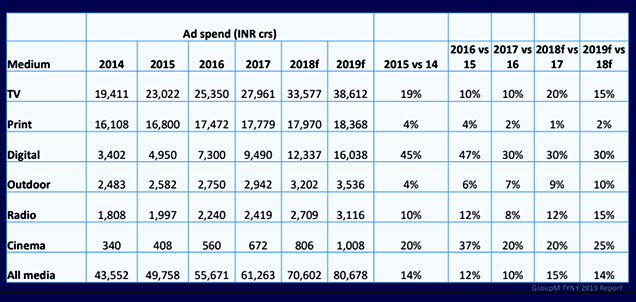
    GroupM, the media investment group of WPP, announced its advertising expenditure (AdEx) forecasts for India for the year 2019.  As per the ‘This Year, Next Year’ (TYNY) 2019 report, India tops the list as the fastest growing major ad market in the world. TYNY forecasts India’s advertising investment to reach an estimated Rs. 80,678 crores this year. This represents strong estimated growth of 14%, for the calendar year 2019 (approx 2x of the GDP growth).


    India will be the third highest contributor to the incremental ad spends, only behind China and USA and the tenth fastest growing country with respect to ad spends across the globe.


    The Cricket World Cup and Elections in 2019 are expected to boost adspends. FMCG, Auto, Retail, e-commerce, Tech/Telecom are expected to contribute to 2/3rd of the AdEx. According to GroupM, the special events of the year (World Cup Cricket and Elections) will add around 3 per cent to the 11 per cent organic growth forecast for the year.


    Speaking on the TYNY 2019 report, Sam Singh, CEO – GroupM South Asia said: “While we are estimating the global advertising expenditure to grow at 3.6%, India would be witnessing the fastest growth at 14% and reach an estimated Rs.80,578 crores. This would be approximately 2x of the estimated GDP growth in India. This also makes India the third largest adex growth to the worldwide ad spends. We expect sustained and stable media investment growth across categories in India”


    This year 37% of incremental ad pends will go towards digital advertising including mobile. The scale at which we are witnessing this digital transformation, GroupM estimates the Digital Adex to continue to grow by 30% in 2019 to Rs. 16,038 crores.


    Added Prasanth Kumar, Chief Operating Officer – GroupM South Asia: “Indian adspends CAGR between 2014-2018 is at 13% and 2019 expected to witness a higher growth. India is unique among key markets and will witness growth in all media segments and not just digital. Offline media is poised to continue to grow and will contribute to being around 80% of ad spends in 2019.”


    Television will continue to grow at a steady pace. This year, the growth rate for TV is estimated to be 15%.


    Print is estimated to grow by 2.2% and the share of print to all media is expected to be at 23%. While it is expected for both English and regional languages to grow, regional will see slightly higher growth. Vernacular will continue to thrive on both TV and print.


    This year radio is expected to grow at 15% which is higher than the last couple of years. Cinema will grow at 25% in 2019, as 2018 saw more titles winning audience at the box office. In 2019 GroupM expects cinema to shift from title-based advertising to continued advertising through the year. Lower tax on cinema tickets is expected to drive more footfalls to theatres.


    GroupM also presented some of the biggest trends that will shape the media Industry in India in 2019. The trends presented were around emerging technology, data, content creation and distribution put the consumer at the center and underline the theme of digital driving the change across all formats of media. The trends touched upon the TRAI tariff order implementation as well its potential impact of increasing original programming and investments on content across broadcaster networks.


    Said Tushar Vyas, President Growth and Transformation – GroupM South Asia: “With the surge of technology, better insights and relevant engagement across different platforms, we are expecting marketers to build superior consumer connections for brands. 2019 will witness a faster growth in digital and we are expecting digital to be at 20% media mix. As we are witnessing one in every three Indians digitally connected, we can expect the convergence of data, digital and content to deliver seamless and powerful solutions to brands as well as constantly adding inventive practices into the market.”  ESP Properties head Vinit Karnik also spoke on the occasion.


    TYNY 2019 Media Handout

  • On R-Day eve, GroupM rejigs top deck


    By A Correspondent


    Okay, the Republic Day reference was just for effect. It’s just a coincidence. Also, the news has been doing the rounds for a bit.


    After announcing a new CEO in Sameer ‘Sam’ Singh last year, GroupM South Asia has announced a significant restructuring in its leadership. Effective immediately, Prasanth Kumar (PK) is named Chief Operating Officer, South Asia, and Tushar Vyas is named President Growth and Transformation, South Asia. Both are new roles in the organisation, notes a commuique.


    Meanwhile, Parthasarathy Mandayam (Maps) is named Mindshare’s CEO for South Asia and Amin Lakhani is named Mindshare’s Chief Operating Officer in South Asia.


    Now here’s what the communique adds:


    As Chief Operating Officer, PK will be responsible for operational excellence, i.e. ensuring client expectations are reliably met by continuously improving processes ensuring clients are successful today. He will guide and lead the teams across OpCos, Trading and Specialised Units to execute the same more consistently and reliably to drive client delight while fortifying partnerships.


    Most recently as Mindshare’s CEO, PK oversaw Mindshare’s rapid expansion in the market, bringing it to a market-leading position and winning numerous global awards. During his tenure, he developed a record for the most number of new business wins by a single market and created a tradition of external accolades, including a Glass Lion at Cannes, a Grand Prix at WARC and an average of over 250 external awards per year. Mindshare India was also recognized globally as #2 in the Gunn report. Prior to Mindshare, he led the GroupM Central Trading Group across South Asia and championed exciting partnerships in digital and traditional media.


    Tushar Vyas will take over the role of President Growth and Transformation. In his new role, Tushar will drive digital transformation and focus on building GroupM wide capability focusing on Digital, Data, Analytics, and Content, and working across GroupM to ensure our clients are ahead of the curve for tomorrow.


    Before taking over his current role of the Chief Strategy Officer at GroupM, Tushar launched the Digital Media Agency business unit (Interaction) for GroupM India and built a 600+ member team by expanding services in areas like content, search, programmatic buying, mobile, digital activation, social insight and digital analytics. Today, GroupM’s digital media practice is the largest digital media solution provider with more than 500+ active clients. Under his leadership, the digital practice was a regular at all the major digital and media awards. He was also part of SureWaves start-up team focused on Media technology.


    Speaking on the new appointments, Sam Singh, CEO, GroupM South Asia said: “PK and Tushar are passionate leaders with high integrity and proven ability to envision and deliver successful outcomes in a challenging environment. As we become a more data-centric organization, there is a need to drive transformation and build future capabilities with a focus on Digital, Data, Analytics, and Content. We must work across GroupM to drive organizational transformation and operational excellence. The new team structure is another step in this direction.”


    He added, “I am also sad to announce that Lakshmi Narasimhan, our Chief Growth Officer for GroupM South Asia, has decided to step down from his current role effective January 31, 2019, to pursue personal interests. I thank him for his contributions over the years and wish him all the best. We will miss him as we continue to build upon his hard work and passion. Lakshmi was instrumental in building our strong trading community with solid practices”.


    Parthasarathy Mandayam (Maps) will take over the role of Chief Executive Officer(CEO) of Mindshare, South Asia effective February 1, 2019. Maps takes on the role from PK, who will be moving to his new role within GroupM.


    Maps has spent 10+ years with Mindshare in various leadership roles – Data, Insights, Analytics, Strategy, Client Leadership and Business Unit leadership. He will report into Sam Singh, CEO GroupM, South Asia, Prasanth Kumar – COO – GroupM South Asia and Amrita Randhawa, CEO Mindshare Asia Pacific.


    Going forward, Amin Lakhani will take on the role of Chief Operating Officer (COO) for Mindshare South Asia.


    Lakhani has over 20 years’ experience in various roles in Mindshare and GroupM and is currently leading Client leadership at Mindshare. He will continue to be based out of Mumbai.


    Talking on the latest developments, Prasanth Kumar, the new GroupM COO, said: “Our industry is an ever-mutating one, so we have to also continue to evolve and adapt. With Maps and Amin now at the helm of Mindshare, we have leaders with a proven track record of consistently achieving clients’ business goals. They will continue cultivating client relationships at the highest level and delivering great results.”


    With investment in data, technology, and diverse talent, GroupM aims to shape the future and transform business challenges into opportunities for clients.


  • Glitch goes content-heavy with the launch of Flux@The Glitch

    By A Correspondent


    Glitch has announced the launch of Flux@The Glitch, a specialised content division. Saransh Agarwal has been elevated to lead content strategy and business for Flux and will report to Varun Duggirala, Content Chief @The Glitch.


    Speaking on the launch, Varun Duggirala, Content chief @The Glitch said:

    “Over the last eight-plus years, we have always relied on a core brand insight driven strategy to build brands across platforms and consumers. It is this very thought process that has helped us create effective branded content as a core part of a brand’s value chain, and we have used that learning to come up with an effective yet fluid system that works for brands, for consumers, for creators and for platforms. The beauty of a fluid model is that it will always be in Flux because the world of content changes every day.”


    Added Tushar Vyas, Chief Strategy Officer, GroupM: “Flux will be empowering brands by providing powerful meeting point between the consumer and the brand across diverse touchpoints- this brings in a unique layer augmenting GroupM’s capability in consumer insight,  planning and activation. Flux will work closely with GroupM Agencies to deliver effective and engaging content solution for our clients across GroupM in India and beyond.”


  • GroupM hosts branded content initiative for clients

    By A Correspondent


    GroupM has unveiled ‘Brew’- its premier content upfront event, exclusively for clients. This day- long event brought together several leading partners from the content industry and over 150 brand managers and marketing heads, across categories. Industry stalwarts such as screen writer Juhi Chaturvedi and Sports journalist Harsha Bhogle were among those who took the stage.


    The ‘Brew’ line up was a mix of formats that included TV, Radio, Digital video and also native content. Presenters included Digital content specialists YFilms, TVF, Arre, Qyuki, OML, Conde Nast, TV Channels MTV and the Star Network, radio channels Radio One and RED FM, and native platforms Firtpost, Mycity4kids, and DailyHunt. Over 20 presentations were made in the course of the day and clients had the option of going online and registering their bid for it immediately after a presentation. The collective worth of the properties presented at Brew 2016 exceeds INR 65 Cr (about $10 Million). Each of the properties have been bid for by multiple clients.


    Branded content, especially on digital is at a tipping point in the Indian market and GroupM estimates this sector to grow manifold. Over the last many years, GroupM has invested in creating a specialist team that works closely with clients to deliver branded content that impacts business goals in a significant manner. “There is a dire need for brands to stay relevant beyond campaigns and we see branded content bridging that chasm,” says Tushar Vyas – Chief Strategy Officer, GroupM South Asia. “It is critical for brands to invest in content across the calendar, to keep the conversation going”.


    “While our endeavour is to strategise and manage the branded content calendar for our clients across the year, Brew is a critical property as it evangelizes an upfront culture in the country, which currently does not exist” says Karthik Nagarajan, who heads the content practice for GroupM India. “The 20 ideas that were presented on the day were shortlisted from over 300, so they could be most relevant for the brands in the room. Brew will be curated as the first stop for premium content in the market.”


  • Is it time for brands and services to go app-only?

    By Amit Bapna


    The ongoing debate on the ‘right time’ for brands to go app-only does not seem even close to getting resolved. It’s however on the minds of several companies in a market that’s reportedly adding a staggering 5 million smart phones every month. Some brands have leapt aboard the app only bandwagon: Myntra, Ola and most recently food-brand Faasos on realising 97 per cent of its customers place orders via the app.


    In principle, while the app has much going for it, the debate remains focused on the readiness (or lack) of the market. The journey is also a function of category and target audience. For instance furniture, household electronics etc. lend themselves better to omni-channel.


    Rathin Lahiri, CMO, Meru Cabs claims an app-first strategy is better than app-only for many reasons. “Ecommerce is still under-penetrated. While the mobile is a more personal shopping device, the website is just easier to browse.” Adds Sabyasachi Mitter, managing director, ibs, “Going app-only is a bad idea at this stage. The market needs more users to experience the online ecosystem.” Once a user sees the benefit of a brand he will naturally look for its app.


    The world’s most valuable start-up Uber is apponly and that is not by coincidence. Taking a leaf, the Indian aggregator Ola has become app-only since August 1 this year. Its call centre is no longer a booking channel but acts purely as customer care. As per Anand Subramanian, senior director – marketing communications, Ola, “The choice was between the call centre and the mobile app since the desktop was never a large contributor.” To keep the experience inclusive, the app has been kept very simple which is the secret sauce is in his view.


    For Myntra, fashion is a very personal experience. Prasad Kompalli, head of eCommerce platform believes that mobile can truly deliver this experience as it captures user’s lifestyle and context in manner that the desktop cannot.


    On the other hand, flipkart has reportedly gone cold on its app-only plans for now, and as per the company spokesperson, “We are constantly experimenting with various aspects of our service to create the best shopping experience for users on our app. Meanwhile, we continue to offer both desktop as well as mobile options.”


    Points out Tushar Vyas, chief strategy officer, GroupM South Asia, “There are significantly more users getting added to mobile internet than PC internet and the battle has moved to owning real estate on the consumer’s phone and becoming a destination of choice.” The app-only approach, thus, is a bold move for the future. According to Milind Pathak, COO, Madhouse, the app gives the brand far more control. Also due to the handset native presence, even when the app is closed, it will pass signals making for personalised interactions.


    With access to location data, relevant push notifications could be bundled, deals, for instance. Adds Rahul Pandey, CEO and co-founder of mobile advertising agency Bonzai, “An app install on consumer’s device provides a higher chance of engagement, and the ability to collect user specific data, build engagement and do re-targeting.” Apps could well be the pillar leading to the maturity of analytics based marketing as against the currently prevalent acquisition driven model.


    According to Joono Simon, co-founder of Bengaluru-based Brave New World, “The marketing efforts to drive traffic to the site and the app are a resource drain. The websites in the current avatar won’t last long.” Agrees and adds Vivek Bhargava, CEO, iProspect-Communicate2, “A key advantage of this approach is that brands have to advertise less once the user starts to order through the app.” However common wisdom is pointing to the fact that shifting consumers desktop to mobile will require a more engaged and evolved ecosystem.


    Whether and when a company decides to go app only requires a careful calibration of how its core consumers are evolving. Flipkart backing down obviously had a lot to do with buyers in big ticket categories that require a lot of comparison and browsing before purchase — electronic goods and computer components for instance — threatening to shift en masse to the competition. While marketers often dream of leading the consumer, following her will perhaps be the best way to go, this time around.


    Source:The Economic Times

    Copyright © 2015, Bennett, Coleman & Co. Ltd. All Rights Reserved

    Licensed to republish